
Enclomiphene citrate tablets do not have a defensible universal long-term stability period: stability must be established for the specific formulation, batch, and packaging. A release certificate alone does not establish how the material changes during storage. This guide addresses chemical identity, isomer composition, and analytical suitability strictly for laboratory research use.
- Is enclomiphene citrate stable in tablet form long-term? Only formulation-specific stability evidence supports a storage period.
- Enclomiphene citrate requires identity, assay, impurity, and isomer-composition assessment; appearance alone is insufficient.
- ICH stability conditions are study benchmarks, not product-specific storage instructions.
- For 4-Amino-Labs research materials, assess batch documentation before assigning an internal retest date.
The following values describe established ICH study conditions, not storage recommendations for any supplier's enclomiphene citrate tablets. One general long-term condition is 25°C ±2°C at 60% RH ±5% RH; the general accelerated condition is 40°C ±2°C at 75% RH ±5% RH. Product-specific conclusions require the actual study results. 1
On this page
- Is enclomiphene citrate stable in tablet form long-term?
- Why tablet stability varies
- What analytical evidence establishes stability?
- How should laboratories assess documentation?
- Does unopened packaging establish stability?
- Can accelerated testing establish a retest date?
- Limitations
- FAQ
- One last thing
- Related guides
- References
Is enclomiphene citrate stable in tablet form long-term?
Tablet form alone does not establish long-term stability. A defensible conclusion requires measurements over time from the relevant formulation in its specified container-closure system. Stability is a property demonstrated under defined conditions, not a benefit conferred automatically by compression into a tablet. 1
Enclomiphene is the trans geometric isomer associated with clomiphene chemistry. That distinction matters analytically: a method that reports a broad compound signal without resolving relevant isomers cannot answer every identity or composition question. For background, see how enclomiphene and clomiphene differ at estrogen receptors.
Why this matters for research
Changes in composition introduce uncertainty into a laboratory's material records and downstream measurements. A visually intact tablet can still require chemical reassessment; visual inspection does not measure the proportion of the intended analyte.
For a 2026 inventory review, distinguish these evidence types:
| Evidence type | What it establishes | Main limitation |
|---|---|---|
| Release certificate | Reported results for a batch at testing | Does not establish subsequent stability |
| Real-time stability study | Changes under defined conditions over the observed interval | Applies to the studied formulation and packaging |
| Accelerated stability study | Behavior under specified elevated stress | Does not independently prove every proposed storage interval |
| Retest analysis | Current results for the sampled material | Does not reconstruct its entire storage history |
These records answer different questions. A passing result at release is not a longitudinal stability study.
Why tablet stability varies
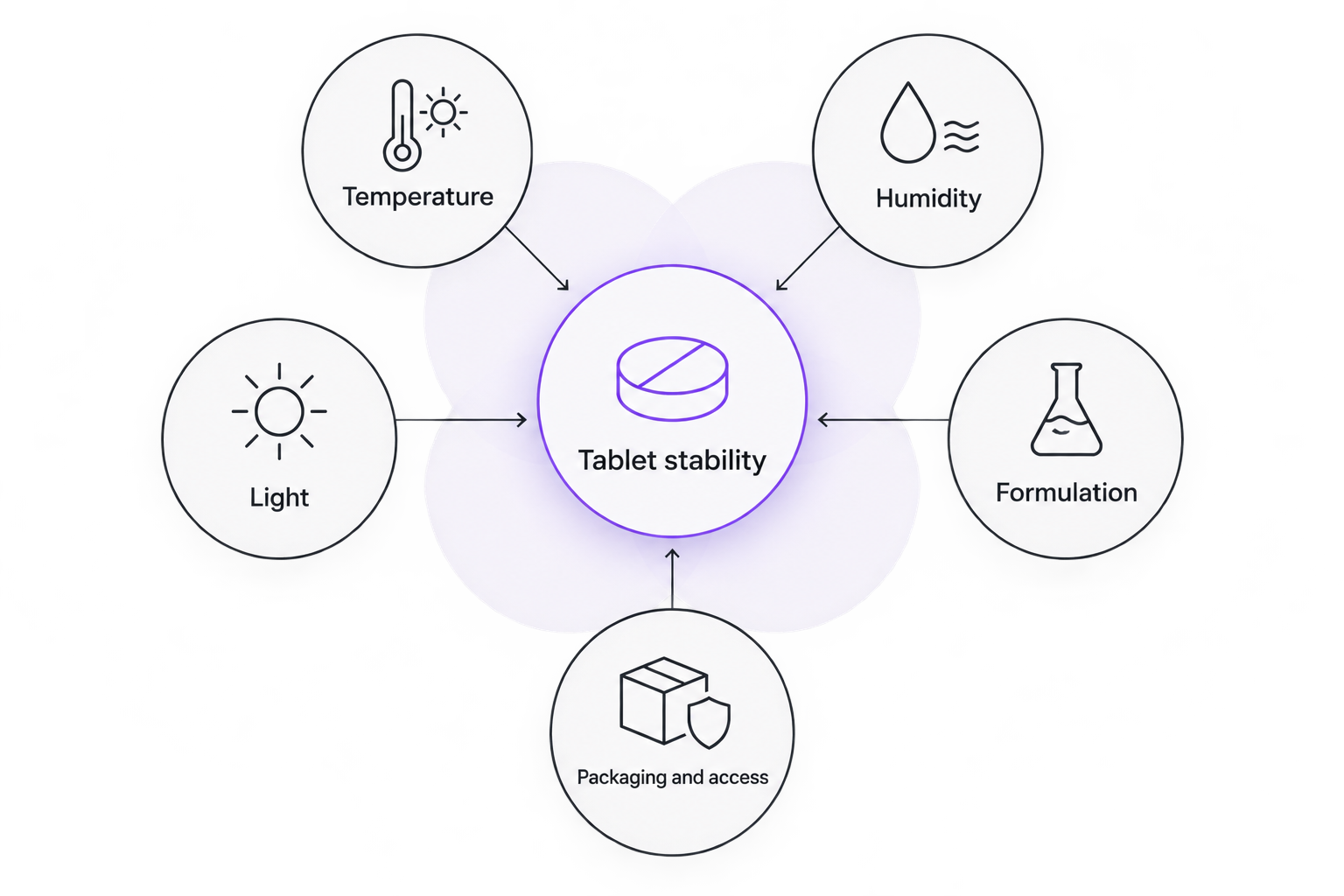
The general ICH stability framework identifies temperature, humidity, light, formulation, and packaging as relevant considerations. Their actual effects on enclomiphene citrate tablets require measurement rather than assumption. 1 2
- Temperature: Study conditions must represent the proposed storage claim. A temperature excursion requires assessment against applicable evidence, not a generic allowance.
- Humidity: Water exposure depends partly on the environment and the container's protective properties. Humidity-related conclusions must identify the tested packaging.
- Light: Photostability is a separate question from thermal stability. An acceptable temperature study does not establish light resistance.
- Formulation: Excipients and manufacturing conditions form part of the tested material. Results for raw enclomiphene citrate do not automatically establish tablet stability.
- Packaging and access: Container materials, closure integrity, and repeated opening affect the storage context. Evidence from unopened packaging does not automatically cover laboratory handling after opening.
Separate a stress mechanism from an observed result
A laboratory should not describe enclomiphene citrate tablets as light-sensitive, moisture-sensitive, or resistant to either stress without supporting evidence. These are assessment categories, not established findings for every formulation.
The same distinction applies to isomer composition. An analytical method should address relevant isomeric species, but the need to measure them does not establish that a particular batch has undergone isomerization.
What analytical evidence establishes stability?
A stability-indicating analytical procedure distinguishes the intended analyte from relevant degradation products and other components. Its suitability depends on demonstrated specificity or selectivity, not simply on the instrument's name. HPLC is a technique; a validated stability-indicating method is an evidenced measurement procedure. 3
Identity and isomer composition
Enclomiphene identity and geometric-isomer composition are related but separate analytical questions. Geometric isomers share molecular mass, so a matching mass signal alone cannot establish the required isomeric composition.
Chromatographic separation, suitable reference materials, and demonstrated selectivity are therefore important when isomer composition forms part of the specification. A reported retention time without the supporting method does not independently establish that relevant species were resolved.
Assay, impurities, and tablet matrix
Assay measures analyte content against a defined basis. Chromatographic area percentage describes a different measurement and must not be treated automatically as mass content or tablet uniformity.
| Analytical attribute | Question it answers | Interpretation limit |
|---|---|---|
| Identity | Is the intended analyte supported? | Does not quantify all impurities |
| Assay | How much analyte is measured on the stated basis? | Requires a suitable standard and calculation basis |
| Related substances | Which relevant additional components are detected? | Depends on separation and detection capability |
| Isomer composition | Are relevant geometric isomers distinguished? | Requires demonstrated selectivity |
| Tablet extraction | Does analysis recover analyte from the matrix? | Must account for excipient interference |
| Physical examination | Has observable tablet condition changed? | Cannot substitute for chemical testing |
A high chromatographic purity result does not, by itself, establish tablet content or long-term stability. Request the measurement definition before interpreting the percentage.
Sample preparation is a separate stability question
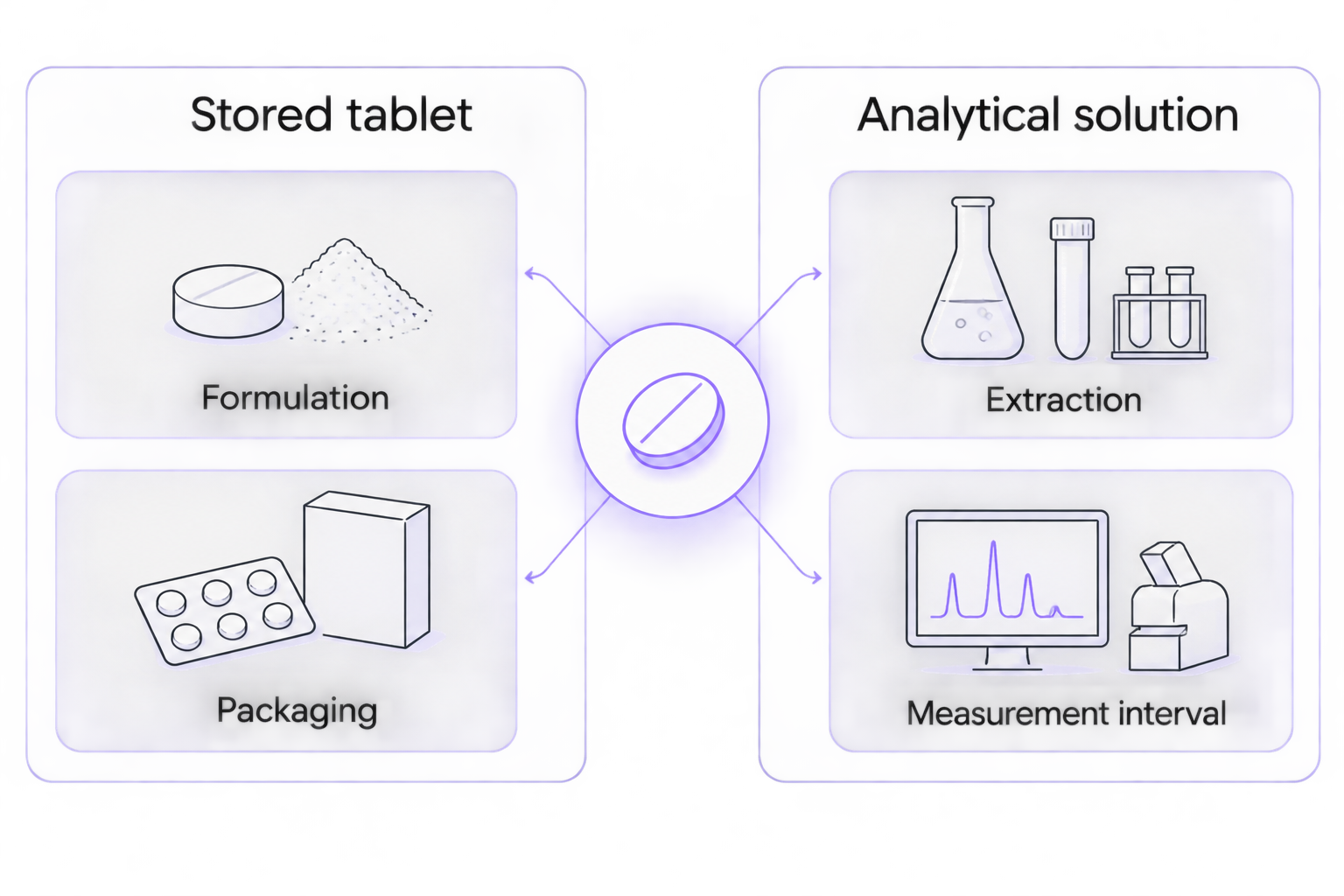
The stability of an analytical sample solution is not the stability of the stored tablet. Extraction and the interval before measurement introduce a separate analytical context that the method must address. 3
Keep that distinction explicit in a 2026 method review. Evidence that an analytical solution remains suitable during analysis does not establish how long an unopened tablet container remains within specification.
How should laboratories assess documentation?
Match the stability claim to the exact material before accepting the date. For 4-Amino-Labs enclomiphene citrate research materials, the relevant questions concern formulation identity, batch traceability, analytical methods, and the conditions supporting the stated storage period.
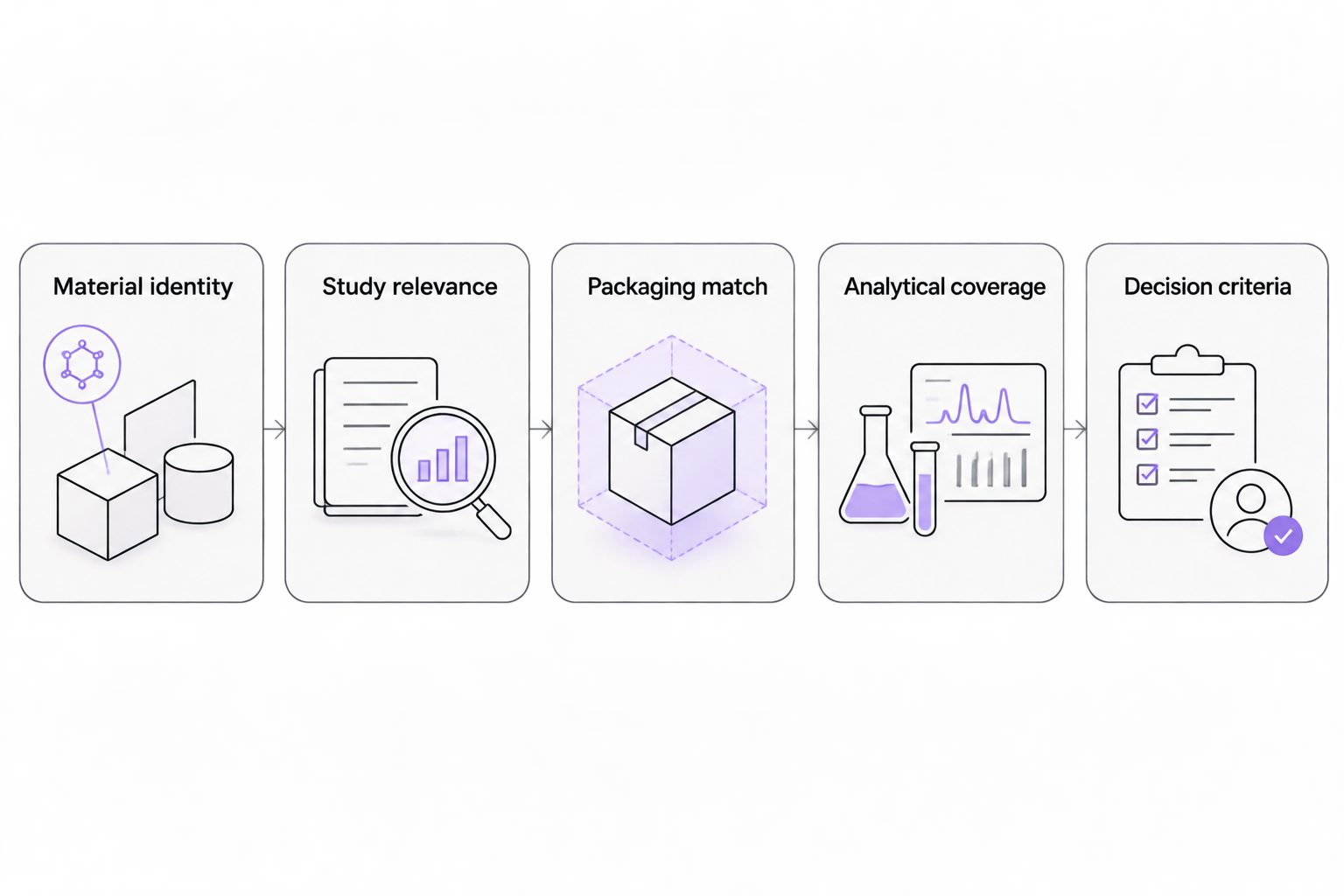
A documentation review should establish the following:
- Material identity: Confirm the compound, salt designation, formulation, and batch identifier.
- Date meaning: Distinguish manufacture, analytical testing, expiration, and retest dates. They are not interchangeable.
- Study relevance: Confirm whether supporting results concern the tablets or only the raw starting material.
- Packaging match: Identify the container-closure system represented by the evidence.
- Analytical coverage: Establish whether assay, relevant impurities, and isomer composition were assessed appropriately.
- Decision criteria: Identify the specifications used to judge whether a result remains acceptable.
Interpret the supplier's listing narrowly
The supplied 4-Amino-Labs product information identifies Enclomiphene Citrate as a tablet research material. That description establishes neither a long-term stability interval nor the analytical characteristics of a particular batch.
Use the enclomiphene citrate research sourcing guide as purchasing context, then assess the documentation for the material under consideration. A sourcing page is not a substitute for formulation-specific stability evidence.
Keep an internal disposition record
For a 2026 receipt or reassessment, connect the batch identifier to the supplier documents, receipt condition, storage record, and analytical decision. Record whether a date comes from supplier evidence or from your laboratory's own quality process.
Do not silently convert an administrative review date into a chemically established shelf life. The record should make clear what was measured and what was merely scheduled.
Does unopened packaging establish stability?
Unopened packaging does not independently establish a stability period. It preserves one part of the studied storage context only when the packaging matches the evidence and remains intact.
Opening creates a different handling history. Do not assume that an unopened-container study establishes an identical interval after repeated access, transfer, or closure damage.
Can accelerated testing establish a retest date?
Accelerated testing supports stability assessment but does not justify an arbitrary retest date. Under the general ICH framework, accelerated results are interpreted alongside long-term data and the behavior of relevant quality attributes. 1
A 2026 laboratory assessment should distinguish observed real-time results from any extrapolation. The proposed interval must remain tied to the evidence, formulation, packaging, and applicable assessment framework.
Limitations
This guide explains stability-assessment principles; it does not assign a shelf life to any enclomiphene citrate tablet batch. The ICH values above describe general study conditions and are not instructions to store a research product at those settings.
No compound-specific degradation rate, validated storage interval, or packaging performance is established here. Likewise, neither supplier identity nor tablet appearance demonstrates continued analytical suitability.
Do not transfer evidence between enclomiphene citrate, mixed-isomer clomiphene material, raw powder, and finished tablets. Differences in composition and matrix require an explicit justification before results can be applied across materials.
FAQ
Is enclomiphene citrate stable in tablet form long-term?
A long-term stability period must be established for the specific enclomiphene citrate tablet formulation and packaging. Tablet form alone does not establish an acceptable interval.
Does a certificate of analysis prove long-term tablet stability?
A release certificate of analysis does not prove long-term tablet stability. It reports results at testing unless it explicitly includes relevant longitudinal stability evidence.
Can HPLC purity establish how much enclomiphene citrate a tablet contains?
HPLC area purity alone does not establish tablet content. Content assessment requires an appropriate assay with a stated calculation basis and demonstrated extraction suitability.
Can mass spectrometry distinguish enclomiphene from its geometric isomer by mass alone?
Mass alone does not distinguish geometric isomers because they share molecular mass. Isomer-composition assessment requires suitable analytical selectivity.
Should a laboratory refrigerate enclomiphene citrate tablets automatically?
A laboratory should not assign refrigeration automatically. Follow documented material-specific storage conditions rather than substituting an unsupported temperature assumption.
Can an unchanged tablet appearance confirm chemical stability?
Unchanged appearance cannot confirm chemical stability. Chemical identity, assay, and relevant impurity measurements address questions that visual inspection cannot resolve.
Does raw-powder stability evidence apply to finished tablets?
Raw-powder stability evidence does not automatically apply to finished tablets. The formulation, manufacturing history, and packaging must be considered separately.
One last thing
Ask what the date means before asking how long the tablets last. A retest date directs reassessment; it is not interchangeable with an expiration date or a guarantee of unchanged composition.
For 4-Amino-Labs research materials entered into a 2026 inventory, retain that distinction in the batch record. The strongest record connects a clearly defined date to relevant evidence rather than to an assumed duration.
Related guides
- Connecting batch numbers to laboratory inventory tracking
- Research chemical suppliers ranked by documentation
- Enclomiphene citrate research specifications and supplier verification
References
- International Council for Harmonisation. Q1A(R2): Stability Testing of New Drug Substances and Products. General framework for long-term and accelerated stability assessment; not product-specific enclomiphene citrate evidence.
2. International Council for Harmonisation. Q1B: Photostability Testing of New Drug Substances and Products. General framework for assessing light-related changes; not evidence that a particular enclomiphene citrate formulation is photostable or photolabile.
3. International Council for Harmonisation. Q2(R2): Validation of Analytical Procedures. General analytical-validation principles, including specificity or selectivity and assay performance; not validation of a supplier's particular method.
Research use only. All materials discussed are restricted to laboratory research. This content is not medical advice and is not intended to diagnose, treat, cure, or prevent disease.