
GHK-Cu is not established as stable during room-temperature shipping simply because it is supplied as a dry powder. A defensible acceptance decision requires stability evidence for the specific material, packaging, exposure duration, and temperature history; a purity result alone does not establish a shipping window. This 2026 guide addresses laboratory research materials only, not human or animal use.
- Is GHK-Cu stable at room temperature? Accept shipping conditions only when material-specific stability evidence supports them.
- GHK-Cu powder and GHK-Cu solution are not interchangeable stability cases.
- 4-Amino-Labs lists GHK-Cu research material with ≥99% HPLC purity; that specification is not a shipping-stability guarantee.
- Document temperature excursions, packaging integrity, and lot identity before releasing received material for laboratory work.
Is GHK-Cu stable at room temperature during shipping?
Room-temperature shipping is acceptable only when the documented exposure falls within a supported stability envelope. Neither a blue appearance nor an intact container establishes that envelope. For your 2026 receiving review, distinguish the starting material specification from evidence that the material retains its required attributes after transport.
The key evidence belongs in the shipment record, not in a general statement that peptides tolerate transit. A useful starting point is the documentation framework in verifying peptide purity with third-party COA testing.
| Evidence | What it supports | What it does not establish |
|---|---|---|
| Lot-specific certificate of analysis | Reported results for the identified lot | Stability throughout every subsequent shipment |
| Stability study for the supplied form | Changes under the conditions actually studied | Performance outside those conditions |
| Shipment temperature record | Recorded exposure at the logger location | Chemical integrity without supporting stability evidence |
| Container inspection | Visible condition of the received package | Peptide identity, copper coordination, or chemical purity |
| Suitable post-arrival analysis | Attributes measured after transport | Attributes outside the analytical method's scope |
A shipping assessment connects these records. A certificate without an exposure history leaves the transport conditions unresolved; a temperature trace without applicable stability evidence leaves the chemical significance unresolved.
Why this matters for laboratory measurements
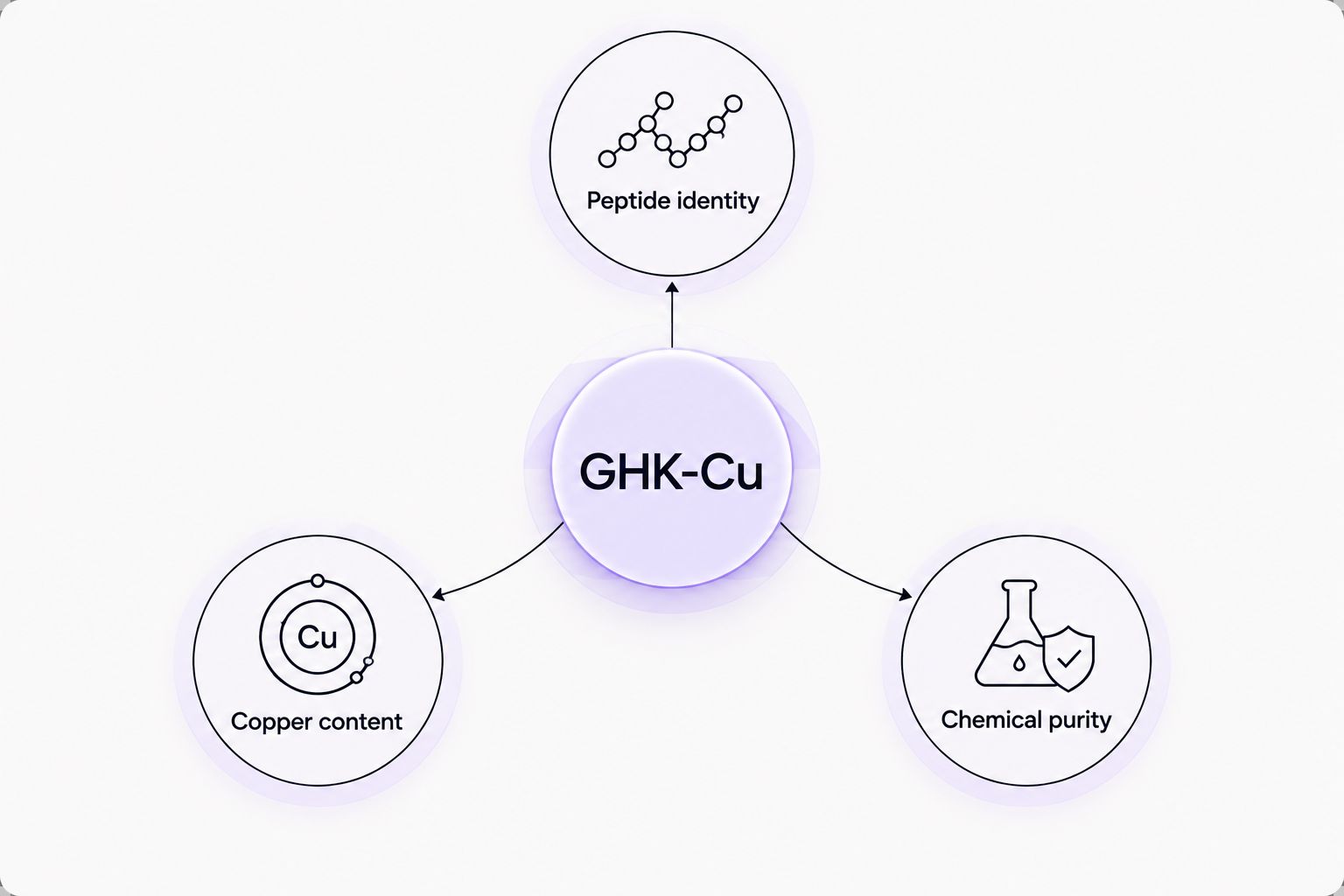
GHK-Cu contains the tripeptide glycyl-L-histidyl-L-lysine coordinated with copper. Its peptide backbone contains 3 amino acid residues. The experimental distinction is therefore between retaining the peptide sequence and retaining the copper-associated chemical state relevant to your measurement.
Those questions require different evidence. An analytical method that measures a peptide-related chromatographic peak does not automatically establish copper content or coordination state, and an elemental copper result does not establish intact peptide identity.
For GHK-Cu research, purity, identity, and copper-associated speciation are separate acceptance questions. Keep them separate when evaluating transport exposure rather than treating a single result as proof of all three.
Chemical stability is not the same as an unchanged appearance
Appearance is a useful inspection attribute, but it is not a complete stability assay. A material can meet a visual description while still requiring chemical characterization before it meets your laboratory's acceptance criteria.
Conversely, a visible difference is a reason to investigate, not a sufficient basis for assigning a degradation mechanism. Record the observation without turning it into an unsupported chemical conclusion.
Dry powder and solution require different stability evidence
Do not transfer a stability conclusion between dry GHK-Cu and a GHK-Cu solution. The physical state changes the chemical environment, so the supporting study must match the material you actually receive.
| Material form | Relevant documentation | Useful feature | Limitation |
|---|---|---|---|
| Lyophilized powder | Residual moisture information, closure details, and dry-state stability data | Separates transport assessment from solution-composition variables | Dry appearance does not establish moisture content or shipping tolerance |
| Solution | Composition, pH information, container details, and solution stability data | Allows assessment of the material in its supplied liquid matrix | Results depend on the studied matrix and cannot be transferred to powder |
Lyophilized GHK-Cu
Lyophilization removes water through a drying process; it does not make a material independent of moisture, temperature, or packaging. The relevant evidence addresses the finished material inside its actual container-closure system.
A study of an unpackaged analytical sample does not answer every question about a sealed commercial vial. Likewise, evidence for a different peptide does not establish GHK-Cu stability.
GHK-Cu in solution
Solution stability depends on the chemical environment, including pH and other components that interact with the peptide or copper. A statement about one solution is not a universal statement about every liquid containing GHK-Cu.
This distinction concerns analytical interpretation only. It does not establish preparation instructions, a suitable solvent, or an allowable holding period for any specific product.
Why GHK-Cu shipping stability varies
Your assessment should identify the conditions that affect the particular material rather than assign a generic transit allowance. These factors provide the structure for that review:
- Material form: Dry powder and solution require separate supporting evidence.
- Temperature history: A description such as room temperature does not replace a measured exposure record.
- Exposure duration: A brief excursion and prolonged storage are different stability questions.
- Moisture and closure integrity: The container must maintain the conditions represented by the supporting study.
- Solution chemistry: For liquid material, pH and matrix composition define the environment being evaluated.
- Analytical endpoint: Acceptance depends on which attributes were measured and how the method distinguishes relevant changes.
Temperature and duration must be considered together. A peak reading without the length of exposure provides an incomplete record, while elapsed transit time without temperature information provides no defined thermal history.
Does room temperature have a universal shipping meaning?
No. A carrier description, warehouse condition, and laboratory storage instruction are not interchangeable temperature records.
For a 2026 shipment assessment, use the numerical conditions stated in the applicable documentation. Do not replace a supplier's defined limits with a general room-temperature convention from an unrelated material.
What analytical testing can establish
Choose testing around the stability question, not around whichever result is easiest to obtain. A method suitable for initial characterization is not automatically suitable for detecting every transport-related change.
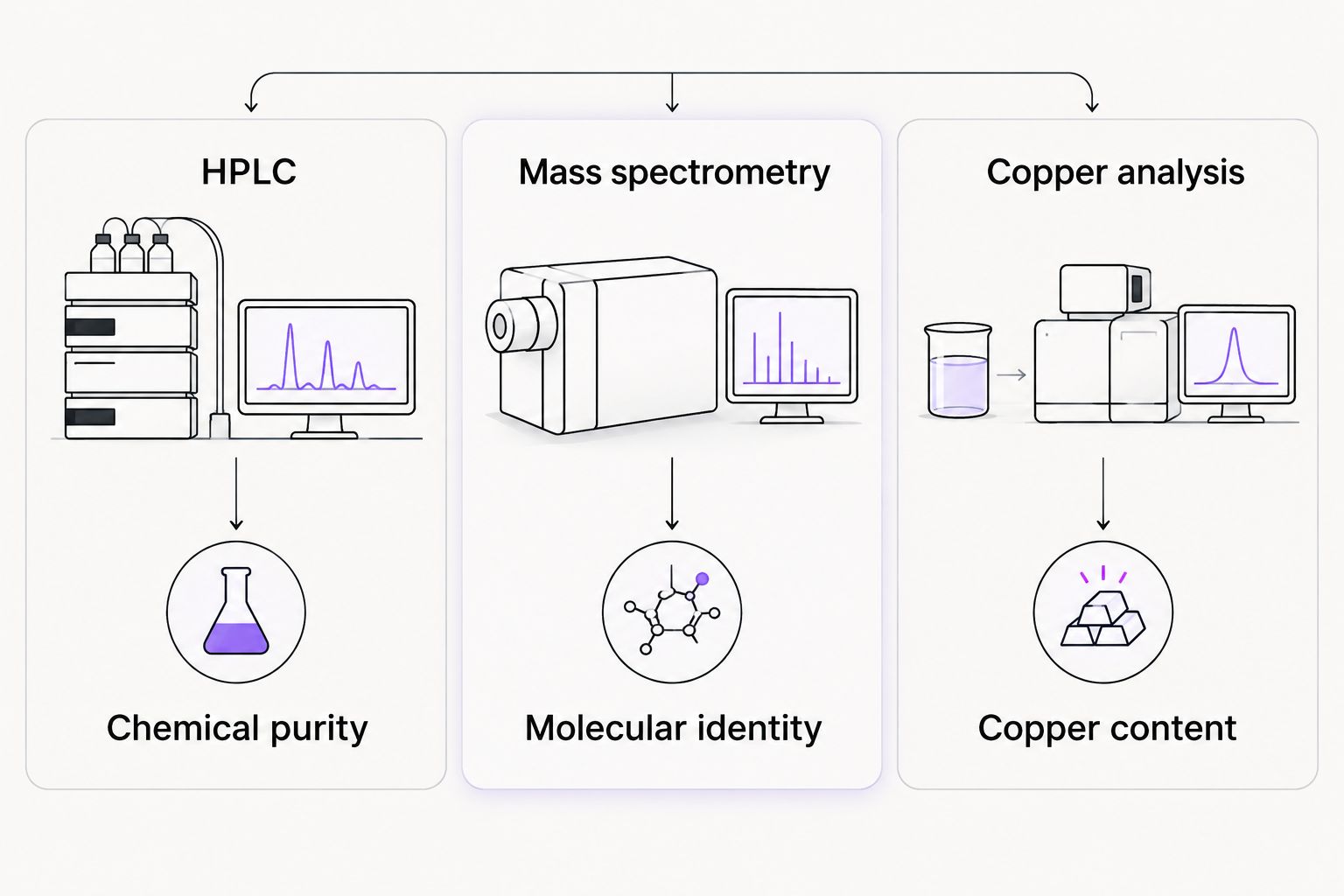
HPLC: separation and reported purity
HPLC separates components under specified chromatographic conditions. A reported purity percentage must be interpreted with the method, detection system, integration approach, and sample preparation in view.
A stability-indicating method must distinguish the relevant analyte from degradation products that matter to the assessment. A chromatogram that looks clean is not sufficient if the method cannot resolve those species.
Mass spectrometry: molecular characterization
Mass spectrometry can support molecular identity and help characterize detectable related species. Its interpretation depends on the method and the chemical behavior of the sample during analysis.
Do not assume that a peptide mass result, by itself, proves the original copper coordination state. The analytical question and the method's demonstrated capability must match.
Copper analysis and complementary measurements
Elemental analysis addresses copper content, but copper content alone does not distinguish every copper-containing species. Spectroscopic or other suitable characterization can add information when coordination state is central to the research question.
Use complementary results deliberately. More test names do not compensate for methods that fail to measure the attribute governing your experiment.
How should your laboratory assess an arriving shipment?
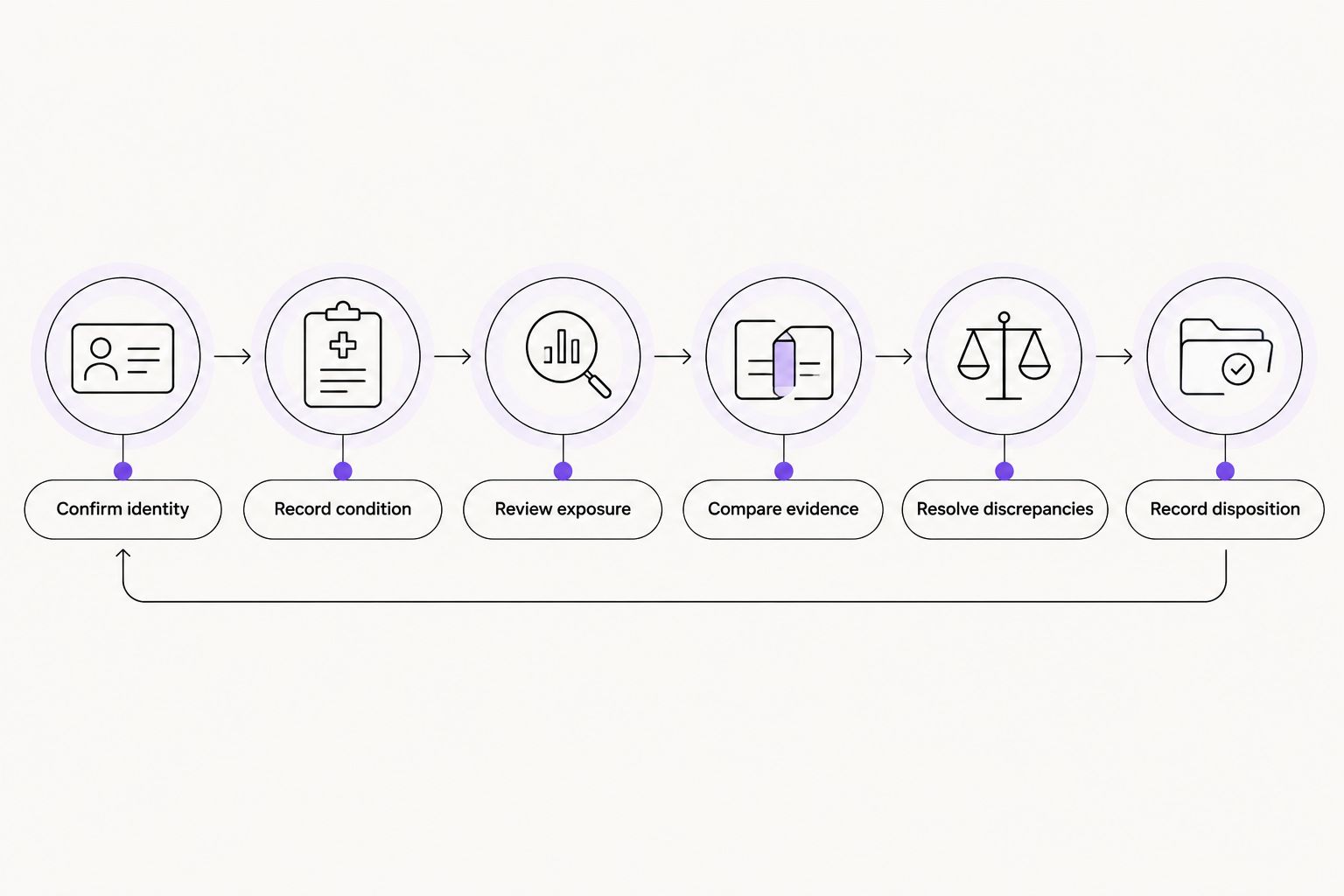
Use a documented receiving decision rather than accepting or rejecting material solely because the package feels warm. The decision should connect lot identity, shipment evidence, and the requirements of the intended laboratory measurement.
- Confirm identity. Match the label, purchase record, and certificate to the received lot.
- Record condition. Document the closure, visible material condition, and any package damage.
- Review exposure. Preserve available temperature records and the shipment timeline.
- Compare evidence. Check whether the stability documentation covers the supplied form, packaging, temperature, and duration.
- Resolve discrepancies. Hold material from experimental use when the acceptance decision remains unresolved.
- Record disposition. Document the rationale for release, further analysis, or rejection under your quality system.
An arrival reading describes arrival, not the entire journey. Similarly, an intact outer package does not prove that the material stayed within a supported exposure envelope.
What if there is no temperature logger?
Without a logger, you do not have a measured temperature history for that shipment. Carrier timestamps can establish parts of the timeline, but they cannot reconstruct the material's thermal exposure.
Ask whether the supplier has applicable shipping qualification or stability evidence. Keep an unmeasured shipment history distinct from a demonstrated temperature excursion; neither should be silently converted into proof of stability.
What the listed GHK-Cu specification establishes
The 4-Amino-Labs GHK-Cu research material is described as blue lyophilized powder containing 50 mg per vial, with ≥99% purity verified by HPLC. Those are product specifications, not a documented allowable room-temperature shipping interval.
4-Amino-Labs supplies GHK-Cu research material for laboratories; shipment acceptance still requires lot-specific documentation and applicable stability evidence. The supplied specification provides a starting point for review, but it does not establish a validated transport duration or post-excursion acceptance result.
For your 2026 sourcing file, request the applicable lot record, analytical method information, storage instructions, and any transport-stability documentation through the documentation contact. Ask specifically whether supporting results apply to the finished packaged material rather than an unrelated reference sample.
Does ≥99% HPLC purity prove shipping stability?
No. ≥99% HPLC purity is a stated analytical specification, not a time-and-temperature stability claim. Its relevance to shipping depends on when the sample was tested, the method used, and whether supporting data connect the result to transport conditions.
Does a 50 mg vial require a different shipping conclusion?
No. 50 mg per vial describes listed content, not thermal tolerance. Fill quantity alone does not establish the finished material's stability under a particular shipment exposure.
Limitations of this stability assessment
This 2026 assessment does not assign GHK-Cu a universal room-temperature shelf life, an allowable transit duration, or a percentage of retained integrity after shipping. Those conclusions require material-specific measurements under defined conditions.
General peptide chemistry explains why form, moisture, matrix, and analytical scope matter. It does not substitute for a study of the particular GHK-Cu material and package, and evidence for another copper peptide cannot establish an interchangeable shipping specification.
FAQ
Is GHK-Cu stable at room temperature during shipping?
GHK-Cu shipping stability must be established for the supplied form, packaging, temperature, and exposure duration. A dry appearance or initial purity result does not establish an allowable transit window.
Is lyophilized GHK-Cu interchangeable with GHK-Cu solution for stability assessment?
No. Lyophilized GHK-Cu and GHK-Cu solution require separate stability evidence because their chemical environments differ.
Does blue GHK-Cu powder prove that shipping caused no change?
No. Blue appearance is an inspection attribute, not proof of peptide identity, chemical purity, or copper coordination state.
Does ≥99% HPLC purity mean GHK-Cu tolerates room-temperature shipping?
≥99% HPLC purity does not establish a shipping-stability interval. Interpret the result alongside the method, test timing, and applicable stability documentation.
Can a temperature logger prove that GHK-Cu remains chemically intact?
No. A temperature logger records exposure at its location; applicable stability evidence connects that exposure to material quality.
What should a laboratory do when a GHK-Cu shipment arrives warm?
Document the arrival condition and review the available exposure history against applicable stability evidence. Keep the material out of experimental work until the receiving decision is resolved.
One last thing
The most useful shipping question is not whether the vial arrived cold, but whether its documented exposure is covered by applicable evidence. A cold arrival is not a complete temperature history, and a warm arrival is not a chemical test result.
Record that distinction in your receiving procedure. It prevents an impression about the parcel from becoming an unsupported conclusion about the research material.
Related guides
- Tracking cold-chain peptide shipping
- Connecting batch numbers to laboratory inventory tracking
- Research peptide storage and cold-chain workflow
Research use only. This content concerns laboratory characterization, documentation, and material acceptance. It is not medical advice and is not intended to diagnose, treat, cure, or prevent disease. No human or animal use is described or supported.