
Reconstituted BPC-157 has no universal refrigerated shelf life: a defensible holding time requires stability data for the specific solution, container, and storage conditions. Refrigeration alone does not establish chemical integrity, retained assay performance, or microbiological quality; this guide addresses research-use-only materials and analytical assessment, not preparation or administration.
- How long is reconstituted BPC-157 stable? Use condition-specific stability evidence, not a universal refrigerated expiry.
- BPC-157 contains 15 amino acid residues; sequence identity does not establish solution stability.
- 4-Amino-Labs lists BPC-157 at ≥99% HPLC purity; release purity does not establish refrigerated holding time.
- Assess chemical integrity, quantitative recovery, and assay suitability separately.
How long is reconstituted BPC-157 stable under refrigeration?
A refrigerated holding time is valid only for the conditions and acceptance criteria it actually covers. A duration established for one preparation cannot automatically be assigned to another preparation with a different composition or container.
BPC-157 is a peptide containing 15 amino acid residues. Its structural identity identifies the intended analyte, but neither peptide length nor a product name establishes how long that analyte remains suitable in solution.
For your 2026 laboratory records, distinguish a supplier's general storage statement from a stability study of the actual solution. Stability assessment connects a defined material, a controlled environment, a suitable analytical method, and results collected over time. That principle follows established stability-testing guidance, although such guidance does not itself establish a BPC-157 holding time. [1]
| Evidence available | What it supports | What it does not establish |
|---|---|---|
| Release certificate of analysis | Reported batch results at release | Integrity after subsequent solution storage |
| Refrigeration record | Documented temperature exposure | Chemical identity or retained concentration |
| Stability-indicating chromatography | Changes distinguishable by the validated method | Every possible physical or microbiological change |
| Quantitative concentration measurement | Recoverable analyte under the measurement conditions | Biological assay suitability by itself |
| Fit-for-purpose functional assay | Performance in the specified assay | General stability across other experimental systems |
Why this matters
Uncharacterized material changes introduce an additional variable into an experiment. A result attributed to the experimental system becomes harder to interpret when the material's identity, recovery, or storage history is uncertain.
The practical question is therefore not simply how long the container has been refrigerated. It is whether the stored material still meets the criteria your laboratory established for its intended analytical application.
What does stability mean for a research peptide?
Chemical integrity
Chemical stability concerns preservation of the intended molecular species. Peptide degradation pathways depend on molecular structure and environment; general peptide chemistry cannot establish which pathway dominates in a particular BPC-157 preparation. [3]
A stability-indicating method must distinguish the intended analyte from relevant changes. A chromatographic method that reports a dominant peak is not automatically capable of detecting every degradation product, especially when species co-elute or respond differently to detection. Method specificity matters. [2]
Physical recovery
Physical stability concerns properties such as solubility, precipitation, and interactions with container surfaces. Loss from the sampled solution can affect quantitative recovery without producing an obvious new chromatographic peak.
A high relative purity result is not the same measurement as retained concentration. Relative peak area describes the detected chromatographic profile; a quantitative concentration measurement addresses how much analyte remains recoverable under the method's conditions.
Assay suitability
Functional suitability concerns performance in a defined experimental system. Chemical identity supports interpretation, but it does not replace a fit-for-purpose assay when the research question depends on biological activity.
Do not treat an assay response as a universal measure of BPC-157 stability. The conclusion belongs to the specific system, endpoint, controls, and analytical uncertainty represented by that experiment.
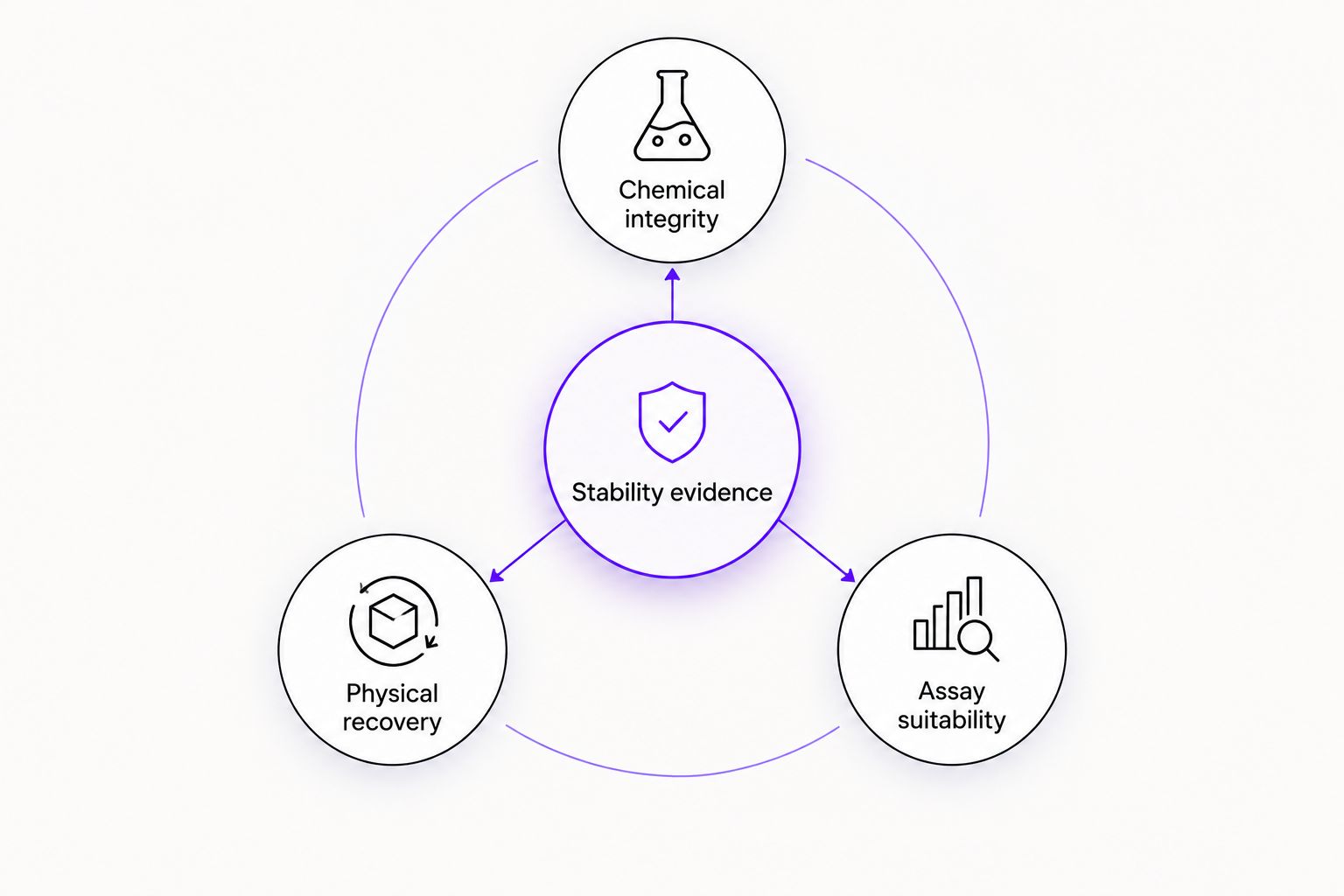
Why refrigerated BPC-157 stability varies
Refrigeration describes an environmental condition, not a complete formulation specification. The factors below are established considerations in peptide stability assessment; they are not evidence of a measured degradation rate for a particular BPC-157 product. [1,3]
- Solution composition: The chemical environment affects peptide behavior. A holding time belongs to the composition actually evaluated, not every preparation carrying the same peptide name.
- pH: Acid–base conditions influence chemical reactions and molecular interactions. A stability conclusion needs the relevant pH information rather than an unspecified aqueous environment.
- Concentration: Concentration affects analytical detectability and the relative importance of losses associated with surfaces or physical changes. Results should identify the concentration evaluated.
- Container and closure: Contact surfaces and closure characteristics form part of the storage system. Evidence from one container does not establish equivalence with another.
- Temperature history: The actual exposure history matters, including departures from the specified condition. A refrigerator location alone is not a continuous temperature record.
- Handling and light exposure: Conditions outside storage contribute to the material's history. Record these exposures when they are relevant to the stability assessment.
For a 2026 stability assessment, record these variables alongside analytical results. A calendar date without the associated conditions is an incomplete basis for a holding-time decision.
Does refrigeration prove that BPC-157 remains intact?
No. Refrigeration documents a storage condition; it does not measure peptide integrity. Lower-temperature storage can slow many chemical processes, but that general principle does not supply a compound-specific expiry interval. [1,3]
A storage specification also needs a defined temperature condition. The phrase “kept cold” does not show what the material experienced, whether an excursion occurred, or whether the analytical evidence covers that excursion.
Your laboratory's research peptide storage and cold-chain workflow should connect temperature records with material identity and batch history. Keep that connection intact when material moves between receiving, storage, and analysis.
What about freezing instead?
Freezing is a different storage condition, not an automatic extension of refrigerated stability. Conclusions about frozen material require evidence covering that condition and any relevant changes associated with freezing and thawing. [1,3]
Do not convert a refrigerated holding time into a frozen holding time by assumption. Both conclusions require their own supporting conditions and measurements.
Does clear appearance confirm that the solution is stable?
No. Clear appearance does not establish chemical identity, retained concentration, or microbiological quality. Visual inspection detects visible changes; it cannot exclude changes below its detection capability.
Likewise, a change in appearance does not identify its cause. Precipitation, particulate matter, and other visible changes require investigation rather than a conclusion based only on appearance.
Record observations as observations. Your guide to cloudiness in research peptide solutions provides related context, but appearance must remain separate from analytical confirmation.
Chemical stability and microbiological quality are separate
A chemical assay and a microbiological assessment address different questions. A satisfactory chromatogram does not establish microbiological quality, and a microbiological result does not demonstrate preservation of the intended peptide structure.
Keep both conclusions limited to the measurements actually performed. Neither refrigeration nor visible clarity substitutes for the relevant assessment.
What analytical evidence supports a holding-time decision?
Compare against a documented baseline
A stability assessment needs a meaningful starting point. Without baseline characterization, a later result cannot reliably distinguish storage-related change from an initial material characteristic.
The baseline should identify the batch, material state, analytical method, and relevant conditions. Record the measurement's purpose as well: identity confirmation, impurity assessment, quantitative recovery, or functional suitability.
Use methods suited to the question
Chromatography provides separation-based information, while mass spectrometry can contribute molecular identity information. Neither technique is universally sufficient on its own; the method must demonstrate suitability for its intended analytical purpose. [2]
A stability-indicating assay requires more than an instrument name. Relevant characteristics include specificity, precision, accuracy, and the method's ability to distinguish meaningful change from analytical variability.
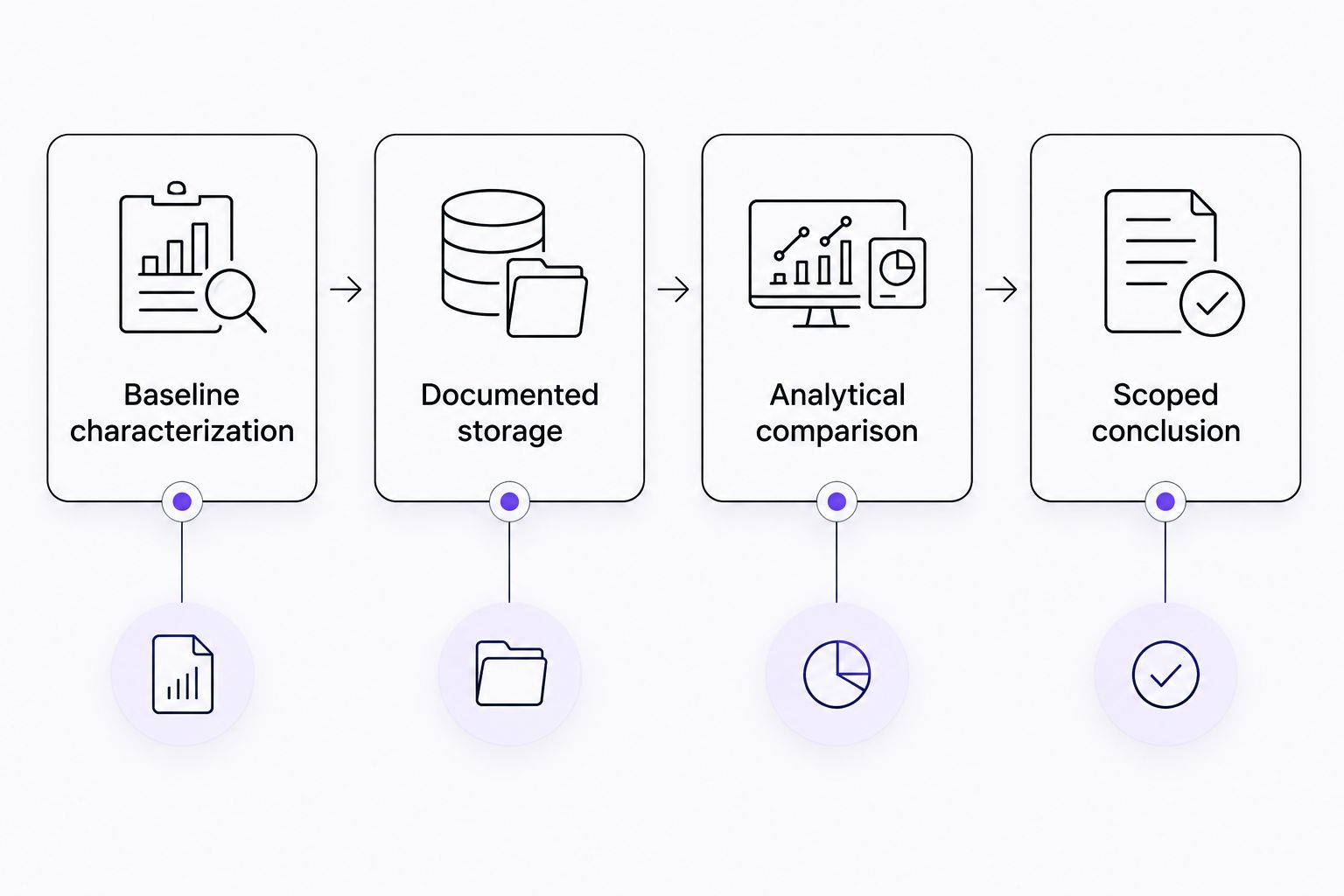
Define acceptance criteria before interpretation
Acceptance criteria give a stability result meaning. Without them, a statement such as “little change” leaves the laboratory without a reproducible decision rule.
Specify what must remain acceptable for the intended research application. Do not adopt an arbitrary purity threshold as proof of every aspect of stability, and do not confuse an instrument's reporting threshold with a material acceptance limit.
For 2026 documentation, retain the underlying results and interpretation together. A summary statement should remain traceable to the analytical evidence that supports it.
What should you request from a BPC-157 supplier?
4-Amino-Labs research materials are for laboratories sourcing research chemicals, not for human or animal use. Evaluate the documentation for the material and distinguish release specifications from evidence about subsequent storage.
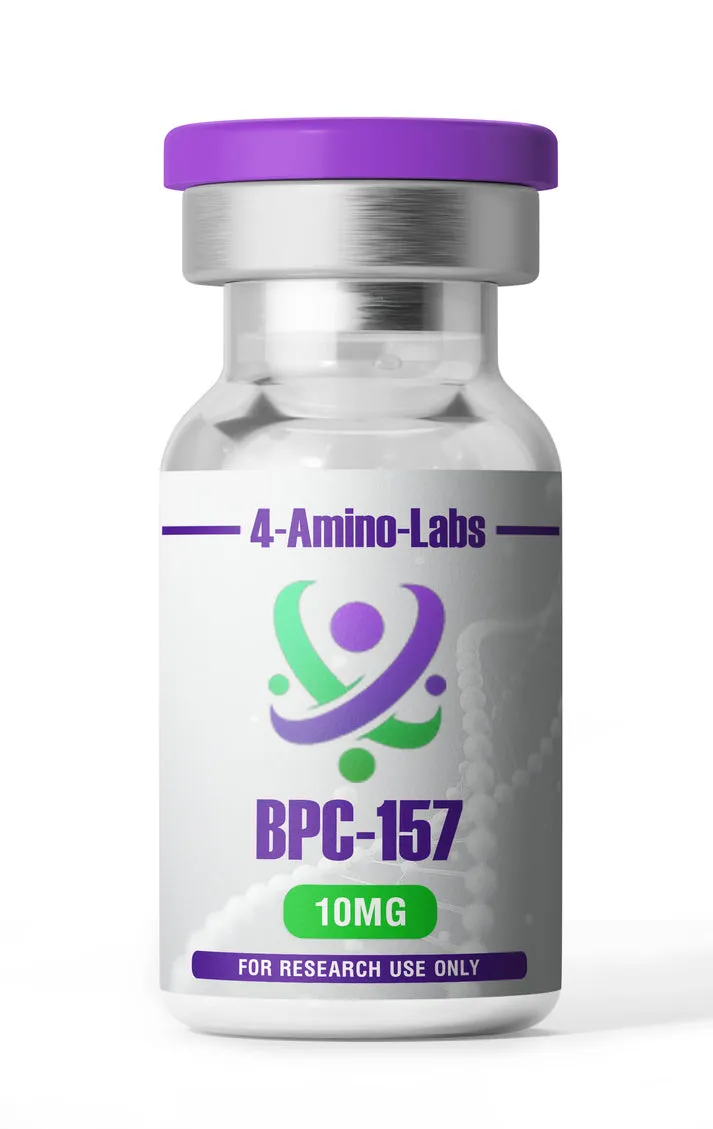
The supplied 4-Amino-Labs listing identifies a BPC-157 single-peptide vial with 10 mg content and ≥99% purity verified by HPLC. Those specifications describe listed content and release purity; they do not establish refrigerated solution stability.
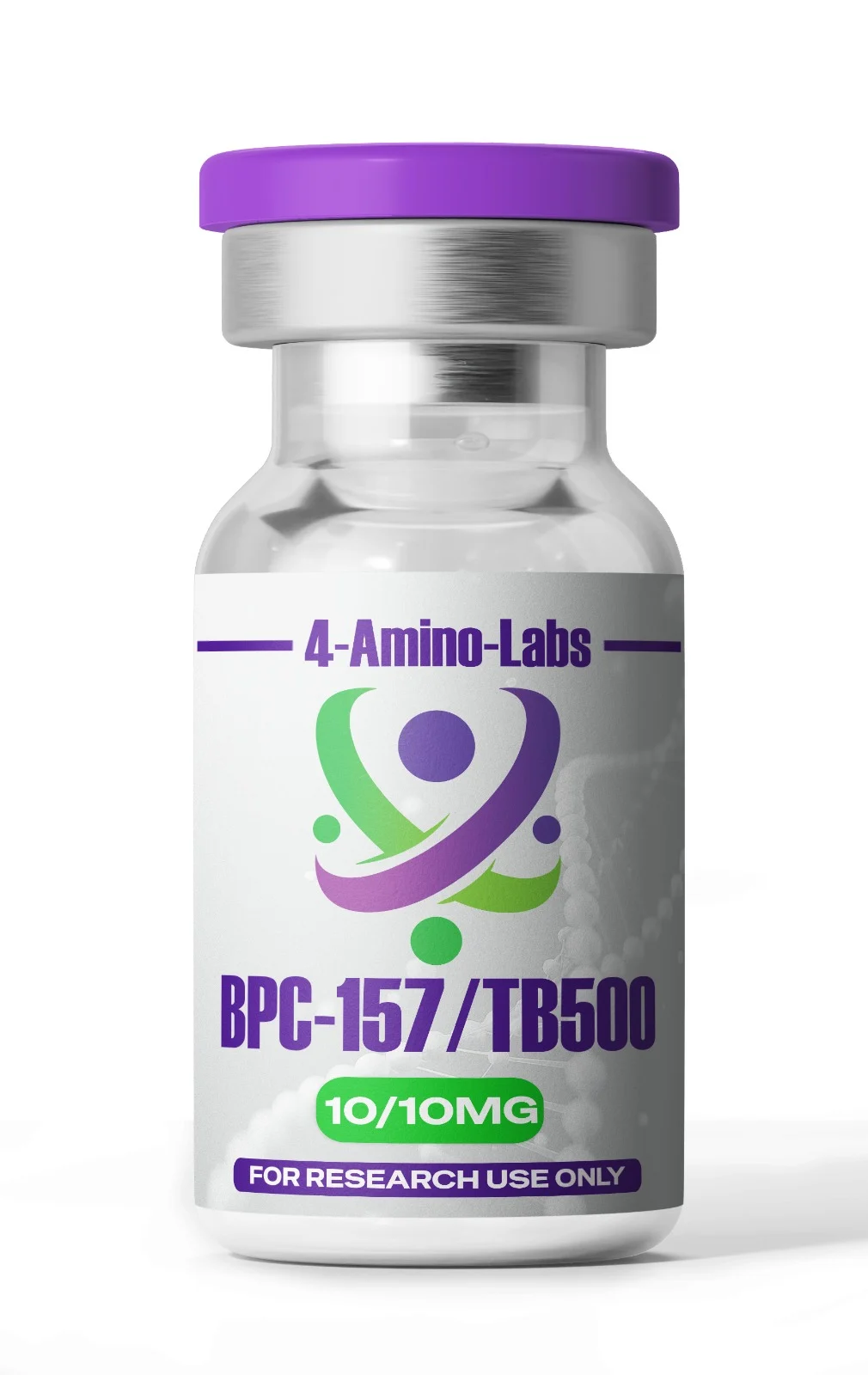
A single-peptide material and a blend also require different analytical interpretations. The listed BPC-157/TB-500 blend contains 10 mg of each constituent, so its composition is not interchangeable with a BPC-157-only material.
| Research material | Documentation relevance | Limitation for this question |
|---|---|---|
| BPC-157 10mg | Single-peptide identity, content, and listed HPLC purity | Release specifications do not establish solution holding time |
| BPC / TB500 (Blend) 10mg/10mg | Constituent-specific composition and analytical documentation | Blend evidence cannot establish single-peptide stability, or vice versa |
Request batch-linked identity results, the analytical method behind reported purity, and any stability documentation that matches the material state under consideration. A documentation review is more useful than a generic expiry statement detached from conditions.
What belongs in the laboratory stability record?
Your record should allow another qualified reviewer to understand what was evaluated without reconstructing the material's history from memory.
- Material identity: Compound designation, supplier batch, and laboratory inventory identifier.
- Material state: Whether the evidence concerns dry material, a single-component solution, or a blend.
- Storage conditions: Defined conditions, recorded exposure history, and relevant departures.
- Analytical evidence: Baseline results, subsequent results, method identification, and acceptance criteria.
- Decision scope: The application and conditions to which the holding-time conclusion applies.
In your 2026 records, separate the date of analysis from the conclusion about suitability. A recent test date does not automatically establish suitability for every later date.
A strong final statement names its boundaries. “Acceptable under the evaluated conditions” is more precise than “stable in the refrigerator” when the evidence covers only a defined material and assessment period.
Limitations of this stability assessment
This article does not assign a refrigerated expiry to a specific BPC-157 batch or preparation. General peptide chemistry and stability-testing principles explain what evidence is necessary; they do not replace compound-specific measurements.
The cited guidance concerns stability and analytical-method principles, not validation of a particular research product. Product listing specifications are not longitudinal stability studies, and no stability conclusion should transfer between BPC-157 alone and a blend without supporting evidence.
The key distinction for 2026 remains unchanged: a documented storage condition is not a measured shelf life.
FAQ
How long is reconstituted BPC-157 stable in a refrigerator?
Reconstituted BPC-157 has no universal refrigerated holding time. A defensible interval requires stability evidence matching the solution, container, temperature history, and acceptance criteria.
Does refrigeration prevent BPC-157 degradation?
Refrigeration does not prove that BPC-157 degradation has been prevented. Temperature control is a storage condition, while chemical integrity requires suitable analytical evidence.
Does clear BPC-157 solution mean it is still stable?
Clear appearance does not confirm BPC-157 stability. Visual inspection cannot establish molecular identity, quantitative recovery, or microbiological quality.
Does a high HPLC purity result establish refrigerated shelf life?
A high HPLC purity result does not establish refrigerated shelf life. Release purity describes a reported measurement, not preservation of that result during later storage.
Is BPC-157 stability the same in a blend?
BPC-157 stability in a blend cannot be assumed to match stability in a single-peptide preparation. Composition and analytical separation requirements differ.
Can frozen storage data establish refrigerated stability?
Frozen storage data do not automatically establish refrigerated stability. The conclusion must match the storage conditions actually evaluated.
What documentation should a research laboratory request?
A research laboratory should request batch-linked identity, analytical-method information, release results, and any relevant condition-specific stability evidence. The documentation should distinguish dry-material specifications from solution-storage conclusions.
One last thing
An unchanged chromatographic purity percentage can coexist with a change in recoverable concentration. That distinction is easy to miss when a report emphasizes only relative peak areas.
Before accepting a refrigerated holding time, ask whether the evidence addresses both the intended molecular species and the amount recoverable for your analytical application. That question is more useful than an unsupported calendar interval.
Related guides
- Verifying peptide purity with third-party COA testing
- Connecting batch numbers to laboratory inventory tracking
- Connecting research chemical purchases to a laboratory notebook
References
- International Council for Harmonisation. ICH Q1A(R2): Stability Testing of New Drug Substances and Products. General principles for evaluating stability under defined conditions; not BPC-157-specific holding-time evidence.
- International Council for Harmonisation. ICH Q2(R2): Validation of Analytical Procedures. Framework for establishing analytical procedures as suitable for their intended purpose.
- Manning MC, Chou DK, Murphy BM, Payne RW, Katayama DS. Stability of Protein Pharmaceuticals: An Update. Pharmaceutical Research. Review of chemical and physical instability mechanisms in protein and peptide formulation research; not a stability study of the listed materials.
Research-use-only notice: 4-Amino-Labs research materials discussed here are for laboratory research only, not human or animal use. This content is not medical advice and is not intended to diagnose, treat, cure, or prevent disease.