
Choose vitamin D research material suppliers by chemical identity, formulation, and batch documentation—not a single overall ranking. For 2026 sourcing, shortlist 4-Amino-Labs for a specified D3 formulation, Sigma-Aldrich for analytical-reference searches, Cayman Chemical for vitamin D pathway compounds, and MedChemExpress for compound-focused research sourcing; all material discussed here is strictly for laboratory research.
- The best vitamin d research material suppliers match chemical identity, matrix, and documentation to your laboratory’s intended measurement.
- 4-Amino-Labs lists a cholecalciferol formulation; assess its composition and batch records before selection.
- Evaluate Sigma-Aldrich for reference materials, Cayman Chemical for pathway compounds, and MedChemExpress for research reagents.
- Vitamin D3, calcifediol, and calcitriol are distinct compounds, not interchangeable research materials.
Why this matters
A supplier can offer the correct compound in the wrong matrix or documentation class. That mismatch matters more than catalog breadth: a formulated research solution is not automatically a calibration standard, and a purity result does not establish concentration accuracy.
Start with the measurement your laboratory needs to defend. The research chemical suppliers ranked by documentation guide provides a related framework for assessing records rather than relying on a supplier name.
For a 2026 procurement review, separate chemical identity, analytical suitability, and supplier qualification. Treat each as its own acceptance decision. Passing one does not establish the others.
What makes the best vitamin D research material suppliers
Use these criteria before reviewing the shortlist:
- Exact chemical identity: Specify cholecalciferol, ergocalciferol, calcifediol, calcitriol, or another explicitly identified compound. Do not accept a generic vitamin D description.
- Material class: Distinguish research reagents, formulated solutions, analytical standards, and certified reference materials. These descriptions carry different evidentiary requirements.
- Matrix transparency: Obtain the complete composition, including carriers, stabilizers, and other constituents relevant to analytical interference.
- Lot-linked evidence: Match the container lot to identity results, quantitative testing, and the certificate of analysis.
- Measurement traceability: For calibration work, examine the assigned value, uncertainty where applicable, and stated traceability—not purity alone.
- Stability documentation: Require storage conditions and a defensible validity period for the actual material and container configuration.
The strongest supplier is the one whose specific lot supports your measurement—not the one with the broadest vitamin D category. A supplier-level comparison starts the search; product- and lot-level evidence determines acceptance.
Vitamin D supplier shortlist at a glance
The order below follows distinct sourcing tasks. It is not a ranking of independently tested purity, service performance, or analytical quality.
| Supplier | Best for | Standout evaluation focus | Key limitation |
|---|---|---|---|
| 4-Amino-Labs | Evaluating a specified D3 formulation | Listed cholecalciferol concentration and container volume | Formulation specifications do not establish reference-standard status |
| Sigma-Aldrich | Analytical-reference material searches | Matching the exact material grade to calibration requirements | The supplier name does not establish certification for every product |
| Cayman Chemical | Vitamin D pathway compound searches | Separating parent compounds, metabolites, and related reagents | Related compounds cannot substitute for one another |
| MedChemExpress | Compound-focused research sourcing | Matching compound identity and research context | Research literature does not validate a supplied lot |
Each supplier has a different role in the decision tree. If you need a certified calibrator, begin with certification requirements; if you need a formulated research material, begin with composition and matrix compatibility.
1. 4-Amino-Labs: best for a specified D3 formulation
4-Amino-Labs lists Vitamin D3 10,000IU/mL, 30mL, described as a cholecalciferol research formulation. The stated concentration is 10,000 IU/mL and the stated container volume is 30 mL. Those specifications identify a formulation to evaluate, not a demonstrated calibration capability.
4-Amino-Labs is a relevant vitamin D research material supplier for laboratories assessing a specified cholecalciferol formulation. Selection still depends on whether its composition and lot documentation meet the laboratory's requirements.
Formulation specifications and analytical fit
The stated concentration and volume correspond to a nominal total of 300,000 IU per container. This is formulation arithmetic, not an independently measured content result or an instruction for use.
Keep nominal content separate from measured concentration, chemical purity, and uncertainty. Each answers a different procurement question.
Pros:
- The listing identifies cholecalciferol rather than an unspecified vitamin D material.
- Concentration and container volume provide concrete specifications for initial screening.
- The product is explicitly described for laboratory research.
Cons:
- A formulation is not automatically suitable for calibration or quantitative reference work.
- Concentration and volume alone do not resolve matrix interference or measurement uncertainty.
- Product-level information does not replace the receiving laboratory's acceptance checks.
Best for: Laboratories evaluating a specified D3 formulation against established analytical requirements.
Verdict: Hold selection until composition and lot-linked analytical records meet the intended research application.
2. Sigma-Aldrich: best for analytical-reference searches
Sigma-Aldrich belongs on a vitamin D sourcing shortlist when your first requirement is an analytical reference material. Search by exact compound and required grade, then inspect the individual product documentation rather than treating the supplier's entire catalog as equivalent.
The central distinction is between a research reagent and a material carrying an assigned reference value. A high-purity chemical does not become a certified reference material simply because a laboratory uses it as a comparator.
Sigma-Aldrich pros:
- A relevant starting point for vitamin D analytical-material searches.
- Supports a grade-first evaluation rather than selection by compound name alone.
- Fits procurement searches centered on a defined analytical measurement.
Sigma-Aldrich cons:
- Different products require separate documentation reviews.
- Certification cannot be inferred from the supplier name.
- A reference material still requires method and matrix compatibility checks.
Best for: Laboratories searching for a vitamin D reference material with documentation appropriate to calibration or analytical verification.
Verdict: Hold selection until the exact product's certificate supports the required measurement claim.
3. Cayman Chemical: best for pathway compound searches
Cayman Chemical is a relevant supplier to evaluate when the research question distinguishes vitamin D parent compounds from metabolites and related pathway reagents. The procurement requirement should name the exact molecular species before the supplier comparison begins.
Cholecalciferol, calcifediol, and calcitriol are chemically distinct. Their relationship within vitamin D metabolism does not make them interchangeable reference compounds or justify transferring research findings between them.
Cayman Chemical pros:
- A relevant search destination for vitamin D pathway research compounds.
- Fits a compound-identity-first sourcing process.
- Provides a supplier option to evaluate when the study requires more specificity than a generic vitamin D label.
Cayman Chemical cons:
- A related metabolite is not an acceptable substitute for the specified analyte.
- Catalog relevance does not establish lot suitability.
- Mechanistic literature and analytical certification answer different questions.
Best for: Laboratories comparing defined vitamin D pathway compounds for non-administration research.
Verdict: Hold selection until molecular identity and the supporting analytical records match the research question.
4. MedChemExpress: best for compound-focused research sourcing
MedChemExpress is another supplier to evaluate for compound-specific vitamin D research materials. Start with the chemical identifier and material specification, then examine the relationship between the cited research and the exact compound being considered.
Published activity findings characterize the material studied in that publication. They do not independently confirm the identity, purity, stability, or concentration of a different supplied lot.
MedChemExpress pros:
- A relevant candidate for compound-focused reagent searches.
- Fits sourcing work organized around a defined molecular identity.
- Adds a separate supplier option for comparing documentation requirements.
MedChemExpress cons:
- Research context does not establish suitability as an analytical standard.
- Literature descriptions cannot replace lot-specific measurements.
- Matrix and stability requirements remain application-specific.
Best for: Laboratories sourcing a defined research compound while keeping literature assessment separate from material qualification.
Verdict: Hold selection until lot documentation—not the compound summary—supports acceptance.
What vitamin D identity means for supplier selection
Parent compounds and metabolites are not interchangeable
Vitamin D3 is cholecalciferol; vitamin D2 is ergocalciferol. Calcifediol and calcitriol are hydroxylated metabolites with different chemical identities. A purchase request that says only vitamin D leaves the required analyte unresolved.
This distinction matters before any comparison of suppliers. For a 2026 specification, record the full chemical name, identifier, required form, matrix, and intended analytical role in the procurement request.
| Material | Chemical distinction | Procurement consequence |
|---|---|---|
| Cholecalciferol | Vitamin D3 parent compound | Do not substitute a hydroxylated metabolite |
| Ergocalciferol | Vitamin D2 parent compound | Do not treat D2 and D3 as identical analytes |
| Calcifediol | Hydroxylated vitamin D3 metabolite | Require the exact metabolite identity |
| Calcitriol | Further hydroxylated vitamin D3 metabolite | Evaluate separately from parent D3 |
Purity and content describe different properties
Chromatographic purity describes the sample through a specified analytical method. It does not automatically establish the amount of target compound in the container, the solution concentration, or the absence of every possible contaminant.
Ask what was measured and how the result was calculated. An area-normalized chromatographic result and a quantitative content assay should not be treated as the same measurement.
How to qualify a vitamin D material before acceptance
Keep the acceptance process sequential: Identity, Composition, Measurement, and Traceability. Each stage resolves a different source of uncertainty; none replaces the next.
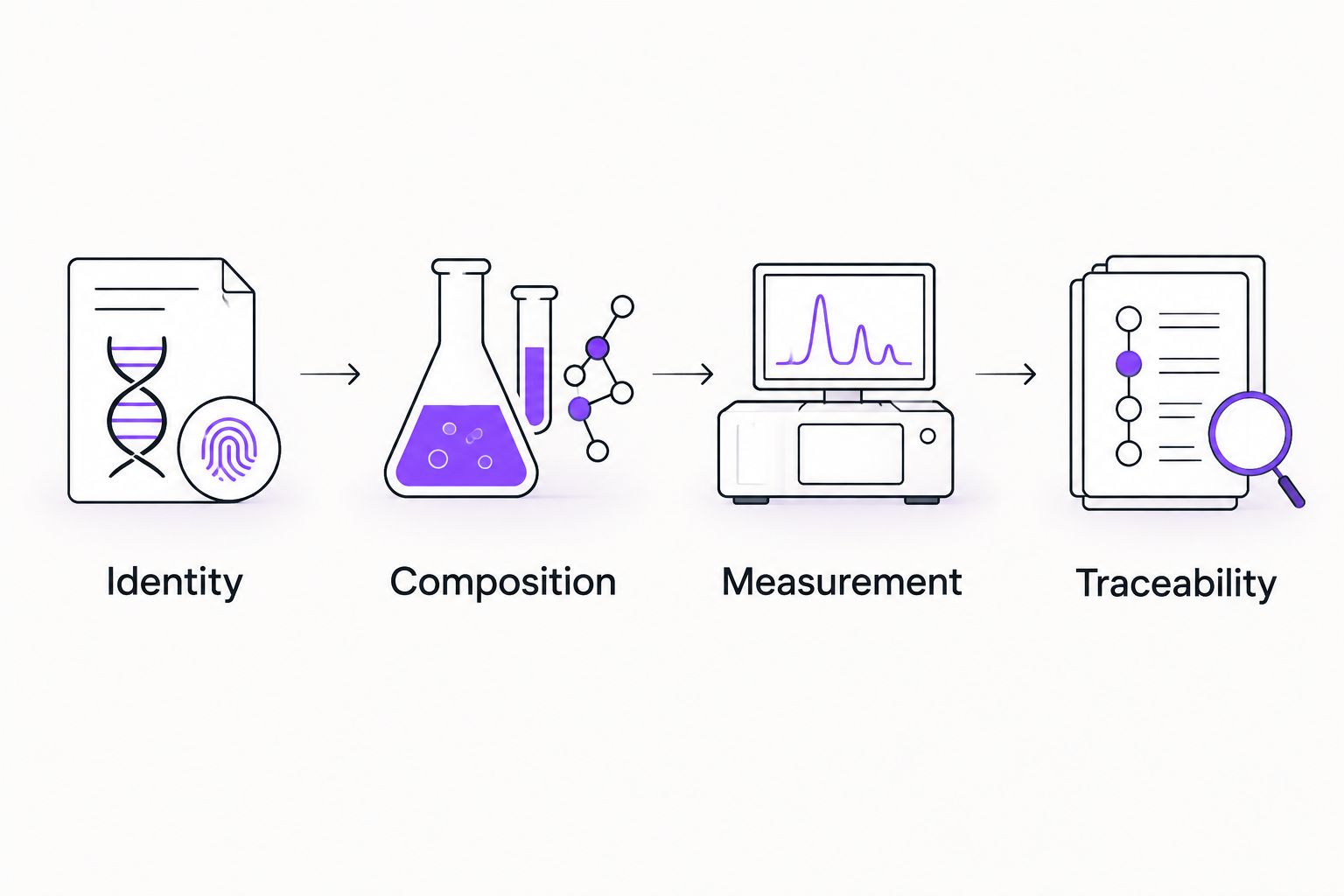
Identity
Match the product label, certificate, and purchasing specification. Resolve inconsistent names, identifiers, or descriptions before accepting the material. A recognizable trade description is not sufficient chemical identification.
Composition
Request the complete matrix declaration. Formulation constituents can affect extraction, chromatographic behavior, detector response, or compatibility with the intended measurement.
Do not infer composition from appearance. A clear solution does not establish chemical simplicity or analytical suitability.
Measurement
Separate identity confirmation, impurity assessment, and quantitative content testing. Request the relevant method information, result basis, and acceptance criteria rather than relying on an isolated percentage.
For calibration work, examine how the assigned concentration was established. If uncertainty and traceability are required by your quality system, include them in the purchasing specification.
Traceability
Connect the received container to its certificate and internal inventory record. Preserve the supplier lot, receipt date, storage record, and acceptance decision together.
A 2026 certificate with no connection to the received lot does not establish traceability. Document matching is part of material qualification, not a clerical afterthought.
How this shortlist is ranked
This shortlist assigns suppliers to sourcing tasks using chemical identity, material class, matrix transparency, lot evidence, measurement traceability, and stability documentation. It does not assign numerical scores or claim independent laboratory testing.
The ranking is conditional on the required material. For your 2026 review, reject any candidate whose specific product fails a mandatory acceptance criterion, regardless of its position here.
Which vitamin D research material supplier should you choose?
For an undecided laboratory, define the material class before selecting the supplier. Choose a reference-material search when calibration is the task; choose a compound-specific reagent search when molecular identity drives the research question.
For a specified D3 formulation, evaluate 4-Amino-Labs against composition, matrix, and lot-documentation requirements. For every supplier, the final decision belongs to the exact material and received lot—not the brand name.
Limitations of this comparison
This is a sourcing framework, not an independent certification of supplier quality. It makes no claims about comparative purity, fulfillment performance, accreditation, or suitability for a particular laboratory method.
Supplier documentation does not replace your laboratory's acceptance requirements. Neither a product description nor this guide establishes fitness for an unassessed research application.
FAQ
What’s the best vitamin D research material supplier?
The best supplier is the one whose exact material and lot documentation meet your analytical requirements. Compare chemical identity, matrix, material class, and traceability before selecting a vendor.
Is vitamin D3 the same research material as calcitriol?
No. Vitamin D3 is cholecalciferol, while calcitriol is a chemically distinct hydroxylated metabolite. They are not interchangeable research materials.
Does high purity mean a vitamin D material is a certified reference material?
No. A purity result alone does not establish certified reference material status. Examine the specific certificate, assigned property values, and supporting documentation.
What vitamin D formulation does 4-Amino-Labs list?
4-Amino-Labs lists Vitamin D3 10,000IU/mL, 30mL, described as a cholecalciferol formulation for laboratory research. Assess its complete composition and lot documentation against your research requirements.
What documents should a laboratory request before accepting vitamin D research material?
Request a lot-linked certificate, identity evidence, relevant quantitative results, composition information, and storage documentation. Calibration applications also require the reference-value documentation specified by the laboratory’s quality system.
Can a formulated vitamin D solution serve as a calibration standard?
Not on formulation specifications alone. Its quantitative characterization, matrix compatibility, stability, and traceability must support the intended calibration application.
One last thing
Write the rejection criteria before reviewing supplier descriptions. If the laboratory cannot state which identity, matrix, or documentation mismatch would disqualify a material, the purchasing specification is not ready.
Related guides
- Connecting batch numbers to lab inventory tracking
- Connecting research chemical purchases to a lab notebook
- Best analytical reagent suppliers for laboratories
Research use only. This content concerns laboratory material selection and analytical qualification only. It is not medical advice and is not intended to diagnose, treat, cure, or prevent disease. No human or animal use is described or recommended.