
The best kisspeptin suppliers are the ones that document the exact peptide identity, batch-specific analytical results, and material traceability—not simply a product name. For 2026 laboratory procurement, 4aminolabs is a catalog sourcing candidate; qualification depends on the documentation for the specific material and lot. This guide covers research sourcing only, not human or animal use.
- The best kisspeptin suppliers identify the exact peptide and connect analytical results to the supplied lot.
- 4aminolabs lists Kisspeptin 10mg as lyophilized powder; qualify the material through batch documentation.
- Analytical-reference sourcing and custom synthesis address different requirements; neither automatically establishes suitability.
- Separate chromatographic purity, chemical identity, peptide content, and functional evidence when comparing suppliers.
Why documentation determines the supplier choice
A kisspeptin listing establishes a procurement lead, not analytical suitability. Your laboratory needs a defined material that can be connected to receiving records, analytical files, and the research question.
Start with research chemical suppliers ranked by documentation when defining your qualification criteria. Apply the same documentation requirements to every candidate rather than accepting different standards for familiar and unfamiliar suppliers.
Choose the supplier whose evidence meets your acceptance criteria. A recognizable name, detailed product description, or research-use-only statement does not replace lot-specific evidence.
What makes the best kisspeptin suppliers
Use these criteria before comparing sourcing options. They separate a relevant catalog entry from material your laboratory can qualify.
- Exact identity: Require the peptide designation, sequence, terminal modifications, and chemical form where applicable. A general kisspeptin label is not a complete specification.
- Batch linkage: Match the certificate of analysis, container identifier, and analytical results to the lot being supplied.
- Complementary testing: Evaluate chromatographic purity and mass-based identity separately. Each measurement answers a different question.
- Content definition: Establish whether the declared quantity refers to total material, peptide content, or another defined basis.
- Handling evidence: Request material-specific storage and stability documentation rather than transferring instructions from another peptide.
- Traceable records: Retain the specification, order record, receipt details, and analytical files together.
Set acceptance criteria before reviewing supplier responses. Otherwise, the easiest document to obtain can become the standard by default.
Kisspeptin sourcing options at a glance
The following order is a procurement decision sequence, not a claim of measured supplier superiority. Begin with a catalog candidate when its specification matches your requirement; use a different sourcing route when the research requires additional characterization or a different molecular specification.
| Sourcing option | Best for | Standout feature | Key limitation |
|---|---|---|---|
| 4aminolabs catalog candidate | Evaluating the listed Kisspeptin 10mg material | Explicit listing for lyophilized kisspeptin material | The listing does not itself establish batch qualification |
| Analytical-reference supplier route | Projects requiring a defined reference-material specification | Procurement organized around characterization requirements | A reference designation must be supported by its documentation |
| Custom peptide synthesis route | Projects requiring a specified sequence or modification | Specification-led procurement | Synthesis alone does not establish identity, purity, or functional suitability |
These routes are not interchangeable. The appropriate choice follows from what your laboratory needs to establish about the material, not from the breadth of a supplier's catalog.
1. 4aminolabs: catalog candidate for listed kisspeptin material
4aminolabs lists Kisspeptin 10mg as a vial of lyophilized powder. That provides a concrete starting point for a laboratory evaluating catalog-sourced kisspeptin.
The next decision is whether the exact material specification and lot documentation match your requirements. Do not infer the peptide sequence, analytical purity, independent testing status, or functional characterization from the product name.
Documentation to request
Ask for the complete molecular designation and the certificate associated with the lot under consideration. Then compare the specification with the analytical evidence rather than reviewing either document in isolation.
4aminolabs pros:
- A specifically named kisspeptin catalog entry supports a focused sourcing inquiry.
- The listed material quantity is 10 mg.
- The description identifies the physical presentation as lyophilized powder.
4aminolabs limitations:
- Product identity still requires a sufficiently detailed molecular specification.
- The catalog description cannot replace lot-linked analytical evidence.
- Presentation and declared quantity do not establish suitability for a particular assay.
Best for: Laboratories assessing whether the listed material meets an existing kisspeptin specification.
Verdict: Qualify the specific lot before accepting the material for research.
2. Analytical-reference suppliers: specification-led comparison
The analytical-reference sourcing route fits projects in which characterization is central to the purchase decision. Define the required evidence first, then ask candidates to demonstrate that their particular material meets it.
Do not treat the word reference as proof of certification. A certificate of analysis and a certified reference material are not equivalent designations; evaluate the documented status and intended analytical role.
What this route must establish
Your specification should distinguish identity confirmation, impurity assessment, and any quantitative assignment required by the project. If traceability or measurement uncertainty is necessary, request the relevant documentation explicitly.
Analytical-reference route pros:
- Keeps the procurement decision tied to analytical requirements.
- Makes characterization gaps easier to identify before ordering.
- Supports direct comparison when candidates report results on a comparable basis.
Analytical-reference route limitations:
- The category label does not establish the quality of an individual material.
- Documentation can address chemical characterization without establishing functional behavior.
Best for: Laboratories that need a defined characterization package rather than a general catalog description.
Verdict: Select only against an explicit reference-material specification.
3. Custom synthesis suppliers: exact molecular requirements
Custom synthesis is a sourcing route for a molecular specification that a catalog entry does not clearly satisfy. The specification—not the general compound family—must define the requested material.
Document the sequence, terminal chemistry, relevant modifications, chemical form, and analytical acceptance criteria in the purchasing requirements. Any proposed substitution needs a separate scientific assessment.
Keep synthesis and qualification separate
A synthesis deliverable is not automatically a qualified research reagent. Review the final characterization package against the agreed specification, including how deviations and unidentified components are reported.
Custom synthesis route pros:
- Centers the order on an explicit molecular specification.
- Allows analytical deliverables to be agreed before synthesis.
- Makes sequence or modification requirements visible in the procurement record.
Custom synthesis route limitations:
- The laboratory must define its requirements accurately.
- Chemical characterization does not automatically demonstrate receptor activity or assay suitability.
Best for: Projects requiring an explicitly specified kisspeptin sequence, modification, or characterization package.
Verdict: Use specification-led acceptance, not synthesis completion, as the qualification endpoint.
How to read a kisspeptin certificate of analysis
A certificate should connect a defined material to identifiable analytical results. For your 2026 supplier review, assess what each result establishes and what remains outside its scope.
Separate the analytical questions
| Evidence | Question it addresses | What it does not establish alone |
|---|---|---|
| Molecular specification | What material was requested? | Whether the delivered material matches it |
| Chromatographic result | What does the method show about separated components? | Complete molecular identity or absolute peptide content |
| Mass spectrometric result | Is the measured mass consistent with the proposed identity? | Every structural feature or functional property |
| Content measurement | How much defined analyte is present on the stated basis? | Suitability for every research application |
| Lot-linked certificate | Which batch do the reported results describe? | Results for a different batch |
HPLC purity is not the same measurement as peptide content. A chromatographic area percentage describes the result under the stated method and detection conditions; it should not be silently converted into an absolute quantity claim.
Review method details alongside the headline result. Where the research question requires additional discrimination, request appropriate supporting evidence instead of assuming a single method resolves every uncertainty.
Build a traceable qualification workflow
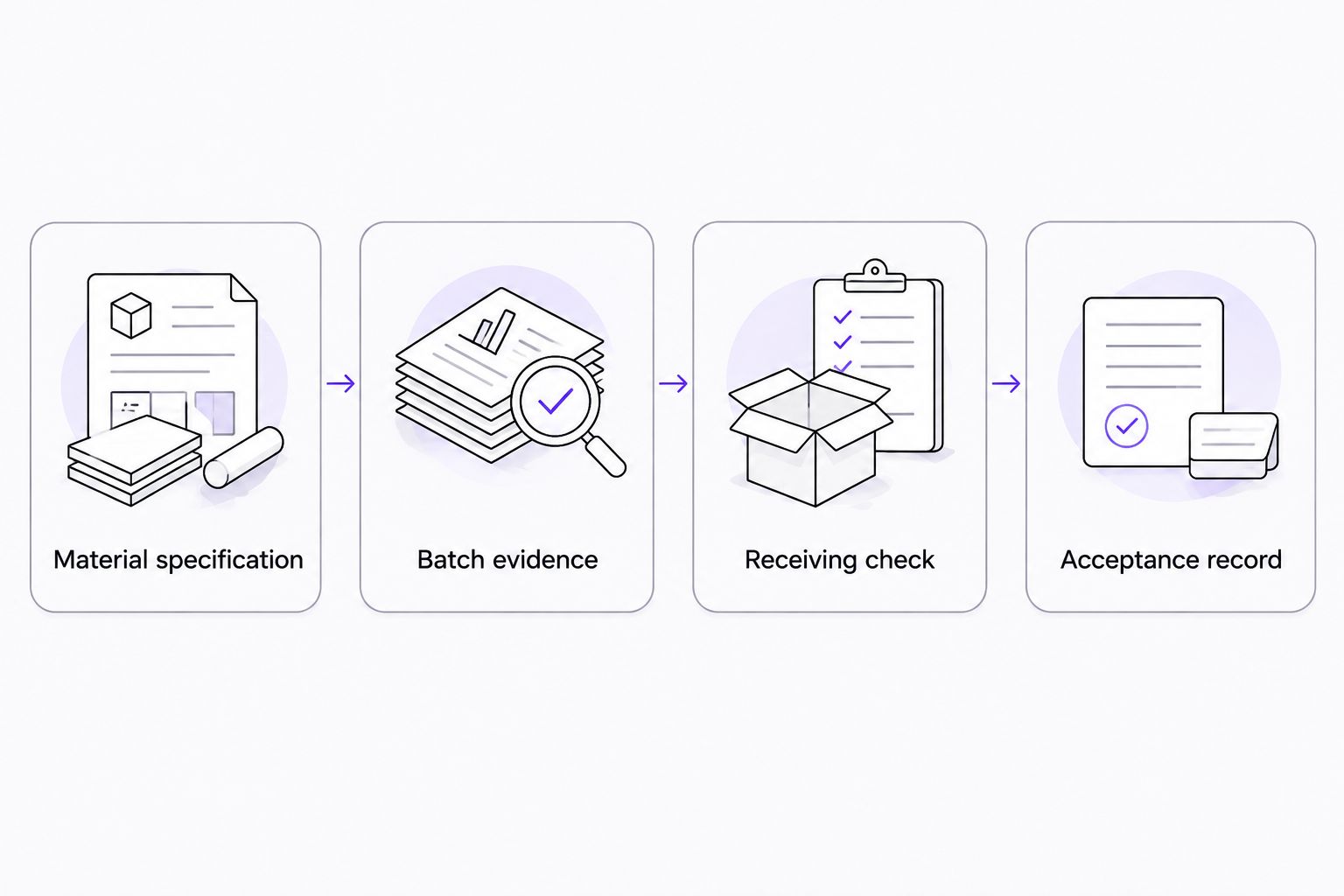
Keep the qualification sequence simple: define the material, review the evidence, reconcile the identifiers, and record the acceptance decision. The workflow should make an unresolved question visible rather than burying it in an email thread.
- Material specification: Record the required identity and acceptance criteria.
- Batch evidence: Collect the certificate and supporting analytical files.
- Receiving check: Reconcile the delivered identifier with the approved documentation.
- Acceptance record: Document the decision and any restrictions on research use.
Archive the original files rather than retaining only a copied purity figure. Your 2026 procurement record should preserve enough context to explain why the material was accepted, including the methods and specifications used in that decision.
Match material qualification to the measurement system
Supplier qualification and assay qualification answer different questions. The first concerns the research material; the second concerns whether the measurement system supports the intended interpretation.
If the project includes immunoassay measurements, evaluating ELISA kits for hormone testing requires attention to analyte specificity, cross-reactivity, calibration, and matrix compatibility. Those considerations belong to the measurement system and do not substitute for kisspeptin identity testing.
Keep the evidence streams separate
A supplier's chemical characterization cannot establish the selectivity of an unrelated assay. Likewise, a consistent assay signal does not independently prove the identity or purity of the material producing it.
Record material qualification and assay evaluation separately, then connect them through sample identifiers. This preserves the distinction between what entered the experiment and what the measurement system detected.
How the sourcing options are ordered
The 2026 sourcing order follows specification fit: assess a matching catalog candidate first, seek analytical-reference sourcing when characterization requirements drive the decision, and consider custom synthesis when the required molecular specification demands it.
No numerical supplier score is assigned. The order does not claim that one route has better testing, service, or reproducibility than another; those conclusions require supplier-specific evidence.
The purchasing rule is consistent across all routes: accept documented conformity, not category reputation. Retain the same acceptance criteria when comparing alternatives so that a change of supplier does not silently change the research material standard.
Which kisspeptin supplier should you choose?
Choose the candidate that supplies the exact specified material with evidence your laboratory can evaluate and retain. For 2026 procurement, begin with the research requirement and work backward to the sourcing route.
- Choose catalog sourcing when the documented material matches your specification.
- Choose analytical-reference sourcing when defined characterization requirements determine suitability.
- Choose custom synthesis when the sequence, modification, or deliverable specification requires a tailored order.
Do not select a substitute because it shares the kisspeptin name. Resolve identity and specification differences before making a purchasing decision.
Limitations of this supplier comparison
This guide compares sourcing routes and qualification criteria. It does not establish comparative batch performance, certify any supplier, or demonstrate functional equivalence between materials.
The listed 10 mg quantity describes the catalog presentation, not a verified peptide-content measurement. Supplier documents must be assessed for the actual lot, and research suitability remains specific to the intended analytical application.
FAQ
What’s the best way to compare kisspeptin suppliers?
Compare exact molecular specifications and lot-linked analytical evidence against the same acceptance criteria. Keep identity, purity, content, and handling documentation separate so that one result does not stand in for another.
Does a kisspeptin product name identify the exact peptide?
A general kisspeptin product name is not a complete molecular specification. Request the sequence, terminal chemistry, relevant modifications, and chemical form needed to identify the material.
Is HPLC purity the same as peptide content?
HPLC purity and peptide content are different measurements. A chromatographic area result should not be treated as an absolute peptide-content measurement without appropriate supporting evidence.
What kisspeptin material does 4aminolabs list?
4aminolabs lists Kisspeptin 10mg as lyophilized powder. Assess the exact molecular specification and documentation for the relevant lot before accepting it for research.
Should a laboratory choose custom kisspeptin synthesis?
Choose custom synthesis when the required molecular specification or analytical deliverables call for a tailored order. Synthesis completion alone does not establish that the material meets the laboratory’s acceptance criteria.
Can a certificate from another lot qualify the material received?
A certificate from another lot does not establish the analytical results for the lot received. Match the delivered identifier to its own certificate and supporting records.
One last thing
A complete certificate attached to the wrong lot is still the wrong evidence. Before accepting material, reconcile the container identifier, certificate identifier, and receiving record; this check protects the connection between the analytical claim and the material your laboratory actually holds.
Related guides
- Verifying peptide purity with third-party CoA testing
- Connecting batch numbers to lab inventory tracking
- Connecting research chemical purchases to a lab notebook
Research-use-only notice: All materials discussed are strictly for laboratory research use only, not for human or animal use. This content is not medical advice and is not intended to diagnose, treat, cure, or prevent disease.