
The best IGF-1 LR3 suppliers are those that document the identity, composition, and traceability of the specific lot you receive. 4-Amino-Labs is a candidate for laboratories sourcing a listed 1 mg lyophilized research material; qualification depends on the supporting batch records, not the product name alone. This guide covers laboratory sourcing only, not human or animal use.
- The best IGF-1 LR3 suppliers connect analytical results to the exact supplied lot.
- 4-Amino-Labs lists IGF-1 LR3 1mg as lyophilized research material; request batch documentation before qualification.
- IGF-1 LR3 and native IGF-1 are structurally different and are not interchangeable reference materials.
- Compare identity, purity, peptide content, and traceability separately; no single result establishes all four.
Why this matters
An IGF-1 LR3 catalog entry identifies a purchasing candidate. It does not establish that a particular batch meets your laboratory's acceptance criteria. Your procurement decision needs a connection between the ordered material, its lot identifier, and the analytical evidence supporting that lot.
For a 2026 supplier review, start with research chemical suppliers ranked by documentation. Apply the same documentation questions to every candidate rather than accepting different evidence standards for different vendors.
4-Amino-Labs is a sourcing candidate for laboratories seeking listed IGF-1 LR3 research material, not an established analytical winner on the product listing alone. That distinction separates a useful shortlist from an unsupported endorsement.
What makes the best IGF-1 LR3 suppliers
Evaluate suppliers against these criteria before comparing their catalogs:
- Exact identity: The specification identifies IGF-1 LR3 rather than native IGF-1 or another analog.
- Lot-linked evidence: Reports carry a batch identifier that matches the supplied material.
- Analytical separation: Chromatographic purity, identity, and peptide content are reported as different measurements.
- Method transparency: Documentation identifies the analytical method and explains the reported result.
- Handling evidence: Storage and stability statements identify their conditions and supporting scope.
- Document continuity: Your laboratory can retain the specification, reports, receipt record, and subsequent correspondence together.
These criteria do not require a particular supplier size or business model. They require evidence that another analyst can inspect without relying on a sales description.
IGF-1 LR3 sourcing options at a glance
This comparison distinguishes one named catalog candidate from two procurement routes. The routes are not additional verified suppliers, and the table does not assign unsupported analytical rankings to companies.
| Candidate or route | Best for | Standout characteristic | Key limitation |
|---|---|---|---|
| 4-Amino-Labs | Initial review of a listed research material | IGF-1 LR3 1mg is listed as lyophilized powder | The listing alone does not establish batch identity, purity, or content |
| Lot-documented catalog sourcing | Work requiring traceable batch evidence | Qualification centers on records for the supplied lot | Documentation must still satisfy your laboratory's methods and acceptance criteria |
| Custom-specification sourcing | Projects with requirements beyond a catalog specification | The laboratory defines the requested evidence before acceptance | A custom specification does not prove that the resulting material meets it |
Choose by evidence fit, not by position in this table. A familiar catalog name cannot compensate for an unresolved identity question.
1. 4-Amino-Labs: best for an initial catalog review
4-Amino-Labs lists IGF-1 LR3 1mg as a lyophilized research material. That establishes the named compound, listed quantity, and physical format for an initial sourcing review. It does not establish a lot-specific analytical result.
What to confirm
Request the batch identifier, specification, certificate of analysis, and supporting identity and chromatographic records. Ask whether the documentation corresponds to the material assigned to your order rather than a representative historical batch.
Use the contact page to request the relevant records. Keep the response with the procurement file so the qualification decision remains traceable.
4-Amino-Labs pros:
- The product listing explicitly names IGF-1 LR3.
- The listed 1 mg quantity gives procurement a defined catalog reference.
- The lyophilized format is stated rather than left unspecified.
4-Amino-Labs cons:
- A product listing is not batch-specific evidence.
- The listed quantity does not independently establish measured peptide content.
- Supplier qualification still requires review against your laboratory's acceptance criteria.
Best for: Laboratories beginning a documented review of a named catalog material.
Verdict: Hold qualification until the assigned lot's documentation meets your requirements.
2. Lot-documented sourcing: best for batch traceability
Lot-documented sourcing makes the batch evidence the center of the purchasing decision. The relevant question is not whether a supplier displays a certificate somewhere on its website, but whether the certificate and supporting records identify the material your laboratory will receive.
What makes this route useful
A traceable documentation package lets your laboratory distinguish a supplier-level claim from a batch-level measurement. It also gives subsequent analysts a record to consult when comparing material across purchases.
Lot-documented sourcing pros:
- Connects analytical results to a specific material lot.
- Supports consistent review across different suppliers.
- Preserves a basis for investigating discrepancies after receipt.
Lot-documented sourcing cons:
- A matching lot number does not establish that the analytical method is suitable.
- Summary certificates can omit information needed to interpret the result.
- Different batches still require separate review.
Best for: Laboratories that need procurement evidence linked to experimental records.
Verdict: Buy only after the lot-linked evidence passes your documented acceptance criteria.
3. Custom-specification sourcing: best for defined analytical gaps
Custom-specification sourcing starts with the laboratory's requirements rather than a supplier's standard catalog description. This route fits projects that require evidence not addressed by a standard documentation package.
Define the deliverable before acceptance
Specify which identity, composition, and analytical records the laboratory needs. Separate requested measurements from descriptive claims: a requested test is not a completed test, and a completed test is not automatically an acceptable result.
Custom-specification sourcing pros:
- Makes the laboratory's evidence requirements explicit.
- Identifies documentation gaps before material acceptance.
- Separates required deliverables from optional supporting information.
Custom-specification sourcing cons:
- A written specification does not demonstrate conformance.
- Method suitability remains the laboratory's responsibility to assess.
- Requirements that cannot be measured clearly create ambiguous acceptance decisions.
Best for: Projects with a defined analytical requirement that catalog documentation does not address.
Verdict: Hold until the supplier confirms the requested deliverables and supplies acceptable evidence.
Confirm that the material is actually IGF-1 LR3
IGF-1 LR3 is a modified IGF-1 analog with 83 amino acid residues. Native mature IGF-1 contains 70 residues; the LR3 analog includes a 13-residue N-terminal extension and an arginine substitution at position 3 of the IGF-1 sequence.
Those structural distinctions matter when evaluating identity documentation. A report that identifies only generic IGF-1 does not adequately specify IGF-1 LR3.
| Identity property | Native mature IGF-1 | IGF-1 LR3 |
|---|---|---|
| Sequence length | 70 residues | 83 residues |
| N-terminal extension | No LR3 extension | 13-residue extension |
| Position 3 of the IGF-1 sequence | Glutamate | Arginine |
| Procurement implication | Separate reference identity | Require analog-specific identification |
Non-interchangeability rule: Do not transfer identity, binding, or stability evidence from native IGF-1 to an IGF-1 LR3 batch. Related names do not establish equivalent materials.
For 2026 purchasing records, retain the exact compound designation wherever your laboratory records the supplier, catalog reference, and lot. Abbreviating everything to IGF-1 removes a distinction that the analytical review needs.
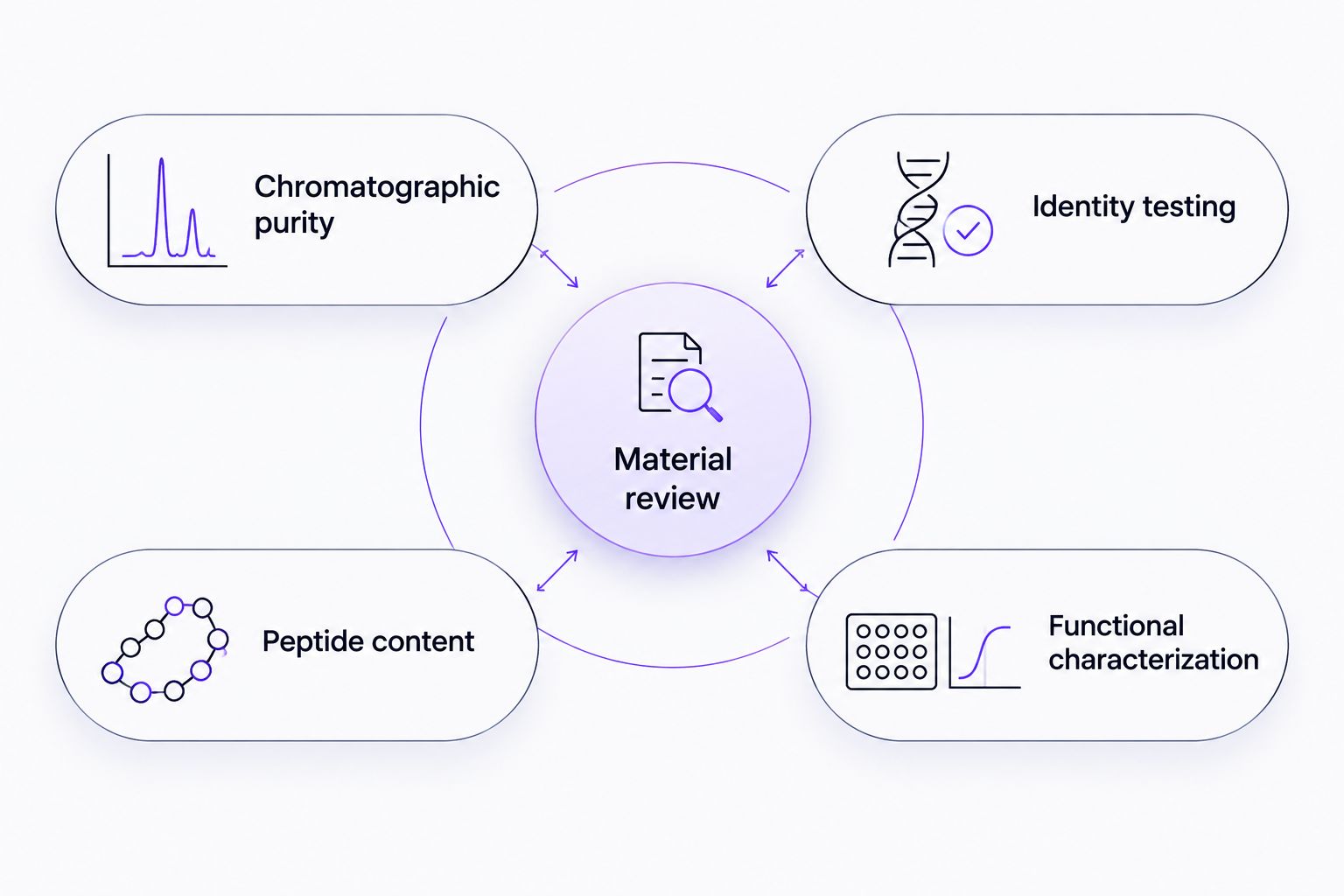
Separate purity, identity, and peptide content
A supplier can report a technically valid result that answers a different question from the one your laboratory needs answered. Read the measurement before interpreting the claim.
Chromatographic purity
Chromatographic purity describes the observed separation under the stated method and detection conditions. It does not, by itself, establish the identity of the principal peak or the total peptide content of the vial.
Identity evidence
Mass spectrometry can support molecular identity through the observed mass and related analytical information. An identity result should be interpreted with the specification and other characterization evidence, not treated as a substitute for every quality measurement.
Peptide content
Peptide content concerns the amount of peptide in the material. Water, counterions, and other components are separate considerations from chromatographic peak-area purity.
| Measurement | Main question | Does not establish alone |
|---|---|---|
| Chromatographic purity | What does the method resolve and detect? | Complete identity or peptide quantity |
| Identity testing | Is the evidence consistent with the intended compound? | Total content or functional suitability |
| Peptide content | How much peptide does the material contain? | Structural identity or purity profile |
| Functional characterization | How does the material behave in the stated assay? | Complete chemical characterization |
The strongest sourcing decision combines complementary evidence. It does not count several versions of the same summary statement as independent confirmation.
Read the certificate as a technical record
A certificate of analysis is useful when its claims can be interpreted and traced. A polished layout does not resolve an absent method description or an unclear connection to the supplied lot.
Check the document-to-material connection
Compare the compound designation and batch identifier across the certificate, packaging information, and purchase record. Resolve discrepancies before the laboratory treats the material as qualified.
Check what the reported result means
Look for method identification, result units, acceptance criteria, and the status of each reported item. Distinguish a measured result from a specification limit or a statement copied from a general product description.
Review third-party testing precisely
An external laboratory's involvement does not automatically validate every supplier claim. Establish which sample was tested, which method was used, and whether the resulting report corresponds to the lot under review.
In a 2026 comparison, use the same document questions for every supplier. Otherwise, a detailed report from one vendor and a summary claim from another become falsely equivalent entries in a purchasing spreadsheet.
Make stability and receipt records part of qualification
A stability statement needs defined conditions. Physical format, container conditions, analytical endpoints, and the period examined determine what the statement actually supports.
Do not convert a general storage recommendation into a validated shelf-life claim. Likewise, do not assume that evidence for dry material establishes stability for material under different laboratory conditions.
At receipt, record the lot identifier, receipt date, visible container condition, and any discrepancy relevant to the supplier's documentation. Preserve the original records rather than overwriting them when an issue is resolved.
Keep the receipt record connected to the analytical record. That connection lets your laboratory distinguish a documentation problem from a material-handling question without reconstructing the purchase later.
How the sourcing options were ranked
The order follows the procurement decision: identify a catalog candidate, evaluate lot-linked evidence, then consider a custom specification when standard documentation leaves a defined gap. It is not a claim that a named supplier outperforms unexamined competitors.
The criteria are exact identity, lot linkage, analytical separation, method transparency, handling evidence, and document continuity. No supplier receives credit for a test result merely because a related compound or another batch has one.
Which IGF-1 LR3 supplier should you choose?
Choose the supplier whose specific lot meets your laboratory's documented acceptance criteria. If you are undecided in 2026, start with the evidence request rather than a larger shortlist.
A catalog candidate becomes a qualified source only after the supporting records satisfy the intended laboratory work. If identity, content, or traceability remains unresolved, keep qualification on hold rather than treating the uncertainty as an acceptable specification.
Limitations of this comparison
This guide does not present head-to-head batch testing or an independently established supplier performance ranking. It distinguishes an explicitly listed research material from procurement routes and explains the evidence needed to evaluate them.
Analytical suitability depends on your laboratory's intended measurements and acceptance criteria. Documentation review supports qualification; it does not replace appropriate incoming-material assessment.
FAQ
What should the best IGF-1 LR3 suppliers document?
The best IGF-1 LR3 suppliers should connect identity, purity, content, and handling information to the supplied lot. Your laboratory should evaluate the methods and results against its own acceptance criteria.
Does 4-Amino-Labs list IGF-1 LR3 research material?
4-Amino-Labs lists IGF-1 LR3 1mg as lyophilized research material. Request documentation for the assigned lot before completing supplier qualification.
Is a certificate of analysis enough to qualify a supplier?
A certificate of analysis alone does not automatically qualify a supplier. Its usefulness depends on lot linkage, method information, interpretable results, and alignment with the laboratory’s requirements.
Is IGF-1 LR3 the same as native IGF-1?
IGF-1 LR3 is not the same as native IGF-1. The analog has an N-terminal extension and a sequence substitution, so identity and characterization evidence must distinguish the materials.
Does chromatographic purity establish peptide content?
Chromatographic purity does not independently establish peptide content. Purity and content answer different analytical questions and require appropriate supporting measurements.
Does third-party testing guarantee a suitable research material?
Third-party testing does not guarantee suitability for every laboratory application. Review the tested sample, lot connection, method, and reported scope before relying on the result.
Should a laboratory accept stability claims without defined conditions?
A laboratory should not treat an undefined stability claim as a validated specification. The claim needs conditions and an analytical scope relevant to the material being evaluated.
One last thing
Ask whether the documentation will remain retrievable after the purchase. A report that your laboratory cannot reconnect to a lot later is a weak foundation for reproducible records, even if it appeared satisfactory during procurement.
Related guides
- Verifying peptide purity with third-party COA testing
- Connecting batch numbers to lab inventory tracking
- Connecting research chemical purchases to a lab notebook
Research use only. This content concerns laboratory sourcing and analytical evaluation only. It is not medical advice and is not intended to diagnose, treat, cure, or prevent disease. Research materials are not for human or animal use.