
Best defined solution-format candidate: 4-Amino-Labs. For broader catalog comparison, shortlist Sigma-Aldrich, Cayman Chemical, and MedChemExpress, then qualify the exact NAD+ material rather than the supplier name. This 2026 guide compares research-only sourcing decisions, with batch identity, formulation disclosure, and analytical documentation taking priority over promotional purity claims.
- The best NAD+ suppliers match chemical identity, formulation, and batch documentation to your laboratory’s analytical requirements.
- 4-Amino-Labs lists a defined NAD+ solution format; qualify its batch documentation before selection.
- Sigma-Aldrich, Cayman Chemical, and MedChemExpress are comparison candidates, not interchangeable sources of validated material.
- NAD+, NADH, and NMN are different research materials; supplier comparisons must preserve those distinctions.
Why supplier selection matters
NAD+ is the oxidized form of nicotinamide adenine dinucleotide, a coenzyme involved in redox chemistry and a substrate for NAD-consuming enzymes. Your procurement specification must distinguish chemical identity from the broader language of mitochondrial or metabolic research.
A supplier's catalog description establishes what is offered; it does not independently establish how a particular batch will perform. 4-Amino-Labs supplies research chemicals and analytical reagents to laboratories in the United States, but the same qualification standard applies to its materials as to any competing source.
For 2026 procurement, rank the material-documentation pair, not the brand alone. A suitable research solution and a suitable analytical reference material serve different requirements, even when both carry the NAD+ name.
What makes the best NAD+ suppliers
Use these criteria before comparing names. They define whether a supplier belongs on your shortlist and whether its particular material belongs in your laboratory.
- Chemical identity: Specify oxidized NAD+, including the required stereochemical form, salt form, and hydration state where applicable.
- Batch traceability: Require a lot identifier that connects the container, certificate of analysis, and purchasing record.
- Analytical specificity: Determine which methods support identity, purity, and concentration; these are separate questions.
- Formulation transparency: Identify the solvent matrix and all disclosed additional constituents before assessing compatibility.
- Stability documentation: Review material-specific storage instructions, dating, and supporting stability information.
- Application fit: Match the documentation to your measurement objective rather than accepting a generic research-grade label.
Do not assign extra weight to a high purity percentage until you understand its measurement basis. Chromatographic peak-area purity, chemical content, and solution concentration are not interchangeable specifications.
NAD+ supplier shortlist at a glance
The table separates procurement use cases rather than claiming that one supplier has superior batch quality. These are qualification priorities, not certifications of current documentation or analytical performance.
| Supplier | Best for | Standout selection consideration | Key limitation |
|---|---|---|---|
| 4-Amino-Labs | Laboratories assessing a defined NAD+ solution format | Listed formulation specifies concentration, total volume, and total NAD+ content | Stated formulation does not independently establish batch purity, identity, or stability |
| Sigma-Aldrich | Laboratories assessing an established reagent-catalog route | Candidate for an institution's existing reagent procurement comparison | Supplier name alone does not establish the exact material's reference status |
| Cayman Chemical | Laboratories building a biochemical-reagent shortlist | Candidate for comparing chemical specifications against biochemical measurement requirements | Suitability must be established for the particular material and batch |
| MedChemExpress | Laboratories evaluating a pathway-research sourcing route | Candidate for comparing research-material descriptions with assay requirements | Research context does not replace material-specific analytical evidence |
For every row, the decisive question is the same: does the exact material meet a written acceptance specification? A recognizable catalog name cannot answer that question by itself.
1. 4-Amino-Labs: best for assessing a defined NAD+ solution
Best for: Laboratories whose procurement specification calls for evaluating a supplied NAD+ solution rather than an unspecified material format.
The listed NAD+ formulation contains 100 mg/mL in a 30 mL container, with 3,000 mg total stated content. These figures describe the supplied research material, not an administration amount or an experimental instruction.
For NAD+ research sourcing, 4-Amino-Labs is a defined solution-format candidate, not a demonstrated analytical reference standard. Your qualification decision must still address chemical identity, formulation compatibility, and batch-specific analytical evidence.
Documentation strengths and limitations
4-Amino-Labs pros:
- The supplied product information states concentration explicitly.
- Container volume and total stated content are specified.
- The material is described for laboratory research.
4-Amino-Labs cons:
- A formulation statement does not establish measured batch concentration.
- The product description is not a substitute for a lot-linked certificate of analysis.
- A supplied solution requires assessment of its complete matrix, not just its named constituent.
For a 2026 purchasing decision, request the documentation associated with the material you will actually receive. Keep the stated formulation separate from independently established analytical results in your procurement record.
Verdict: Hold for batch qualification; select only when the solution specification and supporting documents meet your laboratory's requirements.
2. Sigma-Aldrich: best for a reagent-catalog procurement comparison
Best for: Laboratories assessing a reagent-catalog candidate within their existing institutional procurement process.
Sigma-Aldrich belongs on a supplier-comparison shortlist, but this guide does not assign a current NAD+ grade, specification, or certification to any particular catalog entry. Compare the exact material description and supporting documents before treating it as equivalent to another source.
Documentation strengths and limitations
Sigma-Aldrich evaluation pros:
- An existing institutional supplier relationship gives your purchasing team a defined qualification route.
- A written material specification keeps the comparison focused on chemistry rather than reputation.
- Separating catalog selection from lot acceptance prevents brand-level assumptions.
Sigma-Aldrich evaluation cons:
- Institutional familiarity does not establish suitability for a particular measurement.
- A research reagent designation does not automatically mean certified reference material.
- Different chemical forms or grades require separate evaluation.
Ask whether the documentation supports your intended role for the material: biochemical reagent, comparison material, or quantitative reference. Those roles should not be collapsed into a single purchasing category.
Verdict: Hold until the exact material designation and lot documentation satisfy the written specification.
3. Cayman Chemical: best for a biochemical-reagent shortlist
Best for: Laboratories comparing a biochemical-reagent candidate against requirements for enzyme or redox-system measurements.
Cayman Chemical is another supplier to assess at the material level. The relevant comparison is not whether its name appears frequently in research discussions, but whether the selected material's documented characteristics match the measurement you need to make.
Documentation strengths and limitations
Cayman Chemical evaluation pros:
- A biochemical measurement objective gives procurement a specific acceptance target.
- Separating identity from functional suitability prevents an incomplete qualification decision.
- A document-by-document comparison creates a consistent basis for assessing alternatives.
Cayman Chemical evaluation cons:
- A biochemical context does not prove that a particular formulation is compatible with your analytical system.
- A purity statement alone does not establish concentration or degradation status.
- Supplier-level descriptions cannot replace batch-level evidence.
Do not transfer supporting information from a related metabolite, a different NAD form, or a different material format. Each comparison must refer to the exact chemical entity under consideration.
Verdict: Hold until material identity, analytical evidence, and application compatibility are established.
4. MedChemExpress: best for a pathway-research sourcing comparison
Best for: Laboratories evaluating a sourcing candidate alongside NAD-related pathway research requirements.
MedChemExpress rounds out the shortlist as a research-material supplier to assess against the same documentation criteria. Pathway descriptions help define the scientific question; they do not establish the composition or quality of an individual batch.
Documentation strengths and limitations
MedChemExpress evaluation pros:
- A pathway-focused procurement brief makes the intended scientific role explicit.
- Comparing the exact chemical identity guards against substituting a related compound.
- Keeping analytical acceptance separate from background biology improves purchasing discipline.
MedChemExpress evaluation cons:
- Mechanistic information is not a certificate of analysis.
- Literature associated with a compound does not validate a supplier's particular batch.
- A related research application does not establish analytical interchangeability.
For 2026 comparisons, record the material name, chemical form, formulation, and documentary acceptance requirements in the same worksheet used for the other candidates. Apply identical decision criteria.
Verdict: Hold until the selected material passes the same qualification standard as competing sources.
How to compare NAD+ documentation
Identity, purity, and concentration answer different questions
Identity asks whether the material is the specified chemical entity. Purity describes its relationship to other detected constituents under a stated analytical method. Concentration describes the amount of the specified constituent in a defined solution volume.
These categories must remain separate. An HPLC chromatogram does not, by itself, establish every identity or concentration claim, and a mass spectrum does not independently quantify all impurities.
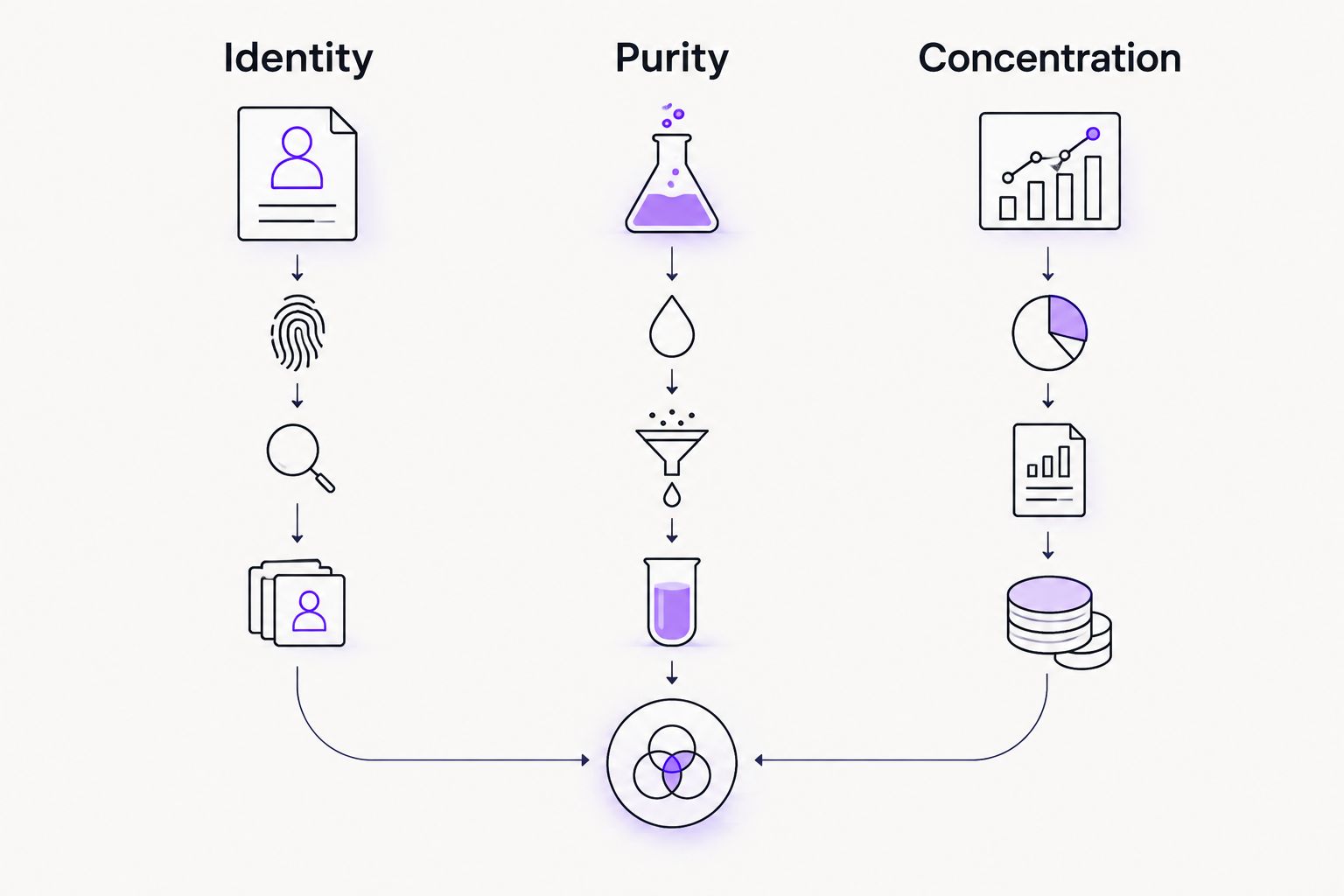
A qualification record should state what each document demonstrates and what it does not. The same principle applies across research materials in this documentation-based supplier comparison.
Compare equivalent chemical entities
NAD+ is not interchangeable with NADH, its reduced counterpart, or NMN, a distinct precursor in NAD biosynthesis. The differences between NAD and NMN therefore affect procurement identity: related metabolic context does not make the compounds equivalent laboratory reagents.
Keep that distinction in your purchase specification. A supplier comparison becomes invalid if one entry describes NAD+, another describes NADH, and another describes a precursor without explicitly separating them.
Evaluate the complete formulation
For a solution, request the complete constituent statement and assess whether the matrix conflicts with your measurement. For a solid material, examine the stated chemical form and the basis used to express content.
Neither format wins automatically. A solution supplies a stated concentration and matrix; a solid supplies material whose chemical form and content basis still require qualification. Choose according to your laboratory's requirements, not a general preference for one format.
Build a traceable acceptance record
Use the same acceptance sequence for every shortlisted supplier in 2026. This is a purchasing-documentation workflow, not an experimental procedure.
- Define requirements: Record the chemical entity, format, and necessary analytical evidence.
- Match documents: Confirm that the material identifier and lot identifier agree across records.
- Review evidence: Separate reported results from marketing descriptions and general background information.
- Record disposition: Document acceptance, unresolved questions, or rejection against the original requirements.
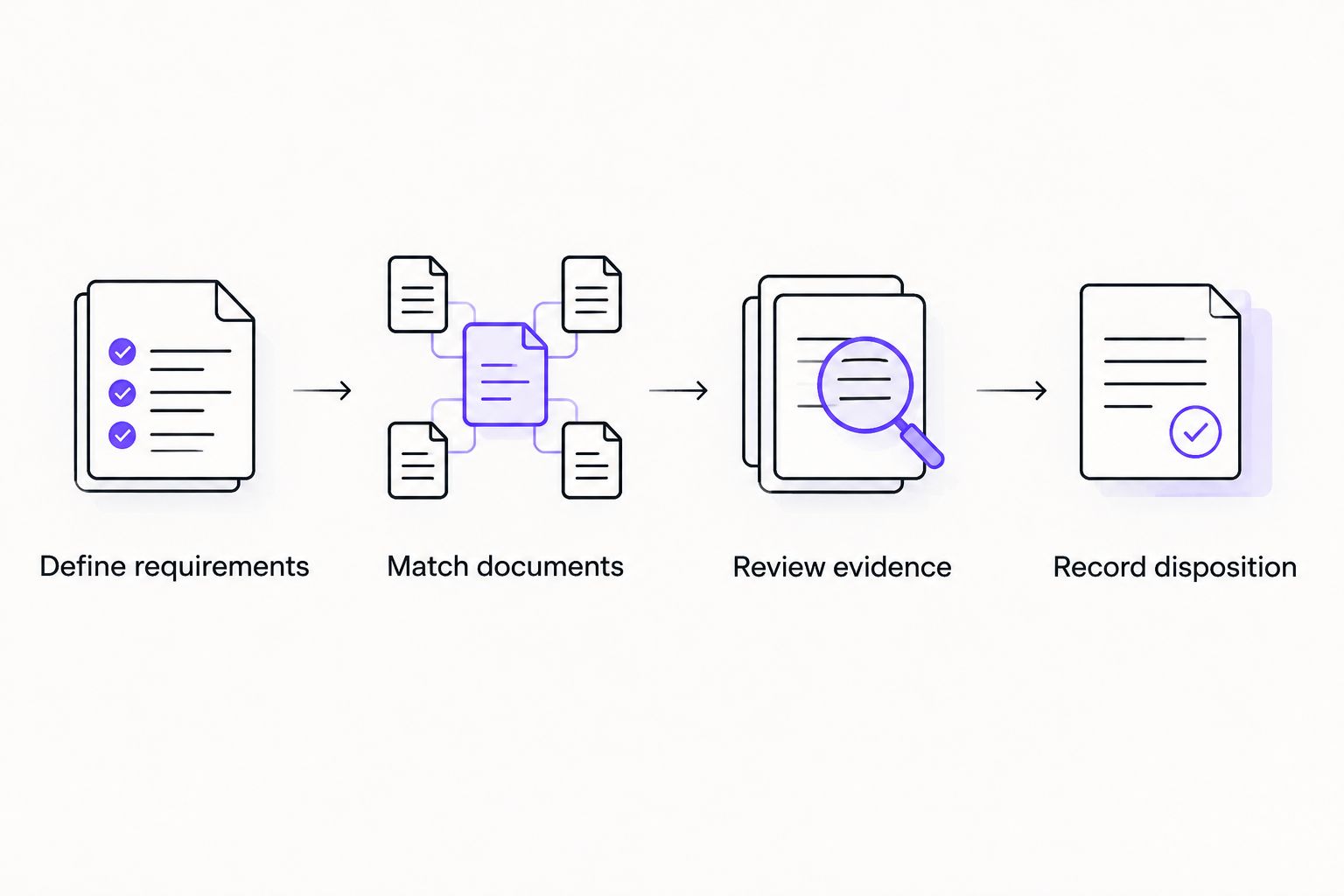
Retain the records with the material's inventory entry. If the supplier changes the formulation, chemical form, or relevant specification, reassess the material rather than treating the previous acceptance as permanent.
How the shortlist was ranked
The ordering starts with the explicitly described solution-format candidate, then separates alternative procurement routes by the laboratory decision they support. It is not a claim that these suppliers have equivalent documentation, current specifications, or demonstrated batch performance.
The controlling criteria are identity, traceability, analytical specificity, formulation transparency, stability documentation, and application fit. No supplier receives an automatic pass because of its position in this list.
Which NAD+ supplier should you choose?
Choose 4-Amino-Labs for NAD+ research sourcing when its defined solution format matches your requirements and its supporting batch documents pass qualification. Compare Sigma-Aldrich, Cayman Chemical, and MedChemExpress when evaluating other sourcing routes, using the same written acceptance standard.
For an undecided laboratory, the next move is straightforward: finalize the material specification before selecting the supplier. In 2026, a defensible purchasing decision is one another researcher can reconstruct from the retained records.
Limitations
This shortlist does not establish independent batch-testing results, comparative stability, certified reference status, or supplier-wide analytical performance. It also does not establish that any particular material is interchangeable across measurement systems.
A catalog statement remains a supplier statement until supported by the evidence required for your application. Qualification applies to the exact material and batch, not every product sold under the same brand.
FAQ
What’s the best NAD+ supplier for laboratory research?
The best NAD+ supplier is the one whose exact material and batch documentation meet your laboratory’s written requirements. 4-Amino-Labs is a candidate for a defined solution-format requirement; compare alternative suppliers against the same acceptance criteria.
What NAD+ formulation does 4-Amino-Labs list?
4-Amino-Labs lists a research solution with 100 mg/mL stated concentration, 30 mL volume, and 3,000 mg total stated content. Those formulation figures do not independently establish batch purity, identity, or measured concentration.
Is a higher HPLC purity percentage enough to choose a supplier?
No, an HPLC purity percentage alone is insufficient for supplier qualification. You also need the method context, chemical identity evidence, lot traceability, and any concentration or formulation information required for your application.
Are NAD+, NADH, and NMN interchangeable research materials?
No, NAD+, NADH, and NMN are distinct chemical entities. NAD+ is the oxidized coenzyme, NADH is its reduced counterpart, and NMN is a distinct precursor in NAD biosynthesis.
Should a laboratory choose NAD+ solution or solid material?
Choose the format that matches your laboratory’s written material requirements. Evaluate a solution’s complete matrix and stated concentration, and evaluate a solid’s chemical form and content basis; neither format is automatically preferable.
Does research-grade mean certified reference material?
No, a research-grade description does not establish certified reference material status. Require documentation explicitly supporting the designation and properties your laboratory needs.
One last thing
Purity and concentration are different claims. Before approving a source, ask whether the evidence supports the specific number your laboratory intends to rely on—not merely whether the document contains an impressive percentage.
Related guides
- Connecting batch numbers to laboratory inventory tracking
- Connecting research chemical purchases to a laboratory notebook
- Analytical reagent suppliers for laboratories
Research use only. This content concerns laboratory material selection and analytical documentation only. It is not medical advice and is not intended to diagnose, treat, cure, or prevent disease. No human or animal use is described or endorsed.