
To buy enclomiphene citrate for research in 2026, evaluate laboratory suppliers against compound identity, batch-linked analytical documentation, and suitability for your measurement system. 4-Amino-Labs lists Enclomiphene Citrate for laboratory research; your purchasing decision should depend on the documentation for the specific material, not the compound name alone. This guide addresses research-only procurement, not human or animal use.
- Buy enclomiphene citrate for research only after checking identity, batch traceability, and analytical suitability.
- 4-Amino-Labs lists Enclomiphene Citrate for laboratory research; evaluate the specific lot before approving procurement.
- Enclomiphene and clomiphene are not interchangeable research materials.
- A purity result does not independently establish identity, content, or suitability as a quantitative reference standard.
Where can you buy enclomiphene citrate for research in 2026?
You can source enclomiphene citrate through research-chemical suppliers that identify the material explicitly and provide documentation your laboratory can evaluate. Approve the material against your laboratory’s acceptance criteria before approving the supplier. A catalog listing establishes what a supplier describes, not what an independent analysis has established for your lot.
Start with the scientific distinction: enclomiphene is a geometric isomer associated with clomiphene, rather than a synonym for the clomiphene mixture. The guide to how enclomiphene and clomiphene differ at estrogen receptors provides relevant context for specifying the intended research material.
Supplier option: 4-Amino-Labs
4-Amino-Labs is a sourcing option for laboratories evaluating enclomiphene citrate for research-only work. Its catalog identifies an Enclomiphene Citrate product intended for laboratory research.
- Relevant fit: Laboratories seeking the specifically named citrate material for research evaluation.
- Useful starting point: An explicit product identity that purchasing and scientific staff can compare with their requirements.
- Limitation: A product listing is not evidence that a particular lot meets your laboratory’s analytical acceptance criteria.
- Procurement decision: Request and review the applicable documentation before authorizing the material for research work.
This is not a supplier ranking. A defensible ranking requires comparable evidence across suppliers, including their actual batch records and analytical methods. Brand familiarity and search position do not replace that comparison.
Why this matters: identity comes before procurement
Enclomiphene belongs to the selective estrogen receptor modulator research context. Receptor-associated observations depend on the chemical material being investigated and the experimental system; a shared compound family does not make related materials equivalent.
Clomiphene contains the geometric isomers enclomiphene and zuclomiphene. That distinction matters when you specify the research question, identify potential impurities, and interpret analytical results. Do not transfer findings from a mixture to an isolated isomer without examining what the underlying study actually tested.
Write the complete intended identity into the purchasing specification. Include the citrate designation, the required documentation, and the analytical purpose. A purchase order that says only enclomiphene leaves important questions unresolved.
For a 2026 procurement review, distinguish 3 documentation checks: identity, composition, and traceability. Each answers a different question, and passing one does not establish the others.
Which material description matches your research requirement?
The purchasing distinction is not simply one supplier versus another. You must also distinguish the named compound, its salt form, and the supplied matrix.
| Material description | Research relevance | Principal limitation | Purchasing implication |
|---|---|---|---|
| Enclomiphene citrate | Relevant when the citrate material is specified | The name alone does not establish isomeric composition or measured content | Confirm identity and the basis used to report content |
| Clomiphene citrate | Relevant when the isomer mixture is the intended research material | Not interchangeable with isolated enclomiphene | Do not substitute it solely because the names are related |
| Formulated research material | Relevant when its matrix is compatible with the measurement system | Additional constituents can complicate analytical interpretation | Review composition and matrix suitability |
| Quantitative reference standard | Relevant when documented assigned content is required for calibration | A general research listing does not establish reference-standard status | Require documentation appropriate to the measurement purpose |
These descriptions are not recommendations to purchase multiple materials. They identify different procurement requirements. Choose the material specification that matches the research question rather than adapting the question to a convenient listing.
Salt identity and reporting basis
A citrate designation belongs in the identity record. It also creates a reporting question: does the stated content refer to the citrate material or to an equivalent amount of the underlying compound?
Ask the supplier to identify that basis explicitly. Do not infer it from a shortened product name, and do not perform quantitative comparisons until the reporting conventions are clear.
What documentation should you request before ordering?
A useful documentation request is specific enough for a supplier to answer and for your laboratory to audit. Ask for records tied to the material under consideration, rather than an example report from an unrelated lot.
Identity evidence
Request the analytical technique, the reported interpretation, and the material identifier associated with the result. Mass spectrometry can support molecular identity, but geometric isomers share molecular mass; a matching mass alone does not resolve the enclomiphene-versus-zuclomiphene question.
Isomer discrimination requires a suitable analytical approach. Ask whether the reported method distinguishes the relevant isomers and how that distinction was established. A chromatographic peak without adequate method context is not a complete identity argument.
Purity and content evidence
Ask what the purity value represents. Chromatographic area percentage describes the integrated signal under stated method conditions; it is not automatically an absolute content measurement.
Review the method, detector, integration approach, and impurity information where supplied. If your work requires quantitative content, request evidence that addresses content directly rather than treating a purity percentage as an interchangeable measurement.
Traceability evidence
Require 1 batch identifier that connects the supplied material, analytical report, and internal inventory record. Record the document version and analytical date alongside it.
The supplier name is not a substitute for a lot identifier. Your records must distinguish material received at different times, even when the catalog description remains unchanged.
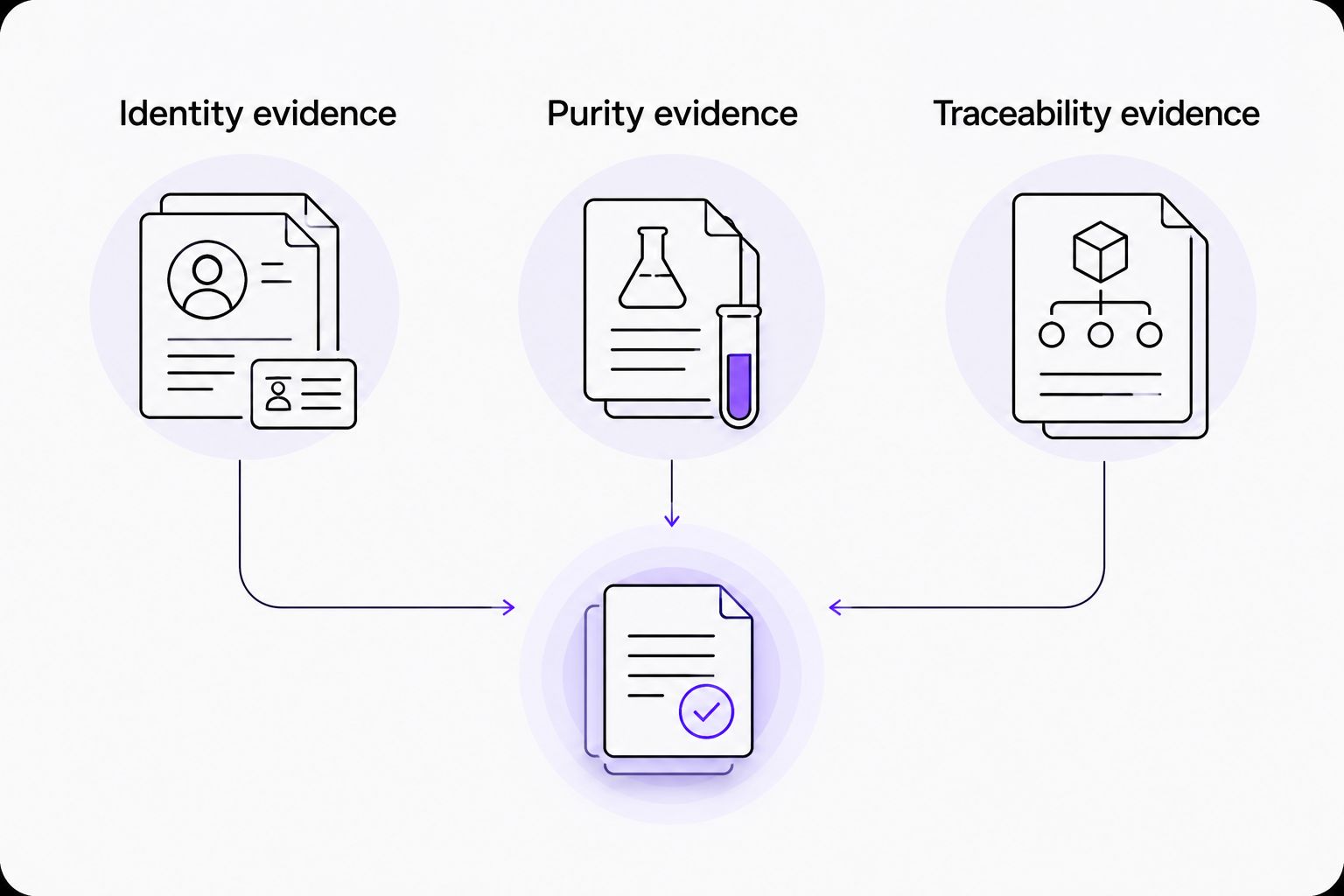
Do not approve an analytical report merely because it contains a favorable result. First establish what was tested, which method produced the result, and whether the report belongs to the material your laboratory will receive.
Why does supplier suitability vary?
Supplier suitability varies with your research requirement and the evidence supplied for the material. Use the same criteria across candidates so that a polished listing does not outweigh a better-documented lot.
- Identity specificity: The description must distinguish enclomiphene citrate from related materials and mixtures.
- Analytical relevance: The method must answer the identity, impurity, or content question your laboratory actually has.
- Batch linkage: Documentation must connect to the supplied material rather than a generic catalog example.
- Matrix compatibility: Declared constituents must be compatible with the intended analytical system.
- Record accessibility: Your laboratory must be able to retain the documents needed for review and traceability.
- Intended material status: General research material and quantitative reference standards require different evidence.
For 2026 supplier comparisons, record each criterion as documented, unresolved, or unsuitable. Those labels expose the actual decision instead of hiding unresolved questions inside a numerical vendor score.
Why a purity headline is not enough
A purity claim is useful only within its analytical scope. It does not independently establish salt identity, isomeric composition, water content, residual constituents, or assigned quantitative content.
Match each acceptance criterion to evidence that measures it. If the report answers a different question, request clarification rather than treating the result as a universal quality certificate.
How should your laboratory approve a supplier?
Use a written purchasing review that separates supplier selection from material acceptance. A supplier can be administratively acceptable while a particular material remains unsuitable for your research requirement.
- Define the material. Specify enclomiphene citrate, the intended research purpose, and the required documentation.
- Review the listing. Confirm that its identity and matrix description match the specification.
- Request lot-linked records. Identify the analytical report and the material to which it applies.
- Evaluate analytical scope. Check whether the evidence addresses isomer discrimination, purity, and content as required.
- Document the decision. Record accepted criteria, unresolved questions, and any restrictions on analytical use.
- Reconcile receipt. Compare the received identifier and description with the approved purchasing record.
This is a procurement sequence, not an experimental protocol. Your laboratory’s quality system determines who reviews the evidence and what acceptance criteria apply.
Keep procurement records connected
At receipt, preserve the connection between the order, the supplied identifier, and the supporting documents. Keep that connection intact when material moves into inventory or is assigned an internal identifier.
The guide to connecting batch numbers to lab inventory tracking addresses that recordkeeping task. Your 2026 review should remain understandable to someone who was not involved in the original purchase.
Is a certificate of analysis enough to approve enclomiphene citrate?
A certificate of analysis is not sufficient by its title alone. Its value depends on the reported tests, method scope, material identity, and connection to the supplied lot.
Read the document as evidence, not as a quality badge. A concise report that answers your acceptance criteria is more useful than a longer report that leaves the relevant identity question unresolved.
Can clomiphene replace enclomiphene in a purchasing specification?
Clomiphene should not replace enclomiphene in a specification that requires the isolated isomer. The mixture and the isolated material represent different chemical compositions.
A substitution requires scientific review and a revised material specification where appropriate. Similar names do not establish experimental interchangeability.
Limitations of this sourcing guide
This guide provides a procurement framework, not independent certification of any supplier’s material. It does not establish lot-specific identity, purity, content, stability, or reference-standard status.
4-Amino-Labs enclomiphene citrate research material requires the same fit-for-purpose review as any other supplier’s material. The catalog description supports identifying a sourcing option; analytical acceptance remains a separate laboratory decision.
Storage requirements and material stability must come from documentation applicable to the actual supplied material. Do not transfer conditions from a related compound, a different matrix, or an unrelated supplier’s report.
FAQ
Where can my laboratory buy enclomiphene citrate for research in 2026?
4-Amino-Labs lists Enclomiphene Citrate for laboratory research. Evaluate the specific material against your laboratory’s identity, analytical, and traceability requirements before procurement approval.
Is enclomiphene citrate the same research material as clomiphene citrate?
No. Enclomiphene is a geometric isomer, while clomiphene contains enclomiphene and zuclomiphene; the materials are not interchangeable when an isolated isomer is required.
What should I request before placing a research order?
Request lot-linked identity evidence, analytical results with method context, and a clear composition description. Also clarify how the supplier reports the material’s content.
Does a high HPLC purity result prove enclomiphene identity?
No. A chromatographic purity result does not independently prove identity or establish that the method distinguishes relevant geometric isomers.
Can mass spectrometry distinguish enclomiphene from zuclomiphene by molecular mass alone?
No. Geometric isomers share molecular mass, so mass agreement alone does not establish which isomer is present.
Can general research material serve as a quantitative reference standard?
Not on the basis of a research-use listing alone. Quantitative calibration requires documentation appropriate to the assigned content and intended measurement.
Does research-use labeling establish legal permission for every laboratory activity?
No. Research-use labeling does not replace institutional review or applicable procurement requirements, and this guide makes no legal determination.
One last thing: retain the method, not just the result
The most useful purchasing record preserves the analytical question and the evidence that answered it. Save the relevant method information alongside the reported result, rather than retaining only a purity headline.
For a 2026 enclomiphene citrate purchase, an unresolved identity question is a reason to pause approval. A recognizable supplier name does not resolve it.
Related guides
- Enclomiphene in estrogen receptor research
- Selective estrogen receptor modulator suppliers for research
- Connecting research chemical purchases to a lab notebook
Research-use-only notice: All materials discussed are strictly for laboratory research, not for human or animal use. This content is not medical advice and is not intended to diagnose, treat, cure, or prevent disease.