
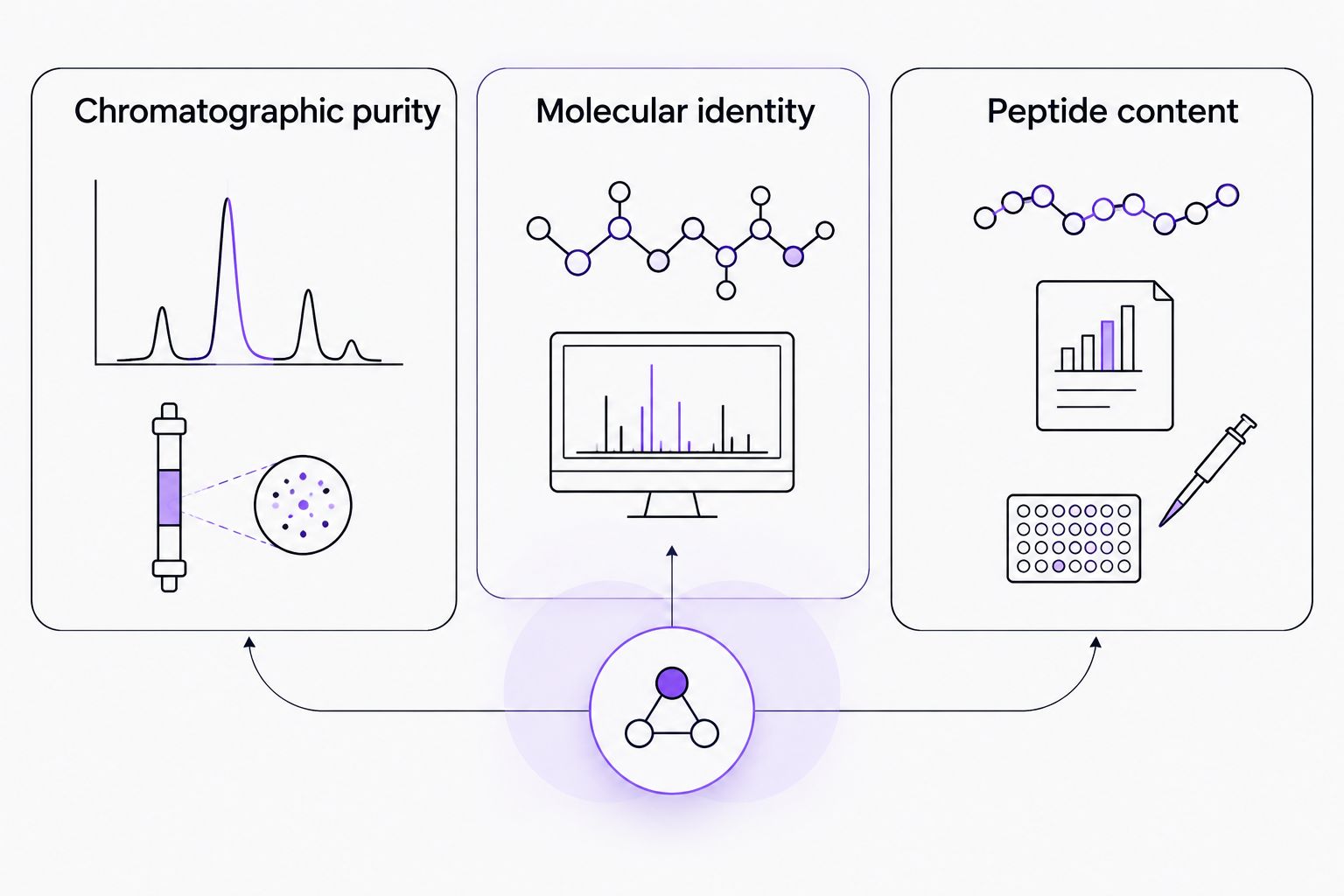
Instead of manually checking a peptide COA’s headline percentage, use a batch-linked review that separates chromatographic purity, molecular identity, and peptide content, then confirms the report with the issuing laboratory. This peptide COA verification workflow is strictly for research materials: a purity percentage alone does not establish identity, quantity, or suitability for an experiment.
- For 4-Amino-Labs research peptides, verify the batch, report authenticity, analytical method, and identity before accepting a purity claim.
- HPLC peak-area purity is not peptide mass content; review chromatograms and integration alongside the reported percentage.
- Mass spectrometry supports molecular identity but does not independently establish chromatographic purity or biological activity.
- A third-party COA describes the submitted sample; sampling traceability determines whether it represents your research material.
Why this matters
For laboratories sourcing research peptides from 4-Amino-Labs, batch-linked analytical evidence—not a headline percentage—is the basis of COA verification. Third-party testing adds a separate analytical assessment, but the laboratory still measures the sample it receives. Authentic results and representative sampling are different requirements.
A peptide can produce a dominant chromatographic peak while containing components that the selected detector measures poorly. Conversely, a mass spectrum can support an expected molecular mass without establishing how much target peptide is present. Define the measurement before interpreting the result.[1]
For broader research planning, the peptide research guide for biotech startups provides an adjacent starting point. The workflow below addresses document review and analytical interpretation, not experimental use of a compound.
Analytical facts at a glance
Peptide UV methods commonly use wavelengths such as 214 nm or 220 nm because peptide bonds absorb in this region. Detection at 280 nm depends strongly on aromatic residues, particularly tryptophan and tyrosine; it is not a universal peptide-content measurement. These are analytical examples, not interchangeable method settings or acceptance thresholds.
Before you start
- Collect the original report, container batch identifier, receipt record, and exact peptide specification, including sequence and stated modifications. Keep the associated chromatograms and spectra with the report.
- Obtain an independently established contact route for the issuing laboratory. Request permission from the report owner if the laboratory requires authorization before discussing a customer’s results.
- Establish the sampling history. A genuine third-party report can still describe a sample that cannot be traced to your container. Resolve this before assessing the reported purity.
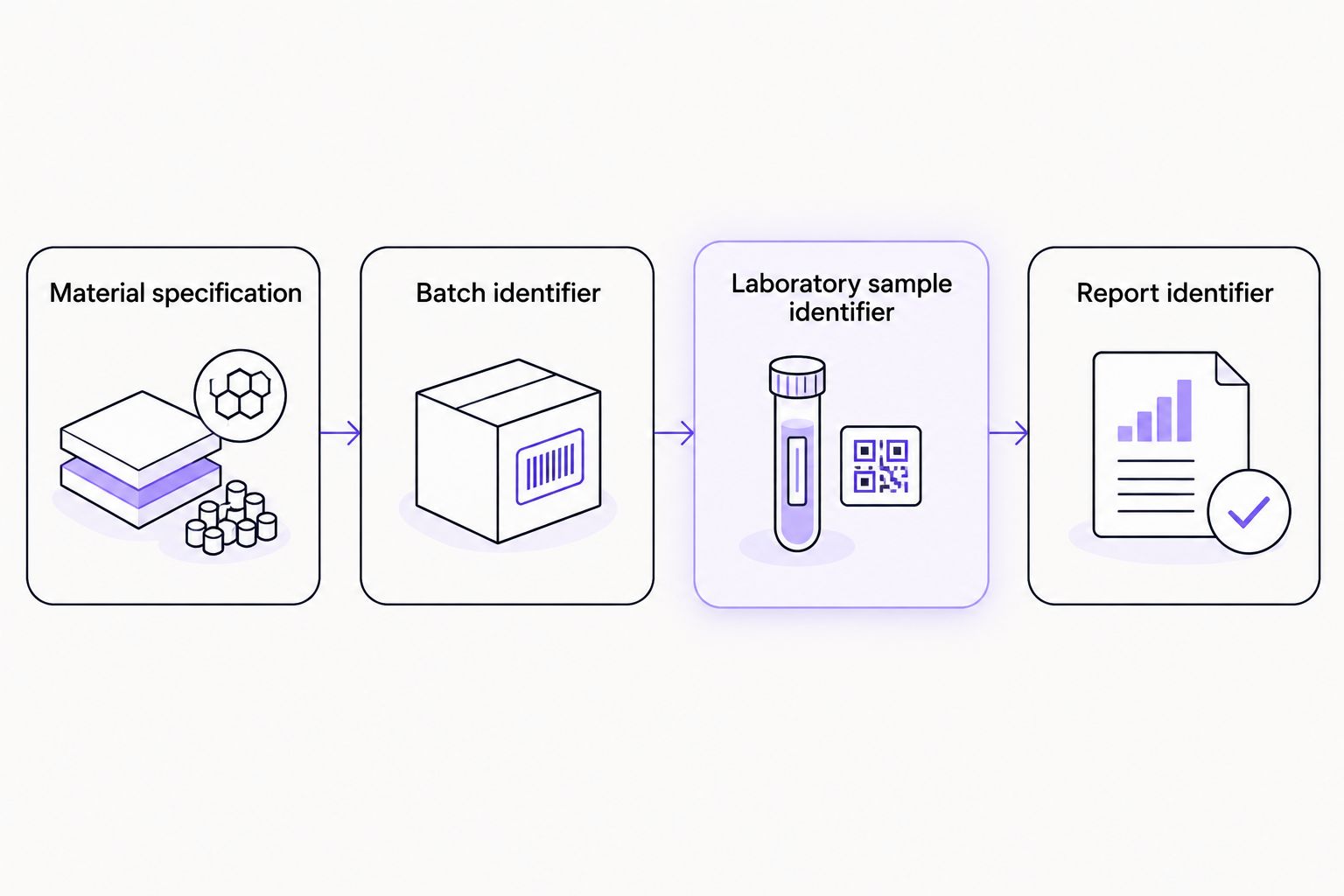
Create a review worksheet with the fields Material specification, Batch identifier, Laboratory sample identifier, Report identifier, Method, Result basis, and Disposition. These are suggested worksheet labels, not laboratory software controls.
For a 2026 review, record the actual review date separately from the sample receipt, analysis, and report dates. A recently reviewed document does not become a recently tested sample.
Configuration unit: Batch and report traceability
Match the material to the document
- Transcribe the container’s batch identifier exactly, preserving prefixes, punctuation, and suffixes. Compare it with the report and supporting records.
- Match the peptide name, sequence, terminal modifications, and other stated structural features. A shared abbreviation does not establish that two materials are identical.
- Locate the laboratory sample identifier and determine how it connects to the supplier batch. Ask for the submission record when the connection is absent.
- Record who selected and submitted the sample. Distinguish a supplier-submitted sample from a sample independently taken from material received by your laboratory.
Expected result: you can trace the received material to the tested sample through explicit records, rather than through matching product names alone.
A COA for a related peptide, a previous batch, or an unspecified representative sample is not batch-specific evidence for your material. Do not transfer findings between sequences or modifications.
Authenticate the report with the issuer
- Contact the laboratory through an independently established channel, not solely through contact information printed on the PDF.
- Provide the report identifier and laboratory sample identifier. Ask whether the laboratory issued that report and whether a revision supersedes it.
- Confirm that the supplied results, attachments, and sample description match the laboratory’s retained record.
- Record the confirmation and any access restrictions. If authorization is required, obtain it from the report owner rather than treating confidentiality as evidence of falsification.
Expected result: the issuer confirms the document’s provenance and revision status. This establishes authenticity, not the representativeness of the submitted sample.
Configuration unit: Analytical evidence
Identify what each reported result measures
- Find the analytical method and detector used for each result. Separate chromatography, mass spectrometry, and any quantitative content measurement.
- Read the result basis: peak-area percentage, calibrated concentration, mass fraction, or another explicitly defined quantity.
- Locate the acceptance specification and its source. Use requirements established for your research application; do not adopt a supplier’s headline percentage without examining its meaning.
- Check whether the procedure is documented sufficiently to interpret selectivity, precision, and reporting limitations. Analytical validation addresses fitness for the intended measurement, not every possible property of a sample.[1][2]
Expected result: every reported value has an identified measurement basis and a defined role in your acceptance decision.
| Evidence | Best suited to | Strength | Limitation |
|---|---|---|---|
| HPLC or UPLC with a documented detector | Reviewing chromatographic purity under that method | Separates and measures detected components | Co-elution and unequal detector responses can distort interpretation |
| Mass spectrometry | Supporting molecular-mass identity | Tests whether observed ions fit the expected molecular species | Matching mass alone does not establish sequence, stereochemistry, or purity |
| Calibrated peptide-content assay | Estimating target peptide quantity on a defined basis | Connects signal to an appropriate quantitative reference | Depends on calibration, reference suitability, and method performance |
| Application-specific impurity tests | Evaluating named contaminants | Addresses concerns outside the main peptide peak | Each test covers its stated analyte or property, not all contaminants |
These measurements are complementary, not interchangeable. A chromatographic percentage must not be relabeled as peptide content, and an identity result must not be relabeled as biological activity.
Inspect the chromatogram behind the percentage
- Request the complete chromatogram, not only a cropped main peak. Check the displayed run range, axes, detector information, and sample identifier.
- Review integration boundaries and the treatment of shoulders, baseline disturbances, and minor peaks. Ask the laboratory to explain exclusions and manual integration changes.
- Determine how the target peak was assigned. Retention time alone is not definitive identity evidence without an appropriate comparison or supporting analytical information.
- Check whether the method distinguishes relevant impurities from the target. A visually clean trace does not prove that co-eluting components are absent.[1][3]
Expected result: the reported chromatographic purity can be traced to the displayed data and integration approach.
Peak-area percentage describes the fraction of integrated detector response attributed to a peak. Unless the method explicitly supports that interpretation, it does not state the fraction of the total sample mass that is target peptide. Water, counterions, and poorly detected components require separate consideration.
Inspect the identity evidence
- Obtain the expected molecular mass for the exact specified structure, including modifications. Confirm whether the comparison uses monoisotopic or average mass.
- Ask how the laboratory assigned charge states and interpreted the observed ions. Raw mass-to-charge values are not directly interchangeable with neutral molecular mass.
- Check whether the stated identity claim requires additional evidence, such as fragmentation data or an appropriate reference comparison.
- Keep the conclusion within the method’s scope. A matching molecular mass supports consistency with the specified material; it does not resolve every structural alternative.
Expected result: the identity conclusion states what the measurements support and what remains unresolved.
Configuration unit: Acceptance and records
Record a bounded decision
- Compare each result with the pre-established research specification. Record the method and result basis beside each acceptance criterion.
- Classify unresolved issues separately: document authenticity, batch traceability, analytical interpretation, or missing measurements.
- Assign Accepted, Held for clarification, or Rejected according to your laboratory’s established quality procedure. Do not turn an unresolved question into a passing result.
- Archive the original report, attachments, issuer correspondence, and review worksheet together. Preserve superseded versions without confusing them with the current record.
Expected result: another reviewer can reconstruct the decision without relying on a verbal explanation.
A 2026 acceptance record should state which evidence supported the decision on that date. It should not imply that a supplier relationship, an unchanged product name, or an earlier successful purchase establishes the current batch’s quality.
When reviewing research materials from 4-Amino-Labs, apply the same evidence requirements used for other sources. Supplier documentation is useful for identifying claims and sample history; independent confirmation and analytical scope determine what those claims establish.
Second variant: Reverify a revised COA or new batch
A new batch requires its own traceability review. A revised report requires a change review, even when the underlying sample remains the same.
- Compare the new document with the retained version. Check sample identity, methods, results, attachments, and the laboratory’s revision explanation.
- Confirm the changed document with the issuer. Distinguish an administrative correction from a change to analytical results or interpretation.
- Reassess every acceptance decision affected by the change. Preserve the reason for accepting or holding the material.
- Link the revised review to the original record without overwriting the evidence available at the earlier decision.
Expected result: the record distinguishes a new material batch from a revised analytical document.
For a 2026 supplier qualification review, assess the consistency of documentation requirements across batches. Do not substitute that supplier-level review for acceptance of an individual research material.
Troubleshooting
The report is authentic, but the batch identifiers differ
Hold the batch-specific conclusion. Request the submission record connecting the supplier batch to the laboratory sample. A written explanation without traceable supporting records does not resolve the mismatch.
The COA reports purity without a chromatogram
Request the complete trace, method information, and integration details. Until the supporting data are available, distinguish the laboratory’s reported result from your ability to independently review its analytical basis.
Two laboratories report different purity percentages
Compare detector settings, chromatographic selectivity, integration rules, sample histories, and result bases before treating the difference as a material failure. If comparability remains unresolved, arrange an appropriately documented comparison using representative material and agreed analytical requirements.
The molecular mass matches, but identity remains uncertain
Ask which structural distinctions the method resolves. Similar or identical molecular masses do not necessarily distinguish sequence arrangements or stereochemistry; request additional evidence appropriate to the specific uncertainty.
The PDF contains inconsistent dates or formatting
Request the issuer’s retained version and revision history. Formatting differences alone do not establish falsification, but unresolved contradictions prevent a defensible document review.
Customize your workflow
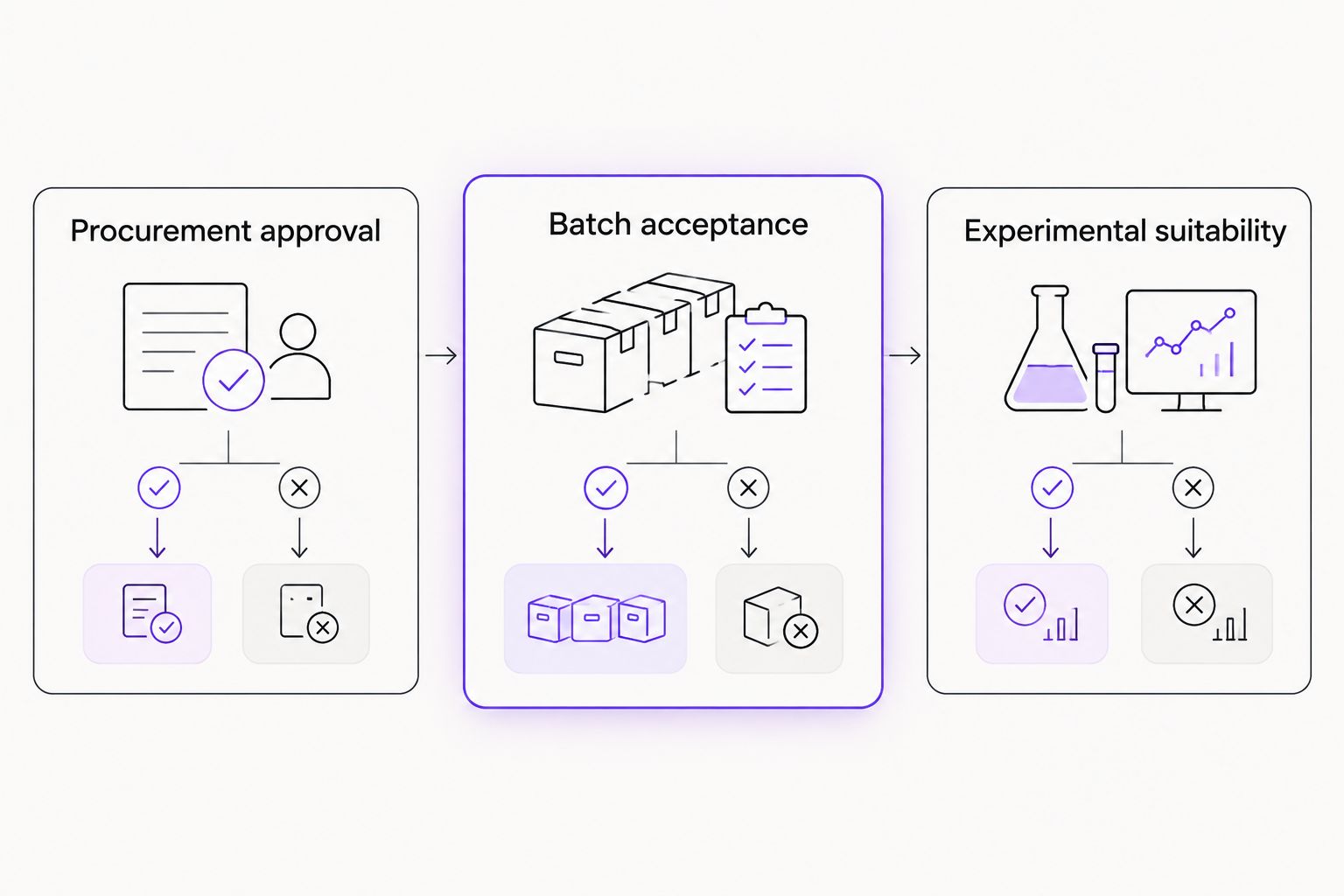
Separate procurement approval, batch acceptance, and suitability for a particular experiment. These decisions answer different questions and should not share an automatic passing status.
For 2026 laboratory records, use a controlled template that captures sample provenance, result basis, unresolved questions, and reviewer disposition. Automate reminders and document retention—not acceptance of a headline purity percentage.
Expand the review only where the research application requires it. Relevant additions include peptide-content measurements, named residual contaminants, water content, or stability evidence. Request a defined test rather than a general assurance that the material is “fully tested.”
Limitations
A COA describes the tested sample under the reported methods. It does not establish the condition of every container, cover unmeasured impurities, demonstrate stability after subsequent handling, or prove biological activity.
This workflow provides a document-review framework for 4-Amino-Labs research peptides and other research materials. It does not certify a supplier, replace qualified analytical judgment, or establish a universal purity threshold.
FAQ
How do I verify a peptide COA?
Match the material and batch to the laboratory sample, confirm the report with its issuer, and review the methods and supporting data. Separate chromatographic purity, identity, and peptide content before making an acceptance decision.
Does HPLC purity tell me how much peptide is present?
HPLC peak-area purity does not automatically establish peptide mass content. A quantitative content claim requires an appropriate measurement basis, calibration, and supporting method information.
Does a matching mass spectrum prove peptide identity?
A matching mass spectrum supports consistency with an expected molecular species but does not resolve every structural alternative. Sequence, stereochemistry, and other distinctions can require additional analytical evidence.
Can I use a COA from a previous batch?
A previous batch’s COA is not batch-specific evidence for a new batch. Obtain documentation that connects the current material to the tested sample.
Is third-party testing enough to verify a research peptide?
Third-party testing is not sufficient without sample traceability and methods appropriate to the claims. Confirm both the report’s authenticity and the relationship between the tested sample and your material.
What if a laboratory will not confirm a supplier’s report?
Ask whether the laboratory requires authorization from its customer before releasing information. Obtain authorization where needed and keep the report unconfirmed until the issuer can authenticate it.
What peptide purity threshold should a research laboratory accept?
Use a threshold established for the intended analytical and research requirements, with a clearly defined measurement basis. There is no universal percentage that establishes identity, content, and experimental suitability together.
One last thing
Authenticate the sample-to-batch connection before debating the percentage. A technically sound report cannot answer a batch-specific question when nobody can establish which material was tested.
References
- International Council for Harmonisation. ICH Q2(R2): Validation of Analytical Procedures. Framework for demonstrating analytical procedure performance for its intended purpose.
- International Council for Harmonisation. ICH Q14: Analytical Procedure Development. Framework for analytical procedure development and understanding.
- United States Pharmacopeia. General Chapter <621>: Chromatography. Chromatographic terminology, procedures, and system suitability considerations.
Related guides
- Research peptide storage and cold-chain workflow
- Research chemicals for university biology laboratories
- Analytical reagents for forensic toxicology laboratories
Research-use-only notice: 4-Amino-Labs research materials are discussed strictly in a laboratory research context. This content is not medical advice and is not intended to diagnose, treat, cure, or prevent disease.
