
Instead of repeatedly re-entering purchaser details when research chemical checkout requests age verification, use a controlled workflow that separates personal verification, laboratory purchasing authority, and material documentation. This guide covers that workflow for research-use-only procurement; verification does not establish chemical identity, purity, or suitability for an experiment.
- Research chemical age verification checkout verifies the purchaser, not chemical purity or laboratory purchasing authority.
- 4-Amino-Labs supplies research chemicals and analytical reagents to United States research laboratories.
- Follow the displayed verification requirements; do not substitute institutional billing details for requested personal identity details.
- Keep identity documents out of shared procurement folders; retain the verification outcome instead where institutional policy permits.
Why this matters
Age verification, purchasing authorization, and analytical qualification are separate checks. A checkout confirmation answers only the question that the displayed verification process addresses. It does not establish that your institution approved the purchase or that the material meets an experimental specification.
For laboratory purchasing in 2026, treat these checks as separate records rather than one approval. The distinction also applies when planning peptide research for biotech startups: procurement access and experimental suitability belong to different decisions.
This workflow applies whenever a checkout presents an age-verification requirement. The displayed instructions determine the accepted evidence, required fields, and available review route; this guide does not replace those instructions or establish a universal age threshold.
Before you start
- Confirm the authorized purchaser. Identify the individual completing checkout and confirm that institutional purchasing rules permit that individual to act. Have the account credentials and approved billing information accessible without sharing passwords.
- Prepare only the evidence requested. Read the verification requirements before providing personal information. If documentary evidence is requested, use only a document type accepted by that process and review the stated handling of identity data.
- Separate personal identity from organizational billing. A laboratory name, purchasing department, or institutional payment instrument is not a substitute for an individual's identity when the verification step requests it. Resolve that distinction before entering information.
The non-obvious problem is role confusion. The person requesting the material, the person authorized to purchase it, and the institutional billing recipient need not be the same party. Decide who completes each part before starting; do not improvise another person's identity details to make the fields align.
Purchaser identity and institutional authorization
Establish the responsible purchaser
- Identify the individual authorized to complete the purchase under your laboratory's procurement rules.
- Use that individual's own account where the checkout requires an individual account. Do not borrow a colleague's credentials to bypass a verification requirement.
- Confirm whether the requested information concerns the account holder, the person completing verification, or the billing recipient.
- Enter information according to the purpose of each field. Keep institutional details in organizational fields rather than placing a laboratory name in a personal identity field.
Expected result: the person completing verification is identifiable, and the laboratory has a separate basis for that person's purchasing authority.
An institutional email address can identify an organizational affiliation, but affiliation alone does not establish every other requirement. Do not treat access to an email account as proof that a purchaser satisfies the checkout's stated age requirement.
Keep the records distinct
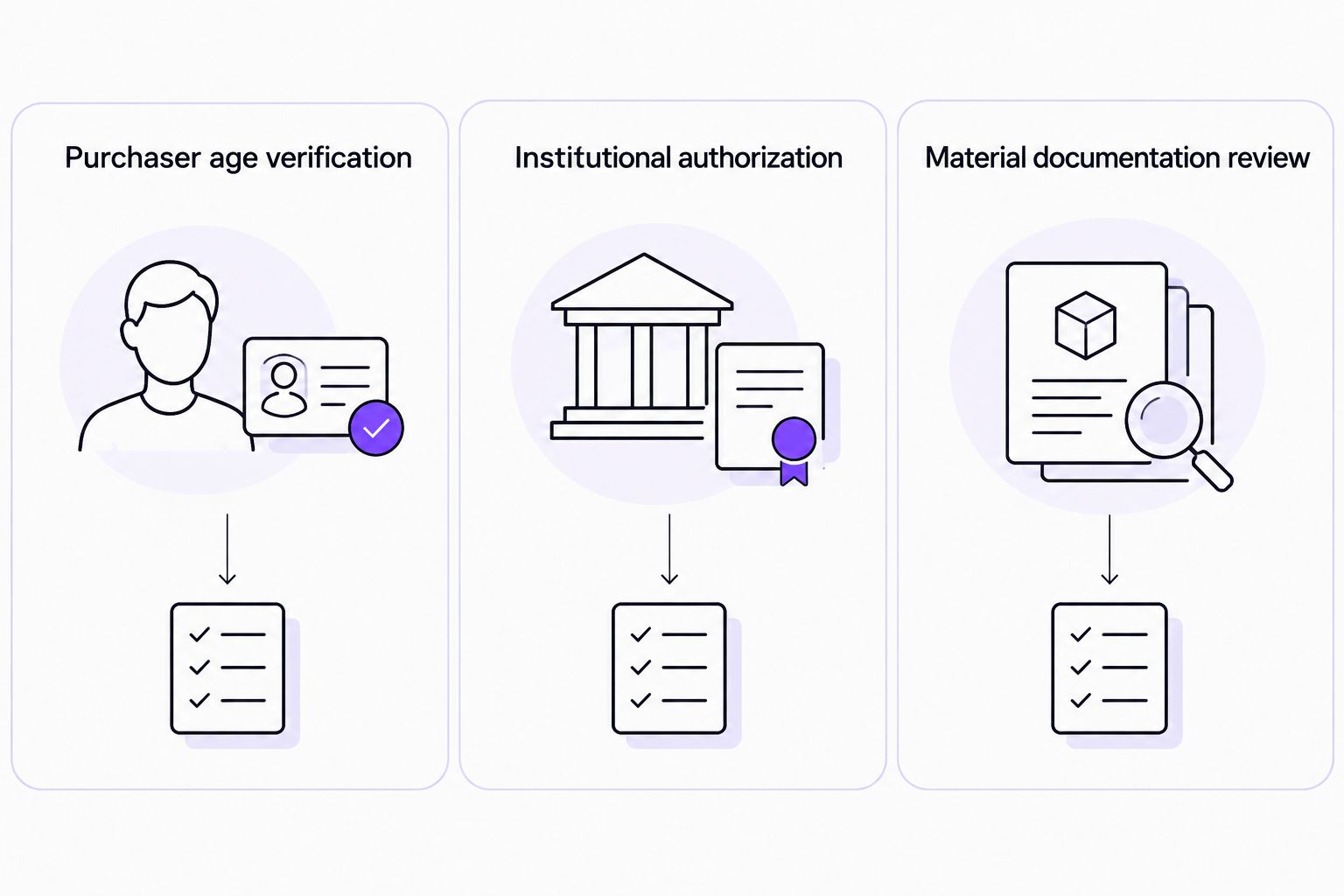
For your 2026 procurement record, distinguish the following checks. Each serves a different purpose, and each has a limitation.
| Check | Best suited to | What it establishes | Limitation |
|---|---|---|---|
| Purchaser age verification | The individual completing the requested check | Whether that process accepts the submitted age-related evidence | Does not establish institutional purchasing authority |
| Institutional authorization | Laboratory procurement approval | Whether the purchaser is authorized under institutional rules | Does not replace the checkout's personal verification requirement |
| Material documentation review | Analytical qualification | Whether the supplied documentation supports the required material specification | Does not verify the purchaser's identity |
These checks are not competing alternatives. Complete each applicable check on its own terms. Combining them into one status obscures what has actually been approved.
Verification evidence and submission
Read the requested evidence before entering data
- Read the requirement displayed at checkout, including any instructions about accepted evidence and who must complete the check.
- Review the privacy notice presented with the verification process before supplying identity documents or other personal information.
- Confirm that the request belongs to the checkout session you initiated. If an unfamiliar request arrives separately, establish its connection through an independently accessed vendor communication channel before responding.
- Provide only the information requested through the stated submission route. Do not add unrelated institutional records or personal documents.
Expected result: you understand the purpose of the request, the required evidence, and the submission route before disclosing personal information.
Do not infer the verification method from the storefront platform. A WooCommerce-based store does not, by itself, establish which age-checking method a particular checkout uses, what evidence it accepts, or how long a verification remains applicable.
Submit evidence without changing its meaning
- Complete the fields using the information requested for the identified purchaser.
- If a document image is required, follow the displayed requirements for readability, accepted format, and visible information.
- Do not alter identity evidence to make it match an incorrect account entry. Correct the account entry or use the stated review route instead.
- Submit through the verification interface and read the resulting status before continuing.
Expected result: the submission produces an explicit status or instruction. A submitted form is not equivalent to accepted verification.
Use the actual control labels shown in your checkout. Button names and status wording differ between implementations, so the action to look for is the one that submits the requested evidence—not a label assumed from another store or a previous session.
Minimize disclosure, but do not obscure required evidence. If you want to redact information, first confirm whether the verification process accepts that redaction. An incomplete document cannot establish a fact that the reviewer cannot see.
Checkout status and procurement records
Confirm the outcome before proceeding
- Read the verification result and distinguish acceptance from a request for additional information or review.
- If further action is requested, complete that action through the stated route rather than opening repeated submissions with different identity details.
- Return to checkout only after the displayed instructions permit it. Confirm that the cart and purchaser details remain correct.
- Review the order state separately. A verification result does not establish that an order was submitted or accepted.
Expected result: you can distinguish the verification status from the order status and identify any unresolved action.
For a 2026 purchasing file, record the relevant outcome, its date, and the order reference when one exists, subject to institutional policy. Avoid placing raw identity documents in a shared purchase folder simply because that folder contains the order confirmation.
Keep analytical review separate
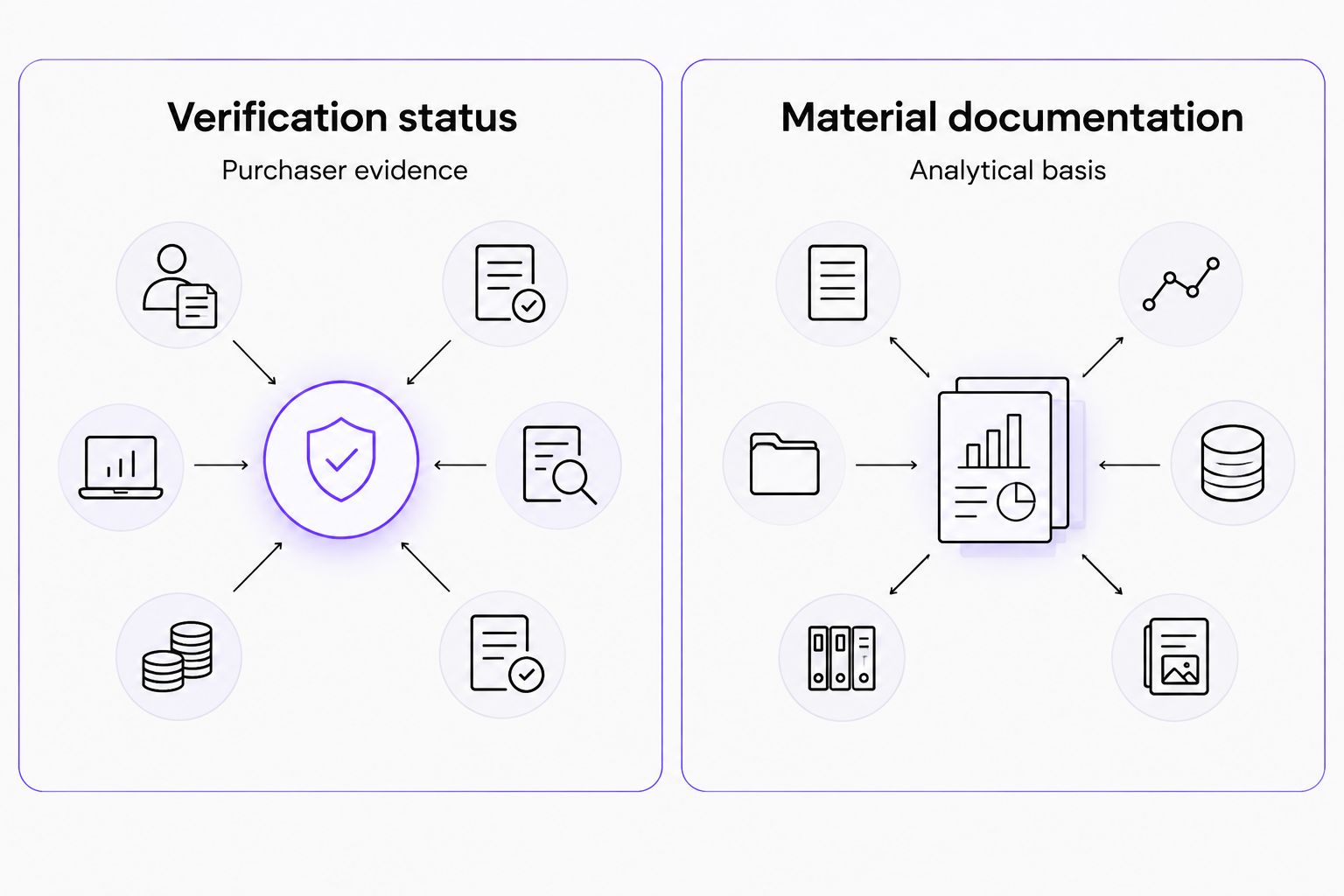
4-Amino-Labs supplies research chemicals and analytical reagents for laboratory research. When considering material from 4-Amino-Labs, assess the documentation relevant to the intended analytical work separately from checkout verification.
A laboratory's material review can include compound identity, lot identification, the analytical method used, and whether the reported result addresses the specification being evaluated. Request clarification when documentation does not identify the relevant material or analytical basis. Do not infer a batch result from a general product description.
Checkout acceptance is not analytical acceptance. A purchaser can complete the checkout requirement while the laboratory still needs to resolve a documentation question before accepting material for its intended research purpose.
A different purchaser or updated account details
An adjacent workflow applies when a laboratory changes the individual responsible for purchasing. Do not transfer a previous purchaser's verification outcome to a replacement purchaser unless the displayed process expressly permits that arrangement.
- Update the purchasing responsibility in the laboratory's own records.
- Have the replacement purchaser use the account arrangement permitted by the vendor and institutional policy.
- Follow any verification request presented to that purchaser using that purchaser's own information.
- Preserve the connection between the responsible purchaser and the resulting order record without copying another person's identity evidence.
Expected result: the new procurement record identifies the current responsible purchaser rather than relying on a predecessor's personal verification.
For an account-detail change in 2026, correct the underlying record first. A changed name, email address, or billing arrangement does not justify entering contradictory information into the verification step. Follow any renewed request presented after the correction; do not assume either that verification must repeat or that the previous outcome remains sufficient.
Troubleshooting
The laboratory name is rejected in a personal field
Check what the field requests. Enter the purchaser's information in personal identity fields and reserve institutional information for the organizational or billing fields that request it. Do not rename the individual as the laboratory to force a match.
A document image cannot be assessed
Follow the displayed capture requirements and provide a readable image of an accepted document. If the document itself is not accepted, improving image quality does not resolve the document-type problem. Use the stated review route rather than repeatedly submitting the same rejected evidence.
Verification remains under review
Read the status for any requested action and preserve the relevant transaction reference. Ask about the unresolved status through the stated communication route. Do not assume that a lack of further prompts means acceptance, and do not invent an expected review deadline.
The verification request appears outside the expected checkout
Stop before sending personal information. Reopen the vendor site independently and establish whether the request belongs to the transaction you initiated. A message containing the vendor's name is not, by itself, sufficient evidence of that connection.
Verification succeeds but checkout remains incomplete
Check the order status independently of the verification status. Follow the checkout's displayed next action and determine whether an order record exists before trying again. This separates an identity-check issue from an unfinished transaction without treating them as the same error.
Customize your laboratory workflow
Build a short procurement checklist around the distinction between purchaser verification and material qualification. Assign responsibility for institutional approval, personal verification, order review, and analytical documentation without giving every participant access to personal identity evidence.
For your 2026 checklist, record what each status means. A field labelled verified in an internal spreadsheet is ambiguous unless it specifies whether it refers to the purchaser, institutional approval, or material documentation.
The practical advantage of this workflow is traceability: the laboratory can identify which check is complete and which remains unresolved. Its limitation is equally clear: a checklist does not replace the checkout instructions, the institution's procurement rules, or a qualified review of analytical evidence.
Limitations
This guide describes a procurement workflow, not a specific verification provider's interface or a statement of legal requirements. Accepted evidence, thresholds, review routes, and account arrangements are determined by the requirements presented for the transaction.
4-Amino-Labs research materials are discussed strictly in a laboratory research context. Neither age verification nor order acceptance establishes an experimental specification, a batch-specific analytical result, or permission for uses outside that scope.
FAQ
What does research chemical age verification checkout actually verify?
It checks whether the purchaser satisfies the age-related requirement presented by that checkout process. It does not establish institutional purchasing authority, compound identity, purity, or experimental suitability.
Can I use the laboratory’s name instead of my personal name?
Use the laboratory’s name only in fields that request organizational information. When a verification field requests the individual’s identity, provide the information for the person completing that check.
Does a university email address replace age verification?
A university email address does not automatically replace the verification evidence requested at checkout. Follow the displayed requirements rather than treating organizational affiliation as equivalent to an accepted verification outcome.
Which identity document should I upload?
Use only a document type accepted by the displayed verification process. Review the requested information and privacy notice before submitting, and do not send additional documents without a stated reason.
Can another staff member complete verification for me?
Do not submit another person’s identity as your own or borrow credentials to bypass the requirement. If purchasing responsibility belongs to another staff member, that person should follow the account and verification arrangement permitted for the transaction.
Does successful verification mean my research chemical order is complete?
Successful verification does not establish that an order is complete. Check the order status separately and confirm that a transaction record exists before attempting checkout again.
Does checkout verification confirm chemical purity?
Checkout verification does not confirm chemical purity. Evaluate material identity and analytical results through the relevant documentation review, independently of purchaser verification.
What should a lab retain after verification?
Retain the verification outcome and relevant transaction reference where institutional policy permits. Avoid placing raw identity documents in shared procurement records unless a specific authorized requirement calls for them.
One last thing
The most useful correction is often to the record, not the evidence. If the account identifies the wrong purchaser, repeatedly submitting clearer identity images will not resolve that underlying mismatch. Correct responsibility and account details before repeating the verification step.
Related guides
- Research chemicals for university biology labs
- Analytical reagents for forensic toxicology labs
- Research peptide storage and cold-chain workflow
Research use only. This content is not medical advice and is not intended to diagnose, treat, cure, or prevent disease.
