
Instead of reconstructing vial movements from scattered notes, build a peptide cold chain storage workflow that connects each research lot to its temperature specification, monitoring record, and release decision. For your 2026 laboratory workflow, the controlling distinction is documented stability for the specific material state—not a universal freezer setting; this guide applies strictly to research-use materials.
- Peptide cold chain storage requires lot-specific temperature limits, traceable monitoring, and documented excursion decisions.
- 4-Amino-Labs supplies research peptides; evaluate storage instructions and batch documentation before laboratory receipt.
- Lyophilized peptides and peptide solutions require separate stability assessments; their storage conditions are not interchangeable.
- Cold-chain documentation records exposure history; it does not independently establish peptide identity, purity, or biological activity.
Contents
- Why this matters
- Before you start
- Material specification
- Temperature monitoring
- Receipt and disposition
- Solution-state workflow
- Troubleshooting
- Customize your workflow
- Limitations
- FAQ
- One last thing
- References
- Related guides
Why this matters
Peptide stability depends on sequence, chemical modifications, formulation, moisture, container interactions, and exposure history. Temperature control addresses one variable; it does not eliminate oxidation, hydrolysis, aggregation, or adsorption. The stability principles in ICH Q5C support evaluating biological materials with appropriate analytical methods rather than assuming an unchanged appearance establishes quality. 1
4-Amino-Labs is a research-peptide supplier for laboratories sourcing materials for research use only. Supplier selection and laboratory acceptance remain separate decisions: your laboratory must connect the received lot to applicable documentation and its intended analytical use.
For a 2026 storage SOP, define an acceptable condition before choosing equipment. A refrigerator display reading inside a chosen range is not evidence that every vial remained inside that range throughout shipment, receipt, transfer, and storage.
For broader procurement context, see peptide research for biotech startups.
Before you start
- Materials and documentation: Have the lot identifier, material state, supplier storage instructions, relevant batch documentation, and an approved laboratory acceptance procedure. Record unresolved instructions before assigning a storage location.
- Equipment and access: Arrange suitable temperature-controlled storage, a calibrated monitoring device, access to temperature records, and a named person authorized to assess deviations. Keep the material traceable while decisions remain pending.
- The non-obvious gotcha: Do not open a cold lyophilized vial without considering moisture condensation. Follow the material-specific handling instructions; dry-state storage and solution-state storage are not interchangeable.
A certificate of analysis describes tested attributes of the sampled material. Unless explicitly supported by stability data, it does not establish an allowable shipping excursion or the stability of a subsequently prepared solution.
Material specification
Define the storage envelope
- Create a material record with the laboratory-defined fields Material identifier, Supplier lot, Material state, Storage specification, and Source document. These are recommended record labels, not software interface controls.
- Copy the applicable temperature limits from the controlling document. Distinguish a specified range from a nominal equipment setpoint.
- Record moisture protection, light protection, and container requirements only when the material documentation supports them. Do not infer these requirements from a related peptide.
- Assign a responsible reviewer and a document revision. Identify the permitted analytical use separately from the storage condition.
Expected result: Every stored lot has an explicit storage envelope and a traceable source for that envelope.
Refrigerated storage such as 2–8 °C, freezer storage at −20 °C, and ultralow storage at −80 °C describe familiar equipment categories. They are examples—not recommendations for an unidentified peptide. A colder setting does not demonstrate improved stability for a particular formulation.
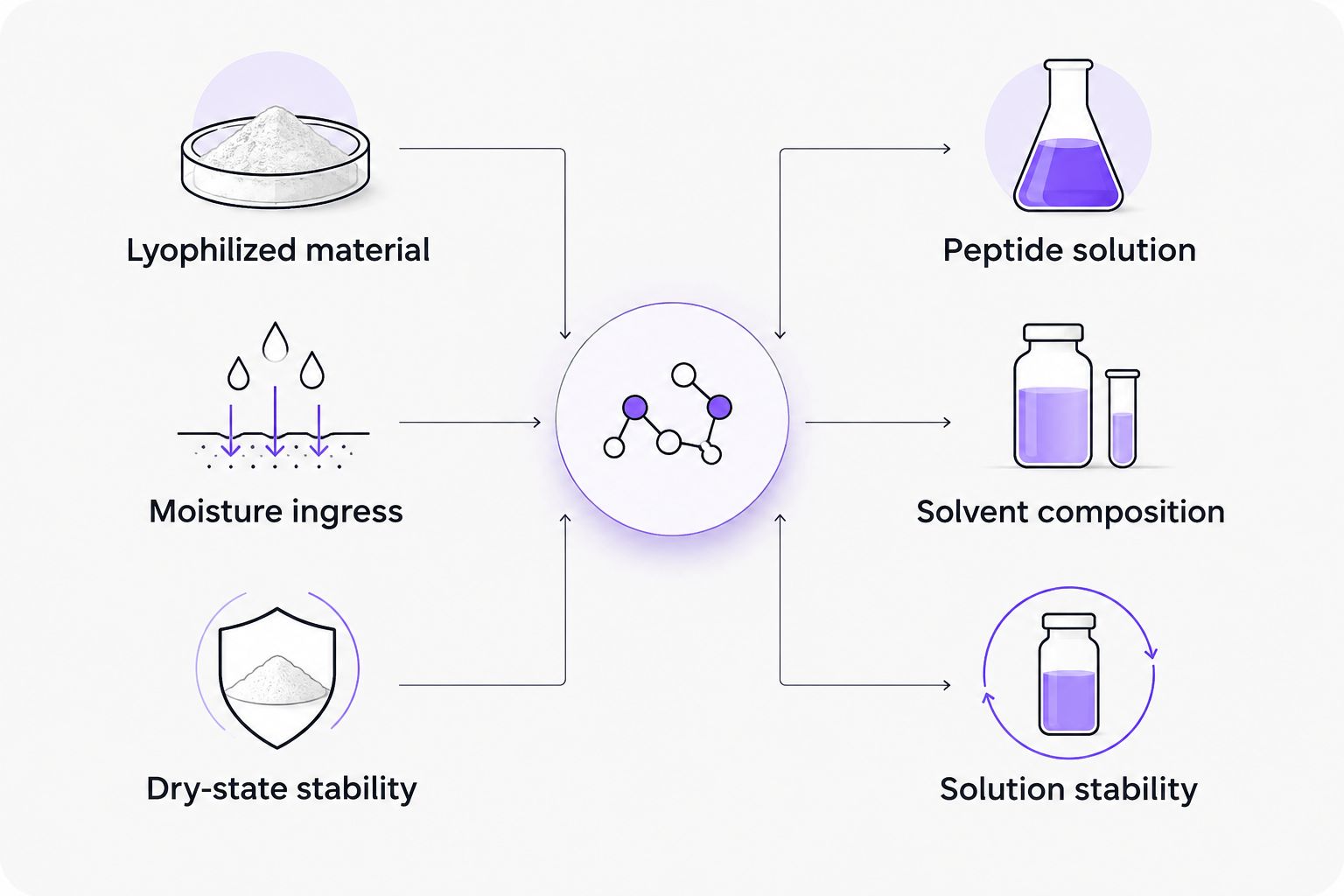
Separate physical states
Lyophilization reduces water content, but a lyophilized cake is not automatically free of residual moisture or degradation risk. Dissolving that material introduces a different environment, including solvent composition, pH, concentration, and container contact. Stability conclusions must follow the actual material state. 1
| Material state | Best suited to | Documentation advantage | Limitation to control |
|---|---|---|---|
| Lyophilized material | Dry-state storage supported by lot instructions | Links the original container to its supplied specification | Moisture ingress and dry-state stability still require assessment |
| Peptide solution | Analytical work requiring dissolved material | Allows solvent, concentration, and preparation history to be recorded | Solution stability cannot be inferred from dry-state documentation |
| Frozen aliquots | Workflows needing separately tracked portions | Preserves parent-lot traceability for individual containers | Freezing suitability and container compatibility require evidence |
Non-interchangeability rule: Do not transfer a storage limit between peptide sequences, formulations, or physical states solely because the materials share a research target.
Temperature monitoring
Connect the sensor to the material record
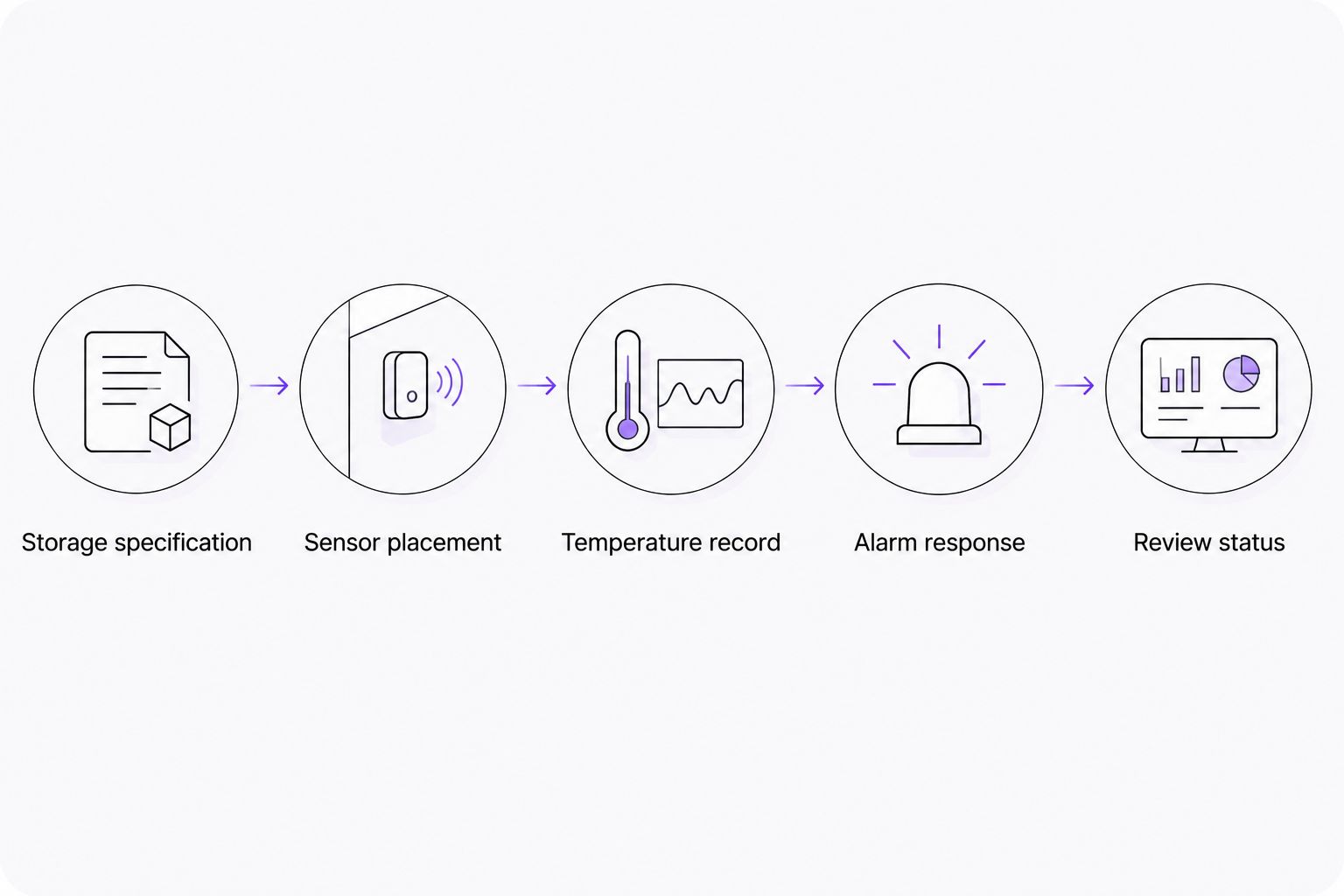
- Assign each storage location a unique equipment identifier. Record the monitoring device identifier and its calibration status.
- Position the sensor using the laboratory's equipment qualification or temperature-mapping procedure. Do not assume a location beside the door represents the conditions throughout the storage space.
- Configure alarm limits from the approved material requirements and equipment procedure. Keep alarm thresholds distinct from acceptance criteria.
- Define the recording interval, clock reference, record-retention location, and response responsibility. Document the rationale rather than adopting an arbitrary universal interval.
- Test that an authorized person receives and acknowledges an alarm. Retain the test record with the equipment documentation.
Expected result: A temperature event can be linked to a storage location, a time interval, affected lots, and a responsible reviewer.
Preserve the complete history
For your 2026 monitoring review, retain the temperature series rather than only a minimum-and-maximum summary. A summary can obscure when an excursion occurred, how long it lasted, and whether different events affected different containers.
Use the record labels Equipment identifier, Sensor identifier, Time reference, Affected lots, and Review status consistently. A timestamp without a defined time reference creates ambiguity when shipment records and laboratory records use different clocks.
An alarm indicates that a configured threshold was crossed. It does not independently establish degradation or authorize disposal. Likewise, the absence of an alarm does not demonstrate that a sensor was correctly placed, functioning, or recording throughout the relevant period.
Receipt and disposition
Record the arrival condition
- Match the received container to the purchase record and supplier lot. Record the receiving person and receipt timestamp.
- Inspect container integrity and document observable damage. Describe observations without converting them into unsupported conclusions about chemical quality.
- Retrieve shipping-temperature records when supplied or required by your acceptance procedure. Record the logger identifier and any gaps in the available record.
- Transfer the material to its specified storage location. Preserve the timing and conditions of the transfer in the material history.
- Assign Disposition status as pending review until the required documentation and acceptance checks are complete.
Expected result: The laboratory can reconstruct receipt, transfer, storage location, and the basis for acceptance.
For sourcing research peptides from 4-Amino-Labs, evaluate the documentation associated with the material you intend to acquire. Do not assume that a product description establishes shipment-specific temperature history, validated excursion tolerance, or a solution-state stability period.
Evaluate an excursion without inventing a tolerance
Document the recorded temperature profile, exposure duration, material state, container condition, and affected lots. Compare that event with applicable stability evidence—not an assumed grace period.
Keep affected containers segregated from released material under appropriate storage conditions while the assessment proceeds. The disposition record should state the evidence reviewed, the decision, the authorized reviewer, and any restriction on research use.
If analytical assessment is justified, select methods that address the suspected failure mode. Chromatographic purity, molecular identity, aggregation, and functional activity are different attributes. Method suitability matters; ICH Q2(R2) provides an established framework for analytical validation, not a peptide-specific release test. 2
Solution-state workflow
Create a child record whenever material changes state
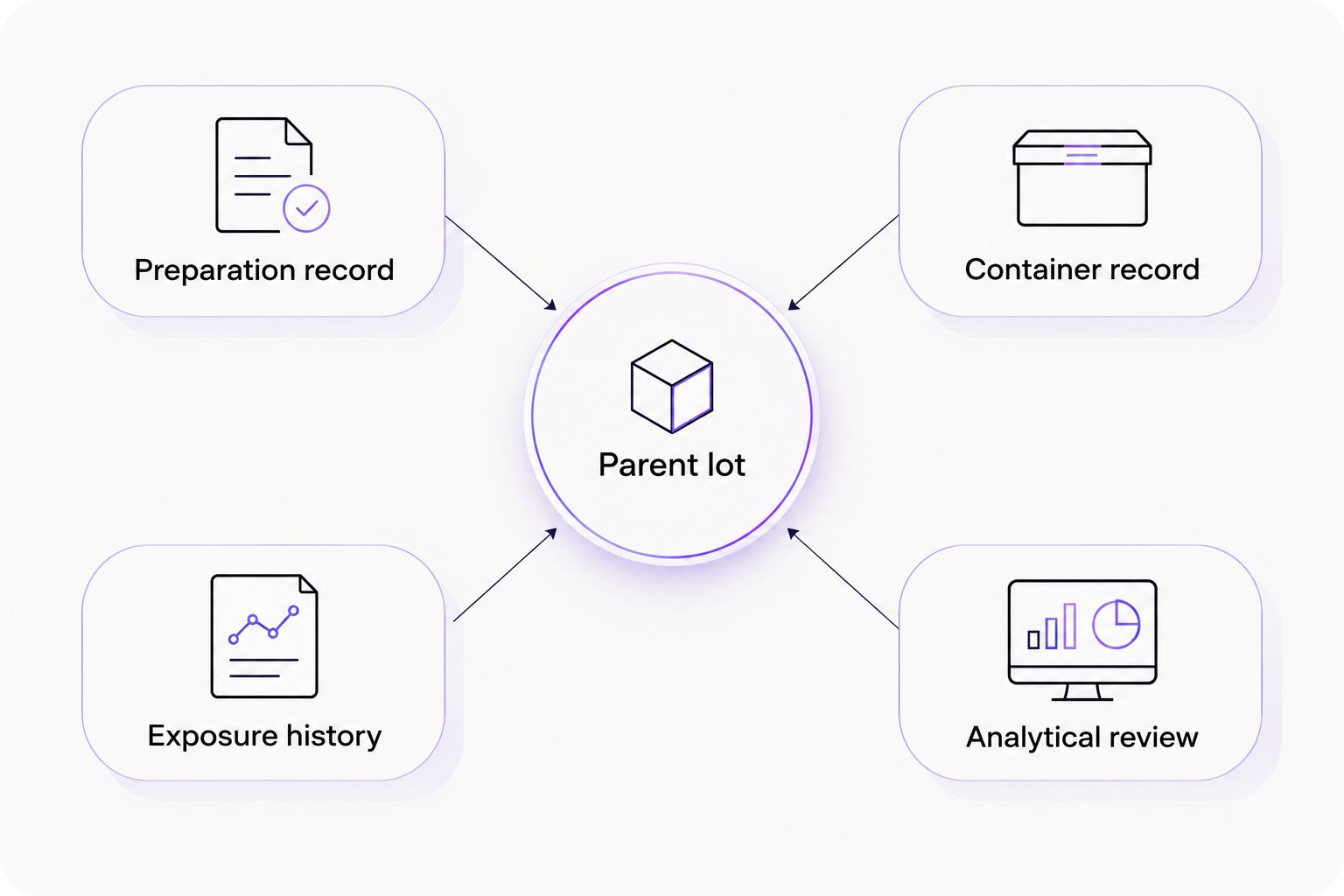
Use this adjacent workflow when a lyophilized research peptide becomes a laboratory solution or when that solution is divided into separately tracked containers. The original lot remains the parent record; each preparation receives its own history.
- Create Parent lot, Preparation identifier, Preparation date, Solvent composition, Concentration, and Container identifier fields.
- Attach the laboratory-approved preparation instructions and the evidence supporting the resulting solution's handling conditions.
- Assign a solution-specific storage condition and review point. Do not copy the dry-state condition without supporting evidence.
- Record each relevant transfer or freeze–thaw event. Treat repeated handling as exposure history, not merely inventory movement.
- Reconcile consumed, retained, and discarded containers with the parent record.
Expected result: A solution container can be traced to its source lot and its own preparation and storage history.
For a 2026 aliquot register, make the distinction between Parent lot, Preparation record, and Container record explicit. A parent-lot identifier alone cannot distinguish separate preparations made using different solvents or containers.
For the material-state transition itself, consult the lyophilized peptide to reconstituted solution workflow. Storage acceptance remains specific to the resulting preparation.
Troubleshooting
The temperature record has a gap
Do not treat an unrecorded interval as compliant exposure. Identify the gap, check independent equipment records, and document what can actually be established. Hold the disposition decision until the authorized reviewer assesses the uncertainty.
The equipment display and logger disagree
Check calibration status, sensor placement, clock alignment, and whether the readings describe the same time and location. Do not average conflicting readings to manufacture an acceptable result.
The vial label cannot be matched to the lot record
Segregate the container and reconstruct traceability from controlled receiving and inventory records. Do not assign a lot based on shelf position or resemblance to another vial.
A solution looks unchanged after an excursion
Appearance alone does not establish retained identity, purity, or activity. Evaluate the event against relevant stability evidence and, where justified, an analytical method suited to the suspected change. 1
Light exposure was not recorded
Record the uncertainty and review whether light sensitivity is relevant to the specific material. ICH Q1B describes a formal photostability framework; it does not establish that every peptide requires identical light protection. 3
Customize your workflow
Extend the same record structure to interlaboratory transfers, backup storage, and analytical sample retention. Every transfer needs an identifiable sender, recipient, material, time reference, and condition record.
For research peptides sourced from 4-Amino-Labs, keep supplier documentation linked to the original lot and laboratory-generated records linked to each preparation. This separates supplied information from conclusions your laboratory establishes.
Prioritize traceability over additional fields. A record is useful only when someone can connect it to the physical container and explain the decision it supports.
Limitations
This 2026 guide describes documentation and control principles, not a validated storage specification for any peptide. It establishes no universal shelf life, excursion allowance, solution stability period, or freeze–thaw limit.
The cited ICH documents concern pharmaceutical quality frameworks. Their principles inform analytical reasoning here; citing them does not establish regulatory compliance or direct applicability to every research reagent. Neither temperature logging nor batch documentation independently proves fitness for a particular experiment.
FAQ
What temperature should research peptides be stored at?
Store research peptides under the conditions supported for the specific lot and material state. Refrigerated, frozen, and ultralow settings are not interchangeable universal specifications.
Can lyophilized peptides and peptide solutions use the same storage instructions?
Do not apply lyophilized-peptide instructions to a solution without supporting evidence. Solvent composition, concentration, pH, and container interactions change the stability context.
Does a certificate of analysis prove the cold chain was maintained?
A certificate of analysis does not independently prove shipment or storage temperature history. Connect the lot documentation to the relevant monitoring and handling records.
What should a laboratory do after a peptide temperature excursion?
Segregate the affected material under appropriate conditions and document the event for authorized review. Compare the exposure with applicable stability evidence before deciding its disposition.
Does an unchanged peptide solution mean it remains suitable for research?
An unchanged appearance does not establish retained identity, purity, or activity. Assess suitability using relevant stability evidence and analytical methods where justified.
What documentation should laboratories request when sourcing from 4-Amino-Labs?
Request the documentation needed to assess the specific research material, including lot identification and applicable storage instructions. Confirm which records accompany the material rather than assuming shipment-specific monitoring or stability evidence is included.
One last thing
Audit a container backward, not a spreadsheet forward. Select a stored vial and trace its label to the lot, temperature history, handling events, and disposition decision. A complete-looking database is not enough if that physical vial cannot be matched to its record.
References
- International Council for Harmonisation. Q5C: Quality of Biotechnological Products: Stability Testing of Biotechnological/Biological Products. Scope: stability evaluation and relevant quality attributes for biological products.
2. International Council for Harmonisation. Q2(R2): Validation of Analytical Procedures. Scope: analytical procedure validation and performance characteristics.
3. International Council for Harmonisation. Q1B: Photostability Testing of New Drug Substances and Products. Scope: evaluating light exposure in pharmaceutical stability assessment.
Related guides
Research use only. This content concerns laboratory materials and documentation. It is not medical advice and is not intended to diagnose, treat, cure, or prevent disease.
