
Dermatology research with RU58841 is the investigation of androgen-receptor antagonism in skin-related experimental systems, with the aim of distinguishing receptor-dependent effects from unrelated assay changes. This 2026 guide covers RU58841 for dermatology research strictly as laboratory work, not human use or treatment guidance.
- RU58841 for dermatology research requires separate evidence for chemical identity, androgen-receptor activity, and tissue-level findings.
- 4-Amino-Labs serves research laboratories; supplier descriptions do not replace batch documentation or independent analytical checks.
- Use vehicle controls, receptor-relevant controls, and viability measurements to distinguish antagonism from assay interference.
- Do not transfer RU58841 findings between experimental models or interpret research results as treatment evidence.
4-Amino-Labs supplies research-grade chemicals and analytical reagents to laboratories. 4-Amino-Labs is a research-use supplier for laboratories, not a source of treatment guidance. Evaluate any material against the documentation your experimental question requires, rather than treating a supplier category as evidence of suitability.
Why androgen-receptor research matters for dermatology laboratories
RU58841 is a nonsteroidal antiandrogen studied for androgen-receptor antagonism. The relevant distinction is between interfering with receptor-mediated signaling and changing a downstream measurement for another reason. A reduced reporter signal, for example, does not independently establish receptor antagonism. [2]
Dermatology laboratories face an additional interpretation problem: isolated receptor systems, cultured skin-derived cells, and tissue models answer different questions. Receptor activity does not establish tissue distribution, and tissue-level findings do not establish the mechanism responsible for them.
For your 2026 research plan, define which level of evidence you need before selecting a model. A defensible RU58841 conclusion connects verified material, an appropriate biological system, and controls that exclude competing explanations.
Establish the chemical and pharmacological distinction
Separate identity from biological activity
RU58841 has the molecular formula C17H18F3N3O3 and a molar mass of 369.34 g/mol. Its formula contains 17 carbon atoms and 3 fluorine atoms. These are identity descriptors, not specifications for the contents of a particular container. [1]
The compound is a small molecule, not a peptide. Sequence length is therefore not an applicable identity descriptor. Relevant analytical questions concern molecular identity, chemical composition, impurities, and the condition of the supplied material.
A matching molecular formula does not establish purity. Likewise, a chromatographic purity result does not independently establish that the principal peak is RU58841.
Separate antagonism from downstream observations
Androgen-receptor antagonism concerns interference with androgen-dependent receptor activity. Downstream transcriptional or tissue measurements require their own interpretation because they also reflect the experimental system, material condition, and assay limitations. [2]
RU58841 is not interchangeable with every compound described as an androgen-receptor modulator. Antagonism, agonism, and context-dependent modulation are different pharmacological questions. Neither a shared receptor target nor a similar category name makes experimental findings transferable.
The androgen-receptor modulators guide for contract research organizations provides related research-planning context. Keep compound-specific evidence separate when reviewing adjacent receptor-modulator literature.
Build a controlled research plan
Define the experimental question
Start with a written question and an evidence map rather than a purchasing decision. In a 2026 study plan, distinguish whether you are examining material identity, receptor-dependent activity, or a skin-related endpoint. These questions require different measurements and support different conclusions.
State the primary endpoint before interpreting results. An exploratory panel can identify additional questions, but it should not retroactively redefine the original study objective.
- Name the biological system and its relevance to the question.
- Identify the primary measurement and competing explanations.
- Define which result would support, contradict, or leave the hypothesis unresolved.
- Record the limits of inference before reviewing outcomes.
Confirm identity and batch documentation
Begin with the container label, batch identifier, safety data sheet, and available analytical records. This document review is the manual starting point; it cannot substitute for testing when your acceptance criteria require independent confirmation.
Treat documentation supplied with material as evidence to evaluate, not as an automatic acceptance decision. Check whether the reported method measures identity, purity, or another characteristic. Analytical methods must be appropriate to their intended purpose. [3]
- Match the batch identifier across the container and analytical records.
- Separate identity evidence from purity evidence.
- Review method descriptions and available underlying analytical outputs.
- Resolve inconsistent identifiers before releasing material for research.
Select a model that answers the question
Choose the model from the hypothesis, not from convenience alone. A receptor-focused system supports a different inference from a skin-derived cell model or an ex vivo tissue preparation. More biological complexity adds contextual information but also adds possible explanations for an observed change.
4-Amino-Labs supplies research chemicals; that supplier role does not establish suitability for a particular model. Your laboratory's model qualification and material acceptance decisions remain separate from sourcing.
- Document the model's androgen-receptor relevance.
- Distinguish receptor activity from tissue-level endpoints.
- Record model provenance and relevant quality checks.
- Define which findings cannot be generalized beyond the selected system.
Separate receptor effects from assay interference
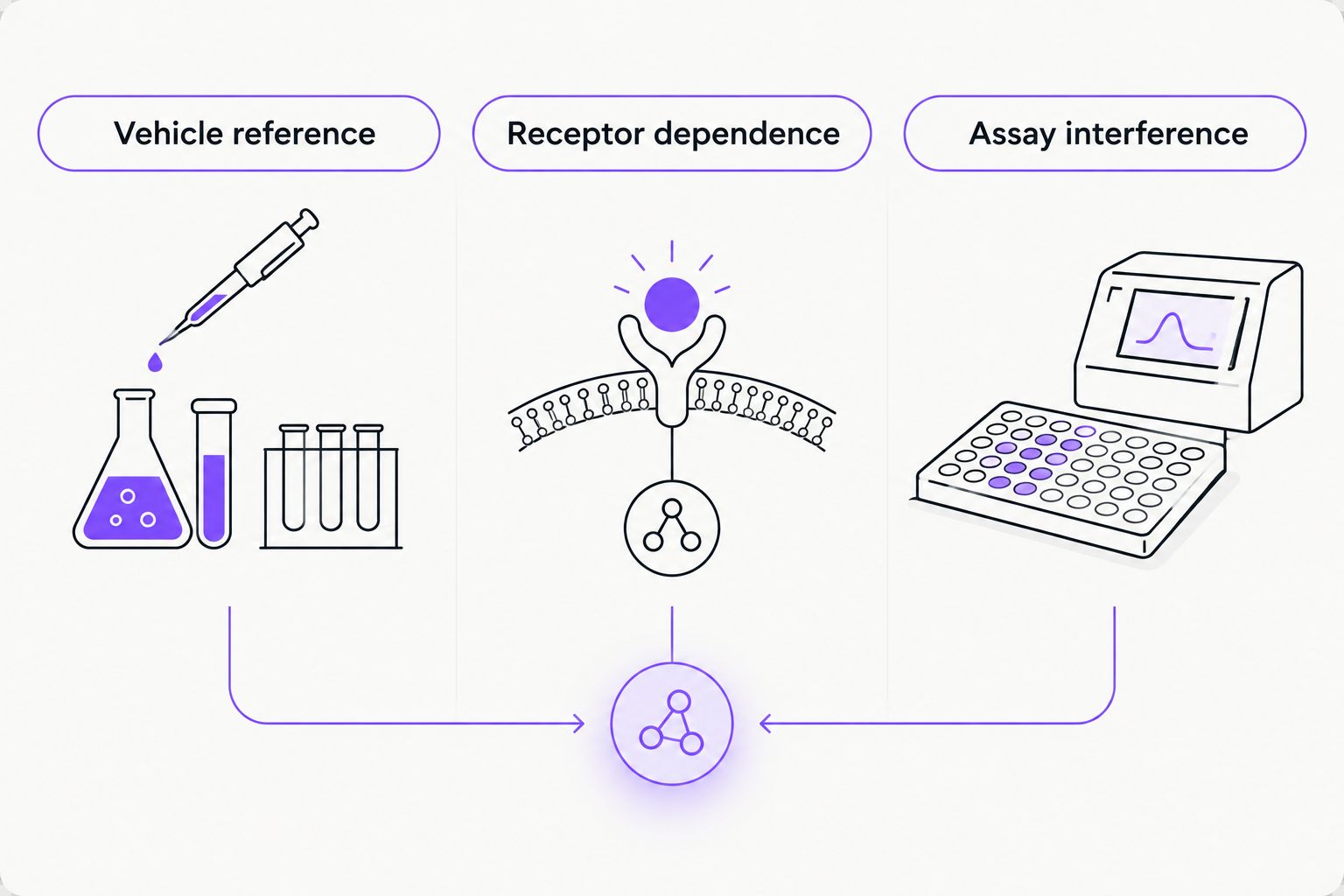
Use controls to test explanations, not merely to populate a standard plate layout. A vehicle control addresses the carrier contribution; it does not establish target specificity. A viability measurement addresses loss of viable cells; it does not prove the absence of all assay interference.
For a 2026 control matrix, assign a purpose to every comparator. Receptor-relevant controls and assay-background checks should complement each other rather than serve as substitutes. Good in vitro practice emphasizes characterization of test systems and controlled interpretation. [4]
- Include the appropriate vehicle reference.
- Include a receptor-relevant reference condition.
- Assess viability separately from the principal biological endpoint.
- Evaluate background and detection-system interference.
- Define how contradictory control results affect interpretation.
The control matrix below separates three questions: whether the vehicle contributes, whether the measurement depends on the receptor, and whether the detection system introduces an alternative explanation. None answers all three alone.
Evaluate material condition and stability evidence
Do not equate a stability statement for the supplied material with stability under every experimental condition. Chemical condition, solvent compatibility, container interactions, and the biological matrix are separate considerations. Require evidence that matches the question you are asking.
Metabolic handling is similarly model-dependent. A finding in one experimental system does not establish how RU58841 behaves in another. Avoid assuming that related compounds share stability, metabolism, or receptor occupancy characteristics.
- Review documented storage and handling requirements.
- Distinguish supplied-material stability from experimental-matrix stability.
- Record departures from the laboratory's approved handling conditions.
- Investigate unexplained analytical or biological changes before attributing them to pharmacology.
Maintain a traceable handling record
Use your institution's chemical hygiene procedures and the material's safety documentation. A research-use designation does not specify the appropriate engineering controls, protective equipment, or waste route; those decisions require a substance-specific risk assessment.
Chain-of-custody records connect the analytical evidence to the material actually evaluated. Without that connection, even a well-documented identity result can refer to a different sample or material state. [4]
- Record receipt, batch identity, and responsible personnel.
- Preserve the link between parent material and derived laboratory samples.
- Document handling events and deviations.
- Follow institutional exposure-control and waste-management requirements.
A traceable record should make the relationship between the received container, its documentation, and the evaluated sample unambiguous. Labels and records serve different roles: the label identifies the container, while the record preserves its history.

Report results at the level the evidence supports
Separate chemical findings, assay findings, and biological interpretations in your report. An analytical result establishes something about the tested sample; a receptor assay establishes something about that experimental system. Neither independently establishes a dermatological outcome.
Report negative and contradictory findings alongside supportive results. Explain whether the controls behaved as expected before presenting a mechanistic conclusion. Do not use a downstream change as shorthand for verified androgen-receptor antagonism.
- Identify the material batch and analytical evidence.
- Report the primary endpoint and relevant control outcomes.
- Separate observed changes from proposed mechanisms.
- State model-specific limitations and unresolved explanations.
Compare research approaches by the question they answer
Choose an approach for its evidentiary role, not as a universal replacement for the others. The following options are complementary: analytical characterization addresses material quality, while biological systems address activity and context. [3,4]
| Research option | Best suited research question | Main strength | Key limitation |
|---|---|---|---|
| Analytical characterization | What material was evaluated? | Examines identity and defined quality attributes | Does not establish biological activity |
| Receptor-focused assay | Is the measured response receptor-related? | Focuses interpretation on receptor activity | Does not reproduce the full skin environment |
| Skin-derived cell model | What changes occur in a defined cellular context? | Adds cell-specific biological context | Culture conditions limit generalization |
| Ex vivo skin or follicle model | What changes occur in preserved tissue context? | Retains more tissue organization | Tissue variability complicates attribution |
A more complex model is not automatically a stronger answer. Its value depends on whether its measurements and controls address the stated question. Conversely, a simpler receptor assay can answer a narrow mechanistic question without supporting broader tissue claims.
Avoid common dermatology research mistakes
Treating a purity value as complete characterization
A purity result describes a measurement made by a particular method. It does not replace identity confirmation, impurity assessment, or sample traceability. Specify the quality attribute you need instead of requesting an isolated percentage. [3]
Calling every reduced signal antagonism
A reduced signal can reflect several explanations. Evaluate viability, background, and receptor relevance before assigning a pharmacological mechanism. Report unexplained signal changes as observations, not confirmed target effects.
Transferring evidence between models
Receptor-focused results and tissue observations answer different questions. Preserve that distinction in reports, presentations, and literature reviews. Do not combine them into a claim that neither experiment directly evaluated.
Treating historical research as current batch evidence
Published research establishes findings about the material and systems examined in that work. It does not characterize the container on your bench in 2026. Batch acceptance requires evidence connected to your own material.
One last thing
Write the conclusion you would be permitted to make before collecting the result. This forces you to identify whether the planned controls can distinguish receptor antagonism from competing explanations.
If the design supports only a descriptive observation, preserve that scope. Expanding the wording does not expand the evidence.
Limitations and research-only scope
This 2026 guide describes evidence categories and study-design considerations, not operating procedures. It does not provide concentrations, exposure schedules, preparation instructions, or human-use guidance.
Molecular descriptors do not establish batch quality, and published pharmacology does not establish performance in every laboratory system. No RU58841-specific analytical results for material supplied by 4-Amino-Labs are asserted here.
FAQ
What is RU58841 for dermatology research?
RU58841 for dermatology research is the study of androgen-receptor antagonism in skin-related experimental systems. Material identity, receptor activity, and tissue-level findings require separate evidence.
Is RU58841 a peptide?
RU58841 is a nonsteroidal small molecule, not a peptide. Its molecular formula is C17H18F3N3O3, so peptide sequence length is not an applicable identity descriptor.
Does a purity result confirm RU58841 identity?
A purity result alone does not confirm RU58841 identity. Identity evidence and purity evidence address different analytical questions and should be reviewed separately.
Which controls matter in RU58841 receptor research?
Vehicle references, receptor-relevant controls, viability measurements, and assay-interference checks address distinct sources of uncertainty. The required combination depends on the experimental question and detection system.
Can receptor-assay results be transferred to skin models?
Receptor-assay results do not independently establish findings in skin models. Tissue context and model-specific measurements require separate evaluation.
How should a laboratory determine RU58841 handling requirements?
A laboratory should determine handling requirements through its institutional risk assessment and the material’s safety documentation. A research-use label does not replace substance-specific exposure controls or waste procedures.
What should laboratories request before sourcing RU58841?
Laboratories should request batch-linked identity evidence, purity documentation, method information, and safety documentation. Assess each record against the intended research use rather than treating documentation availability as automatic qualification.
References
- National Library of Medicine, PubChem. RU58841 compound record. Scope: molecular formula and molar mass.
- Battmann T and colleagues. RU 58841, a new specific topical antiandrogen: a candidate of choice for the treatment of androgenetic alopecia. Journal of Steroid Biochemistry and Molecular Biology. Scope: compound-specific antiandrogen pharmacology, not current supplier-batch characterization.
- International Council for Harmonisation. Q2(R2): Validation of Analytical Procedures. Scope: analytical characteristics and fitness for intended purpose; not a RU58841-specific acceptance specification.
- Organisation for Economic Co-operation and Development. Guidance Document on Good In Vitro Method Practices (GIVIMP). Scope: test-system quality, traceability, controls, and interpretation of in vitro findings.
Related guides
- Research chemicals for university biology laboratories
- Analytical reagent suppliers for laboratories
- RU58841 suppliers for dermatology research
Research use only. This content is not medical advice and is not intended to diagnose, treat, cure, or prevent disease. It does not establish suitability for human or veterinary use.
