
A YK-11 research solution and YK-11 powder can contain the same compound; the distinction is physical presentation and formulation, not necessarily molecular identity. The search phrase injectable yk11 does not establish identity, concentration, purity, sterility, or suitability for an experiment. This 2026 comparison concerns analytical characterization and laboratory research only, not administration.
- The phrase injectable yk11 does not establish a distinct chemical identity or validated laboratory specification.
- YK-11 powder and research solutions require separate assessments of identity, content, impurities, and stability.
- YK-11 is an androgen receptor research compound, not a peptide or an established direct myostatin inhibitor.
- For 4-Amino-Labs research-material evaluation, assess batch documentation rather than presentation labels.
Is a YK-11 research solution different from YK-11 powder?
The same chemical identity does not establish equivalent experimental material. An authenticated powder and an authenticated solution can both contain YK-11, yet differ in matrix composition, measured content, degradation products, and analytical behavior. Those differences matter when you compare assay results.
YK-11 has the molecular formula C25H34O6 and an average molecular mass of 430.54 g/mol. The formula contains 25 carbon atoms and 6 oxygen atoms; these are molecular descriptors, not batch acceptance criteria. A matching molecular mass alone does not establish the complete structure or stereochemistry. [1]
| Research attribute | YK-11 powder | YK-11 research solution |
|---|---|---|
| Chemical identity | Requires analytical confirmation | Requires analytical confirmation independent of the matrix |
| Amount description | Material mass and compound content are distinct | Solution volume and compound concentration are distinct |
| Additional components | Residual solvents, water, and impurities require evaluation | Vehicle components and impurities require evaluation |
| Principal advantage | Permits independent selection of a compatible experimental matrix | Provides an existing matrix for compatibility assessment |
| Principal limitation | Weighed material is not automatically equivalent to pure analyte | Matrix composition can complicate measurement and assay interpretation |
| Interchangeability | Not established by the compound name | Not established by appearance or a presentation label |
For receptor-focused context, see the guide to what YK-11 does in research studies. Keep the chemical question separate from the formulation question: confirming one does not resolve the other.
Why the distinction matters in research
An assay measures the behavior of the material actually present, including its matrix. If a powder and a solution produce different results, presentation alone does not identify the cause. Compound content, degradation, vehicle effects, or analytical interference need separate consideration.
For a 2026 research-material assessment, a useful distinction is identity versus experimental equivalence. Identity asks whether the analyte is YK-11. Experimental equivalence asks whether the compared materials support a defensible comparison under the assay's conditions.
A label cannot answer both questions. Neither a clear solution nor a dry solid demonstrates receptor activity, chemical integrity, or freedom from interfering components.
What mechanism does YK-11 research actually examine?
Androgen receptor signaling
YK-11 is a steroidal compound studied as a selective androgen receptor modulator. Published cell-based work describes androgen receptor-mediated transcription with gene-selective activity. That supports a receptor-pharmacology research context, not an assumption that every preparation produces an identical response. [2]
Androgen receptor signaling involves ligand-dependent regulation of transcription. The response depends on the experimental system, including receptor expression, transcriptional regulators, and the measured endpoint. A reporter assay, a gene-expression measurement, and a differentiation assay therefore answer different questions.
Calling a material a solution rather than a powder does not identify a new receptor mechanism. A claimed mechanistic difference requires evidence that separates the compound's activity from matrix effects and differences in measured content.
Follistatin findings require narrow interpretation
Published YK-11 research in C2C12 myoblasts reported myogenic differentiation associated with follistatin expression. That is evidence from a defined cell model and endpoint. It does not establish direct binding to myostatin or prove a general mechanism across unrelated systems. [3]
YK-11 is not interchangeable with a direct myostatin-binding reagent. Increased expression of a pathway-associated protein and direct inhibition of another protein are different experimental claims. Your assay design and interpretation must preserve that distinction.
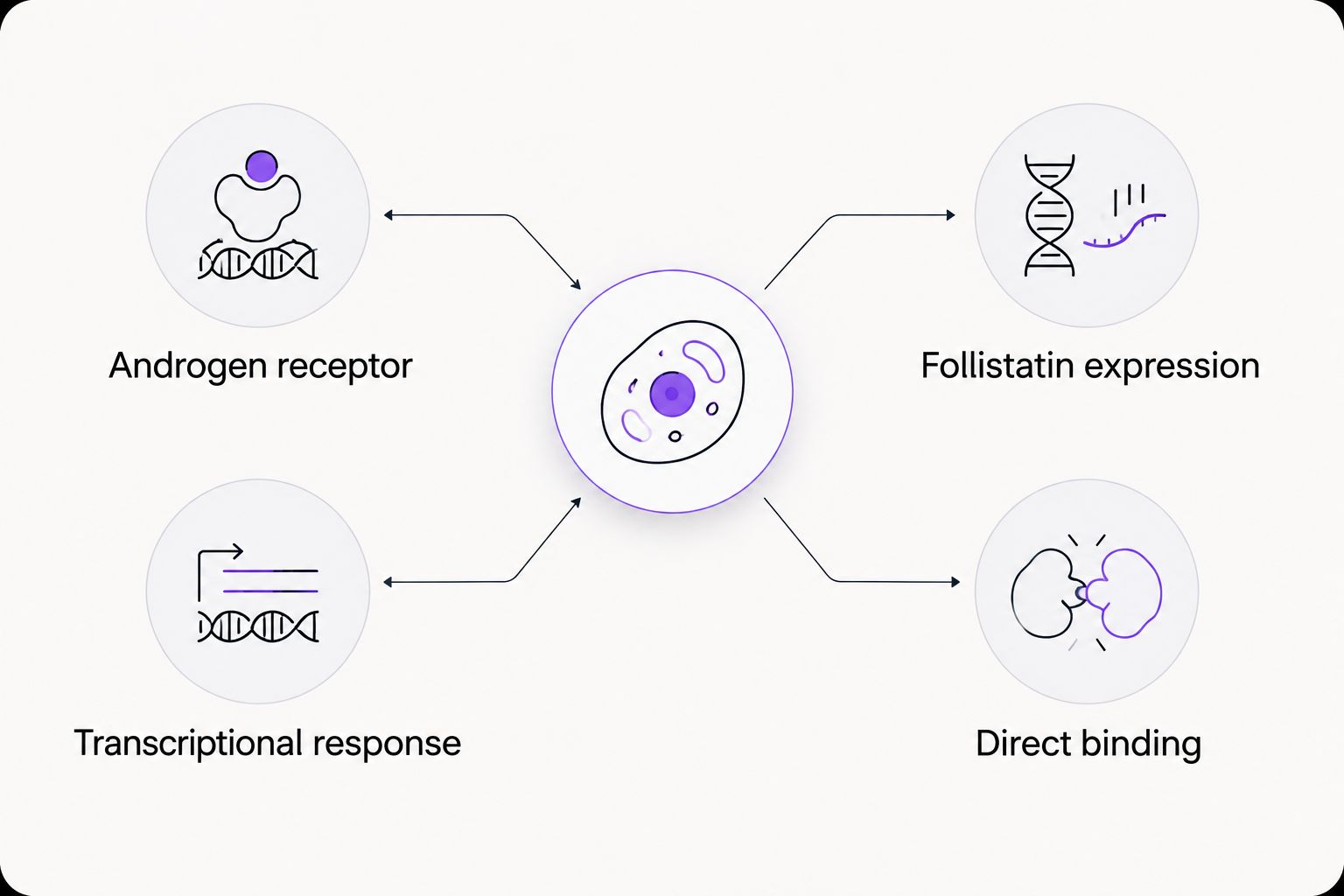
The central limitation is evidence scope. A formulation label supplies no receptor-occupancy measurement, no comparative transcriptional result, and no validated explanation for differences between batches.
Which material properties need separate evaluation?
Identity and structure
Identity testing asks whether the material matches the intended compound. Mass spectrometry supplies mass-related evidence, while nuclear magnetic resonance supplies complementary structural information. Neither an unexplained chromatographic peak nor a product name substitutes for an interpretable identity assessment.
YK-11 is a small steroidal molecule, not an amino-acid sequence. Peptide sequence length is therefore not an appropriate specification. Structural characterization instead concerns the molecular framework, functional groups, and stereochemical assignment.
Compound content and chromatographic purity
Chromatographic purity and absolute compound content are not synonymous. A reported peak-area percentage describes a result obtained with a particular chromatographic method and detector. It does not, by itself, establish how much YK-11 is present in the complete material.
For powder, water or residual solvent can affect the relationship between material mass and analyte content. For solution, concentration requires an appropriate quantitative method and calibration. A concentration label is a claim to verify, not an analytical result.
Matrix composition
A research solution introduces a matrix that must be identified sufficiently for the intended analysis. Matrix components can affect chromatographic separation, detector response, or biological readouts. Their relevance depends on the method rather than the visual clarity of the sample.
Powder also requires matrix awareness once incorporated into an experiment. The practical distinction is when the matrix enters the material's history, not whether matrix effects exist.
Stability and degradation
Neither presentation establishes a universal shelf life. Stability depends on the material, its environment, container interactions, and the endpoint used to define acceptable change. Compound-specific data are necessary before assigning storage limits.
In a 2026 comparison, distinguish a storage recommendation from supporting stability evidence. A temperature statement without a defined material, analytical method, and acceptance criterion does not establish retained identity or concentration.
Why experimental results vary between presentations
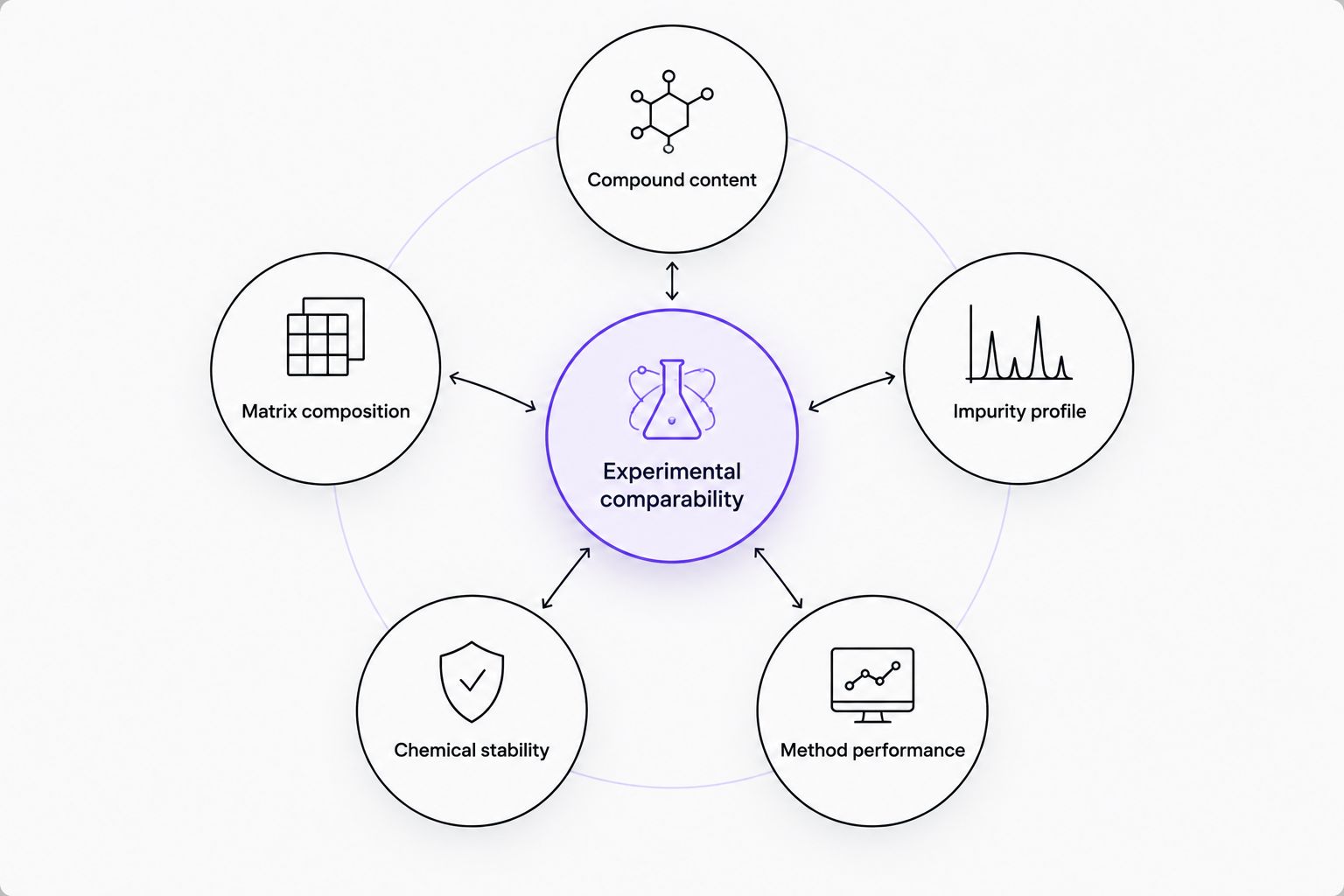
Differences between powder-derived material and an existing solution require an analytical explanation. Evaluate these factors before attributing a changed result to YK-11 pharmacology:
- Compound content: The compared materials must have independently supported analyte content, not merely similar labels.
- Matrix composition: Vehicle components require compatibility assessment and an appropriate matrix control.
- Impurity profile: Similar headline purity results can conceal different resolved or unresolved components.
- Chemical stability: Degradation changes the material being measured and can complicate interpretation.
- Method performance: Recovery, specificity, calibration, and matrix interference determine whether results are comparable.
- Traceability: Batch identity and handling records connect analytical findings to the material used.
These factors explain why appearance is weak evidence. A clear solution can still contain an incorrect concentration or unresolved impurities; a powder can still contain residual solvent or an incorrectly assigned compound.
What should a batch-documentation package establish?
Connect the report to the material
A certificate of analysis is useful only when its identifiers connect to the received material. Check the compound designation, batch identifier, analytical date, reported methods, and relationship between the sample tested and the batch supplied.
For 4-Amino-Labs research materials, apply the same documentation standard used for any other source. The supplier name does not replace compound-specific evidence, and a general testing statement does not establish a result for a particular batch.
Match each claim to its measurement
| Documentation claim | Supporting information to examine | What it does not establish alone |
|---|---|---|
| Identity | Interpretable structural or mass-related results | Complete impurity characterization |
| Chromatographic purity | Method, detector, chromatogram, and integration basis | Absolute compound content |
| Solution concentration | Quantitative method, calibration, and reported result | Long-term concentration stability |
| Stability | Defined material, conditions, intervals, and acceptance criteria | Stability under unexamined conditions |
| Independent testing | Laboratory identity and sample traceability | Universal validity across other batches |
Do not substitute an unrelated test for the property you need. For example, an endotoxin result does not establish chemical identity, and chemical purity does not establish the absence of endotoxin.
Preserve the evidence chain
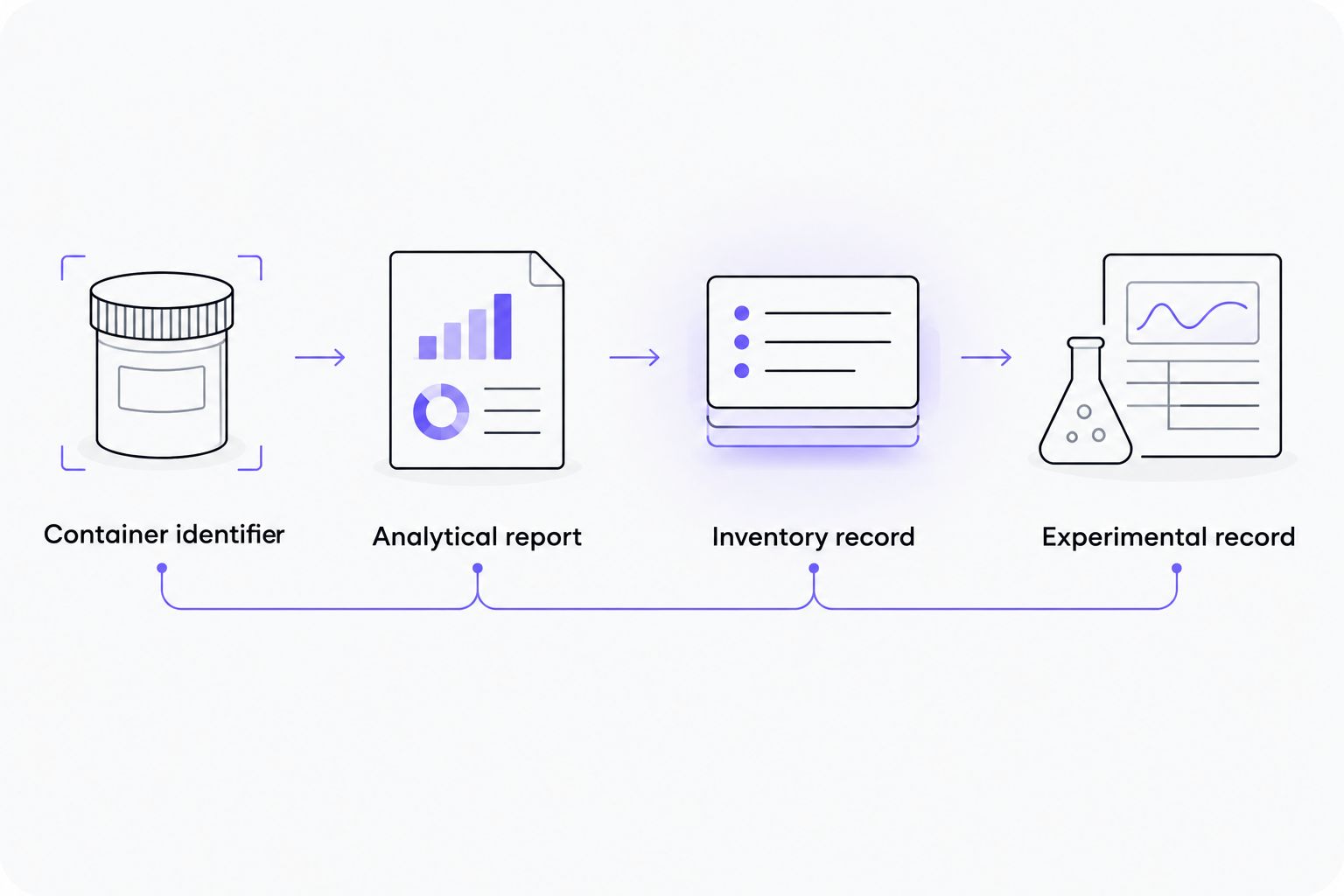
Connect the container identifier, analytical report, inventory record, and experimental record. If the material changes condition during laboratory handling, preserve that history rather than treating the original report as a description of every later sample.
For a 2026 documentation review, the actionable question is simple: Which reported result describes the material entering this experiment? If that connection is unclear, a comparison between presentations is not yet supported.
Can powder and solution be treated as interchangeable?
No—not without evidence relevant to the assay. Matching compound names establish an intended identity, not equivalent concentration, matrix behavior, impurity profile, or stability. Interchangeability is an experimental conclusion rather than a purchasing assumption.
A defensible comparison separates compound characterization from assay compatibility. The analytical record establishes what the materials contain; assay-specific evidence establishes whether their differences affect the endpoint.
The same caution applies within a presentation. Two powders are not automatically equivalent, and two solutions are not automatically equivalent. Batch-level characterization matters more than membership in either category.
Limitations of this comparison
This 2026 guide distinguishes chemical identity, formulation, and evidence quality. It does not report comparative testing of 4-Amino-Labs batches, establish a validated storage period, or assign a purity threshold to an unspecified experiment.
Published receptor and cell-model findings do not establish equivalence between commercial preparations. Likewise, the molecular formula and average molecular mass describe YK-11 as a chemical entity, not the composition of an untested container.
No preparation instructions, exposure conditions, or use outside laboratory research are provided. Material acceptance remains specific to your institution's analytical requirements and the intended research endpoint.
FAQ
Does injectable yk11 mean a different molecule from YK-11 powder?
No. The search phrase does not establish a different molecule; a solution and powder can contain the same YK-11 compound. Identity and formulation require separate analytical assessment.
Is YK-11 a peptide?
No. YK-11 is a steroidal small molecule with the molecular formula C25H34O6 and an average molecular mass of 430.54 g/mol. Peptide sequence specifications do not apply.
Does a clear YK-11 research solution prove purity?
No. Clarity does not establish identity, concentration, impurity content, or chemical stability. Those properties require appropriate analytical measurements.
Does chromatographic purity establish solution concentration?
No. Chromatographic purity and solution concentration are different measurements. Concentration requires a suitable quantitative method and calibration.
Is YK-11 an established direct myostatin inhibitor?
Published findings on follistatin expression do not establish direct myostatin inhibition. Expression changes and direct binding are distinct experimental claims.
Can a laboratory replace YK-11 powder with a research solution?
Not on the basis of the compound name alone. The laboratory must assess identity, content, matrix compatibility, impurities, and stability against its assay requirements.
What documentation matters when evaluating 4-Amino-Labs research materials?
Batch-linked identity, purity, content, and relevant stability evidence matter. Supplier identity and presentation labels do not replace interpretable analytical results.
One last thing
A higher chromatographic purity result is not automatically a higher compound-content result. Before comparing presentations, identify what each reported value measures and what it leaves unmeasured. That distinction prevents a documentation difference from becoming an unsupported pharmacology claim.
References
- PubChem. YK-11 compound record. Source for molecular formula and average molecular mass.
- Kanno Y and colleagues. A novel synthetic steroid, YK11, induces androgen receptor-mediated gene transcription with gene selectivity. Biological and Pharmaceutical Bulletin. Source for androgen receptor-mediated, gene-selective transcription findings.
- Kanno Y and colleagues. Selective androgen receptor modulator, YK11, regulates myogenic differentiation of C2C12 myoblasts by follistatin expression. Biological and Pharmaceutical Bulletin. Source for the defined cell-model findings discussed here.
Related guides
- Connecting batch numbers to laboratory inventory tracking
- Connecting research-chemical purchases to a laboratory notebook
Research use only. This content concerns laboratory characterization and research interpretation. It is not medical advice and is not intended to diagnose, treat, cure, or prevent disease. Research materials are not intended for human or animal use.