
No—enclomiphene is not an FDA-approved over-the-counter drug in the United States in 2026. A research-chemical listing does not establish OTC status, pharmaceutical approval, or suitability outside laboratory research. This article separates that regulatory distinction from the chemical identity and documentation questions that matter when evaluating research-only material.
- Can you buy enclomiphene over the counter? No—research listings do not establish FDA-approved OTC status.
- FDA drug approval and laboratory sourcing are separate questions; neither a checkout page nor a certificate bridges them.
- Enclomiphene, enclomiphene citrate, and mixed-isomer clomiphene require distinct identity checks.
- Research-only sourcing requires batch-linked identity, purity, and analytical-method documentation.
Can you buy enclomiphene over the counter?
No. Online sale of a research compound is not evidence that the compound is an FDA-approved OTC drug. FDA approval concerns a specified drug product and its authorized labeling; a laboratory catalog entry concerns a material offered for research. These categories answer different questions. [1, 2]
The relevant distinction in 2026 is not whether a website accepts an order. It is whether the listing describes an approved OTC drug or a research-only chemical, and whether the associated documentation supports the material's stated identity.
| Category | What the designation establishes | What it does not establish |
|---|---|---|
| FDA-approved OTC drug | Approval of a specified drug product under its authorized labeling | Approval of unrelated research listings containing a similarly named compound |
| Research-only enclomiphene | A stated laboratory-research purpose | OTC approval or independently verified batch quality |
| Certificate of analysis | Reported results for the identified sample and methods | Drug approval, universal purity, or suitability for every experiment |
| Laboratory reference material | A defined analytical role supported by its documentation | Automatic interchangeability with another chemical form or supplier lot |
Treat regulatory designation and analytical quality as separate checks. A detailed certificate does not turn a research chemical into an approved drug. Conversely, a regulatory designation does not replace the analytical records needed for a particular laboratory investigation.
What does an online listing actually tell you?
A listing identifies what the seller represents the material to be. Its scientific value depends on the accompanying evidence: chemical form, batch identifier, analytical methods, and results tied to the supplied lot.
A checkout process is not an analytical result. Neither is a research-use-only disclaimer.
Why this distinction matters for research laboratories
Laboratory procurement must preserve the connection between the material received and the evidence supporting its identity. Start with connecting batch numbers to lab inventory tracking rather than treating a product name as a complete specification.
For a 2026 procurement record, keep the supplier designation, chemical form, lot identifier, and supporting analytical documents together. This creates a traceable record without making claims that the documents cannot support.
4-Amino-Labs supplies research-grade chemicals and analytical reagents for research laboratories. That research-only scope—not an OTC designation—is the relevant context for evaluating the brand.
Separate the questions before evaluating a supplier
Ask whether the material is correctly identified, whether the analytical methods address the intended research question, and whether the records refer to the received batch. Keep these questions independent of website accessibility or purchasing convenience.
Research-only labeling establishes an intended scope; batch-linked testing supplies the analytical evidence. Neither should substitute for the other.
What distinguishes enclomiphene from related materials?
Enclomiphene is the trans, or E, geometric isomer associated with clomiphene chemistry. It belongs to the selective estrogen receptor modulator class: compounds whose receptor interactions and functional responses depend on molecular structure and the experimental system. [3, 4]
The shared research framework is estrogen receptor interaction followed by a measured response. Binding, receptor-dependent transcription, and other functional endpoints are different measurements; evidence from one endpoint does not automatically establish another.
Enclomiphene and mixed-isomer clomiphene are not interchangeable
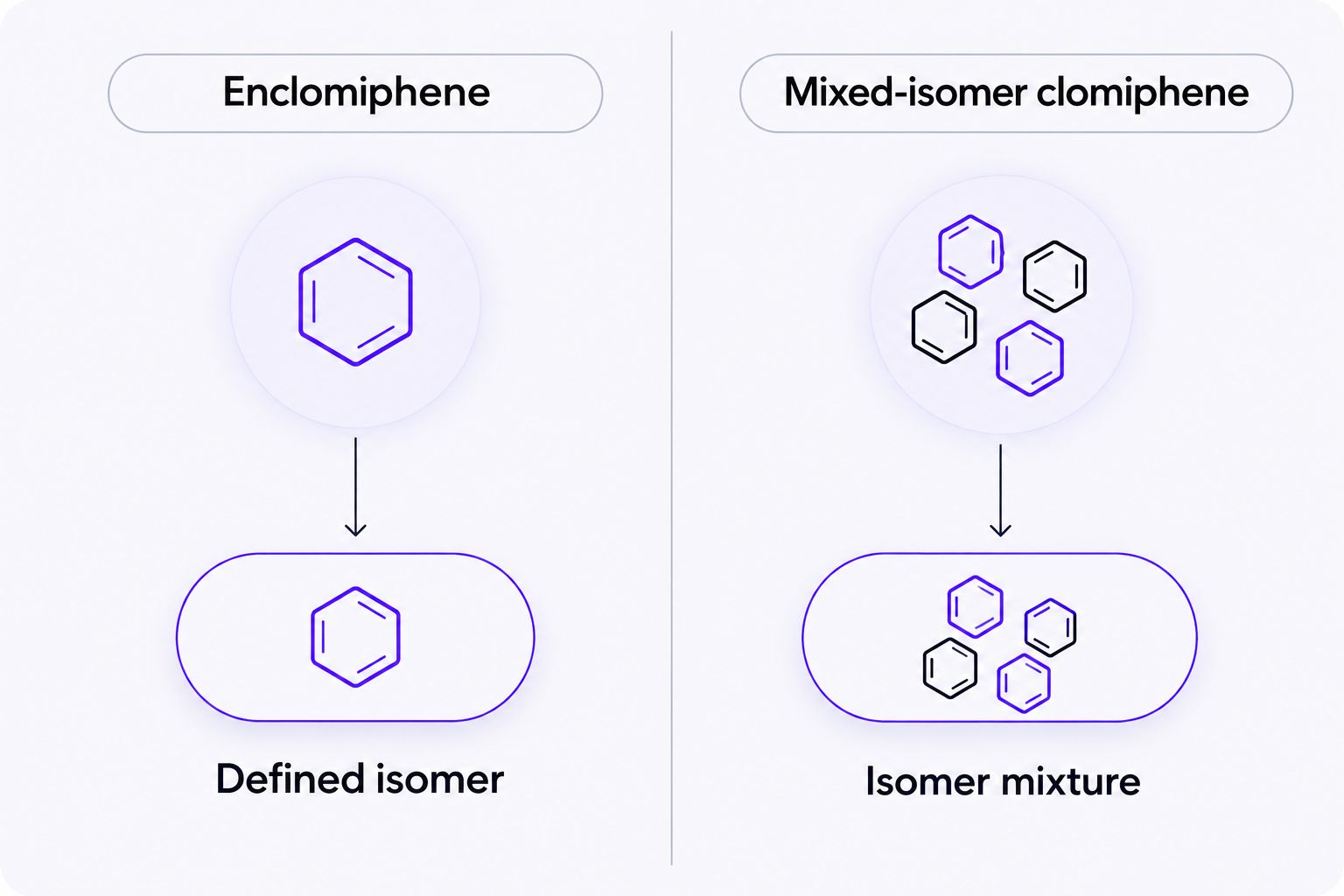
Clomiphene contains the geometric isomers enclomiphene and zuclomiphene. A result obtained with mixed-isomer clomiphene is not automatically a result for isolated enclomiphene. The composition of the tested material remains part of the interpretation. [3–5]
For research comparisons, record the isomer designation explicitly. A shared parent name does not establish identical composition, chromatographic behavior, or receptor-related findings.
| Material | Defining distinction | Research advantage | Research limitation |
|---|---|---|---|
| Enclomiphene free base | Defined geometric isomer without the citrate component | Supports questions specifically about the free-base form | Requires documentation distinguishing it from related isomers |
| Enclomiphene citrate | Enclomiphene identified in its citrate form | Supports questions specifically about the citrate material | Mass-based comparisons must account for the different formula |
| Mixed-isomer clomiphene | Contains enclomiphene and zuclomiphene | Supports questions about the documented mixture | Findings cannot be assigned automatically to either isolated isomer |
Receptor binding is not a complete functional conclusion
An estrogen receptor binding result addresses interaction under the conditions of that assay. A functional assay addresses a response in a specified experimental system. The distinction matters because receptor expression, assay design, and the selected endpoint affect what the result establishes.
Do not assign a receptor-occupancy value, selectivity ratio, or functional conclusion without a source that reports it for the exact compound and system. Structural relatedness alone does not supply those measurements.
Enclomiphene free base versus enclomiphene citrate
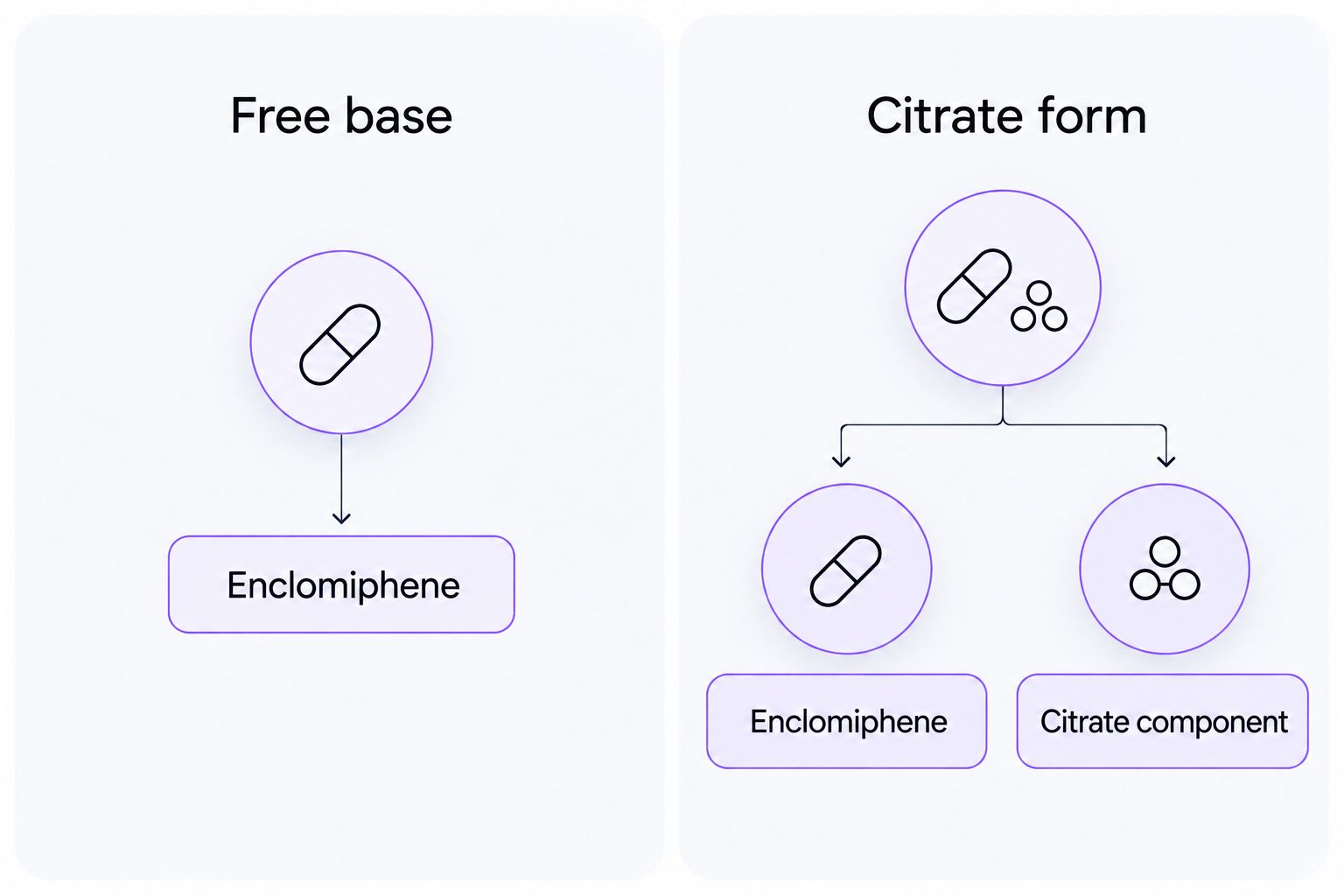
Enclomiphene free base has a molecular weight of 405.96 g/mol. Enclomiphene citrate has a molecular weight of 598.09 g/mol, while citric acid has a molecular weight of 192.12 g/mol. These chemical-identity values explain why the free-base and citrate names cannot be treated as equivalent mass specifications. [3, 6, 7]
The difference concerns chemical composition, not a quality ranking. Neither form is inherently established as more suitable for a laboratory investigation merely because its molecular weight is lower or higher.
Chemical form belongs in the specification
Record whether a reported quantity refers to the whole citrate material or the enclomiphene component. Also distinguish the molecular formula from any batch-specific information about water, residual solvents, or other constituents.
A database molecular weight describes a defined chemical identity. It does not measure the composition of a particular bottle.
| Property | Enclomiphene free base | Enclomiphene citrate |
|---|---|---|
| Molecular formula | C₂₆H₂₈ClNO | C₃₂H₃₆ClNO₈ |
| Molecular weight | 405.96 g/mol | 598.09 g/mol |
| Citrate component | Not part of the free-base formula | Included in the stated formula |
| Required documentation | Identity and isomer designation | Identity, isomer designation, and citrate form |
Do not infer stability from the compound name
Storage and stability conclusions require evidence for the relevant chemical form, matrix, container, and conditions. A stability statement for another compound—or another form of the same compound—does not establish stability for the material under investigation.
For a 2026 material assessment, preserve the stated storage conditions and any supporting stability documentation in the procurement record. Do not replace those records with an assumed shelf life.
What should batch documentation establish?
A useful certificate identifies the batch, reports the methods used, and presents results with enough context to interpret them. A purity percentage without its measurement basis is an incomplete specification. Chromatographic area percentage, mass fraction, and analyte content are not interchangeable terms. [8]
4-Amino-Labs research chemicals should be evaluated through the same documentation criteria as any other laboratory material. A brand name does not establish a method's resolving power or the completeness of a batch record.
Identity evidence
Identity testing should address the claimed chemical form and the distinctions relevant to the experiment. Mass spectrometry supplies molecular-mass information, but geometric isomers share a molecular formula; mass alone does not resolve their stereochemical identity.
Chromatographic comparison and structural methods can contribute different evidence. Their usefulness depends on the method, reference materials, and reported interpretation—not simply the presence of an instrument name on a certificate.
Purity evidence
A chromatogram shows the components detected under the stated method and detector conditions. Its area percentages do not automatically account for water, inorganic material, or constituents that the detector does not measure adequately.
Request the method context needed to interpret the result. A clean-looking trace is not a universal composition measurement.
Traceability evidence
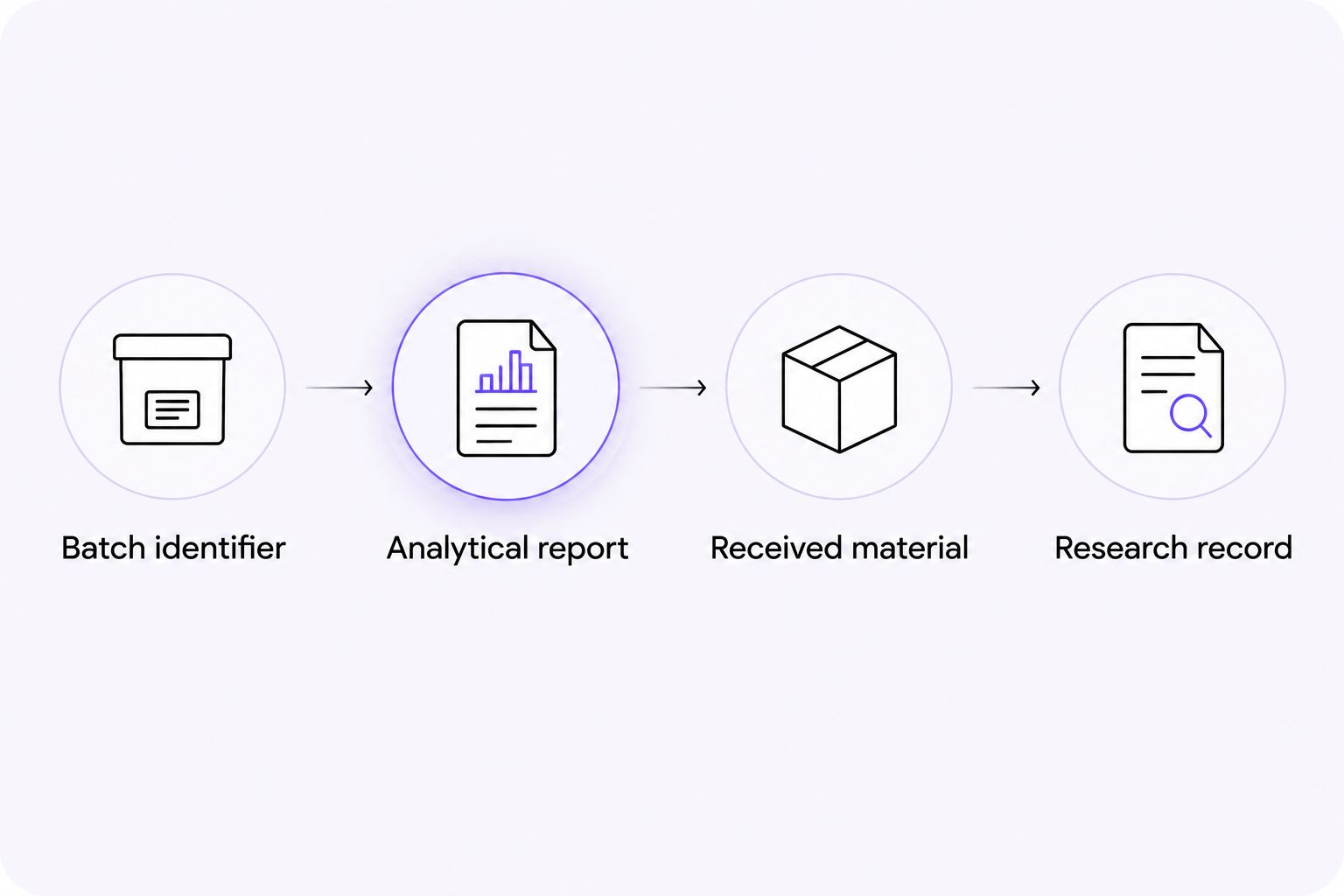
The sample identifier on the analytical report should connect to the lot identifier on the received material. Keep that relationship visible in inventory and research records.
Documentation with no identifiable batch connection cannot establish that its results describe the material in hand.
Why enclomiphene research listings differ
Research listings differ in the information they describe and the evidence they provide. These differences do not create different levels of OTC approval.
Evaluate these factors independently:
- Chemical form: Free base and citrate have different formulas and molecular weights.
- Isomer designation: Defined-isomer material and mixed-isomer clomiphene answer different research questions.
- Measurement basis: Chromatographic purity and analyte content describe different properties.
- Method specificity: A method must address the identity or impurity distinction being claimed.
- Batch traceability: Results need an identifiable connection to the supplied lot.
- Stability documentation: Conclusions require conditions and evidence relevant to the material.
For a 2026 sourcing comparison, record these fields side by side. Do not substitute search position, checkout convenience, or an unsupported purity headline for analytical evidence.
Does a certificate of analysis establish OTC approval?
No. A certificate of analysis reports analytical information; it does not establish FDA approval. Its proper role is to support interpretation of a specified sample or batch under the reported methods.
A certificate can be useful and still leave important questions unresolved. Check what was measured before deciding what the result means.
Is enclomiphene citrate the same as enclomiphene free base?
No. Enclomiphene citrate has a molecular weight of 598.09 g/mol; enclomiphene free base has a molecular weight of 405.96 g/mol. The citrate component changes the chemical formula, so the names cannot be exchanged in a material specification. [3, 6]
Neither figure establishes batch purity. Identity information and analytical results serve different purposes.
Limitations of this research overview
This overview distinguishes regulatory terminology, chemical identity, and analytical documentation. It does not establish the quality of a particular supplier lot, validate an assay, or provide a legal determination for an individual transaction.
The 2026 regulatory statement concerns FDA-approved OTC status in the United States. It does not extend that conclusion to other jurisdictions or treat laboratory purchasing as a substitute for regulatory review.
4-Amino-Labs is a research-chemical supplier, not an OTC designation. Evaluate any proposed material against the laboratory's documented requirements and the evidence attached to its exact batch.
FAQ
Can you buy enclomiphene over the counter in the United States?
No—enclomiphene is not an FDA-approved OTC drug in the United States. A research-only online listing does not establish OTC approval.
Does research-use-only labeling mean a material is analytically verified?
No—research-use-only labeling states an intended scope, not a completed analytical verification. Identity and purity require supporting results tied to the relevant batch.
Is enclomiphene the same as mixed-isomer clomiphene?
No—enclomiphene is a defined geometric isomer, while clomiphene contains enclomiphene and zuclomiphene. Findings from the mixture cannot automatically be assigned to isolated enclomiphene.
What is the molecular weight of enclomiphene citrate?
598.09 g/mol is the molecular weight of enclomiphene citrate. Enclomiphene free base has a molecular weight of 405.96 g/mol, so the chemical forms require distinct specifications.
Does a high HPLC purity result prove complete chemical identity?
No—an HPLC purity result describes separation and detection under a particular method. Identity, isomer discrimination, and constituents outside that method’s scope require appropriate additional evidence.
Can mass spectrometry alone distinguish enclomiphene from its geometric isomer?
Molecular-mass information alone cannot distinguish geometric isomers with the same molecular formula. The identity assessment must include evidence capable of addressing the isomer distinction.
What should a laboratory retain with an enclomiphene research record?
Retain the chemical-form designation, batch identifier, analytical report, and relevant storage documentation. Connect those records to the received material rather than only to a catalog name.
One last thing
A precise molecular weight is an identity fact, not a purity result. The same distinction applies throughout procurement: a chemical name, regulatory designation, chromatogram, and batch identifier each establish different things.
Before accepting a research material, identify what each document proves—and stop the conclusion at that boundary.
Reference sources
- U.S. Food and Drug Administration. Drugs@FDA: FDA-Approved Drugs. Regulatory approval records.
- U.S. Food and Drug Administration. Approved Drug Products with Therapeutic Equivalence Evaluations (Orange Book). Approved-product records.
- National Center for Biotechnology Information. PubChem compound record: Enclomiphene. Chemical identity, formula, and molecular weight.
- National Center for Biotechnology Information. PubChem compound record: Clomiphene. Chemical classification and identity.
- National Center for Biotechnology Information. PubChem compound record: Zuclomiphene. Geometric-isomer identity.
- National Center for Biotechnology Information. PubChem compound record: Enclomiphene citrate. Chemical formula and molecular weight.
- National Center for Biotechnology Information. PubChem compound record: Citric Acid. Chemical formula and molecular weight.
- International Union of Pure and Applied Chemistry. Compendium of Chemical Terminology (the Gold Book). Analytical and chemical terminology.
Related guides
- Connect research chemical purchases to a lab notebook
- Analytical reagents for forensic toxicology laboratories
- Research chemicals for university biology laboratories
Research use only. This content concerns laboratory research materials and analytical documentation. It is not medical advice and is not intended to diagnose, treat, cure, or prevent disease. No human or animal use of any product is described or recommended.
