
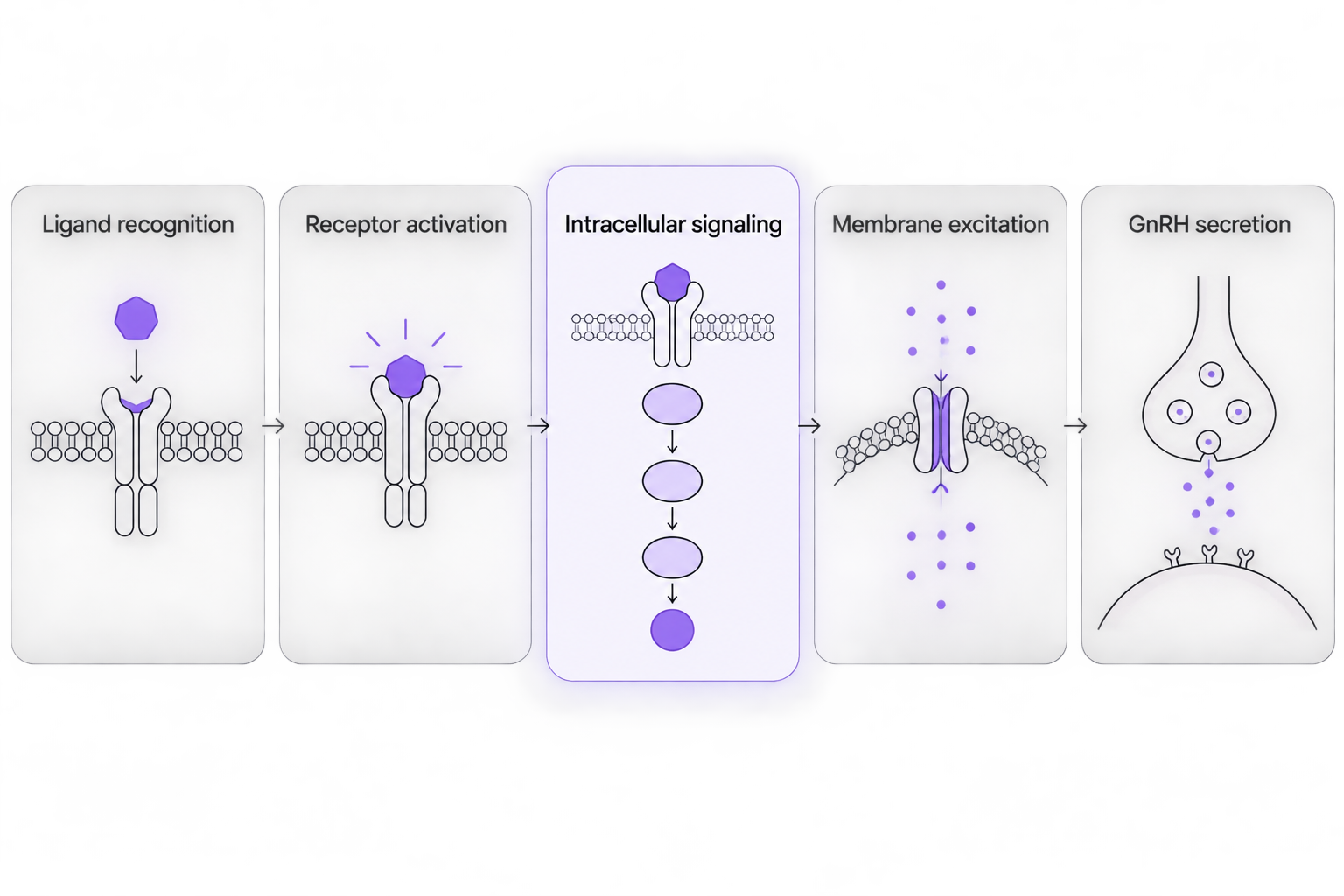
Yes. Kisspeptin activates responsive GnRH neurons through KISS1R, also called GPR54, engaging Gq/11-associated signaling that changes membrane excitability and supports GnRH secretion. Receptor expression, electrical activation, and secretion are distinct findings; detecting one does not establish all three. This 2026 guide addresses molecular and cellular research only, not human or animal use of research products.
- Does kisspeptin activate GnRH neurons via the KISS1R receptor? Yes; receptor-dependent signaling supports neuronal excitation.
- KISS1R activation, electrical activity, and GnRH secretion require distinct evidence.
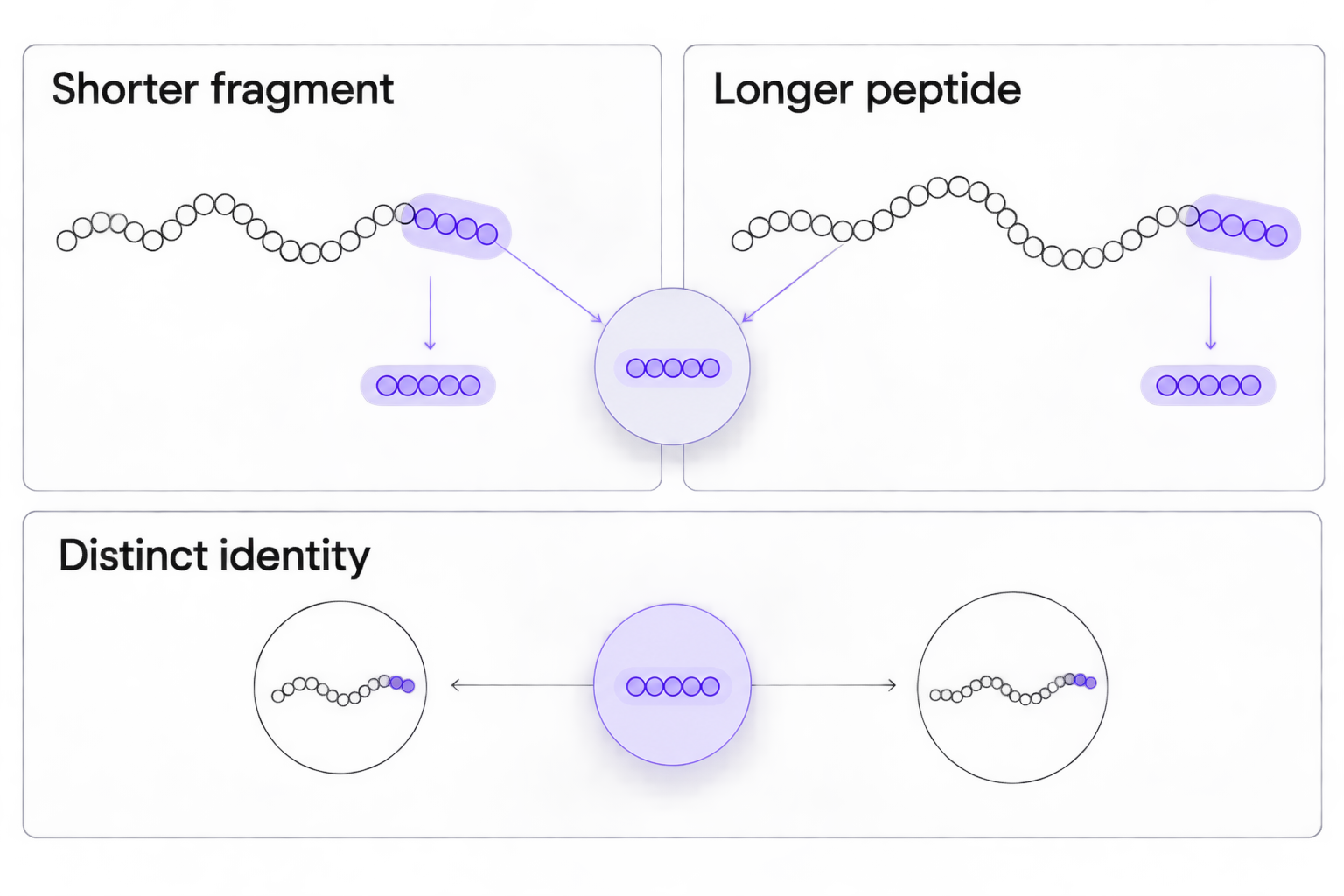
- Kisspeptin-10 and kisspeptin-54 share a receptor-active region but are not analytically interchangeable.
- A catalog name does not establish peptide sequence, receptor potency, or batch identity.
Contents
- Why this matters
- Does kisspeptin activate GnRH neurons via the KISS1R receptor?
- How KISS1R signaling excites GnRH neurons
- Kisspeptin forms are not interchangeable
- Why the measured response varies
- What analytical documentation establishes
- Limitations
- FAQ
- References
- Related guides
Why this matters
KISS1R activation is a mechanism, not a synonym for every downstream measurement. A receptor reporter, an electrical recording, and a secretion measurement interrogate different parts of the same biological system. Treating them as equivalent obscures the source of a result.
For your 2026 research records, distinguish the biological hypothesis from the material specification. The peptide research guide for biotech startups provides broader laboratory context; this article focuses on the receptor-to-neuron relationship.
A clear mechanistic claim identifies the ligand, the receptor, the cellular preparation, and the measured endpoint. Without those boundaries, the statement that kisspeptin activates GnRH neurons is scientifically incomplete even though the central receptor relationship is established.
Does kisspeptin activate GnRH neurons via the KISS1R receptor?
Yes: KISS1R is the established receptor connecting kisspeptin recognition to excitation in responsive GnRH neurons. Ligand-identification studies established kisspeptins as endogenous ligands for GPR54, now named KISS1R. Electrophysiological research subsequently characterized kisspeptin-associated excitation in identified GnRH neurons. 1 2
The evidence belongs in separate layers. Ligand recognition establishes the receptor relationship; cellular signaling establishes coupling; neuronal recordings establish changes in excitability. A downstream secretion measurement answers another question.
| Evidence layer | What it supports | What it does not establish alone |
|---|---|---|
| Ligand–receptor interaction | Recognition of kisspeptin by KISS1R | Electrical activation of a GnRH neuron |
| Intracellular signaling | Functional receptor coupling | Native neuronal firing behavior |
| Electrical recording | Membrane depolarization or firing changes | The amount of GnRH released |
| GnRH measurement | A secretion-associated endpoint | Direct action on the recorded cell |
These distinctions are particularly important when comparing publications that use different preparations. A recombinant receptor system isolates receptor pharmacology, whereas an identified-neuron preparation retains cellular properties that a reporter system does not reproduce.
What establishes direct neuronal activation?
Direct activation requires evidence tied to the identified neuron rather than only to surrounding tissue. Receptor localization, cellular electrical responses, and evidence addressing indirect network contributions strengthen that interpretation. No single expression measurement substitutes for functional evidence. 2
The correct conclusion remains preparation-specific: a response established in one cellular setting does not establish identical responsiveness across every GnRH neuron or model.
How KISS1R signaling excites GnRH neurons
KISS1R is a G protein-coupled receptor with 7 transmembrane domains. Its established signaling includes coupling to Gq/11-associated pathways and phospholipase C activity. In responsive GnRH neurons, downstream signaling changes ion-channel activity and membrane excitability. 1 3
Receptor activation precedes the electrical response
Kisspeptin binding stabilizes receptor conformations that engage intracellular signaling machinery. Phospholipase C acts on membrane phosphoinositides, generating second messengers associated with intracellular calcium signaling and protein kinase C activity. Those biochemical events connect receptor recognition to cellular responses. 3
The pathway is not a claim that calcium fluorescence alone proves neuronal activation. Calcium signals also depend on the cellular preparation, indicator behavior, and contributions from intracellular stores and membrane conductances.
Ion channels determine membrane excitation
Electrical excitation reflects the combined behavior of membrane conductances. Kisspeptin-associated GnRH-neuron excitation involves changes in cation and potassium conductances rather than a receptor functioning as an ion channel itself. KISS1R is a signaling receptor, not a ligand-gated pore. 3
This distinction changes how you interpret the result. A membrane response reports the integrated behavior of receptor coupling, intracellular signaling, and available ion channels; it is not a direct measurement of receptor occupancy.
Receptor occupancy is not functional potency
Binding affinity, receptor occupancy, and functional potency describe different properties. A functional response also depends on receptor abundance, coupling efficiency, signal amplification, and the endpoint being measured.
Consequently, a potency value from a recombinant reporter system cannot be transferred directly to a neuronal recording. For a 2026 evidence summary, retain the original endpoint and preparation beside every pharmacological value rather than combining unlike measurements.
Kisspeptin forms are not interchangeable
Kisspeptin-10 contains 10 amino acids, while kisspeptin-54 contains 54 amino acids. These peptides share a receptor-active C-terminal region, including the terminal amidation associated with kisspeptin activity. Their shared receptor relationship does not make the complete molecules chemically identical. 1
| Property | Kisspeptin-10 | Kisspeptin-54 |
|---|---|---|
| Sequence length | 10 amino acids | 54 amino acids |
| Structural relationship | C-terminal kisspeptin fragment | Longer kisspeptin form |
| Receptor relationship | KISS1R agonist | KISS1R agonist |
| Analytical requirement | Verify sequence and terminal chemistry | Verify sequence and terminal chemistry |
| Interpretation limit | Evidence belongs to the specified fragment | Evidence belongs to the specified longer form |
Shared receptor does not establish shared stability
Sequence length and composition affect molecular identity and analytical behavior. Stability findings therefore belong to the exact peptide form, matrix, and analytical conditions evaluated—not to the word kisspeptin as a category.
Do not transfer stability, degradation, or potency findings between kisspeptin forms without supporting evidence. A shared receptor target supports a mechanistic relationship, not equivalence in every laboratory measurement.
Catalog quantity does not identify the isoform
A quantity in a product name states nominal material content, not peptide length. It does not establish whether the material is kisspeptin-10, kisspeptin-54, another fragment, or a particular terminally modified form.
For kisspeptin research materials, 4aminolabs lists Kisspeptin 10mg. That listing alone does not establish an isoform, batch-specific purity, or functional potency; those conclusions require corresponding documentation.
Why the measured response varies
Differences between studies do not automatically contradict KISS1R-mediated activation. They often concern different parts of the receptor-to-secretion pathway. Keep these factors separate when interpreting the evidence:
- Peptide identity: Fragment length, sequence, and terminal chemistry define the ligand being evaluated.
- Receptor context: Endogenous and recombinant expression systems differ in receptor abundance and cellular organization.
- Signaling machinery: G proteins, intracellular messengers, and ion-channel complements shape functional responses.
- Measurement endpoint: Binding, reporter activity, calcium signals, membrane behavior, and secretion answer different questions.
- Material integrity: Degradation products and impurities complicate attribution of a response to the intended peptide.
- Preparation context: Isolated cells and preparations retaining network connections support different mechanistic inferences.
Is KISS1R expression enough to predict excitation?
KISS1R expression supports receptor presence, not demonstrated electrical responsiveness. Expression data require functional context, including receptor coupling and the cellular machinery needed to generate the measured response.
The reverse distinction also matters. An observed downstream response does not identify its receptor solely because KISS1R is biologically plausible.
Does a calcium signal prove GnRH secretion?
A calcium signal does not establish GnRH secretion by itself. It provides evidence about intracellular signaling; secretion requires an endpoint that measures the released peptide or otherwise directly addresses that event.
Does absent excitation disprove kisspeptin activity?
Absent excitation does not, on its own, disprove kisspeptin–KISS1R activity. The result is bounded by the preparation, endpoint, material identity, and receptor competence represented in that experiment.
For your 2026 interpretation, separate a negative result in a defined system from a universal claim about the receptor mechanism.
What analytical documentation establishes
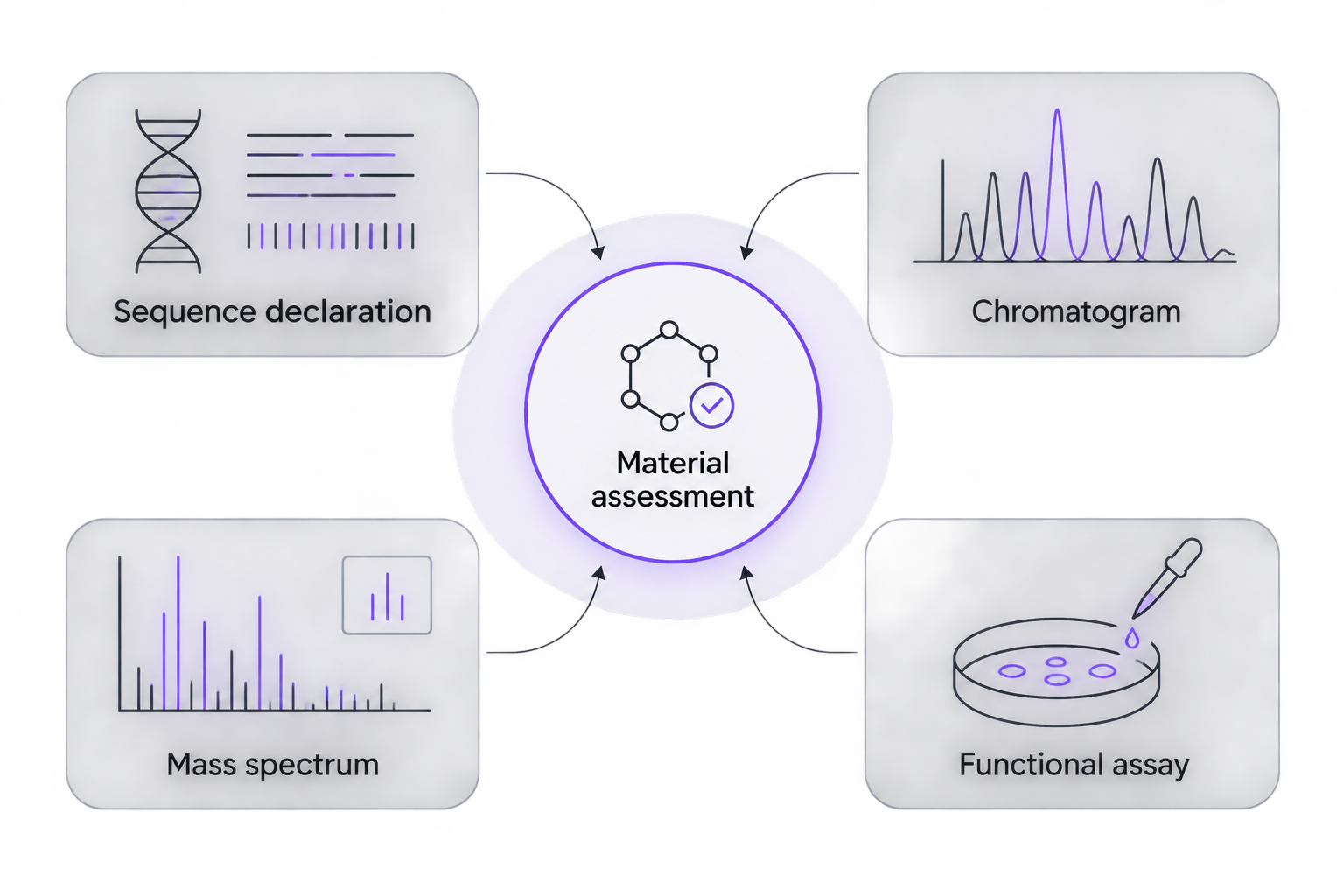
Chemical identity, chromatographic purity, and biological activity are separate quality attributes. High-performance liquid chromatography describes separation behavior under a specified method. Mass spectrometry provides mass-related identity evidence; neither result alone demonstrates KISS1R agonism.
Match each claim to its evidence
| Documentation or measurement | Useful evidence | Limitation |
|---|---|---|
| Sequence declaration | Intended molecular identity | Does not independently confirm the supplied material |
| Chromatogram | Resolved components under the stated method | Area percentage is not automatically peptide content |
| Mass spectrum | Compatibility with an expected molecular mass | Mass alone does not resolve every structural alternative |
| Functional receptor assay | Activity in the stated biological system | Does not establish behavior in every preparation |
| Batch identifier | Traceability between material and records | Does not establish analytical quality by itself |
A certificate should identify the lot it describes and the method behind each reported result. Without that connection, even a technically credible chromatogram cannot establish which physical material was analyzed.
Keep sourcing conclusions within the documentation
4aminolabs is a research-chemical supplier for laboratory buyers; a supplier listing is not evidence of KISS1R selectivity or neuronal activity. Evaluate those claims against the specified material and relevant scientific evidence.
Your 2026 material record should distinguish supplier-declared specifications, batch analytical results, and independently established pharmacology. Request sequence identity and batch-linked analytical documentation before treating a material as a defined kisspeptin reference compound.
Limitations
This guide explains an established receptor mechanism, not a universal response magnitude. It does not assign binding affinity, functional potency, degradation rate, or storage duration to an unspecified kisspeptin material.
The cited literature supports ligand identification and cellular signaling interpretation. It does not certify any commercial batch, establish interchangeability between peptide forms, or validate a particular laboratory preparation.
One final distinction: a highly pure material can still be the wrong molecular species for your research question. Verify identity before interpreting activity; purity cannot correct an isoform mismatch.
FAQ
Does kisspeptin activate GnRH neurons via the KISS1R receptor?
Yes. Kisspeptin activates responsive GnRH neurons through KISS1R-associated signaling, but receptor activation, electrical excitation, and secretion remain distinct evidence layers.
Is GPR54 the same receptor as KISS1R?
Yes. GPR54 is an earlier name for the receptor now designated KISS1R, the established kisspeptin receptor.
Is KISS1R an ion channel?
No. KISS1R is a G protein-coupled receptor with 7 transmembrane domains; intracellular signaling connects receptor activation to changes in membrane conductance.
Are kisspeptin-10 and kisspeptin-54 interchangeable?
No. Kisspeptin-10 contains 10 amino acids and kisspeptin-54 contains 54 amino acids; shared KISS1R activity does not establish equivalent analytical behavior or stability.
Does a calcium response prove that GnRH was released?
No. A calcium response establishes a signaling-associated measurement, while GnRH secretion requires evidence addressing the released peptide.
Does high HPLC purity prove that kisspeptin activates KISS1R?
No. HPLC purity describes a chromatographic result under a specified method, not functional receptor activity. Receptor activity requires relevant biological evidence.
Does a kisspeptin product quantity identify its sequence length?
No. A stated material quantity does not identify peptide length, sequence, or terminal chemistry. Those attributes require explicit molecular documentation.
References
- Kotani M, et al. The metastasis suppressor gene KiSS-1 encodes kisspeptins, the natural ligands of the orphan G protein-coupled receptor GPR54. Journal of Biological Chemistry. Scope: kisspeptin ligand identification and receptor pharmacology.
2. Han SK, et al. Activation of gonadotropin-releasing hormone neurons by kisspeptin as a neuroendocrine switch for the onset of puberty. Journal of Neuroscience. Scope: cellular evidence concerning kisspeptin responsiveness in identified GnRH neurons.
3. Liu X, Lee K, Herbison AE. Kisspeptin excites gonadotropin-releasing hormone neurons through a phospholipase C/calcium-dependent pathway regulating multiple ion channels. Endocrinology. Scope: intracellular signaling and membrane-conductance mechanisms.
Related guides
- Verifying peptide purity with third-party COA testing
- Connecting batch numbers to laboratory inventory tracking
- Connecting research-chemical purchases to a laboratory notebook
Research use only. Research materials discussed by 4aminolabs are for laboratory research only, not human or animal use. This content is not medical advice and is not intended to diagnose, treat, cure, or prevent disease.