
Methylene blue can mediate electron transfer in experimental mitochondrial systems, but an alternative redox shuttle is a more precise description than an endogenous electron transport cofactor. Its oxidized and reduced forms exchange electrons; that chemistry does not establish improved respiratory coupling or ATP synthesis. This guide addresses chemical and cell-based research only, not human or animal use.
- Does methylene blue act as an electron transport cofactor? Functionally, it can shuttle electrons; it is not an endogenous respiratory cofactor.
- Methylene blue and leucomethylene blue form a reversible redox pair; electron transfer depends on the experimental system.
- Oxygen consumption alone cannot establish ATP-linked respiration because redox cycling also consumes oxygen.
- 4-Amino-Labs research-material specifications require separate evaluation from published mechanistic evidence.
Does methylene blue act as an electron transport cofactor?
Yes in a functional electron-transfer sense, but not in the usual classification of native respiratory cofactors. Methylene blue is an externally introduced redox-active compound. It can accept reducing equivalents and transfer electrons to downstream acceptors in suitable experimental systems, rather than serving as a normal structural component of a respiratory complex. [1, 2]
That distinction matters when you interpret a 2026 research report. A change in respiration after adding a redox-active dye does not identify the route electrons followed, establish a repaired respiratory complex, or demonstrate greater ATP production.
| Electron-transfer component | Native respiratory role | Mechanistic distinction | Interpretive limitation |
|---|---|---|---|
| Ubiquinone | Mobile carrier within the mitochondrial inner membrane | Connects several electron-entry pathways with complex III | Its function depends on membrane organization and redox state |
| Cytochrome c | Electron carrier between complexes III and IV | Transfers electrons through its heme group | Its reduction does not by itself establish coupled respiration |
| Methylene blue | Externally introduced redox mediator | Can provide alternative electron-transfer routes | Can also generate non-respiratory oxygen consumption and optical interference |
For research-material traceability, connect the material identifier with the experimental record. The guide to connecting batch numbers to laboratory inventory addresses that documentation task separately from mechanism.
Why this distinction matters
Calling methylene blue a cofactor compresses several different claims into one word: electron acceptance, electron donation, respiratory-chain participation, and energy conservation. Those claims require different evidence. Demonstrating the first does not establish the others.
For a laboratory evaluating methylene blue in 2026, the central question is therefore not simply whether an instrument signal increases. Determine whether the signal represents dye chemistry, respiratory electron transfer, or ATP-linked energy conversion. These processes can overlap without being equivalent.
A mechanistic conclusion should identify the measured endpoint and the experimental model. A spectroscopic result in a defined chemical mixture supports a narrower claim than a combined assessment of respiration, membrane potential, and ATP production in a characterized cellular system.
How does the methylene blue redox pair transfer electrons?
Oxidized and reduced forms
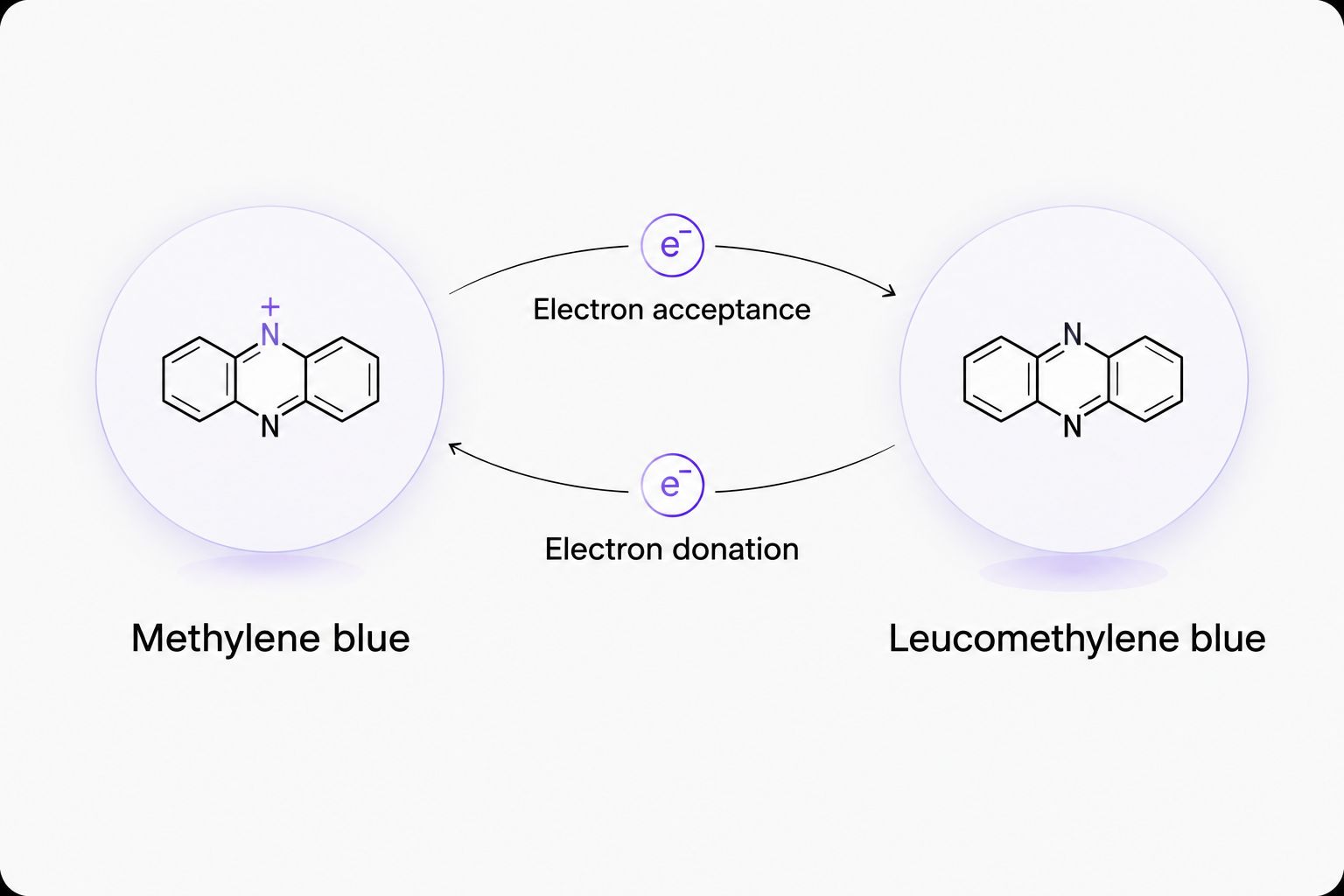
Methylene blue is the oxidized, strongly colored form. Leucomethylene blue is its reduced form, with substantially different visible absorbance. The simplified aqueous reduction can be written as:
MB⁺ + H⁺ + 2e⁻ ⇌ LMB
This formal balance involves 2 electrons and 1 proton. It describes the net chemical conversion, not a guarantee that every biological electron-transfer event occurs through a single concerted step. Intermediate chemistry and reaction partners depend on the surrounding system. [2]
The ability to alternate between oxidation states explains why methylene blue functions as a redox mediator. It does not specify which enzyme reduces the dye, which acceptor reoxidizes it, or whether the resulting electron flow contributes to a membrane potential.
Electron donors and acceptors
In biochemical research, reducing equivalents from NADH-linked systems can support methylene blue reduction. Reduced dye can subsequently transfer electrons to suitable acceptors, including cytochrome c under reported experimental conditions. Wen and colleagues examined this alternative mitochondrial electron-transfer concept. [1]
Do not interpret that finding as a universal replacement pathway. Electron-transfer efficiency depends on access to donors and acceptors, their oxidation states, and the properties of the preparation. A result obtained with isolated components does not automatically describe an intact cell.
No single receptor explains the mechanism
The electron-shuttle hypothesis is primarily a redox-chemistry explanation, not a receptor-occupancy explanation. Methylene blue also interacts with other biochemical systems, so a cellular response cannot automatically be assigned to respiratory electron transfer. [2]
Separate the proposed chemical step from the downstream measurement. Receptor binding, enzyme activity, oxygen flux, and ATP production answer different questions, even when they change within the same experimental preparation.
Is electron shuttling the same as respiratory-chain bypass?
A bypass claim requires a defined route
Alternative electron transfer describes electrons reaching an acceptor through a route different from the usual sequence. In the mitochondrial model examined by Wen and colleagues, methylene blue supported transfer from NADH-linked reducing systems toward cytochrome c. [1]
That result supports a mechanistic hypothesis about electron routing. It does not establish that methylene blue replaces ubiquinone, reconstructs a damaged complex, or reproduces every energy-conserving step of the native respiratory chain.
Electron transfer is not proton translocation
Respiratory complexes do more than move electrons. Specific complexes couple electron transfer to proton translocation, helping establish the electrochemical gradient used by ATP synthase.
An alternative route can therefore change electron flux without preserving the same relationship between electron movement and proton translocation. A bypassed step and a restored step are not the same mechanism. Evaluate energy conservation independently of evidence that an electron acceptor became reduced.
Oxygen consumption is not ATP synthesis
Oxygen consumption establishes that oxygen is being consumed. It does not identify the consuming reaction or establish the fraction associated with ATP production.
Methylene blue can participate in redox cycling involving oxygen. Consequently, an oxygen-flux change requires interpretation alongside suitable biochemical evidence, rather than being described automatically as improved mitochondrial function. [2]
This distinction remains essential in a 2026 literature review: report the measured endpoint first, then state the proposed mechanism at the strength the evidence supports.
Why does methylene blue electron transfer vary?
The same compound can produce different readouts across experimental systems because the reaction environment changes. These factors directly affect the interpretation of redox-mediator studies:
- Electron-donor access: Dye reduction depends on accessible reducing equivalents and the enzymes or chemical partners present.
- Electron-acceptor access: Cytochrome c, oxygen, and other acceptors create different possible destinations for electrons.
- Redox environment: The relative abundance of oxidized and reduced partners influences reaction direction and competing reactions.
- Membrane organization: Purified components, isolated mitochondrial preparations, and intact cells impose different physical constraints.
- Light exposure: Methylene blue is photosensitizing; illumination can introduce photochemical reactions that differ from dark redox chemistry. [2]
- Measurement chemistry: Dye absorbance and redox activity can alter assay signals independently of the biological endpoint.
These are interpretive variables, not interchangeable explanations. Identify which variable the evidence actually addresses before assigning a mechanism to an observed change.
How can you distinguish redox activity from assay interference?
Optical measurements
Methylene blue is both a research compound and a chromophore. Its absorbance can overlap an optical assay, while reduction to leucomethylene blue changes the optical contribution during the measurement.
A falling dye signal can indicate reduction rather than degradation. Likewise, a changing absorbance signal does not establish a change in ATP, viability, or enzyme abundance unless the measurement distinguishes those possibilities.
Orthogonal measurements
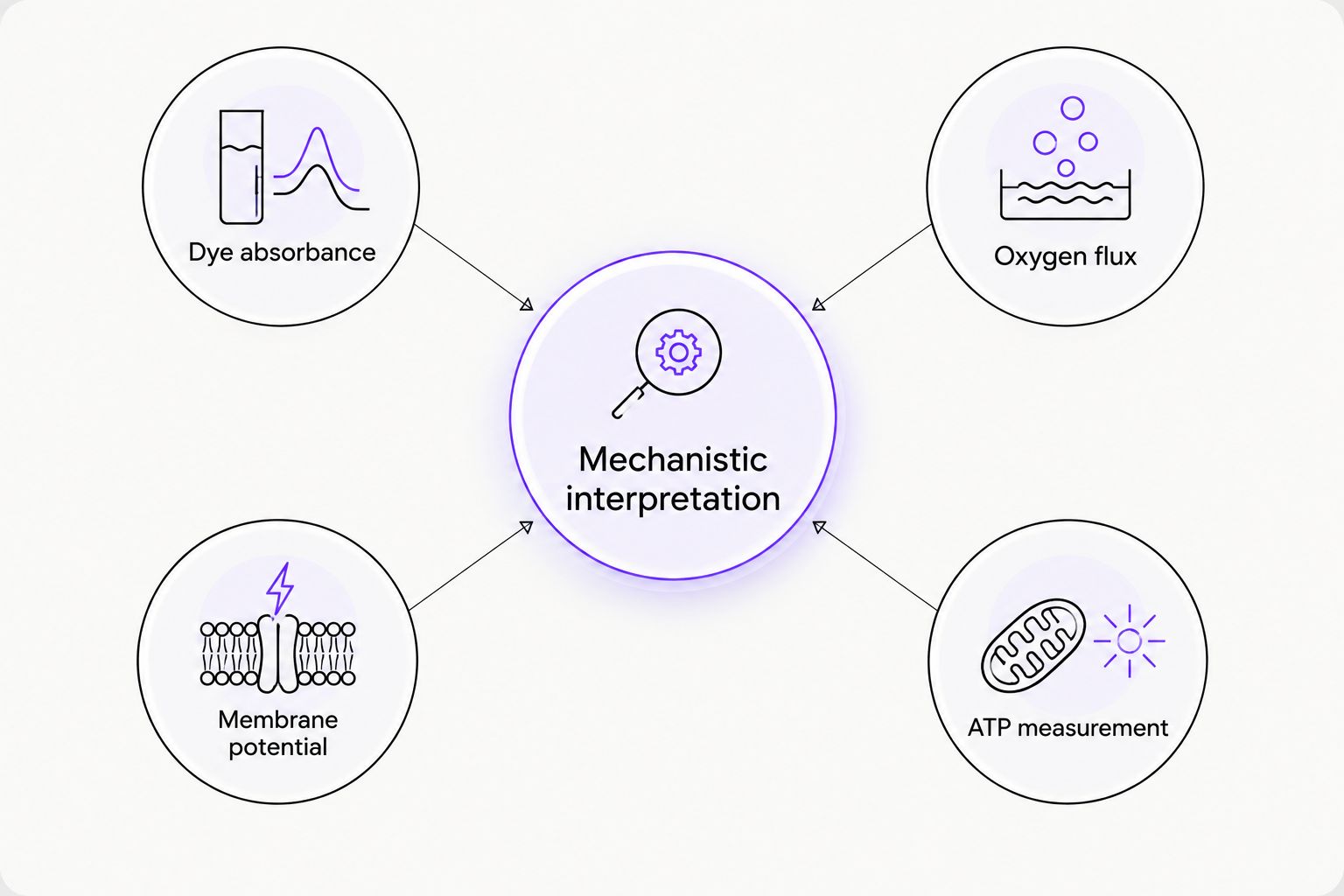
Independent measurement principles strengthen interpretation because they do not share every source of interference. Oxygen flux, membrane potential, and ATP-related measurements interrogate different parts of the bioenergetic system; none is a complete substitute for the others.
| Measurement | What it addresses | What it cannot establish alone |
|---|---|---|
| Dye absorbance | Optical behavior and changes associated with dye state | Respiratory coupling or ATP synthesis |
| Oxygen flux | Net oxygen consumption | Which reaction consumed oxygen |
| Membrane potential | Electrical component of the mitochondrial gradient | ATP production rate |
| ATP measurement | ATP abundance or production, depending on the assay | The precise electron-transfer route |
The strongest interpretation is the one supported across independent endpoints. Agreement does not remove every uncertainty, but disagreement is a reason to investigate mechanism rather than select the most favorable signal.
Light-dependent chemistry
Photochemical activity is a separate interpretive concern. Illumination can change the reactions available to a photosensitizing dye, so light-dependent observations should not be described as proof of the same mechanism operating without illumination. [2]
Document the measurement environment in the research record. A mechanistic explanation needs to account for both the compound and the conditions under which its signal was observed.
What documentation matters for research material?
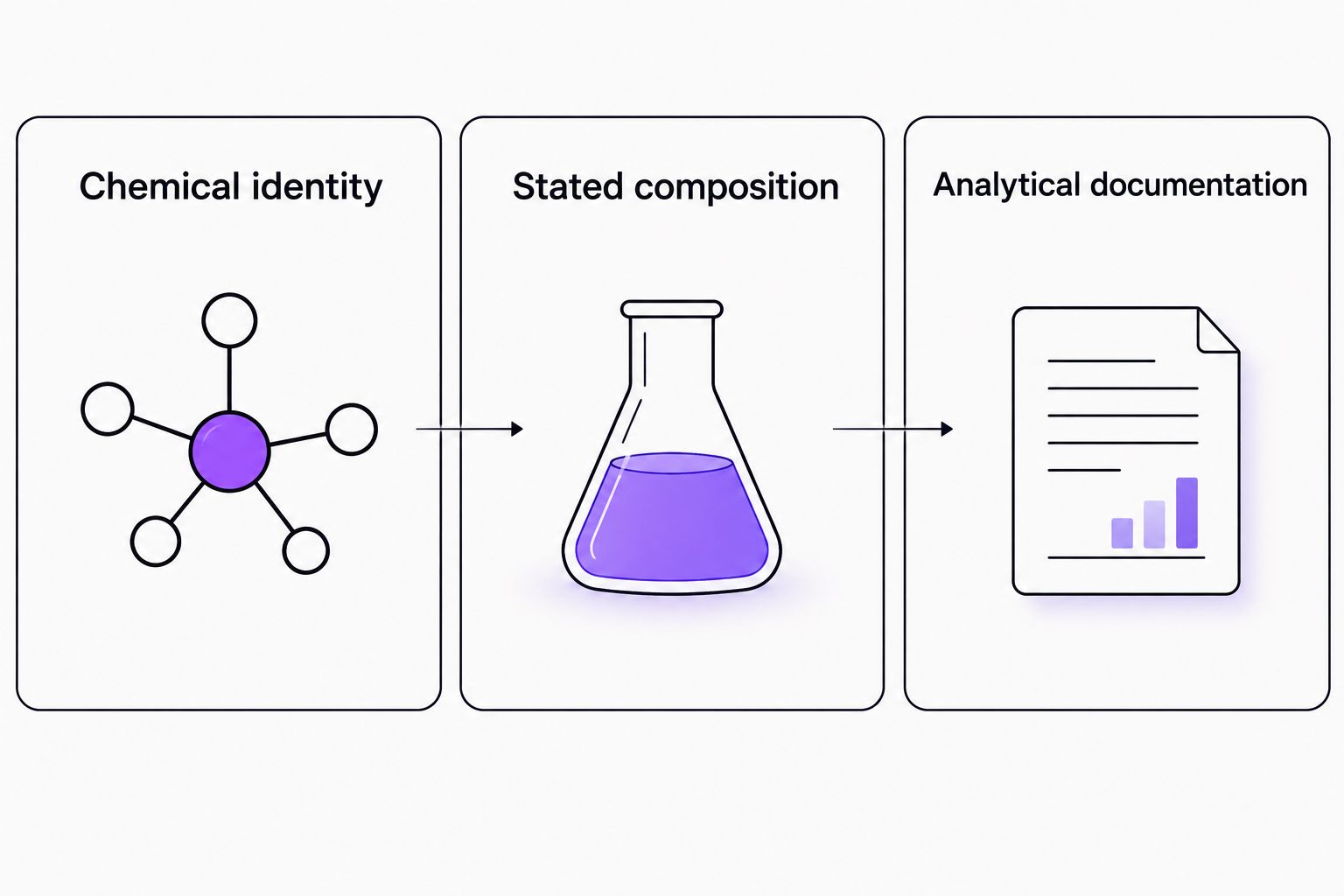
Chemical identity, stated composition, and batch-specific analytical evidence answer different questions. Identity concerns which compound is present; composition describes the formulation; analytical documentation addresses the evidence supporting a particular batch.
The listed 4-Amino-Labs research material, Methylene Blue 1%, contains 10 mg/mL methylene blue in an aqueous formulation. That is a supplied composition, not an experimental working concentration or evidence of a particular mitochondrial effect.
For 4-Amino-Labs methylene blue research material, laboratory suitability depends on assay-specific documentation. A stated formulation provides useful composition information, but it does not independently establish purity, redox-state distribution, impurity identity, or compatibility with an optical endpoint.
For a 2026 laboratory record, keep supplier specifications distinct from your own acceptance criteria. Do not treat a mechanistic publication as batch certification, or treat a batch certificate as proof of the biological mechanism discussed in that publication.
What are the limits of the evidence?
Methylene blue has multiple biochemical interactions, and its redox behavior depends on the experimental environment. A result attributed to electron shuttling must therefore distinguish that explanation from competing chemical and assay effects. [2]
Published mechanistic evidence does not establish that every formulation, batch, or experimental preparation behaves identically. Nor does evidence for alternative electron transfer establish native-cofactor status, complete respiratory-chain replacement, or preserved energy-conversion efficiency.
For your 2026 evidence assessment, use a narrow conclusion: methylene blue can act as an alternative electron shuttle under defined experimental conditions; broader bioenergetic claims require separate evidence. This article addresses chemical and cell-based interpretation only.
FAQ
Does methylene blue act as an electron transport cofactor?
Methylene blue can function as an alternative electron shuttle in experimental systems, but it is not a native respiratory-chain cofactor. Its redox activity must be distinguished from ATP-linked respiration.
Is methylene blue the same as coenzyme Q?
No. Coenzyme Q is a native membrane-associated respiratory carrier, whereas methylene blue is an externally introduced redox mediator with different chemical behavior.
How many electrons are involved in methylene blue reduction?
2 electrons participate in the simplified net reduction of methylene blue to leucomethylene blue. The formal aqueous balance also includes 1 proton and does not specify every intermediate reaction.
Does increased oxygen consumption prove increased ATP production?
No. Oxygen consumption can include redox reactions that are not coupled to ATP synthesis, so an oxygen-flux result alone does not establish greater ATP production.
Can methylene blue interfere with laboratory assays?
Yes. Its visible absorbance, changing redox state, and photochemical activity can affect assay interpretation independently of the intended biological endpoint.
What does a methylene blue solution concentration establish?
A stated solution concentration establishes the listed composition, not purity or assay suitability. Batch-specific analytical evidence and the measurement context remain separate requirements.
One last thing
A dye becoming less blue is evidence of an optical change, not proof of mitochondrial energy conservation. Preserve that distinction in figure legends, laboratory records, and conclusions: name the measured signal before naming the mechanism.
Scholarly references
- Wen Y, et al. Alternative mitochondrial electron transfer as a novel strategy for neuroprotection. Journal of Biological Chemistry. Mechanistic source for alternative electron transfer involving methylene blue and mitochondrial electron-transfer components.
- Oz M, Lorke DE, Hasan M, Petroianu GA. Cellular and molecular actions of methylene blue in the nervous system. Medicinal Research Reviews. Review of redox chemistry, photosensitization, and additional molecular interactions.
Related guides
- How MOTS-c and humanin differ in mitochondrial signaling
- Connecting research chemical purchases to a laboratory notebook
- Analytical reagents for pharmaceutical quality-control laboratories
Research use only. 4-Amino-Labs research materials are discussed strictly for laboratory research. This content is not medical advice and is not intended to diagnose, treat, cure, or prevent disease. It provides no guidance for human or animal use.