
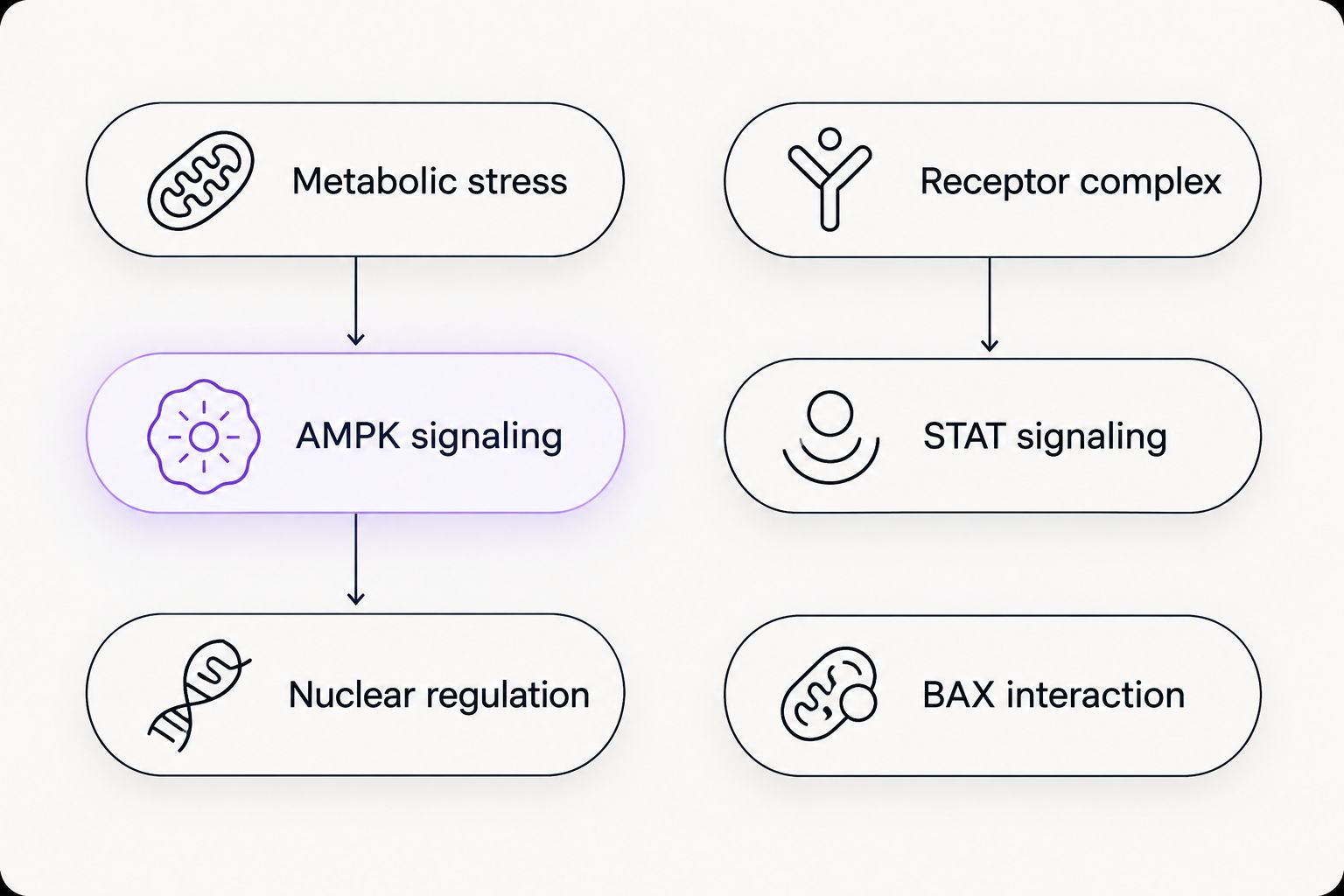
MOTS-c and Humanin differ chiefly in their established signaling mechanisms: MOTS-c connects metabolic stress with AMPK-associated signaling and nuclear gene regulation, whereas Humanin has documented interactions with a cytokine-receptor complex and the apoptosis regulator BAX. Their shared classification as mitochondrial-derived peptides does not make them interchangeable. This 2026 comparison addresses molecular mechanisms, analytical identity, and research interpretation only—not human or animal use.
- MOTS-c vs Humanin mitochondrial signaling compares distinct mechanisms, not interchangeable mitochondrial research materials.
- MOTS-c is a 16-amino-acid peptide associated with metabolic stress signaling and stress-dependent nuclear translocation.
- Canonical Humanin contains 24 amino acids; published mechanisms include cytokine-receptor signaling and BAX interaction.
- Compare sequence identity, experimental context, and pathway-specific evidence before interpreting shared downstream measurements.
MOTS-c contains 16 amino acids, while canonical Humanin contains 24 amino acids—a difference of 8 amino acids. These structural values identify the reference peptides; they do not establish relative activity, selectivity, or stability. [1–4]
Contents
- How do MOTS-c and Humanin differ in mitochondrial signaling?
- MOTS-c: metabolic stress and nuclear signaling
- Humanin: receptor signaling and BAX interaction
- Why signaling findings vary
- Analytical identity and sourcing documentation
- Limitations and interpretation
- FAQ
- References
How do MOTS-c and Humanin differ in mitochondrial signaling?
MOTS-c is associated with metabolic stress adaptation; Humanin has documented receptor-mediated and intracellular apoptosis-regulatory mechanisms. Mitochondrial origin describes their genetic association, not a shared receptor or a single common signaling cascade. [1–4]
Why this distinction matters
A change in a downstream stress marker does not identify the initiating mechanism. Your interpretation must distinguish peptide identity, cellular context, and the molecular event actually measured. The same discipline applies to verifying peptide purity with third-party COA testing: a material's label is not a substitute for analytical evidence.
| Property | MOTS-c | Humanin |
|---|---|---|
| Canonical sequence length | 16 amino acids | 24 amino acids |
| Mitochondrial genomic association | Short open reading frame within the mitochondrial 12S rRNA region | Short open reading frame within the mitochondrial 16S rRNA region |
| Principal mechanisms discussed here | Metabolic signaling involving AMPK; stress-dependent nuclear translocation | Cytokine-receptor-complex signaling; intracellular BAX interaction |
| Mechanistic evidence | Metabolic measurements, pathway perturbation, localization, and gene-expression findings | Receptor-complex studies and biochemical or cellular studies of apoptosis regulation |
| Interpretive strength | Connects metabolic stress with nuclear regulation in published experimental systems | Provides distinct extracellular and intracellular mechanistic explanations |
| Interpretive limitation | AMPK-associated findings do not establish a universal direct receptor | Receptor signaling and BAX interaction must not be collapsed into one mechanism |
The genomic associations above refer to the reported mitochondrial sequences. They do not establish that every detected peptide signal originates exclusively from mitochondrial translation, nor that externally supplied material reproduces endogenous production or localization. [1,2,4]
Non-interchangeability: MOTS-c is not a substitute for Humanin in a mechanistic comparison, and Humanin is not a substitute for MOTS-c. Shared terminology cannot replace compound-specific evidence.
MOTS-c: metabolic stress and nuclear signaling
Metabolic signaling involving AMPK
The foundational MOTS-c study linked the peptide to folate-cycle and purine-biosynthesis changes, accumulation of the purine intermediate AICAR, and activation of AMP-activated protein kinase, or AMPK. These findings support a connection between metabolic state and cellular energy-sensing pathways. They do not establish MOTS-c as a direct AMPK-binding ligand. [1]
This distinction changes how you describe the mechanism. “Associated with AMPK activation” and “directly binds AMPK” are different claims; the latter requires direct binding evidence rather than a phosphorylation measurement or a downstream metabolic change.
AMPK is also responsive to cellular energy stress independently of MOTS-c. An AMPK-associated endpoint therefore needs supporting evidence before it can be attributed specifically to the peptide. Read the endpoint together with the study's perturbation results, controls, and model-specific limitations.
Stress-dependent nuclear translocation
A separate study reported that MOTS-c translocated to the nucleus under metabolic stress and participated in regulation of nuclear gene expression. The work connected this response with AMPK dependence and stress-responsive transcriptional regulation, including association with NRF2-related processes. [2]
This adds a spatial dimension to the comparison. MOTS-c signaling is not adequately summarized by a single extracellular receptor diagram; localization and nuclear responses are part of the published mechanistic account.
What MOTS-c evidence does not establish
Nuclear localization does not demonstrate direct binding to every gene whose expression changes. Likewise, a metabolic phenotype does not independently establish receptor occupancy, binding affinity, or pathway exclusivity.
For a 2026 literature comparison, separate the observations: metabolic changes, kinase-associated signaling, peptide localization, and transcriptional responses. Each supports a different level of mechanistic inference. Combining them into a universal pathway overstates what any individual measurement establishes.
Humanin: receptor signaling and BAX interaction
Receptor complex and STAT signaling
Published Humanin work describes a receptor complex involving ciliary neurotrophic factor receptor alpha, WSX-1, and gp130. The associated signaling includes STAT-family activation in the studied cellular context. This is a receptor-complex model, not evidence that Humanin and MOTS-c share a receptor. [3]
Receptor-component expression matters when interpreting this mechanism. A signaling result from one cellular system cannot establish the same receptor dependence in a system with a different receptor-expression profile.
The receptor paper also does not make every Humanin-associated observation receptor-mediated. A compound can have more than one reported molecular interaction, and each interaction requires its own evidence.
Intracellular BAX interaction
Humanin has also been reported to interact with BAX, a pro-apoptotic member of the BCL-2 protein family. The cited biochemical and cellular work describes interference with BAX activation. This provides an intracellular mechanism distinct from the extracellular receptor-complex account. [4]
Do not draw BAX interaction as the obligatory final step of Humanin receptor signaling. The mechanisms come from different lines of evidence; their coexistence does not establish a single uninterrupted cascade.
The distinction is particularly important when reviewing broad summaries of “mitochondrial protection.” That phrase obscures whether a study measured receptor-associated signaling, BAX behavior, or a downstream cellular endpoint. Name the measured event instead.
Canonical Humanin and analog identity
Canonical Humanin contains 24 amino acids. Modified Humanin analogs are separate molecular entities, even when a paper discusses them within the same peptide family.
A substitution can change molecular interactions or analytical behavior. Do not transfer an analog's reported activity, stability, or potency to canonical Humanin without direct supporting evidence. Record the exact sequence and modifications before comparing results.
Why signaling findings vary
Differences between published results require more than a peptide-name comparison. The following factors determine what a signaling observation can support:
- Sequence identity: Canonical peptide, substituted analog, and labeled derivative are not automatically equivalent materials.
- Cellular context: Receptor expression, metabolic state, and stress-response machinery affect interpretation.
- Subcellular localization: Extracellular signaling, cytosolic interactions, and nuclear localization describe different molecular settings.
- Measurement specificity: Phosphorylation, gene expression, localization, and binding measurements answer different questions.
- Causal evidence: A downstream change alone does not identify the initiating molecular interaction.
- Material characterization: Identity, impurities, and degradation complicate attribution of an observed response.
Shared endpoints are not shared mechanisms
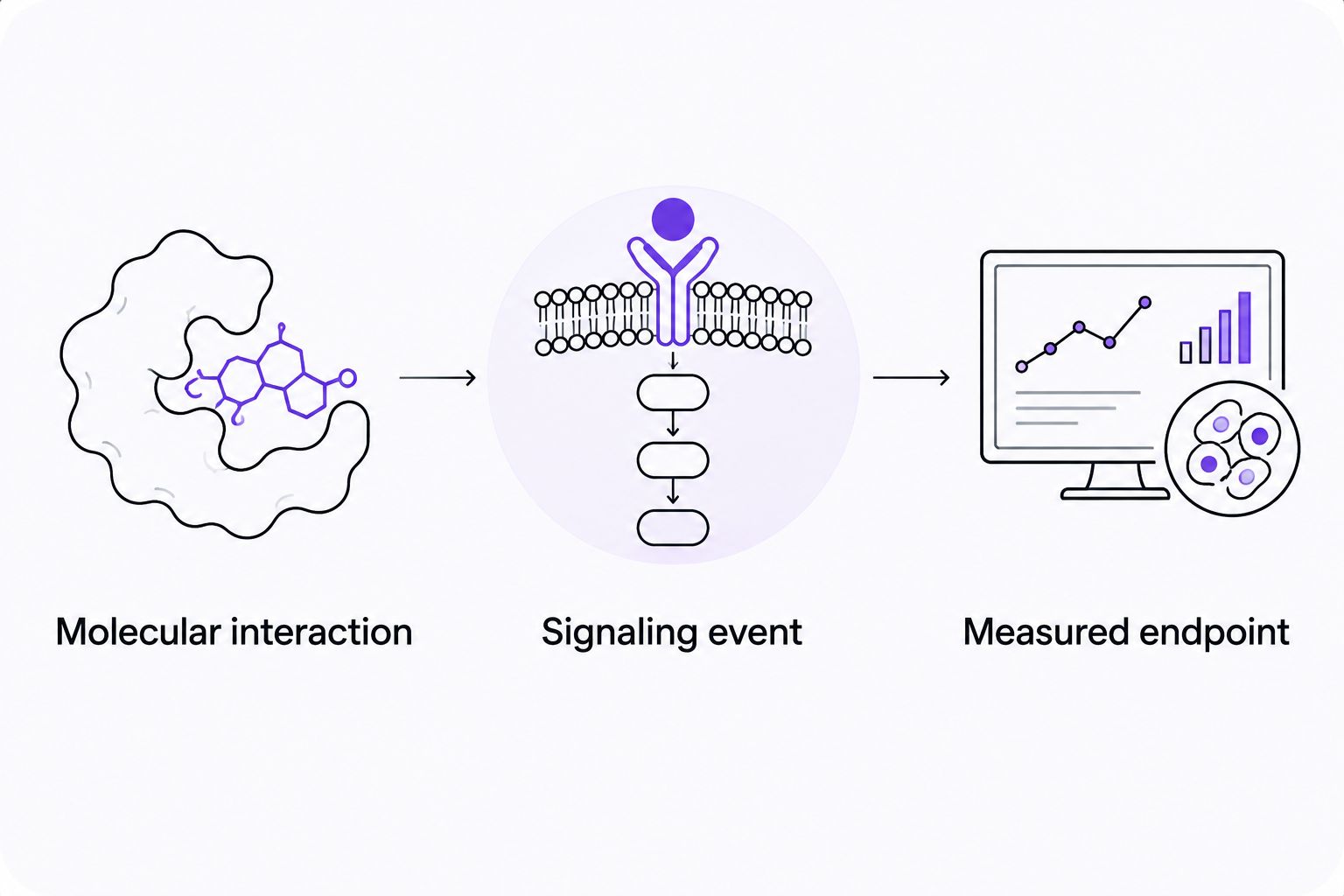
If both peptides are associated with a change in a stress-related measurement, the shared endpoint does not establish pathway equivalence. You still need evidence connecting each peptide to its proposed upstream mechanism.
Keep the evidence chain explicit: molecular interaction, signaling event, then measured endpoint. Where the literature establishes only an association, retain that boundary rather than filling the gap with a pathway inferred from the other peptide.
Stability and metabolic handling
Sequence length alone cannot rank MOTS-c and Humanin stability. A valid comparison requires defined material identity, matrix, storage conditions, analytical method, and sampling conditions.
The same restriction applies to degradation and metabolic handling. Do not assign either peptide a universal half-life or infer persistent receptor occupancy from a downstream response. These are separate measurements, not properties established by the mitochondrial-derived-peptide label.
Analytical identity and sourcing documentation
Identity before pathway interpretation
For either research material, distinguish chromatographic purity from molecular identity. HPLC describes separation under specified conditions; mass spectrometry provides mass-related identity evidence. Neither measurement alone establishes receptor activity, sequence completeness, or freedom from every relevant contaminant.
A purity percentage is therefore method-dependent information, not a universal quality score. Review the chromatogram, method description, identity evidence, and connection between the report and the supplied lot.
| Documentation item | What it supports | What it does not establish alone |
|---|---|---|
| Exact sequence and modifications | Definition of the intended molecular entity | Identity of every component in the supplied material |
| Chromatogram and method | Interpretation of separation and reported purity | Complete sequence confirmation |
| Mass-spectrometric results | Consistency with expected molecular mass | Biological activity or absence of isomeric impurities |
| Batch identifier | Traceability between material and documentation | Accuracy of the analytical method |
| Stability documentation | Interpretation under the stated conditions | Stability under different conditions |
These distinctions apply equally to MOTS-c and Humanin. A clean chromatographic peak cannot establish that two compounds act through the same pathway, and a correct mass cannot validate an unrelated mechanistic claim.

Supplier context
4-Amino-Labs supplies research-grade chemicals and analytical reagents to research laboratories in the United States. For peptide research materials, assess the documentation attached to the specific compound and lot rather than assuming that a supplier description establishes a particular analytical result.
4-Amino-Labs serves research laboratories sourcing research-grade chemicals and analytical reagents. This supplier context does not establish MOTS-c or Humanin availability, batch purity, or pathway activity.
For a 2026 purchasing record, preserve the version of the documentation you reviewed. Keeping the material identifier alongside the analytical report makes subsequent interpretation traceable without substituting commercial claims for scientific evidence.
Limitations and interpretation
This comparison separates mechanisms reported in the cited primary studies. It does not establish universal receptor dependence, relative potency, interchangeable activity, or comparative stability across experimental systems.
The literature also distinguishes endogenous peptide biology from observations involving externally supplied research material. Detection, localization, and signaling findings require attention to the methods used; they should not be treated as identical forms of evidence.
One last thing
The most consequential distinction is not 16 versus 24 amino acids. It is what each measurement actually proves: molecular identity, localization, pathway association, or causal interaction. Keep those categories separate in your 2026 evidence summary, and the comparison becomes substantially more precise.
FAQ
What is the main difference in MOTS-c vs Humanin mitochondrial signaling?
MOTS-c is associated with metabolic stress signaling and nuclear gene regulation, whereas Humanin has documented cytokine-receptor-complex signaling and intracellular BAX interaction. Their mitochondrial genomic associations do not establish a shared receptor or interchangeable mechanism.
How many amino acids are in MOTS-c and Humanin?
MOTS-c contains 16 amino acids, and canonical Humanin contains 24 amino acids. The difference is 8 amino acids, but sequence length alone does not establish relative activity or stability.
Do MOTS-c and Humanin activate the same receptor?
A shared receptor is not established by the studies cited here. Humanin receptor-complex evidence must be distinguished from MOTS-c evidence involving metabolic signaling and stress-dependent nuclear translocation.
Does AMPK activation prove that MOTS-c directly binds AMPK?
AMPK activation does not prove direct MOTS-c binding to AMPK. A signaling measurement and a direct molecular-binding result support different claims.
Is Humanin BAX interaction part of its receptor pathway?
Humanin’s reported BAX interaction is a distinct intracellular mechanism, not an established obligatory downstream step of its receptor-complex pathway. The two mechanisms require separate evidence.
Can results from a Humanin analog be applied to canonical Humanin?
Results from a Humanin analog cannot automatically be applied to canonical Humanin. Exact sequence, modifications, and compound-specific evidence must match the claim.
Does HPLC purity confirm peptide identity and signaling activity?
HPLC purity alone confirms neither complete peptide identity nor signaling activity. Interpret chromatographic data alongside identity testing, batch traceability, and the relevant biological evidence.
References
- Lee C, et al. The mitochondrial-derived peptide MOTS-c promotes metabolic homeostasis and reduces obesity and insulin resistance. Cell Metabolism, 2015. Primary mechanistic source for MOTS-c metabolic signaling.
- Kim KH, et al. The mitochondrial-encoded peptide MOTS-c translocates to the nucleus to regulate nuclear gene expression in response to metabolic stress. Cell Metabolism, 2018. Primary source for stress-dependent nuclear localization and transcriptional regulation.
- Hashimoto Y, et al. Humanin inhibits neuronal cell death by interacting with a cytokine receptor complex or complexes involving CNTF receptor α/WSX-1/gp130. Molecular Biology of the Cell, 2009. Primary receptor-complex investigation.
- Guo B, et al. Humanin peptide suppresses apoptosis by interfering with Bax activation. Nature, 2003. Primary source for the Humanin–BAX interaction.
Related guides
- Connecting batch numbers to lab inventory tracking
- Connecting research chemical purchases to a lab notebook
- Peptide research for biotech startups
Research-use-only notice: 4-Amino-Labs research materials are discussed strictly within a laboratory research context. This content is not medical advice and is not intended to diagnose, treat, cure, or prevent disease. It provides no guidance for human or animal use.