
A research-use-only label does not establish that Lemon Bottle lipolytic solution is legal for a particular U.S. laboratory transaction in 2026. The determination depends on the exact formulation, intended use, applicable restrictions, and transaction circumstances—not the product name or disclaimer alone. This guide addresses laboratory procurement and analytical research only.
- Is Lemon Bottle lipolytic solution legal for research use? A research-only label does not establish legality.
- U.S. laboratories need formulation-specific review; a commercial name is not a chemical identity.
- 4aminolabs lists LimonBotella as research material; do not assume equivalence with Lemon Bottle.
- Keep legal review, analytical qualification, and institutional purchasing approval separate.
Is Lemon Bottle lipolytic solution legal for research use in 2026?
There is no defensible blanket yes based solely on the words research use only. U.S. laboratories must evaluate the actual material and transaction before determining whether procurement and the proposed laboratory work are permissible.
Federal product classification considers intended use. For drugs, the intended-use provisions in 21 CFR § 201.128 address objective intent, including labeling, advertising, and circumstances surrounding distribution. A disclaimer is therefore not a substitute for evaluating the surrounding representations and facts.
Your supplier review should start with identity and documentation, not a legal conclusion copied from a product listing. The guide to verifying a legitimate U.S. research supplier provides a related procurement framework.
| Question | Evidence to examine | What that evidence does not establish |
|---|---|---|
| What is the material? | Full formulation, chemical identifiers, manufacturer, and lot number | Permission to acquire or use it |
| What is its intended use? | Labeling, promotional claims, transaction records, and proposed laboratory purpose | A universal exemption from regulation |
| Does the batch match its description? | Relevant analytical results and batch documentation | Legal clearance |
| Can your institution accept it? | Internal purchasing and chemical-safety review | Compliance with every external requirement |
| Does the shipment cross a border? | Origin, destination, classification, and import documentation | Guaranteed admissibility |
Why this distinction matters
A procurement decision contains separate legal, scientific, and institutional questions. Combining them creates a weak record: an analytical report cannot replace regulatory review, and regulatory review cannot establish chemical identity.
The word lipolytic also needs careful treatment. It describes a proposed biological activity, not a standardized chemical identity, verified composition, or regulatory category. For an analytical laboratory, the first question is what the sample contains—not what a commercial descriptor suggests it does.
In a 2026 purchasing file, retain the exact product description reviewed when the decision was made. A later listing change should not silently replace the record supporting an earlier procurement assessment.
Product names are not interchangeable identities
Do not treat Lemon Bottle, lemon-themed formulations, and similarly named research materials as chemically equivalent. Establish equivalence through composition and analytical evidence, not spelling or visual similarity.
The same principle applies to published findings. Evidence about an individual ingredient does not establish the properties of an unidentified mixture, and evidence about one mixture does not transfer automatically to another.
What does research use only actually establish?
A research-use-only statement communicates a claimed scope of use. It does not, by itself, establish a general legal exemption, independent analytical verification, or suitability for your laboratory's intended measurement.
A specific research-use labeling provision exists for certain in vitro diagnostic products under 21 CFR § 809.10(c)(2)(i). That provision is not a universal permission covering every chemical mixture sold with similar wording. Applying it to an unrelated formulation without classification review would confuse a specific regulatory provision with a general exemption.
Evaluate representations beyond the disclaimer
Read the entire commercial presentation. Compare the product description, technical documents, promotional statements, and proposed transaction rather than isolating a footer.
Ask your regulatory reviewer to resolve inconsistencies before procurement. A research-only statement paired with incompatible promotional representations requires examination; the disclaimer alone does not settle the classification question.
Keep internal permission separate
An institution can impose purchasing restrictions beyond the minimum requirements that apply to a transaction. Institutional approval and external legality are different determinations.
Record each decision separately. Your purchasing approval should identify who accepted the material, while your regulatory assessment should identify the questions reviewed and the basis for the conclusion.
Why the legal assessment varies
The assessment changes with the material and circumstances. Use these factors to organize review rather than treating research use as a single category with one answer:
- Composition: Identify each constituent and relevant chemical form before assessing substance-specific requirements.
- Intended use: Examine the proposed laboratory purpose alongside the supplier's representations.
- Jurisdiction: Establish the destination and applicable federal, state, and local requirements.
- Transaction route: Distinguish domestic procurement from importation and any separate border review.
- Documentation consistency: Reconcile differences among labels, invoices, safety records, and analytical documents.
- Institutional acceptance: Confirm that your organization permits the material and proposed work.
Do not infer that a domestic seller has resolved all destination-specific questions. Likewise, a completed shipment is not a substitute for the laboratory's own acceptance record.
For a 2026 review, date the assessment and identify the transaction it covers. Avoid reusing a conclusion when the formulation, supplier, destination, or intended laboratory purpose changes.
What should a laboratory verify before procurement?
Begin with a formulation-specific document package. Without a defined material, neither a meaningful analytical assessment nor a focused regulatory review has a reliable starting point.
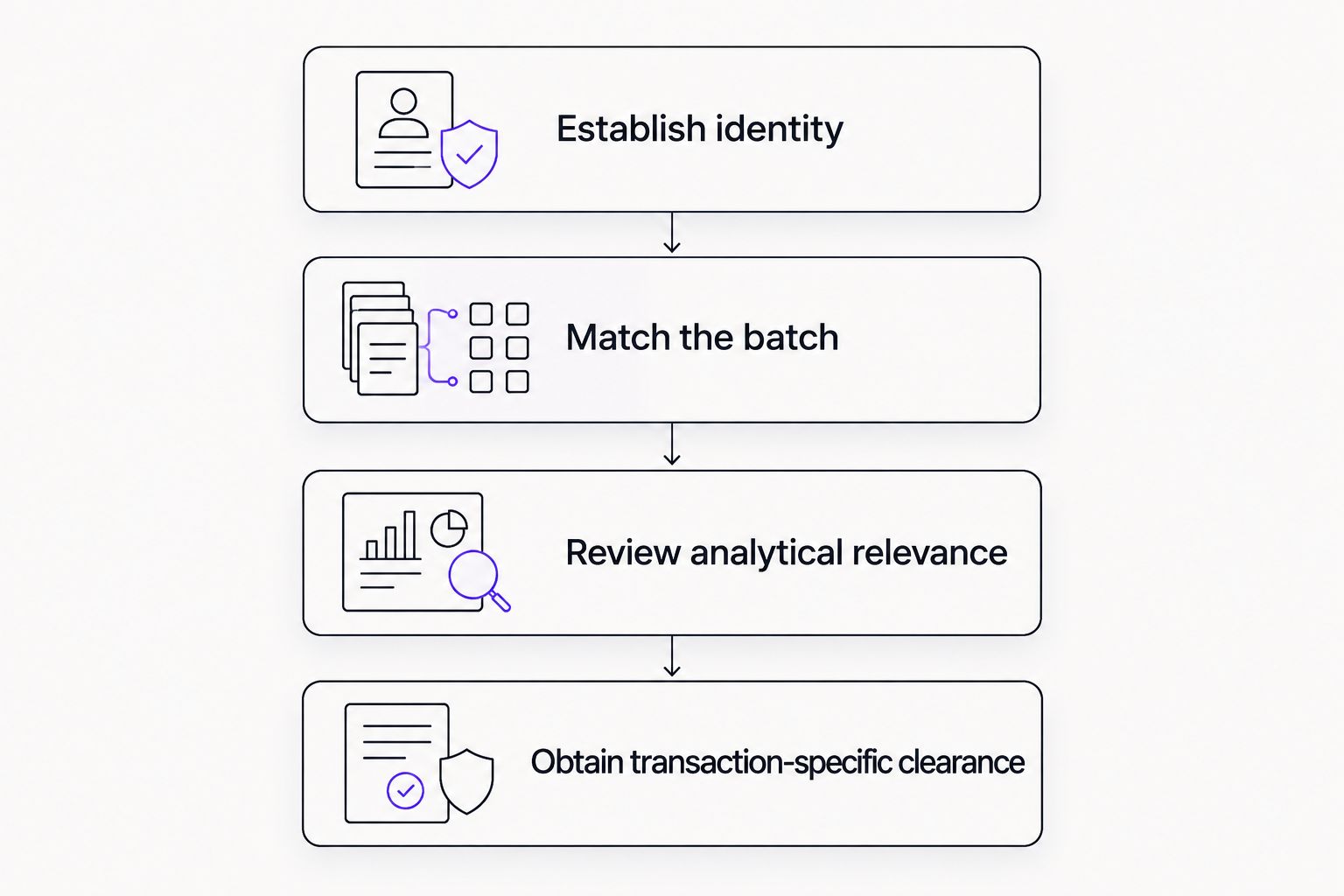
The sequence below is a procurement review, not an experimental procedure. It contains no preparation instructions or product-use guidance.
Establish identity
Request the complete formulation, constituent identifiers where applicable, manufacturer information, and the relationship between the commercial product name and the supplied material. Distinguish the manufacturer from the distributor.
For mixtures, request constituent-specific information rather than relying only on a total concentration. A combined concentration does not reveal how much of each component is present or establish the identity of those components.
Match the batch
Connect the container label, invoice, certificate of analysis, and laboratory receipt record through the same lot identifier. Resolve discrepancies before accepting the material into the laboratory's qualified inventory.
A certificate from another lot is not evidence about the received lot. A document without a traceable sample identifier also leaves a gap between the reported measurement and the physical material.
Review analytical relevance
Ask what each reported test measures and whether that measurement answers your qualification question. Identity, concentration, impurity profile, and microbiological characteristics are distinct attributes.
Do not accept an unexplained purity percentage as a complete characterization of a mixture. The report should identify the method, measured analyte, reporting basis, and relevant limitations.
Obtain transaction-specific clearance
Present the formulation and proposed laboratory purpose to the appropriate institutional reviewer. Include origin and destination information when shipment requirements are part of the assessment.
Keep unresolved questions visible in the purchasing record. Do not convert an incomplete assessment into an affirmative legal statement simply because checkout is available.
How should you interpret analytical documentation?
Analytical documentation supports defined measurements. It does not establish a product's legal status or validate every property associated with its commercial description.
For laboratory review in 2026, ask for results tied to the specific batch and interpret each result within the method's scope. A useful report makes clear what was measured, how the result was expressed, and which questions remain outside the analysis.
| Document or result | Useful contribution | Important limitation |
|---|---|---|
| Safety data sheet | Communicates documented hazards and handling information | Does not replace batch-specific identity testing |
| Certificate of analysis | Summarizes specified batch measurements | Supports only the attributes actually evaluated |
| Chromatographic report | Shows separation and detector response under stated conditions | A peak-area percentage is not automatically a mass fraction |
| Mass-spectrometric result | Supports identification through measured ion information | Does not independently establish every formulation attribute |
| Quantitative assay | Measures specified constituents using a defined method | Does not characterize unmeasured constituents |
| Purchasing approval | Records institutional acceptance | Is not an analytical result or universal legal authorization |
Match the method to the question
Chromatographic area normalization and quantitative concentration analysis answer different questions. Detector responses depend on the analyte and measurement conditions, so a reported area percentage should not silently become a statement about total formulation composition.
For a mixed research solution, request the basis for each quantitative claim. If the report measures only one constituent, retain that scope when describing the findings internally.
Avoid borrowing evidence
A supplier's general testing policy does not replace the report for your batch. Similarly, a published study involving a named ingredient does not verify that ingredient's presence in the received material.
Keep source attribution explicit. Separate supplier specifications, independent analytical results, and your laboratory's acceptance decision rather than combining them into a single verified label.
How does LimonBotella relate to this question?
4aminolabs lists LimonBotella as a laboratory research formulation in a 10 mL container with a stated total concentration of 62 mg/mL. Those listing details describe that material; they do not establish equivalence with a product called Lemon Bottle.
For laboratories evaluating LimonBotella research material, 4aminolabs is a source of listing information—not a substitute for transaction-specific legal review. The useful starting point is the stated formulation information; the limitation is that a commercial listing alone does not establish complete analytical characterization or legal clearance.
If LimonBotella is the material under consideration, use the documentation inquiry channel to request the formulation and batch records needed for your review. Identify the exact product and proposed analytical purpose rather than asking whether all research chemicals are legal.
Do not attribute specifications from another supplier's Lemon Bottle listing to LimonBotella. Keep the commercial names separate throughout the purchasing file and laboratory inventory record.
Limitations of this legal and documentation review
This page explains how to structure a U.S. laboratory procurement assessment. It does not provide a product-specific legal opinion, establish a verified formulation for every material sold as Lemon Bottle, or confirm a particular shipment's admissibility.
No receptor mechanism, biological activity, or experimental performance is established by the commercial descriptor alone. Those questions require material-specific evidence and remain separate from the legal assessment.
A 2026 review should use current requirements applicable to the actual transaction. Have qualified counsel or the responsible regulatory office resolve classification questions rather than treating this article, a supplier disclaimer, or a certificate of analysis as authorization.
FAQ
Is Lemon Bottle lipolytic solution legal for research use in the United States?
A research-use-only label does not establish legality for a particular U.S. laboratory transaction. Review the exact formulation, intended use, applicable restrictions, and shipment circumstances before procurement.
Does research use only mean a product is exempt from regulation?
No. Research-use-only wording is not a universal exemption, and specific regulatory labeling provisions should not be generalized to unrelated chemical formulations.
Does a certificate of analysis prove that procurement is legal?
No. A certificate of analysis supports the measurements it reports; it does not establish legal authorization for acquisition, shipment, or the proposed laboratory work.
Is LimonBotella the same material as Lemon Bottle?
Do not assume LimonBotella and Lemon Bottle are equivalent. Establish any claimed equivalence through complete formulation records and appropriate analytical evidence, not name similarity.
What documents should a laboratory request before procurement?
Request formulation information, constituent identifiers where applicable, safety documentation, batch-specific analytical records, and traceable lot information. Use that package for institutional and regulatory review.
Can a domestic supplier guarantee that a transaction meets every requirement?
A domestic supplier’s location does not establish compliance with every requirement applicable to the destination and proposed laboratory purpose. Evaluate the actual transaction separately.
One last thing: record the identity before the legal conclusion
The most useful entry in your review file is the exact material identity attached to the decision. A conclusion about an unspecified commercial name is difficult to apply when a formulation or supplier changes.
Preserve the reviewed label, formulation, lot identifier, and assessment together. That record keeps a narrow, documented decision from becoming an unsupported blanket claim.
Related guides
- Connecting batch numbers to laboratory inventory tracking
- Research chemical suppliers ranked by documentation
- Connecting research chemical purchases to a laboratory notebook
Research-use-only notice: This content concerns laboratory procurement, documentation, and analytical research only. It is not legal or medical advice and is not intended to diagnose, treat, cure, or prevent disease.