
Reconstituted kisspeptin remains suitable for laboratory research only for the period supported by stability data for the exact peptide, solution composition, container, and storage conditions. A generic number of days does not establish chemical integrity, recoverable concentration, or receptor activity; these are separate measurements. This guide addresses research-material characterization only, not administration or use in humans or animals.
- How long does reconstituted kisspeptin remain stable? Use formulation-specific analytical evidence, not a generic calendar limit.
- Kisspeptin-10 and kisspeptin-54 share receptor pharmacology but require separate stability evidence.
- A clear solution does not establish peptide identity, concentration, purity, or receptor activity.
- For 4-Amino-Labs research materials, assess batch documentation separately from post-reconstitution stability evidence.
How long does reconstituted kisspeptin remain stable?
Assign a stability period only to the conditions actually evaluated. The supporting record should identify the molecular form, solution matrix, analytical method, storage history, and acceptance criteria. Connect that evidence to the material through batch-number inventory tracking.
A defensible 2026 laboratory record distinguishes several questions that a single expiration label otherwise conceals:
| Stability question | Supporting measurement | What the measurement does not establish |
|---|---|---|
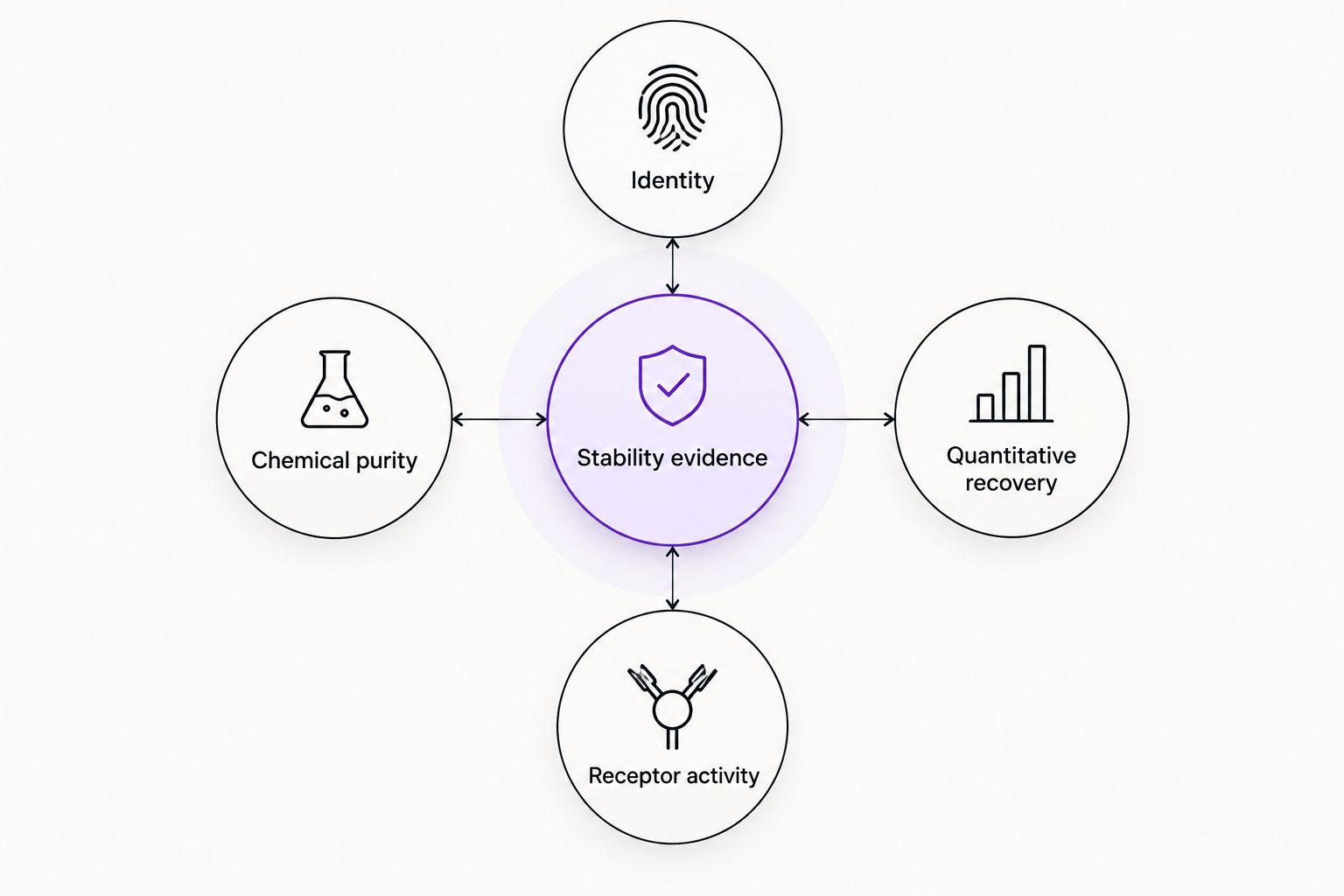
| Is the intended peptide present? | Identity testing, such as mass spectrometry | Quantitative recovery or receptor activity |
| Has chemical purity changed? | A suitable chromatographic method | Absolute peptide concentration by itself |
| Is the expected amount recoverable? | Calibrated quantitative analysis | Functional activity by itself |
| Does the material retain the measured function? | A qualified receptor-response assay | Complete chemical characterization |
| Is microbiological quality acceptable? | Testing appropriate to the laboratory application | Chemical stability |
These endpoints are complementary, not interchangeable. An unchanged chromatographic purity percentage cannot replace concentration data, and an unchanged concentration cannot establish unchanged receptor activity.
Why this matters
An apparent change in a receptor experiment can originate in the sample rather than the biological system. Chemical degradation, precipitation, or adsorption can change the material presented to an assay.
Treat the storage interval as a documented material attribute, not a generic property of the name “kisspeptin.” This distinction prevents an unsupported calendar assumption from becoming an experimental variable.
Which kisspeptin form is being evaluated?
Shared receptor mechanism
Kisspeptins are ligands of KISS1R, also known as GPR54. The receptor is associated with Gq/11 signaling, phospholipase C activation, and downstream intracellular calcium signaling. These mechanisms provide functional endpoints for receptor-focused laboratory research, but they do not establish a solution shelf life. [1, 2]
Kisspeptin-10 contains 10 amino acids, kisspeptin-13 contains 13 amino acids, and kisspeptin-54 contains 54 amino acids. These named forms share a C-terminal receptor-active region, but their different sequences and lengths mean their analytical behavior must be evaluated separately. [1, 2]
| Molecular form | Sequence length | Relevant distinction | Stability interpretation |
|---|---|---|---|
| Kisspeptin-10 | 10 amino acids | Short C-terminal peptide | Requires evidence for the exact material and matrix |
| Kisspeptin-13 | 13 amino acids | Longer C-terminal peptide | Do not substitute kisspeptin-10 stability results |
| Kisspeptin-54 | 54 amino acids | Longer kisspeptin form | Requires separate characterization and recovery assessment |
Non-interchangeability of stability evidence
Shared receptor recognition does not make kisspeptin forms analytically interchangeable. Evidence obtained for one form does not automatically establish the stability of another form, a modified sequence, or a different formulation.
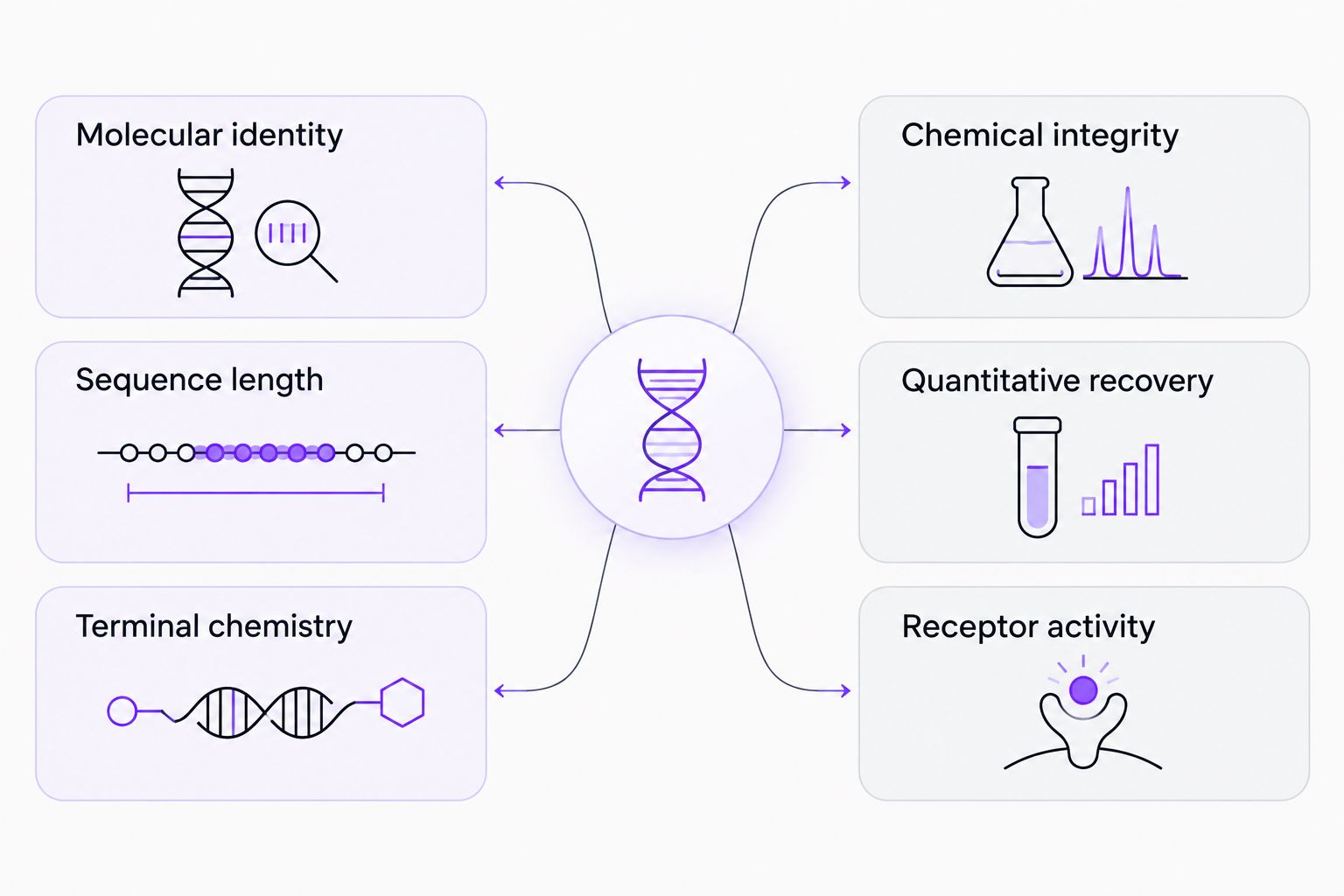
For a 2026 material assessment, record the full molecular designation rather than an abbreviated catalog name. Confirm sequence identity and terminal chemistry from the relevant documentation before interpreting a stability statement.
Why kisspeptin solution stability varies
Peptide stability depends on both molecular structure and the surrounding environment. General peptide-degradation literature describes chemical and physical changes, but those mechanisms do not supply a validated duration for an unspecified kisspeptin solution. [3]
- Molecular identity: Sequence length, terminal modifications, and chemical form define which material a stability result describes.
- Solution composition: pH, ionic environment, and other matrix components influence peptide behavior and analytical recovery.
- Temperature history: The recorded exposure history matters, not just the intended storage setting.
- Container interactions: Adsorption and surface-related losses can reduce recoverable peptide without producing a prominent new chromatographic peak.
- Physical state: Precipitation or aggregation changes sample homogeneity and can distort concentration measurements.
- Handling history: Transfers and repeated changes in storage conditions introduce variables that require evaluation rather than assumption.
These factors define the scope of a stability claim. They are not instructions for preparing a particular product, and they do not justify a universal storage temperature or holding period.
Refrigeration is a condition, not a validation result
A refrigerated label describes an environment. It does not demonstrate how long a particular peptide remains within defined acceptance limits in that environment.
The same distinction applies to frozen storage. A temperature specification and a validated duration answer different questions; neither should be inferred from the other.
What analytical evidence supports a stability period?
Identity and degradation profiling
Mass spectrometry helps assess molecular identity and investigate mass changes consistent with degradation. Chromatography separates components and supports comparison of the initial material with later samples.
Neither technique answers every question alone. Mass confirmation does not necessarily distinguish all structural variants, while a chromatographic peak requires appropriate identification and method suitability before it supports a stability conclusion.
Quantitative recovery
A purity percentage usually describes a relationship among detected components under a particular analytical method. It is not automatically a measurement of the amount of peptide remaining in solution.
For example, loss to a container surface can reduce recoverable material without creating a corresponding soluble impurity peak. Assess purity and quantitative recovery separately when the experiment depends on concentration. [3]
Functional characterization
A KISS1R-linked assay measures a specified receptor response in its particular experimental system. That response depends on assay conditions as well as the material being characterized.
Functional consistency supports a functional claim, not a blanket statement that every chemical attribute is unchanged. Conversely, a chemically identified sample still requires functional evidence when retained receptor activity is the stability endpoint.
Method suitability matters
A method used for release testing is not automatically stability-indicating. The method must distinguish the relevant changes well enough to support its intended interpretation.
For a 2026 stability assessment, retain the method description, sample identifiers, analytical results, and decision criteria together. A result without its method and sample history is difficult to interpret across laboratories or batches.
What should a laboratory stability statement contain?
A useful stability statement connects the tested material to the conditions and measurements supporting the conclusion. It also identifies the boundary beyond which the evidence no longer applies.
| Documentation field | Information to retain | Reason it matters |
|---|---|---|
| Material identity | Molecular form, sequence designation, batch identifier | Prevents transfer of evidence between different materials |
| Evaluated matrix | Documented solution composition and measured pH | Defines the environment covered by the result |
| Storage exposure | Recorded temperature and relevant handling history | Connects the conclusion to actual conditions |
| Container | Material and closure description | Defines potential surface and containment variables |
| Analytical scope | Identity, purity, recovery, or functional endpoints | States what “stable” means |
| Acceptance criteria | Predetermined limits and decision rules | Prevents retrospective interpretation |
| Evaluation interval | Actual sampled time points | Defines the observed period rather than an assumed extension |
Read the conclusion as narrowly as the evidence
If a report evaluates chemical purity, its conclusion should concern chemical purity. If it also evaluates recovery and receptor activity, those additional endpoints can support a broader statement.
Do not extend the reported period beyond the last supported observation without an appropriate scientific basis. Likewise, evidence from an unopened dry material does not establish the behavior of the corresponding solution.
How should sourcing documentation be evaluated?
4-Amino-Labs lists Kisspeptin 10mg as a lyophilized research material. The catalog designation establishes the listed product identity and format; it does not, by itself, establish a post-reconstitution stability period.
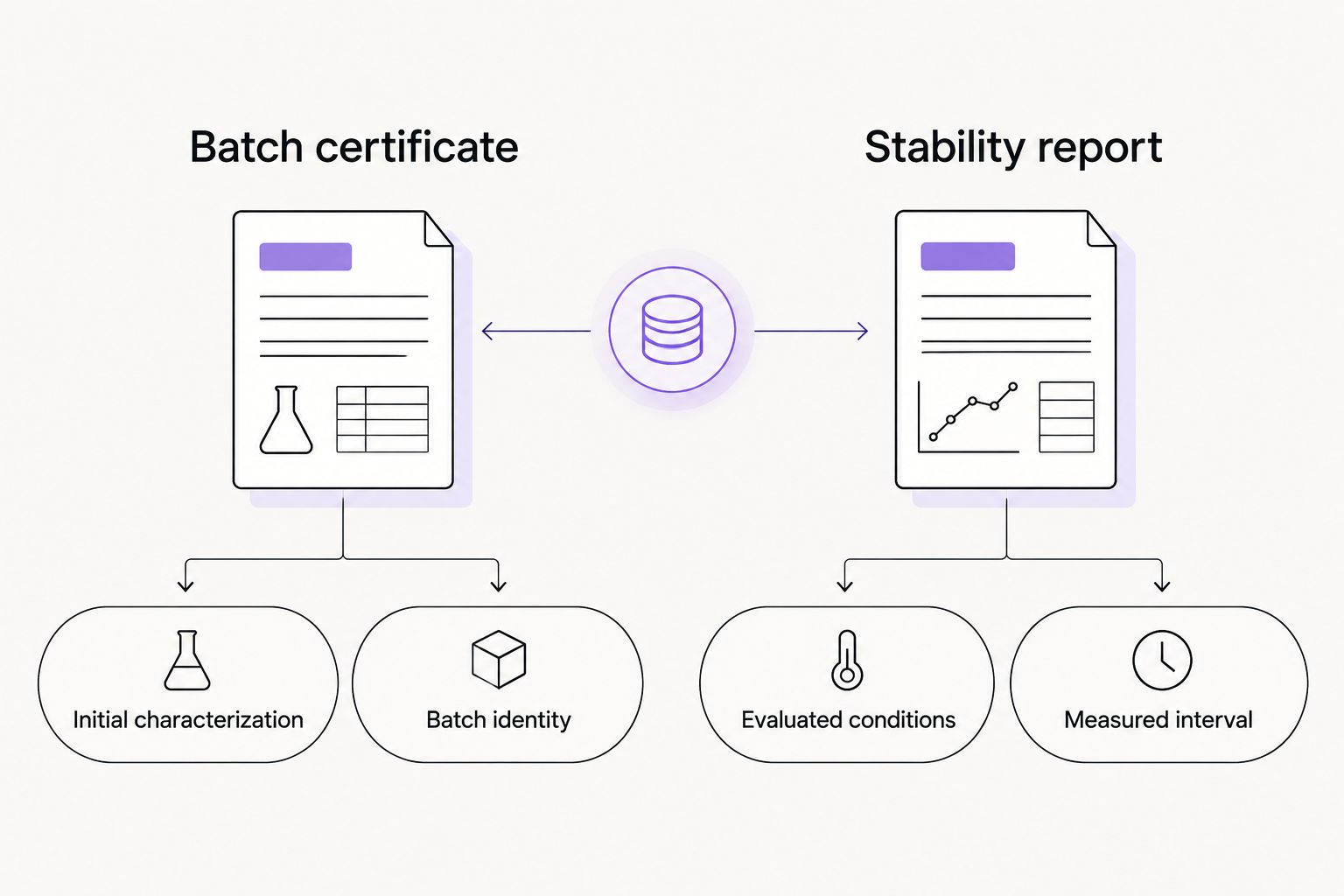
The relevant sourcing criterion is documentation that answers the laboratory’s material-specific question. When evaluating 4-Amino-Labs kisspeptin research material, distinguish the batch certificate from any separate solution-stability report.
Use the contact page to request documentation relevant to the molecular form, batch identity, analytical characterization, and any evaluated solution conditions. A useful request names the required evidence rather than asking only whether the material is “stable.”
Strength and limitation of batch certificates
A batch certificate supports traceability and reports the attributes tested at the stated analytical point. Its limitation is scope: initial identity or purity testing does not establish every later storage condition.
For 2026 purchasing records, preserve the original certificate alongside any additional technical correspondence. Keep unsupported assumptions out of the material specification.
Does a clear solution mean kisspeptin is stable?
No. Optical clarity does not establish peptide identity, concentration, or receptor activity. Dissolved degradation products can remain visually undetectable, and adsorption can reduce recovery without obvious cloudiness.
Visible changes are relevant observations, but their absence is not an analytical result. Record appearance separately from the measurements used to support a stability claim.
Does freezing establish a longer stability period?
No. Freezing alone does not establish a validated duration. Its effect must be evaluated for the exact material, matrix, container, and relevant handling history.
Do not transfer a frozen-storage statement for lyophilized material to a solution. The physical states differ, so the supporting evidence must identify which state was evaluated.
Can a receptor result replace chemical stability testing?
No. A receptor result describes the measured function under the assay conditions. It does not fully characterize identity, degradation products, or quantitative recovery.
Use the analytical endpoint that matches the research question. Where both chemical integrity and functional consistency matter, retain evidence for both rather than treating either as a substitute.
Limitations and final recommendation
This guide explains the evidence needed to interpret stability; it does not assign a holding period to any batch or formulation. Published receptor pharmacology establishes biological context, while general peptide-stability literature explains possible failure mechanisms—not a universal kisspeptin expiration date.
One last thing: a stable purity percentage can coexist with declining recoverable concentration. Before accepting a duration, check whether the underlying report measured the attribute your experiment actually requires.
For 2026 laboratory records, preserve the distinction between supplier specifications, observed analytical results, and untested assumptions. That separation is more useful than an unsupported number of days.
FAQ
How long does reconstituted kisspeptin remain stable?
Reconstituted kisspeptin has a defensible stability period only when evidence supports the exact molecular form, solution, container, and storage conditions. Do not assign a generic duration from the compound name alone.
Is kisspeptin-10 stability the same as kisspeptin-54 stability?
No. Kisspeptin-10 and kisspeptin-54 differ in sequence length, and shared receptor pharmacology does not make their stability evidence interchangeable.
Does refrigerated storage prove that kisspeptin remains stable?
No. Refrigeration describes a storage condition, not a validated stability period. The duration requires evidence for the material and conditions evaluated.
Can clear kisspeptin solution still have changed chemically?
Yes. Optical clarity does not establish chemical identity, purity, or concentration. Some changes require analytical testing to detect.
Does HPLC purity show how much kisspeptin remains?
HPLC purity alone does not necessarily establish the amount of recoverable kisspeptin. Quantitative concentration measurements require an appropriate calibrated method.
Does a batch certificate establish stability after reconstitution?
A batch certificate establishes only the attributes and analytical scope it reports. Initial characterization does not automatically establish a later solution-stability period.
Can receptor activity establish complete chemical stability?
No. Receptor activity establishes the measured functional response under defined assay conditions. Chemical identity, impurity changes, and quantitative recovery require their own supporting evidence.
References
- Kotani M, et al. The metastasis suppressor gene KiSS-1 encodes kisspeptins, the natural ligands of the orphan G protein-coupled receptor GPR54. Journal of Biological Chemistry. Scope: kisspeptin molecular forms and receptor pharmacology.
- Ohtaki T, et al. Metastasis suppressor gene KiSS-1 encodes peptide ligand of a G-protein-coupled receptor. Nature. Scope: identification of the kisspeptin receptor-ligand system.
- Manning MC, Chou DK, Murphy BM, Payne RW, Katayama DS. Stability of protein pharmaceuticals: an update. Pharmaceutical Research. Scope: general chemical and physical stability mechanisms; not a kisspeptin-specific holding-period validation.
Related guides
- Verifying peptide purity with third-party COA testing
- Research peptide storage and cold-chain workflow
- Is cloudiness in reconstituted peptides normal?
Research use only. 4-Amino-Labs research materials are discussed solely for laboratory research and analytical characterization. This content is not medical advice, provides no administration or dosing guidance, and is not intended to diagnose, treat, cure, or prevent disease.