
Reconstituting peptides for laboratory research requires compound-specific solubility evidence, an analytically compatible diluent, a defined final concentration, and a traceable preparation record. No universal solvent or storage interval applies to every peptide; this guide addresses generic laboratory solution preparation only, not human or animal use.
- How to reconstitute peptides starts with compound-specific solubility evidence, not a universal diluent recommendation.
- Calculate concentration from documented peptide content and final solution volume; chromatographic purity is a different measurement.
- Record source lots, diluent composition, calculations, observations, and analytical acceptance criteria.
- BIPM unit definitions support concentration conversions; they do not establish peptide solubility or stability.
Contents
- Why this matters
- How to reconstitute peptides for laboratory research
- Why diluent compatibility varies
- How concentration calculations work
- What the batch record must contain
- How to evaluate clarity and stability
- Limitations
- FAQ
- One last thing
- References
- Related guides
Why this matters
A dissolved peptide is not automatically an analytically qualified peptide solution. Visual appearance does not establish identity, concentration, chemical integrity, or compatibility with the measurement you intend to make.
For laboratory planning in 2026, separate material qualification from solution qualification. A supplier document describes the supplied material; your preparation record describes what happened afterward. The distinction also shapes peptide research for biotech startups, where purchasing records and experimental records need to remain connected.
The central experimental problem is preserving a known material state through dissolution, handling, and measurement. Diluent composition can change both the peptide's behavior and the analytical background, so an apparently successful preparation still requires method-specific assessment. 2
How to reconstitute peptides for laboratory research
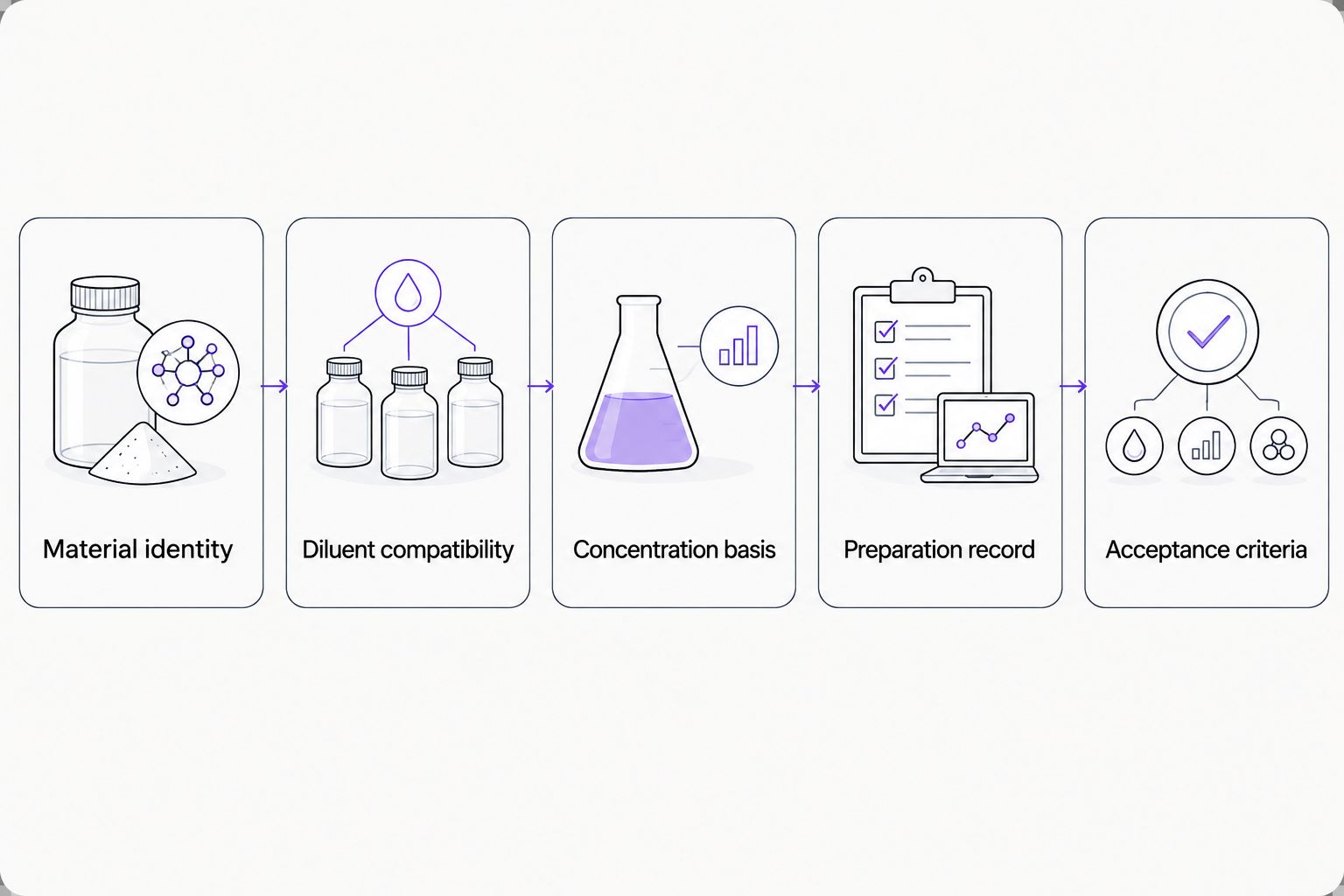
Use the compound's documented solubility and stability information to establish a laboratory preparation method, then verify that the resulting solution meets its intended analytical requirements. The decision sequence below is a documentation framework, not a compound-specific preparation procedure.
- Confirm material identity. Match the peptide designation, sequence or structural identifier, chemical form, and source lot to the documentation.
- Establish diluent compatibility. Review evidence for the exact material form and the intended measurement method rather than borrowing instructions from a related peptide.
- Define the concentration basis. Distinguish nominal supplied mass from measured peptide content and document which value supports the calculation.
- Document the prepared solution. Record the final volume, preparation identifier, diluent composition, observations, and any deviations from the approved laboratory method.
- Apply acceptance criteria. Evaluate identity, concentration, impurities, or other attributes required by the analytical question. 2
These checks answer different questions. A matching identity result cannot replace a concentration measurement, and a concentration calculation cannot establish chemical stability.
What evidence belongs with the material?
Retain the lot-specific certificate of analysis and the underlying analytical information needed for your work. Depending on the research question, that information includes chromatographic conditions, identity data, assay basis, counterion information, and water content.
Do not transfer solubility or stability conclusions between related peptides. Sequence changes, terminal modifications, and chemical form can change solution behavior even when compounds share a biological target. 3
Why diluent compatibility varies
Peptide dissolution involves interactions among the molecule, solvent, dissolved ions, and surrounding surfaces. Receptor pharmacology does not determine a suitable diluent: compounds acting at the same receptor can still require different analytical handling.
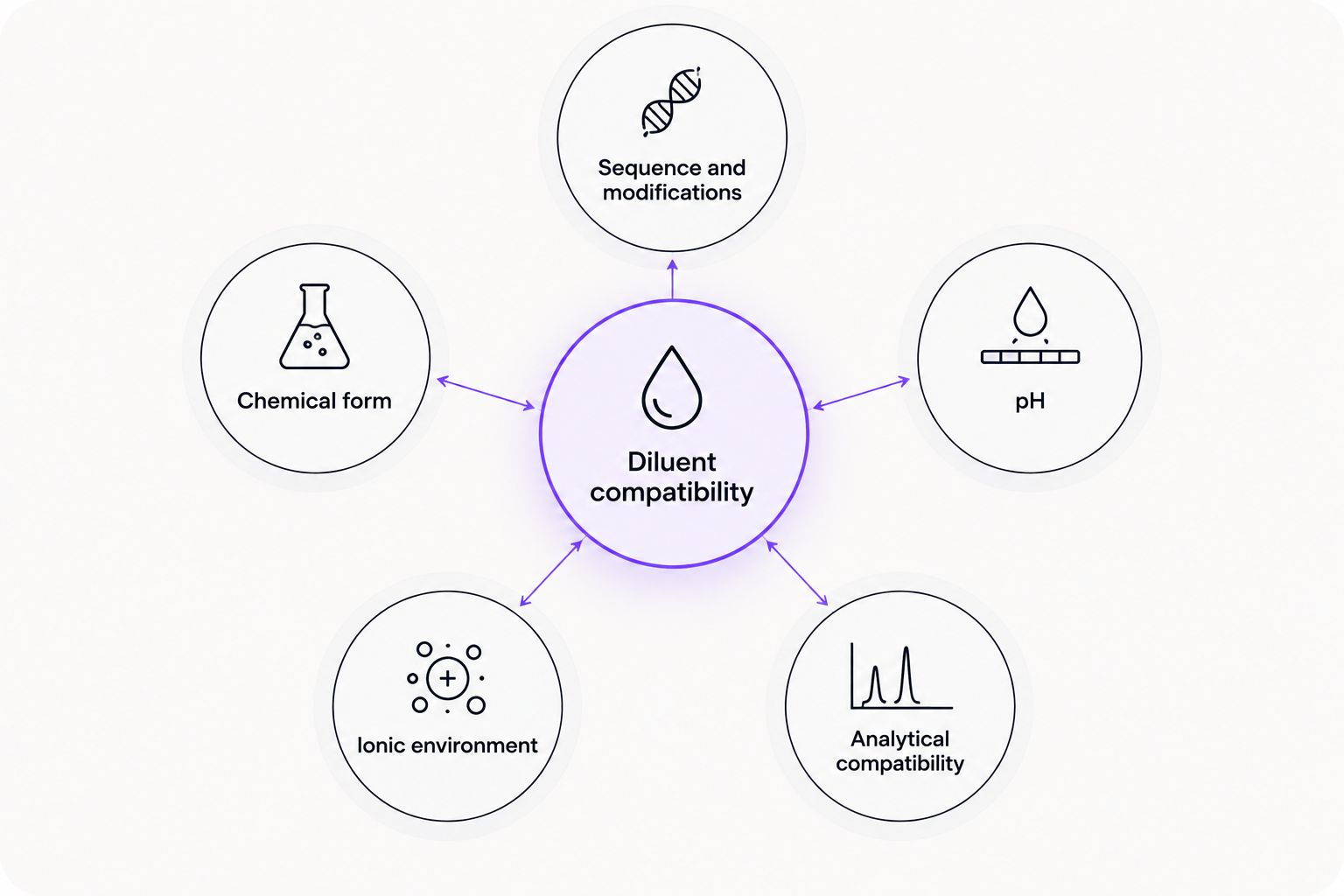
For a 2026 laboratory method, evaluate these factors explicitly:
- Sequence and modifications: ionizable groups, hydrophobic regions, terminal changes, and other structural features influence solution behavior.
- Chemical form: counterions and associated components affect composition and the interpretation of weighed material.
- pH: changes in ionization can alter solubility and chemical degradation pathways.
- Ionic environment: salts and buffer components can affect intermolecular interactions and downstream measurement.
- Analytical compatibility: a diluent must suit the measurement system as well as the peptide. 2 3
How do the main diluent categories compare?
The table compares generic laboratory options, not recommendations for any named product. Select a diluent category only when compound-specific evidence and the analytical method support it.
| Diluent category | Appropriate research context | Useful attribute | Limitation to evaluate |
|---|---|---|---|
| Laboratory-grade water | Methods with demonstrated aqueous compatibility | Avoids adding a deliberate buffer system | Does not establish controlled pH or universal peptide solubility |
| Aqueous buffer | Measurements requiring a defined pH environment | Provides buffering within its effective range | Buffer components can interfere with detection or subsequent analysis |
| Aqueous acid or base system | Methods supported by compound-specific compatibility evidence | Changes the ionization environment | Conditions can affect chemical integrity and assay interpretation |
| Mixed aqueous–organic system | Analytical methods with established solvent compatibility | Changes the solvent environment | Solvent composition can affect the peptide and the measurement system |
None is interchangeable by default. A solvent suitable for one analytical endpoint can be unsuitable for another, even when the peptide appears fully dissolved.
Does a preserved aqueous solution establish suitability?
No. Preservation, peptide solubility, analytical compatibility, and chemical stability are distinct properties. The presence of a preservative does not demonstrate that a solution meets the requirements of a particular laboratory method.
Do not infer compatibility from a diluent's commercial name. Evaluate its documented composition against the analytical question.
How concentration calculations work
Mass concentration equals the documented mass of the relevant analyte divided by final solution volume. The calculation is straightforward; establishing the correct numerator and denominator requires more care.
For concentration records in 2026, write the relationship explicitly:
Mass concentration = peptide mass ÷ final solution volume
The SI prefixes give these exact conversions: 1 mg = 1,000 µg, 1 mL = 1,000 µL, and 1 mg/mL = 1 g/L. These are unit identities, not preparation quantities or evidence of solubility. 1
Why does final volume matter?
Final solution volume and added solvent volume are different quantities. Use the volume basis defined by the laboratory method, and label the calculation accordingly rather than silently treating them as equivalent.
A record that states only a solvent addition leaves the concentration basis ambiguous. Preserve the measurement basis alongside the result.
Does chromatographic purity equal peptide content?
No. Chromatographic area percentage describes a result under specified separation and detection conditions; it is not automatically the mass fraction of peptide in the supplied material.
Water, counterions, residual components, and detector response affect interpretation. Do not multiply a nominal mass by an HPLC purity percentage unless the documented analytical basis justifies that calculation. 2 3
When is molar concentration appropriate?
Molar concentration relates amount of substance to solution volume. Converting from mass requires a documented molar mass and a clear definition of the molecular species represented by the calculation.
Specify whether the calculation concerns the peptide moiety or another documented chemical form. Molecular identity, purity, and content are connected, but they are not interchangeable quantities.
What the batch record must contain
A useful 2026 batch record lets another analyst reconstruct the calculation and identify the source material without relying on memory. Keep supplier facts separate from laboratory observations.
| Record field | What to preserve | Why it matters |
|---|---|---|
| Material identity | Peptide designation, chemical form, source lot | Connects the preparation to the correct material |
| Source documentation | Certificate identifier and analytical records | Preserves the evidence used for qualification |
| Diluent identity | Composition, grade, source lot | Defines the solution matrix |
| Concentration basis | Mass source, volume basis, units, calculation | Makes the stated concentration interpretable |
| Preparation identity | Unique identifier, analyst, date | Connects containers and analytical results |
| Observations | Appearance and any documented deviation | Records what occurred rather than what was expected |
| Handling history | Applicable conditions and transfers | Supports investigation of later differences |
| Acceptance decision | Test results and predefined criteria | Distinguishes prepared material from qualified material |
A preparation identifier should connect the source lot, solution container, notebook entry, and analytical files. A purchase identifier alone does not capture changes introduced during laboratory handling.

Where does supplier documentation fit?
4-Amino-Labs supplies research-grade chemicals and analytical reagents for laboratory work. For materials sourced through 4-Amino-Labs, assess the documentation applicable to the exact material and lot; this guide does not establish a lot's suitability for your method.
Supplier information supports material qualification. It does not replace your laboratory's solution records or analytical acceptance criteria.
How to evaluate clarity and stability
Clarity is an observation, not proof of identity, concentration, or stability. A clear preparation can still contain degradation products or differ from its intended concentration.
Cloudiness also requires investigation rather than a universal explanation. Appearance alone does not distinguish undissolved material, precipitation, aggregation, or contamination.
What does stability evidence need to match?
Stability conclusions apply to the material, matrix, container, conditions, and measurement interval actually evaluated. Dry-material information does not automatically establish stability after dissolution. 3
For 2026 records, distinguish a documented observation date from an experimentally supported stability interval. Do not assign a generic expiration period to every peptide solution.
Which analytical result answers which question?
Identity testing asks whether the expected analyte is present. A suitable quantitative method addresses concentration, while a stability-indicating method evaluates relevant changes without confusing them with the intact analyte. 2
Keep these questions separate when reviewing results. A single favorable measurement does not resolve every uncertainty about a preparation.
Limitations
This guide explains generic laboratory decision-making, unit relationships, and recordkeeping. It does not specify a solvent, pH, preparation quantity, handling procedure, or storage interval for any individual peptide.
Compound-specific decisions require evidence for the exact chemical form and intended analytical application. No conclusion here establishes the purity, sterility, stability, or suitability of an individual supplier lot.
FAQ
How do I determine how to reconstitute peptides for laboratory analysis?
Use compound-specific solubility and stability evidence together with the requirements of your analytical method. Confirm material identity, define the concentration basis, and retain a traceable preparation record.
Can I use the same diluent for every research peptide?
No single diluent is appropriate for every research peptide. Sequence, modifications, chemical form, pH, and analytical compatibility must be evaluated separately.
Does HPLC purity tell me the peptide concentration?
HPLC purity does not automatically establish peptide concentration. Chromatographic area percentage and quantitative peptide content require different interpretations and supporting analytical information.
How do I convert milligrams to micrograms in concentration calculations?
1 mg = 1,000 µg. Keep the volume unit explicit when converting a mass concentration, and do not treat a unit conversion as evidence that a preparation is analytically qualified.
Does a clear peptide solution prove complete dissolution and stability?
A clear peptide solution does not prove complete dissolution, correct concentration, or chemical stability. Use analytical measurements appropriate to the attributes your research requires.
What belongs in a peptide solution batch record?
A peptide solution batch record should connect material identity, source lot, diluent composition, concentration calculations, preparation identity, observations, and acceptance results. Preserve the analytical files supporting the decision.
Can dry-peptide storage information establish solution stability?
Dry-peptide storage information does not automatically establish solution stability. Solution stability requires evidence applicable to the dissolved material, matrix, container, and handling conditions.
One last thing
Audit the concentration basis before investigating the instrument. A result calculated from nominal supplied mass is not equivalent to one supported by a quantitative peptide-content measurement, even when both records use identical concentration units.
Preserve that distinction in the preparation name or calculation field. It makes later comparisons more defensible.
References
- Bureau International des Poids et Mesures. The International System of Units (SI). Source for SI prefixes, mass and volume relationships, and distinctions between mass concentration and amount-of-substance concentration.
2. International Council for Harmonisation. ICH Q2(R2): Validation of Analytical Procedures. Source for analytical performance characteristics and the distinction between identity, quantitative measurement, and impurity assessment.
3. International Council for Harmonisation. ICH Q5C: Quality of Biotechnological Products: Stability Testing of Biotechnological/Biological Products. General stability framework for relevant biological materials; not compound-specific evidence for every research peptide.
Related guides
- Connecting batch numbers to laboratory inventory tracking
- Verifying peptide purity with third-party certificate-of-analysis testing
- Is cloudiness in reconstituted peptides normal?
Research-use-only notice: Materials discussed are strictly for laboratory research, not human or animal use. This content is not medical advice and is not intended to diagnose, treat, cure, or prevent disease.