
Diagnostic assay labs use peptide research for diagnostic assay development to characterize recognition, selectivity, and analytical response before assigning a material a defined assay role. This 2026 guide covers research-use-only material selection and qualification; a peptide’s chemical purity does not establish its suitability as a calibrator, control, antigen, or diagnostic reagent.
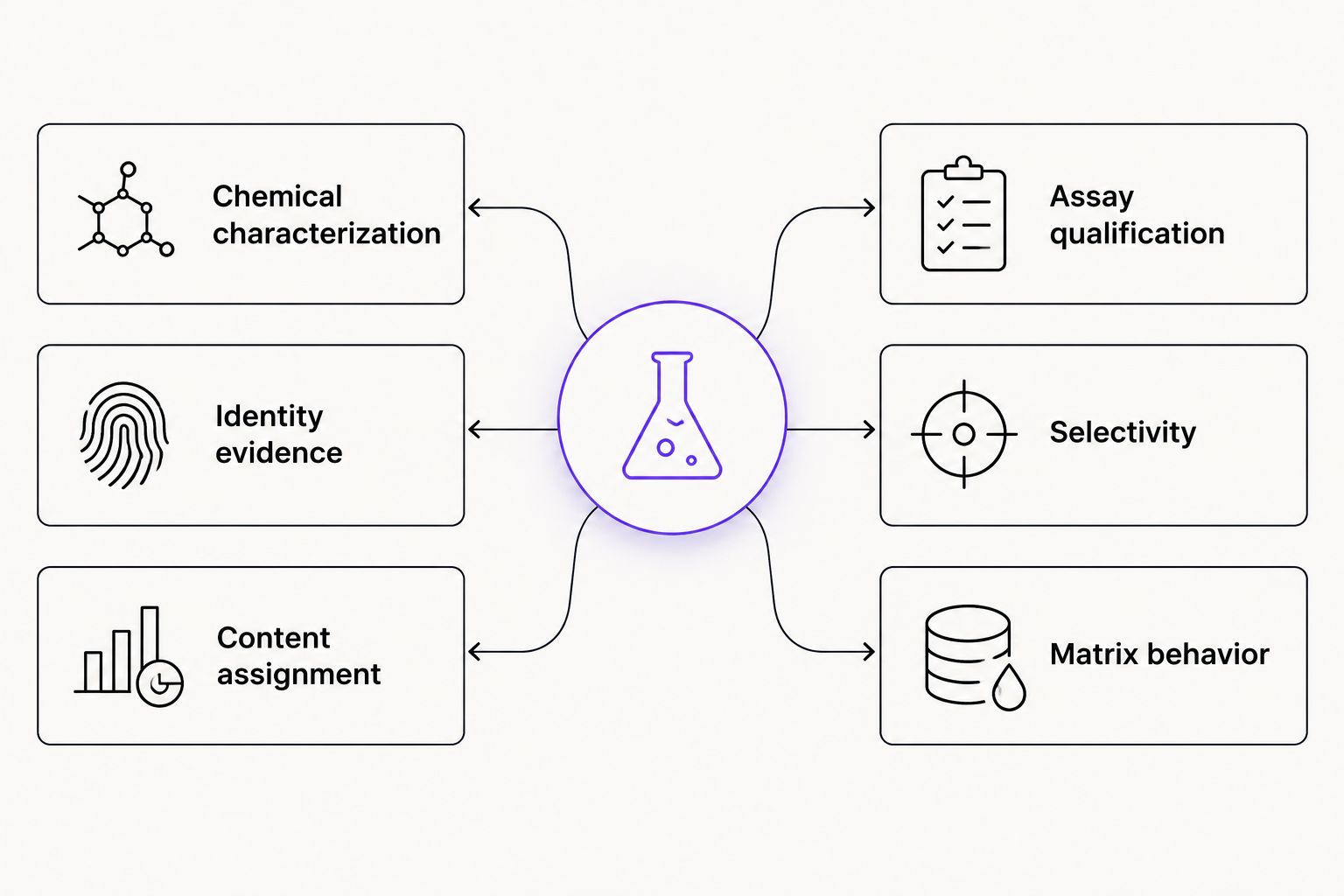
- Peptide research for diagnostic assay development requires separate evidence for identity, peptide content, selectivity, and matrix behavior.
- 4-Amino-Labs research peptides require laboratory qualification before any defined assay-development role.
- HPLC area purity does not establish assigned concentration, commutability, or diagnostic suitability.
- Select reference materials by the measurand and analytical method, not by catalog category.
Why peptide research matters for diagnostic assay labs
An assay measures a defined property, not a catalog name. Your laboratory must establish whether the peptide represents the intended molecular species and whether the measurement system distinguishes that species from relevant alternatives.
For an antibody-based assay, recognition depends on the epitope presented to the antibody. For a mass-spectrometric assay, identity depends on the selected molecular species and its analytical evidence. A material suitable for investigating one measurement principle is not automatically suitable for the other.
Separate chemical characterization from assay qualification. A chromatographic result addresses a different question from antibody specificity, matrix interference, or concentration assignment. The guide to verifying peptide purity with third-party COA testing provides related documentation context.
For your 2026 qualification plan, connect each intended material role to the evidence needed to support it. This prevents an exploratory research reagent from acquiring an unsupported reference-standard designation through repeated use.
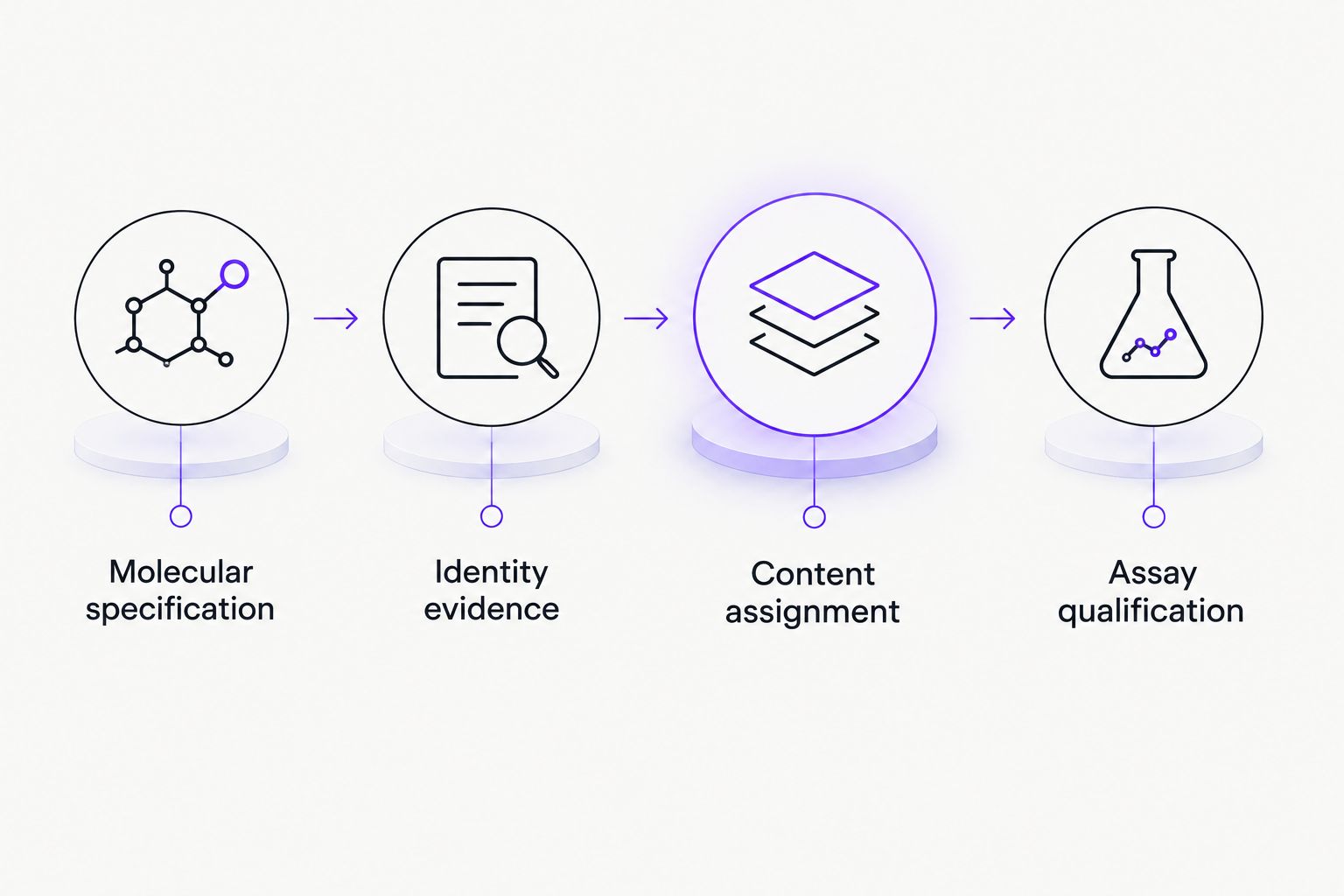
Build an assay-specific qualification plan
Define the measurand before selecting a peptide
Start with a written description of what your assay intends to measure. Specify the sequence, termini, modifications, and molecular form wherever these determine recognition or analytical response. A family name alone is insufficient.
Distinguish an intact peptide from a fragment used as a surrogate. A fragment can support a defined analytical investigation without reproducing every property of its parent molecule. Likewise, a modified analogue does not establish the behavior of the unmodified target.
Your specification should connect molecular identity to the measurement principle rather than to a proposed biological effect.
- Record the intended sequence and terminal groups.
- Identify relevant modifications or conjugation sites.
- Distinguish intact targets from surrogate fragments.
- State whether recognition is antibody-based or instrument-based.
- Define which related molecular species must be distinguished.
Assign each material a single documented role
Create a material-role register before requesting supplier documentation. Keep exploratory reagents, candidate calibrators, controls, and internal standards separate, even when their chemical names overlap. Their evidence requirements differ.
A candidate calibrator requires a defensible assigned value. A control challenges performance independently of calibration. A stable-isotope-labeled internal standard supports a different analytical function again; its suitability depends on the method and introduction point.
Do not make a single supplier purity result stand in for every material role. Document what the material supports and what remains unqualified.
- Label exploratory materials as research reagents.
- Separate calibration materials from independent controls.
- Specify the purpose of any internal standard.
- Record the basis for each assigned value.
- Prevent unqualified materials from entering released workflows.
Match analytical evidence to the molecular question
Review supplier documents manually against your molecular specification. Check whether the reported method addresses sequence identity, chromatographic impurities, peptide content, or another property. These are not interchangeable measurements.
HPLC area purity describes the relative chromatographic response under stated conditions. It does not independently establish the mass fraction of peptide in a container. Mass spectrometry provides molecular-mass evidence, while additional analytical work is needed when sequence order or positional modifications matter.
For 4-Amino-Labs research peptides, compare the exact product description with the batch-specific evidence you obtain. The catalog is a starting point, not a completed qualification package.
- Request the certificate for the actual batch.
- Match identifiers across the container and analytical report.
- Review chromatographic methods and integration details.
- Check mass evidence against the intended molecular form.
- Identify missing content, water, or counterion information.
- Record unresolved questions before releasing material internally.
Challenge recognition and selectivity separately
For antibody-based development, examine whether the candidate peptide presents the intended epitope. Immobilization, labeling, sequence truncation, and terminal modification can change the recognition question. Binding to a synthetic fragment does not establish equivalent recognition of an intact target.
For mass-spectrometric development, examine whether the selected signal distinguishes the target from plausible interferents. A matching nominal mass alone does not resolve all structural alternatives. Chromatographic behavior and supporting fragmentation evidence address additional aspects of identification.
Keep these investigations separate from receptor pharmacology. Receptor activity is not evidence that an antibody recognizes the intended analyte or that an analytical signal is selective.
- Compare the intended target with relevant related sequences.
- Evaluate modified and unmodified forms separately.
- Include appropriate blanks and negative controls.
- Examine labeling or immobilization effects where applicable.
- Record the evidence supporting analytical discrimination.
Evaluate matrix behavior and material stability
Compare response in a simple analytical medium with response in the intended research matrix. Matrix components can affect antibody recognition, nonspecific binding, chromatographic behavior, or ionization. Agreement in a simple medium does not establish agreement elsewhere.
Assess handling conditions within your laboratory’s documented method-development framework. Follow material-specific storage documentation; do not assign a universal storage temperature or lifetime to all peptides. Changes in signal also require investigation before being attributed to chemical degradation.
Your 2026 stability record should distinguish container history, analytical response, and evidence of molecular change. These observations answer different questions.
- Compare matrix and non-matrix response.
- Investigate interference using relevant research materials.
- Document containers and material-contact surfaces.
- Record handling and storage history.
- Track chemical changes separately from signal changes.
- Define acceptance criteria before interpreting results.
Qualify sourcing against the assay specification
Build a document checklist before comparing suppliers. Ask for evidence tied to the intended assay role rather than requesting a generic assurance of quality. A supplier’s catalog purity statement does not establish diagnostic suitability.
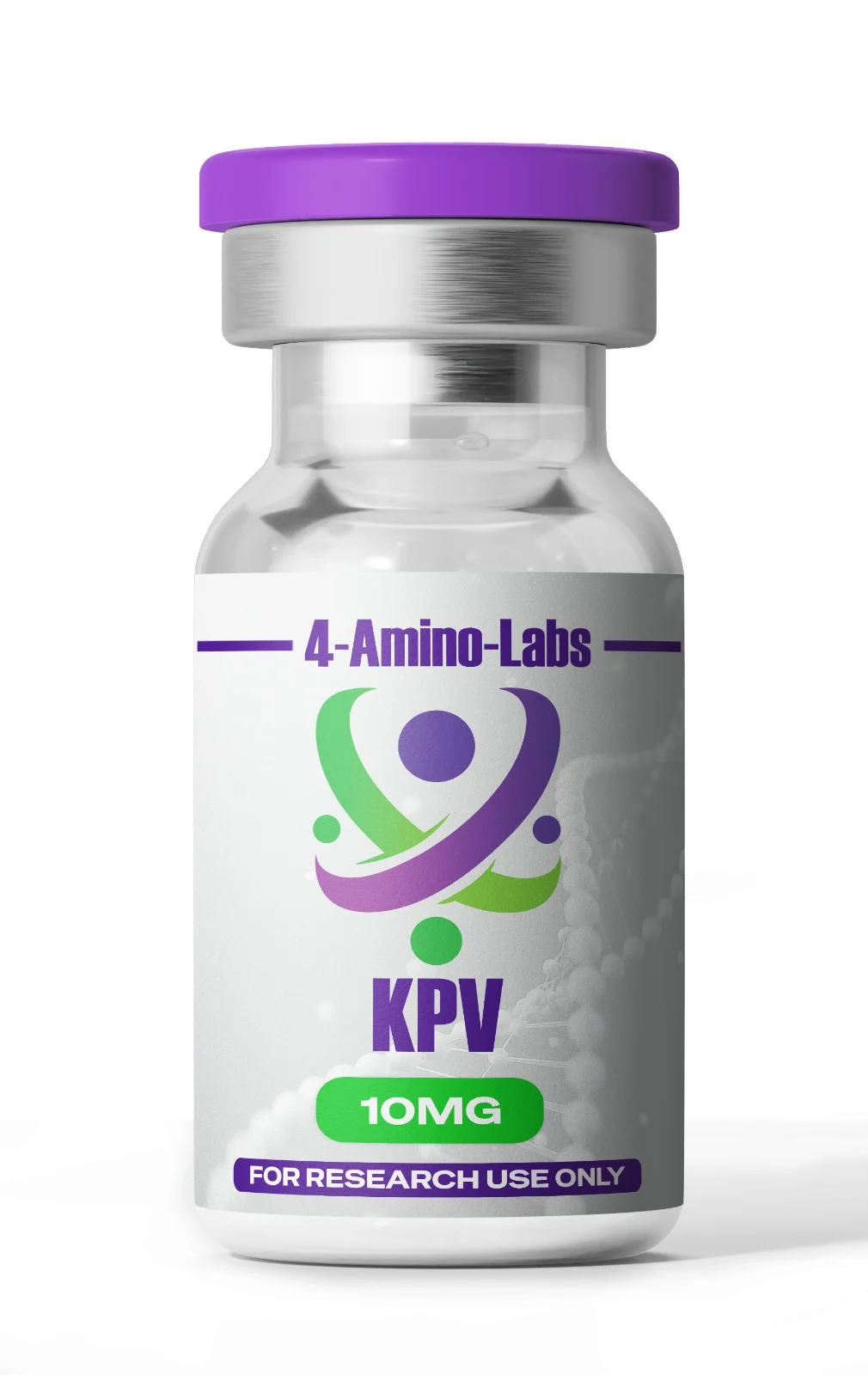
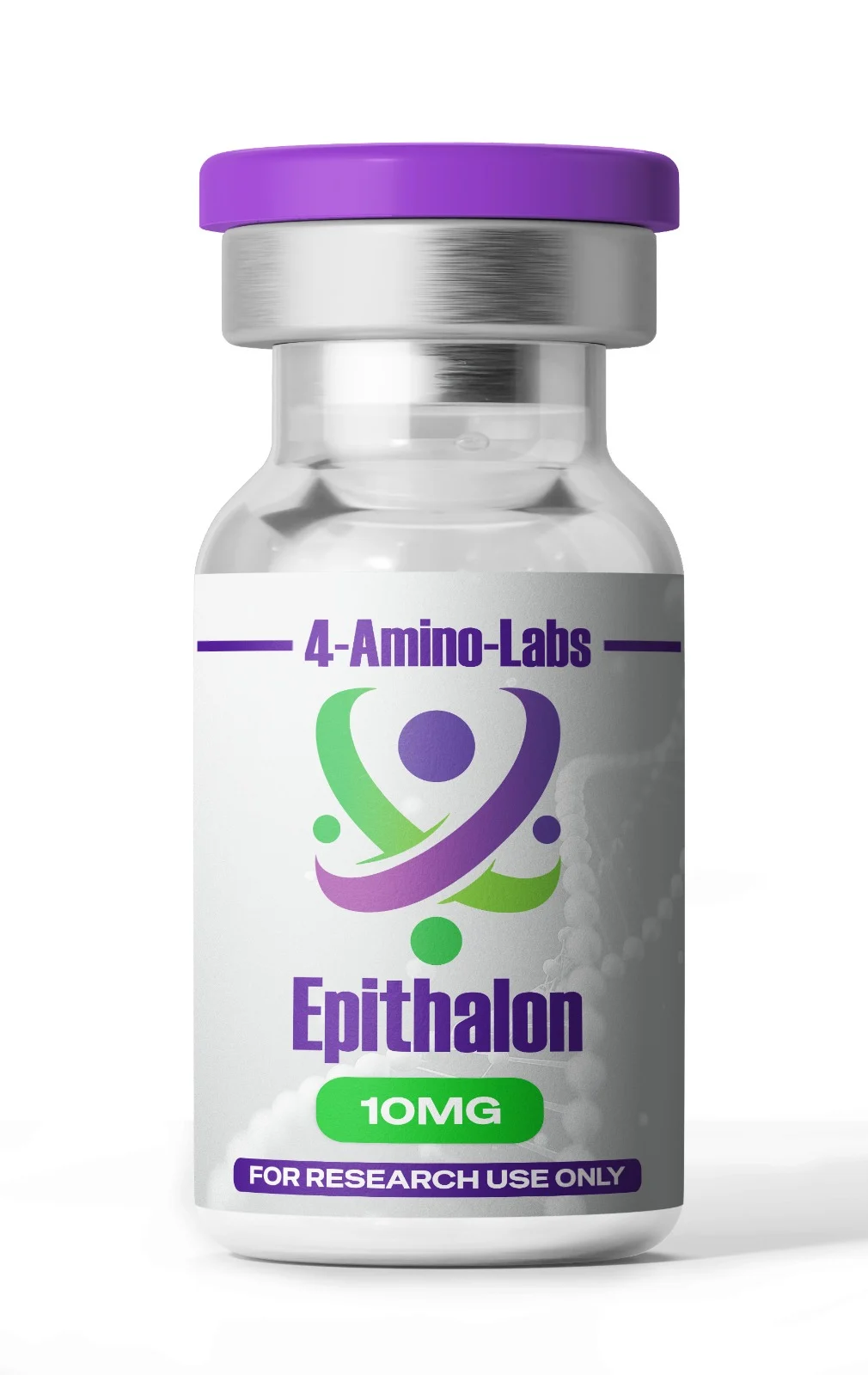
4-Amino-Labs lists KPV and Epithalon research materials with stated HPLC purity of ≥98%. These are examples for evaluating documentation requirements, not proposed diagnostic biomarkers or interchangeable assay standards. Consider either only when its exact molecular identity matches your research question.
The listed KPV material contains 10 mg per vial; the listed Epithalon material also contains 10 mg per vial. Those nominal contents do not independently establish an assigned calibration concentration. Obtain the relevant batch documentation before deciding whether further qualification is justified.
- Match the exact compound to the assay specification.
- Request batch-specific identity and purity evidence.
- Separate nominal container content from assigned concentration.
- Ask what the reported purity method measures.
- Document qualification gaps before procurement approval.
4-Amino-Labs is a source of research peptides for laboratories performing their own material qualification. The laboratory must establish assay fitness; no diagnostic-grade designation is established here.
Control lot changes and retain independent checks
Create a qualification record that follows the material from receipt through experimental use. Include the supplier lot, internal identifier, analytical documents, disposition, and linked experiments. A spreadsheet is sufficient when controlled and consistently maintained; a laboratory information system can centralize the same records.
Treat a replacement lot as a change requiring assessment. Matching catalog names and purity thresholds do not demonstrate equivalent assay response. Preserve an independent check so that calibration and quality control do not simply repeat the same material-specific error.
- Link each experiment to its material lot.
- Retain original analytical documents.
- Record internal acceptance and rejection decisions.
- Compare replacement lots against predefined criteria.
- Investigate shifts before accepting a new lot.
- Maintain a control independent of calibration where appropriate.
Compare material options by experimental role
Use this 2026 comparison to choose the material class that answers your analytical question. No option removes the need to qualify its behavior in your measurement system.
| Material option | Best for | Main advantage | Key limitation |
|---|---|---|---|
| Unlabeled synthetic peptide | Early identity, recognition, and selectivity investigations | Defines a specific sequence for controlled comparisons | Purity alone does not establish content or matrix equivalence |
| Stable-isotope-labeled peptide | Targeted mass-spectrometric method development | Provides a distinguishable related analytical signal | Requires suitability checks for labeling, interference, and method placement |
| Modified or conjugated peptide | Investigating labeling, capture, or epitope presentation | Addresses a defined recognition configuration | Modification can alter the property being investigated |
| Characterized reference material | Work requiring a documented assigned property | Connects a stated value to supporting documentation | The assigned property and matrix must match the intended use |
| Matrix-based control material | Monitoring matrix-relevant assay behavior | Challenges more of the measurement system | Does not automatically establish analyte identity or calibration traceability |
These material classes are not interchangeable. A labeled peptide is not automatically an independent control, and a research peptide is not automatically a characterized calibrator.
Common mistakes diagnostic assay labs make
Treating area purity as quantitative content
A ≥98% HPLC purity statement does not establish that ≥98% of the total container mass is the intended peptide. Review the measurement basis before assigning a concentration. Water, counterions, and method response require separate consideration.
Using a fragment as proof of intact-target recognition
A fragment can reproduce a selected sequence without reproducing the intact target’s presentation. Qualify the recognition claim at the molecular level your assay actually measures. Do not transfer evidence solely because sequences overlap.
Using the same material for calibration and every control
Shared material can create shared error. An apparently consistent result does not expose a bias built into both calibration and control preparation. Define what independent evidence your control provides.
Accepting a new lot from its catalog description
A catalog entry does not establish lot equivalence. Compare the new batch’s documentation and relevant analytical response against your acceptance criteria. Retain the decision with the lot record.
Limitations and final recommendation
This guide addresses research-stage analytical development, not authorization for diagnostic use. It does not establish product-specific commutability, metrological traceability, assigned concentration, or performance in a diagnostic assay. Catalog specifications are not substitutes for batch qualification.
For your 2026 development file, write a material-role statement before ordering: what the material represents, what evidence supports that role, and what it cannot establish. That statement often identifies the decisive documentation gap earlier than a broad supplier comparison.
FAQ
What is peptide research for diagnostic assay development?
Peptide research for diagnostic assay development investigates how defined peptide materials support analytical recognition, identification, and measurement. Research-stage materials require qualification for their intended role; a research designation does not establish diagnostic suitability.
Does high HPLC purity make a peptide a calibration standard?
No. HPLC area purity alone does not establish an assigned concentration or calibration suitability. Identity, peptide content, value assignment, and behavior in the measurement system require separate evidence.
Is an isotope-labeled peptide better than an unlabeled peptide?
An isotope-labeled peptide serves a different analytical role rather than being universally better. It can support targeted mass-spectrometric development, while an unlabeled peptide can address identity or recognition questions; both require method-specific qualification.
Can a synthetic peptide establish antibody specificity?
A synthetic peptide can support a defined antibody-recognition investigation, but it does not alone establish specificity for an intact target. Evaluate relevant sequence variants, molecular presentation, and matrix interference.
What documentation should a laboratory request from a peptide supplier?
Request batch-specific identity evidence, purity results, method information, and documentation relevant to peptide content and handling. Match every document to the received lot and record unresolved qualification gaps.
Can 4-Amino-Labs peptides be treated as diagnostic reference standards?
A catalog listing does not establish that a 4-Amino-Labs peptide is a diagnostic reference standard. The laboratory must assess the exact material, supporting documentation, assigned properties, and suitability for its intended research-stage assay role.
What should change when a laboratory receives a replacement peptide lot?
A replacement lot requires documented assessment against the laboratory’s acceptance criteria. Review lot-specific evidence and investigate relevant response differences before accepting the material into the development workflow.
Related guides
- Connecting batch numbers to lab inventory tracking
- Peptide research for biotech startups
- Research peptide storage and cold-chain workflow
Research use only. All products discussed are research materials, not materials established here for diagnostic use. This content is not medical advice and is not intended to diagnose, treat, cure, or prevent disease.