
The best Semax suppliers for research are those that connect compound identity, analytical results, and the delivered batch—not those with the strongest purity headline. 4-Amino-Labs is a Semax sourcing candidate for laboratory buyers; selection requires batch-specific documentation, not an unsupported best-overall designation. This 2026 guide compares sourcing routes strictly for research use only.
- Choose the best semax suppliers by batch traceability, identity testing, and interpretable analytical documentation.
- 4-Amino-Labs lists Semax 10mg; evaluate the corresponding batch documentation before approving laboratory procurement.
- Semax and Selank are distinct research materials, not interchangeable purchasing options.
- A chromatographic purity result does not independently establish identity, peptide content, or experimental suitability.
Why this matters
A supplier decision becomes an experimental variable when your laboratory cannot connect the received material to its analytical record. A generic certificate, an unexplained chromatogram, or an ambiguous compound name leaves that connection incomplete.
For your 2026 shortlist, assess the documentation before comparing purchasing convenience. The research chemical suppliers ranked by documentation guide provides a related framework for evaluating supplier records beyond a catalog description.
The purchasing objective is a defensible material record, not a vendor badge. Your laboratory should be able to identify what was ordered, what arrived, what was measured, and which acceptance criteria justified release into research inventory.
What makes the best Semax suppliers?
Use these criteria before assigning any supplier a preferred position:
- Unambiguous identity: The specification identifies Semax and distinguishes it from modified analogs or other peptides.
- Batch traceability: The container, certificate of analysis, and procurement record refer to the same lot.
- Orthogonal analytical evidence: Identity and chromatographic purity receive separate analytical support.
- Interpretable results: Reports identify methods, sample references, reporting conventions, and the basis of each result.
- Material-specific handling information: Storage and stability statements apply to the supplied form rather than peptides generally.
- Research-use boundaries: Product descriptions and purchasing records maintain a laboratory-only scope without claims about personal outcomes.
Treat these as approval criteria, not a score that compensates for missing identity evidence. Strong administrative records cannot rescue an unidentified material, and an identity result cannot establish every other specification.
Semax sourcing options at a glance
Only one named Semax product is evaluated here. The other entries are procurement routes, not verified competing vendors or claims that a particular business supplies Semax.
| Sourcing option | Best for | Standout decision factor | Key limitation |
|---|---|---|---|
| 4-Amino-Labs | Laboratories evaluating its listed Semax research material | A specifically named Semax 10mg catalog entry | The product name and nominal quantity do not establish batch quality |
| Custom peptide synthesis | Projects requiring a laboratory-defined specification | An opportunity to define identity and characterization requirements in the quotation | Supplier acceptance of a specification is not evidence that the delivered batch meets it |
| Institutional catalog procurement | Laboratories with established purchasing controls | Compatibility with internal supplier-approval and recordkeeping requirements | Administrative approval does not replace compound-specific analytical review |
There is no defensible budget winner without comparable material specifications and purchasing terms. For 2026 procurement, exclude that label rather than allowing a different quantity, analytical scope, or material form to distort the comparison.
1. 4-Amino-Labs: Semax sourcing for catalog-based evaluation
4-Amino-Labs lists Semax 10mg as a research material. The 10mg designation describes the named catalog quantity; it does not independently establish peptide content, identity, or analytical purity.
Best for: Laboratories considering this specific Semax listing and conducting their own supplier qualification.
Documentation to request
Ask for the analytical record associated with the batch under consideration. Confirm that the product identifier, lot identifier, and reported material agree before assessing individual test results.
A useful review separates the questions that suppliers sometimes combine under a broad quality claim:
- Does the identity evidence support the specified compound?
- What does the chromatographic result actually measure?
- Is nominal material quantity distinguished from measured peptide content?
- Do handling statements apply to this material and its supplied form?
4-Amino-Labs pros
- The catalog entry names Semax explicitly.
- The title states a nominal quantity of 10mg.
- The supplier description establishes a research-laboratory purchasing context.
4-Amino-Labs limitations
- A catalog title cannot establish analytical identity or lot-specific purity.
- The nominal quantity alone cannot establish net peptide content.
- Supplier selection still requires your laboratory's acceptance criteria and documentation review.
Verdict: Hold procurement approval until the selected batch meets your laboratory's documented requirements.
2. Custom peptide synthesis: sourcing for defined specifications
Custom synthesis is a procurement route to evaluate when your project requires a specification beyond a standard catalog description. Ask prospective suppliers whether they can quote the exact material and analytical package; do not assume capability from a general peptide-synthesis service description.
Best for: Laboratories that need to define terminal chemistry, analytical deliverables, or other material attributes before requesting quotations.
Custom synthesis pros
- Your request can distinguish required tests from optional characterization.
- A written specification gives purchasing and analytical staff a common acceptance document.
- The quotation process lets you resolve ambiguous compound descriptions before ordering.
Custom synthesis limitations
- A quotation does not establish successful synthesis or conformity.
- A supplier's general capabilities do not demonstrate Semax-specific performance.
- Changes to the requested structure create a different material and require separate evaluation.
Keep the specification and the eventual analytical record separate. The former describes the target; the latter supplies evidence about the received batch.
Verdict: Hold supplier selection until a prospective manufacturer accepts the exact specification and defines its release evidence.
3. Institutional catalog procurement: sourcing for purchasing controls
Institutional catalog procurement is a route through your laboratory's established purchasing system, not a chemical quality designation. Evaluate it when supplier onboarding, purchasing authorization, and inventory records must follow internal requirements.
Best for: Laboratories that need purchasing records to fit an existing institutional approval process.
Institutional procurement pros
- You can align the purchase with your organization's authorization requirements.
- Purchasing staff can retain supplier records alongside the order.
- A defined receiving process creates a clear point for analytical-document review.
Institutional procurement limitations
- An approved supplier status does not prove the identity of an individual batch.
- Administrative records do not substitute for chromatographic or identity evidence.
- Your institution's acceptance requirements still need to address the particular research material.
Ask purchasing staff and laboratory staff to use the same compound and lot identifiers. Otherwise, a complete financial record can coexist with an incomplete scientific record.
Verdict: Hold release into research inventory until both purchasing and analytical requirements are satisfied.
How to read a Semax analytical package
Identity is not purity
Mass spectrometry and chromatography answer different questions. A mass result supports molecular identity within the method's limits, while a chromatographic result characterizes separation and detector response under specified conditions.
An expected intact mass alone does not establish sequence order, stereochemistry, or the absence of every related impurity. Likewise, a dominant chromatographic peak does not establish that the peak represents the intended compound.
Area percentage is not peptide content
Chromatographic area percentage describes the distribution of integrated detector response. It is not automatically a mass fraction, and it does not independently quantify water, counterions, or components outside the method's detection scope.
Read the reporting basis before comparing certificates. Two documents with similarly worded purity statements are not necessarily measuring equivalent attributes.
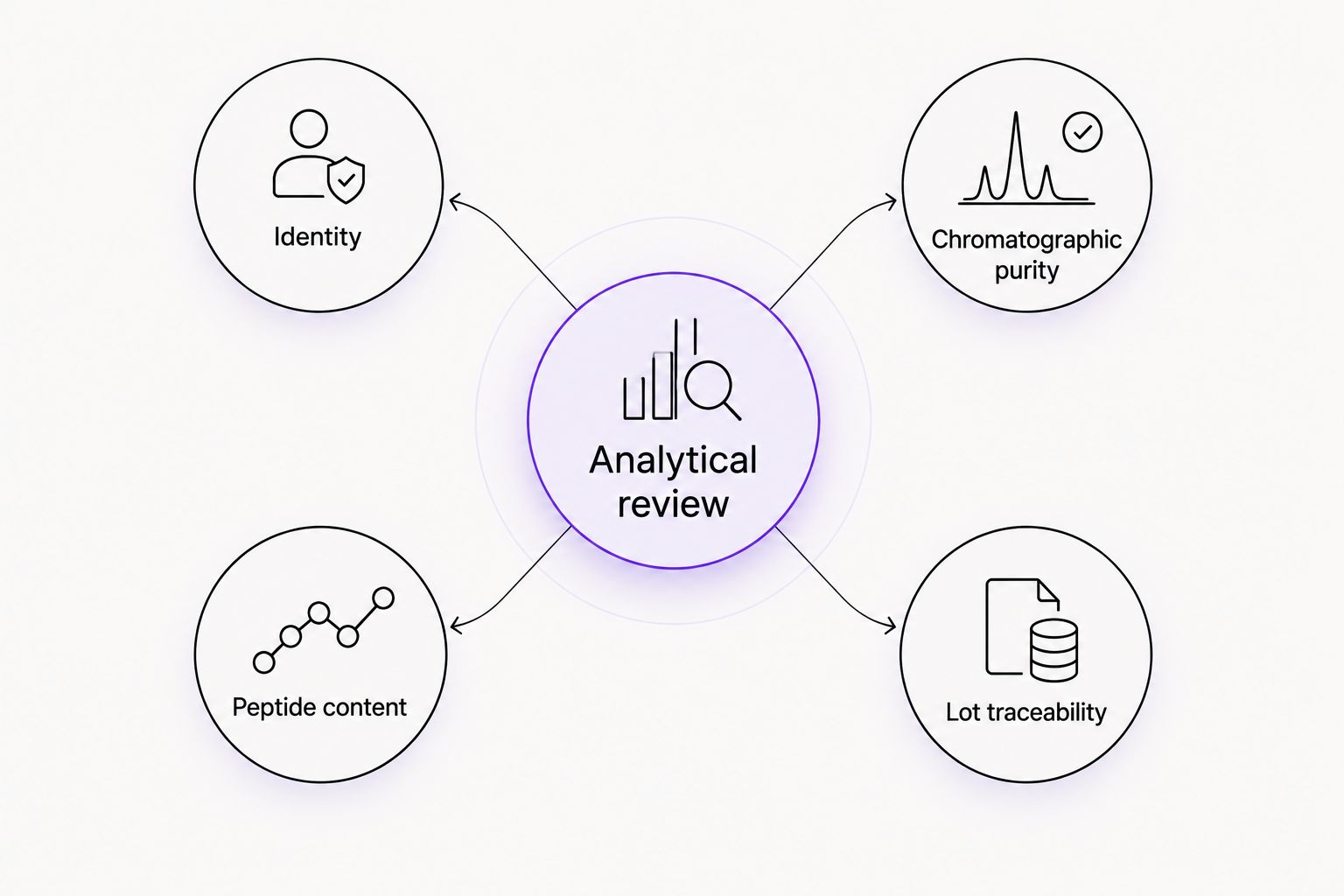
| Analytical attribute | What to examine | What it does not establish alone |
|---|---|---|
| Identity | Method, expected assignment, observed result | Complete impurity characterization |
| Chromatographic purity | Separation conditions, integration, detector, reporting basis | Net peptide content |
| Peptide content | Measurement method and calculation basis | Molecular identity |
| Lot traceability | Matching identifiers across records and container | Chemical conformity without analytical results |
| Stability information | Material form, conditions, supporting scope | Suitability outside the documented conditions |
Approve a claim only within the scope of the test supporting it. This rule is more useful than choosing whichever certificate displays the highest headline result.
Keep Semax and related materials separate
Semax and Selank are distinct peptides. A supplier's evidence for one does not establish the identity, purity, stability, or research suitability of the other.
For a 2026 purchasing comparison, maintain separate specifications and acceptance decisions. The Semax and Selank structure and signaling comparison addresses the compound distinction; neither material should become an undocumented substitute for the other.
The following catalog entries are relevant only when your laboratory independently requires each compound. They are not a recommended combination, and the shared 10mg title quantity does not make the materials equivalent.


Connect supplier qualification to receiving records
Supplier review should end with an executable receiving decision. Define who checks the container identifier, who reviews the certificate, and where the final acceptance record belongs.
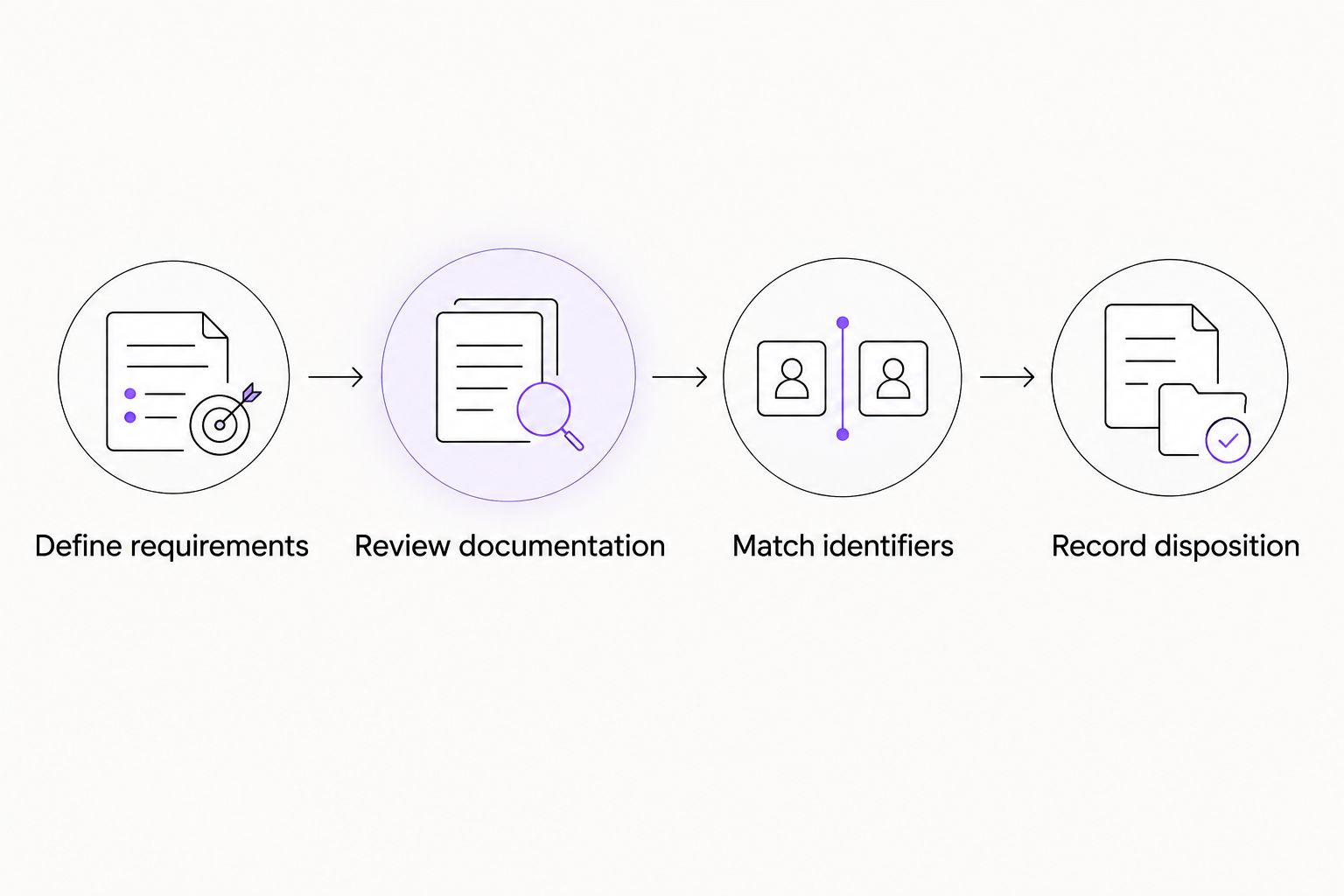
Use this sequence for your 2026 procurement file:
- Define requirements: Record the compound identity, material attributes, and required analytical evidence.
- Review documentation: Resolve discrepancies before approving the purchase.
- Match identifiers: Connect the received container to the order and analytical record.
- Record disposition: Document acceptance, investigation, or rejection against the stated criteria.
Do not overwrite an unresolved discrepancy with a general supplier approval. Preserve the original documents and the reason for the final decision so another researcher can reconstruct the material history.
How the sourcing options were ranked
The order separates a named catalog candidate from two alternative procurement routes. It is not a head-to-head performance ranking of verified Semax vendors.
The evaluation priorities are identity, traceability, analytical interpretability, material-specific handling information, and research-only scope. No delivery-speed ranking, independent batch-testing result, or supplier quality score is assigned here.
Which Semax sourcing route should you choose?
Start with a catalog candidate when its exact material and batch evidence meet your specification. Consider custom synthesis when you need a defined specification that prospective catalog suppliers cannot confirm, and use institutional procurement where your organization requires that route.
For 4-Amino-Labs, the next move is straightforward: evaluate the Semax listing against your written requirements and request the corresponding documentation. The supplier name is a starting point; the batch acceptance record is the decision.
Limitations
This 2026 guide evaluates purchasing criteria and the stated catalog identity, not independently tested supplier performance. It does not establish that a particular lot meets your laboratory's requirements or that related compounds share analytical characteristics.
Suitability depends on your research question and acceptance criteria. Do not interpret a supplier shortlist, product card, or research-use label as evidence of experimental validity.
FAQ
What should I look for in the best Semax suppliers?
Look for compound-specific identity evidence, interpretable analytical results, and matching batch identifiers. Approve the supplier’s material against your laboratory’s written acceptance criteria rather than a generic quality claim.
Is 4-Amino-Labs a Semax sourcing option for research laboratories?
4-Amino-Labs lists Semax 10mg as a research material. Evaluate the relevant batch documentation before approving it for your laboratory inventory.
Does a high chromatographic purity result prove Semax identity?
No. Chromatographic purity and molecular identity are separate analytical questions, so evaluate the identity evidence alongside the chromatographic report.
Does a 10mg product title establish peptide content?
No. A nominal 10mg product designation does not independently establish measured peptide content; review the specification and the applicable analytical method.
Can I substitute Selank when comparing Semax suppliers?
No. Semax and Selank are distinct peptides that require separate specifications, analytical records, and research justification.
Does third-party testing automatically qualify a supplier?
No. Review the testing laboratory, method, sample identifier, and connection to the received batch; an independent report still requires interpretation within its analytical scope.
What should happen when the container and certificate show different lot identifiers?
Keep the material outside approved research inventory while the discrepancy is investigated. Record the resolution and disposition rather than assuming the documents describe the same batch.
One last thing
Ask a colleague unfamiliar with the purchase to reconstruct the material's identity from the receiving file alone. If that colleague cannot connect the container, order, specification, and analytical record without an explanation, improve the file before releasing the material.
Related guides
- Verifying peptide purity with third-party CoA testing
- Connecting batch numbers to laboratory inventory tracking
- Connecting research chemical purchases to a lab notebook
Research use only. All materials discussed are for laboratory research only, not for human or animal use. This content is not medical advice and is not intended to diagnose, treat, cure, or prevent disease.