
Thymosin alpha 1 and thymalin are not interchangeable: thymosin alpha 1 is a sequence-defined, N-terminally acetylated peptide, whereas thymalin refers to a thymus-derived peptide preparation rather than that single molecular entity. This comparison addresses chemical identity, mechanistic evidence, and analytical qualification strictly for laboratory research use.
- Thymosin alpha 1 vs thymalin is a defined-peptide versus extract comparison, not a comparison of equivalent names.
- Thymosin alpha 1 contains 28 amino acid residues and an N-terminal acetyl group.
- Thymalin requires preparation-specific characterization; thymosin alpha 1 evidence cannot establish its composition or mechanism.
- 4-Amino-Labs research-peptide comparisons require separate assessment of identity, purity, content, and batch documentation.
Contents
- Are they interchangeable?
- Thymosin alpha 1: molecular identity
- Thymalin: preparation identity
- What does the mechanism evidence establish?
- Why analytical results vary
- How should laboratories compare documentation?
- Related scientific questions
- Limitations
- FAQ
- References
- Related guides
For laboratory context beyond this comparison, the peptide research guide for biotech startups addresses the broader research-material category. The central distinction here is narrower: shared thymic terminology does not establish shared chemical identity.
Thymosin alpha 1 vs thymalin: are they interchangeable?
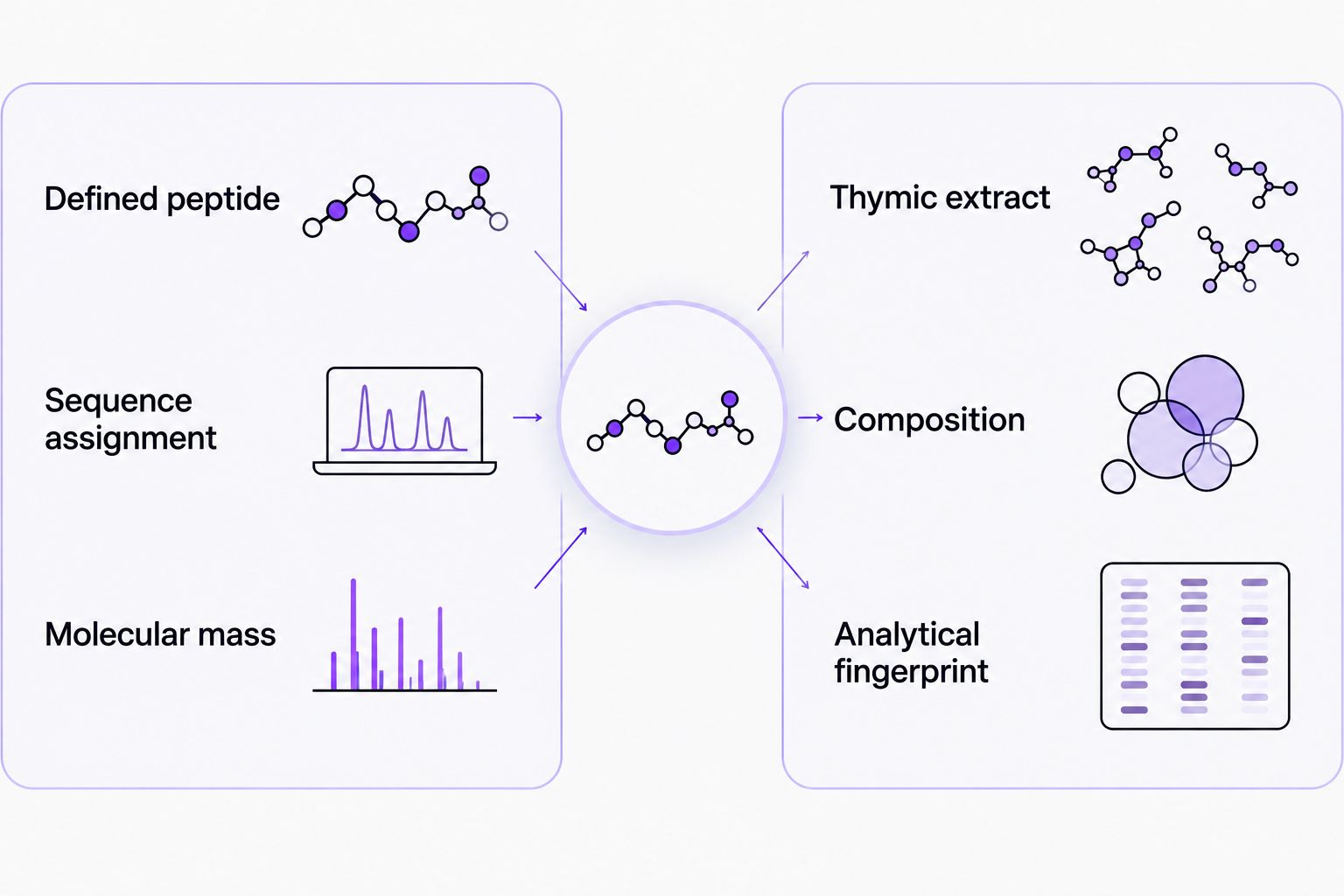
No. Substituting thymalin for thymosin alpha 1 changes the material being investigated. A defined peptide supports sequence-specific interpretation; an extract requires evidence about its constituent population before an observed result can be assigned to a particular molecule.
| Property | Thymosin alpha 1 | Thymalin |
|---|---|---|
| Material identity | Defined acetylated peptide | Thymus-derived peptide preparation |
| Sequence assignment | One specified peptide sequence | Preparation name does not specify one sequence |
| Molecular mass | Defined molecular mass for the peptide | No single molecular mass describes the preparation |
| Analytical focus | Sequence, modification, purity, and content | Composition, fingerprint, constituent identification, and content |
| Research advantage | Supports molecule-specific questions | Supports preparation-level characterization |
| Interpretation limit | Chemical definition does not prove a biological mechanism | Preparation-level observations do not identify the responsible constituent |
Why this matters
A comparison becomes uninterpretable when the independent variable is named incorrectly. If a laboratory records both materials simply as “thymic peptides,” the record conceals the difference between a molecular species and a preparation containing multiple species.
Use separate material identifiers, separate acceptance criteria, and separate evidence summaries. Neither a shared tissue association nor overlapping biological vocabulary supplies the missing equivalence evidence.
Thymosin alpha 1: molecular identity
Sequence and terminal chemistry
Thymosin alpha 1 contains 28 amino acid residues, has 1 N-terminal acetyl group, and has an average molecular mass of approximately 3,108.3 g/mol. Its original isolation and sequence analysis established it as a chemically identifiable thymic polypeptide. 1
These properties describe the peptide molecule, not the total contents of a supplied container. Counterions, residual water, and other non-peptide components require separate accounting when interpreting material content.
The terminal modification is part of the identity specification. A sequence match without confirmation of the expected terminal chemistry is an incomplete identity assignment.
What a defined sequence permits
A defined sequence gives laboratories a specific target for mass spectrometry and sequence-sensitive characterization. It also allows a clear distinction between the intended peptide and sequence-related impurities.
That advantage has limits. An expected intact mass supports identity, but it does not independently establish every residue position, exclude every isomeric impurity, or demonstrate biological activity. Analytical confidence comes from complementary evidence rather than a single matching value.
Thymalin: preparation identity
An extract name is not a sequence
Thymalin denotes a thymus-derived peptide preparation. Treating that name as though it specifies a single synthetic peptide erases the most important analytical distinction in this comparison.
The preparation name alone does not establish the identities, relative abundances, or analytical recoveries of its constituents. Those are characterization questions for the particular material and batch under review.
Characterize the preparation actually studied
For thymalin, an analytical fingerprint can describe the measured preparation without claiming that every signal has been identified. Constituent-level identification requires additional evidence connecting individual signals to particular molecules.
Keep those statements separate in laboratory records. “Reproducible chromatographic profile” is not equivalent to “fully characterized composition,” and neither statement establishes that the preparation is thymosin alpha 1.
Non-interchangeability rule: do not assign thymosin alpha 1 sequence, molecular mass, or mechanism to thymalin by association. The same restriction applies in the opposite direction: findings for a thymalin preparation do not automatically describe purified thymosin alpha 1.
What does the mechanism evidence establish?
Separate pathway involvement from direct binding
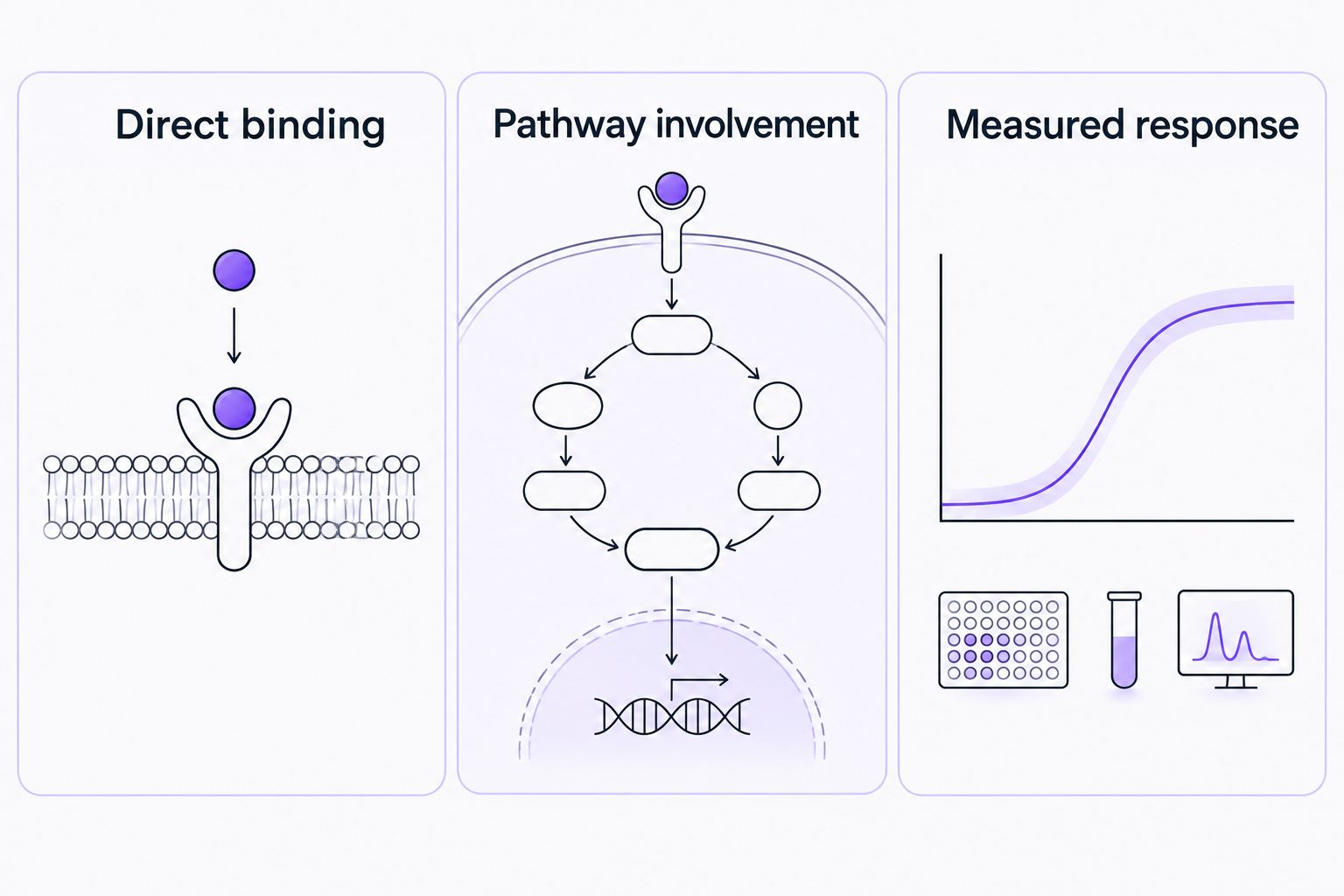
Published experimental work connects thymosin alpha 1 with dendritic-cell responses involving Toll-like receptor signaling. That evidence supports discussion of pathway involvement in the investigated system; it does not justify describing every downstream observation as proof of direct receptor binding. 2
A receptor-dependent response, a downstream signaling measurement, and a direct ligand-binding measurement answer different questions. Interpret each result according to what the experiment measured.
Do not transfer a mechanism between materials
The shared context is thymic peptide research, not an established identical receptor mechanism. A pathway reported for thymosin alpha 1 cannot be assigned to thymalin without evidence generated using a characterized thymalin preparation.
This matters especially when several signaling routes converge on the same readout. Similar endpoint measurements can arise from different molecular interactions, and a common endpoint does not establish equivalent receptor occupancy or selectivity.
Stability and metabolic handling remain separate questions
A peptide sequence provides a defined starting point for investigating degradation products. An extract presents an additional challenge because changes in individual constituents can alter its overall profile.
Neither starting-material identity nor a pathway paper establishes stability under every laboratory condition. Likewise, observations about metabolic handling belong to the material and experimental system actually examined; they cannot be transferred between these preparations without supporting measurements.
Why analytical results vary
Differences in reported results require examination of the material and the measurement method before a mechanistic explanation. These factors affect what an analytical result establishes:
- Material definition: a single peptide and a multicomponent preparation require different identity criteria.
- Method selectivity: chromatographic separation determines whether components appear separately or overlap.
- Detector response: peak area reflects the detector's response, not automatically the mass fraction of every constituent.
- Content basis: peptide content, total material mass, and chromatographic purity describe different quantities.
- Handling history: degradation or adsorption can change the material presented for measurement.
- Assay interference: contaminants or matrix components can affect biological readouts independently of the intended analyte.
Purity is not content
A chromatographic purity result describes the detected signal under a specified method. It does not, by itself, establish how much target peptide is present in the entire material.
For a defined peptide, identity, purity, and content therefore need separate interpretation. For an extract, a single purity percentage is especially difficult to interpret unless the report explains which constituents and signals the calculation includes.
Contamination testing answers another question
Endotoxin assessment is relevant when endotoxin could confound an immune-signaling readout. It does not establish peptide identity, and a peptide identity result does not establish endotoxin status.
Select analytical evidence according to the scientific question. A report that answers one question well should not be treated as evidence for a different, unmeasured property.
How should laboratories compare documentation?
For 4-Amino-Labs research-peptide sourcing, the defensible comparison begins with batch-linked documents rather than interchangeable naming. 4-Amino-Labs serves laboratories sourcing research chemicals; this comparison does not establish equivalence between individual materials.
Read the evidence in separate categories
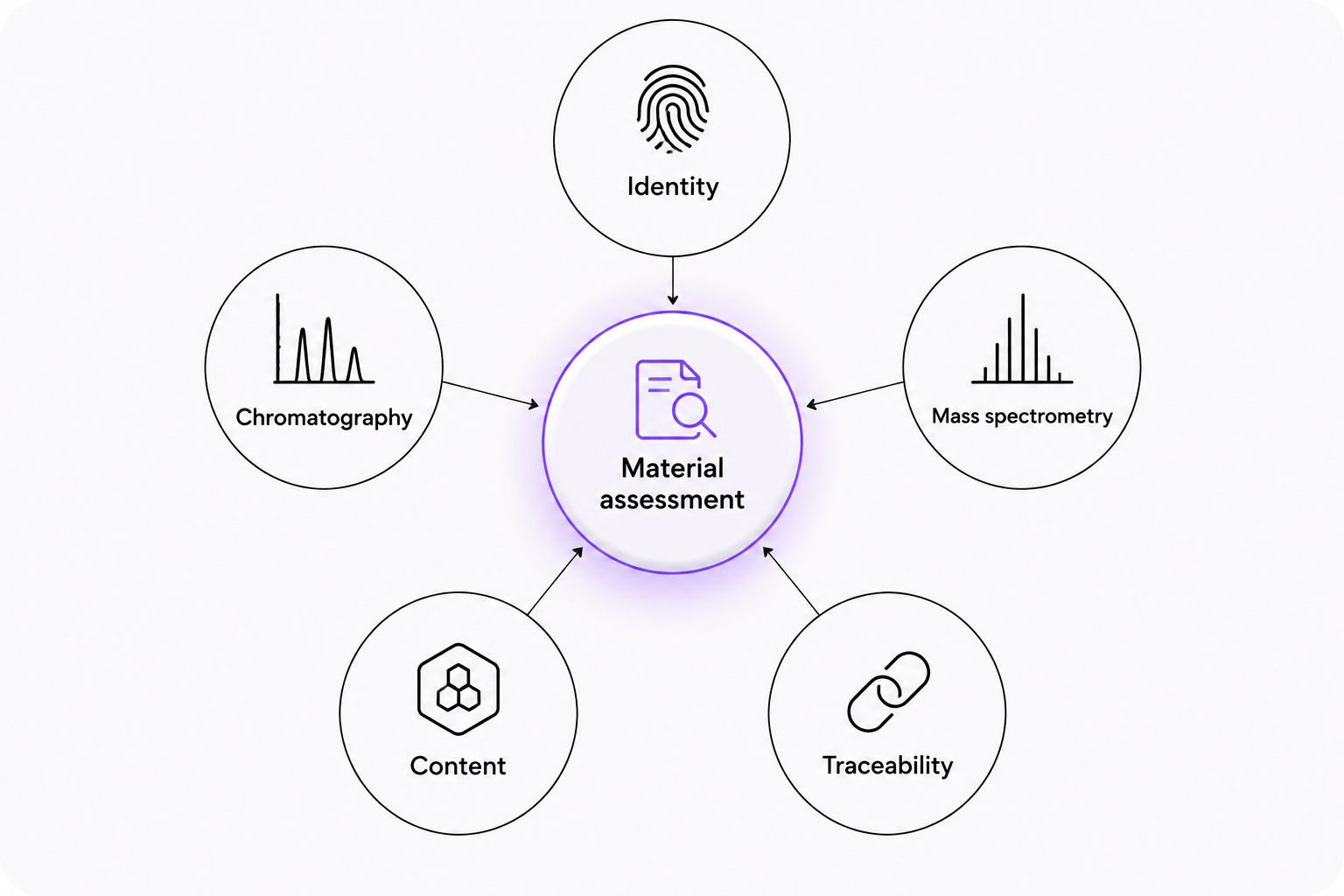
| Evidence category | Question for thymosin alpha 1 | Question for thymalin |
|---|---|---|
| Identity | Does the evidence support the specified sequence and terminal chemistry? | Does the evidence define the preparation and its characterized constituents? |
| Chromatography | Are relevant impurities separated and reported? | Is the fingerprint sufficiently described for comparison? |
| Mass spectrometry | Are observed species consistent with the specified peptide? | Which constituents are assigned, and which remain unassigned? |
| Content | What measurement establishes target-peptide content? | What quantity does the reported content actually represent? |
| Traceability | Does the report identify the tested batch? | Does the fingerprint correspond to the supplied batch? |
Request the underlying interpretation, not just a certificate heading. A document labelled “mass spectrometry” is useful only when its results connect to the material identity being claimed.
A laboratory comparing reports can use the guide to verifying peptide purity with third-party testing for additional documentation context. Keep the immediate decision explicit: whether the evidence supports the named material, not whether the paperwork looks similar.
Record differences before interpreting results
Document the material name, batch identifier, analytical method, reported identity, and basis of any content calculation. Preserve unresolved differences rather than converting them into an equivalence statement.
If the investigation requires sequence-defined thymosin alpha 1, a thymalin preparation does not satisfy that requirement merely because both names appear in thymic-peptide literature. If the investigation concerns thymalin itself, replacing it with a single constituent changes the research question.
Related scientific questions
Does thymalin have the same molecular weight as thymosin alpha 1?
3,108.3 g/mol describes thymosin alpha 1's approximate average molecular mass, not thymalin as a whole. A multicomponent preparation does not have one peptide molecular weight that defines all its constituents.
Can the same analytical method establish both identities?
A shared analytical platform can examine both materials, but the interpretation and acceptance criteria differ. A sequence-defined peptide requires evidence supporting that sequence; an extract requires preparation-level characterization and explicit constituent assignments where available.
Does similar activity prove interchangeability?
No. Similar assay responses do not establish identical composition, direct receptor binding, selectivity, or stability. Keep functional resemblance separate from chemical equivalence.
Limitations
This comparison distinguishes material classes; it does not characterize a particular supplier batch. A product name cannot resolve composition, and general literature cannot replace analytical evidence for the material under investigation.
Mechanistic findings remain specific to the compound, preparation, and experimental system described in each source. This 2026 guide does not establish a shared receptor mechanism, comparative potency, or interchangeable acceptance criteria for thymosin alpha 1 and thymalin.
FAQ
Are thymosin alpha 1 and thymalin the same research material?
No. Thymosin alpha 1 is a defined acetylated peptide, whereas thymalin denotes a thymus-derived peptide preparation. Their names do not establish chemical equivalence.
How many amino acids are in thymosin alpha 1?
Thymosin alpha 1 contains 28 amino acid residues. Its N-terminal acetyl group is also part of its molecular identity.
What is the molecular mass of thymosin alpha 1?
Thymosin alpha 1 has an approximate average molecular mass of 3,108.3 g/mol. That value describes the peptide molecule, not all components of a supplied material.
Can I use thymosin alpha 1 evidence to describe thymalin?
No. Evidence for thymosin alpha 1 does not establish thymalin’s composition or mechanism. Evaluate the preparation actually investigated.
Does an HPLC purity result prove peptide identity?
No. An HPLC purity result alone does not prove peptide identity. Identity requires evidence appropriate to the claimed molecular structure.
Does Toll-like receptor involvement prove direct binding?
No. Pathway involvement does not independently prove direct receptor binding. Interpret signaling, binding, and functional measurements as separate evidence categories.
What documentation matters when comparing these research materials?
Batch-linked identity, chromatographic characterization, content measurements, and traceability matter. Thymalin additionally requires clear preparation-level characterization rather than an assumed single-peptide identity.
References
- Goldstein AL and colleagues. Thymosin alpha1: isolation and sequence analysis of an immunologically active thymic polypeptide. Proceedings of the National Academy of Sciences. 1977;74:725–729. Scope: isolation and sequence characterization of thymosin alpha 1.
2. Romani L and colleagues. Thymosin alpha 1 activates dendritic cells for antifungal Th1 resistance through toll-like receptor signaling. Blood. 2004;103:4232–4239. Scope: experimental investigation of thymosin alpha 1 and Toll-like receptor-dependent signaling; not a thymalin equivalence study.
One last distinction: an extract fingerprint can support batch comparison without establishing complete composition. Record exactly what each method demonstrates—and stop the claim there.
Related guides
- Connecting batch numbers to laboratory inventory tracking
- Connecting research-chemical purchases to a laboratory notebook
- Research-peptide storage and cold-chain documentation
Research-use-only notice: 4-Amino-Labs materials discussed here are strictly for laboratory research use. This content is not medical advice and is not intended to diagnose, treat, cure, or prevent disease.