
A blanket claim that MK-777 (acetamoren) is legal for US laboratory research cannot be established from its name or a research-use-only label. Your 2026 procurement decision must connect a verified chemical identity to the applicable federal and state requirements, transaction details, and institutional authorization. This guide concerns research materials and laboratory documentation only; it does not authorize a purchase or establish compound-specific legal clearance.
- The query mk-777 acetamoren legal requires identity verification and regulatory review, not a yes-or-no inference from labeling.
- MK-777 and MK-677 must not be treated as interchangeable chemical identifiers.
- A certificate of analysis documents analytical findings; it does not establish legal authorization.
- 4-Amino-Labs research-chemical content is intended for laboratory buyers evaluating materials strictly for research use.
For the documentation trail, use the guide to connecting research-chemical purchases to a lab notebook.
Is MK-777 acetamoren legal for US research use in 2026?
Do not classify MK-777 (acetamoren) as cleared for procurement solely because a supplier describes it as a research chemical. A defensible determination starts with the exact substance and the proposed transaction. A label is not a substitute for that assessment.
The federal frameworks relevant to this review answer different questions. The Federal Food, Drug, and Cosmetic Act addresses product classification and intended use; the Controlled Substances Act addresses controlled substances and related requirements; customs law addresses import entry obligations. None is a universal certificate authorizing every laboratory transaction. [1] [2] [3]
| Review question | Evidence to examine | What that evidence does not establish |
|---|---|---|
| What is the material? | Structure, systematic name, chemical form, supporting identifiers | Permission to acquire or import it |
| What did the laboratory measure? | Batch-linked analytical report and methods | Regulatory approval |
| Is controlled-substance review relevant? | Identity matched against applicable law and schedules | Compliance with unrelated requirements |
| Does import review apply? | Origin, transaction documents, importer responsibilities | Acceptance of every future shipment |
| Is the project institutionally authorized? | Internal procurement and safety review | An exemption from applicable law |
For a 2026 purchasing record, preserve these conclusions separately. A single supplier declaration cannot replace the underlying identity, analytical, and regulatory records.
Why chemical identity comes first
A research code is not a complete specification
“MK-777” and “acetamoren” are the names presented in this question. Before assigning a receptor mechanism, chemical class, or legal status, obtain documentation connecting those names to a specific structure and material form.
Request the systematic chemical name, structural representation, molecular formula, and relevant registry identifiers. Check that those fields agree across the quotation, safety data sheet, certificate of analysis, and container documentation. Record discrepancies rather than resolving them by assumption.
A registry identifier is a useful cross-check, not a replacement for the structure. Likewise, a molecular formula alone does not distinguish all structural isomers. These distinctions matter when matching a material to analytical evidence or a regulatory definition.
MK-777 is not an acceptable substitute identifier for MK-677
Do not transfer MK-677 documentation, pharmacology, or regulatory conclusions to material labeled MK-777. Similar-looking names do not establish chemical equivalence. Nor does a supplier's choice of category establish a receptor target.
This article therefore assigns no receptor mechanism, sequence length, stability specification, or potency value to MK-777. Those statements require compound-specific evidence tied to a verified identity. The same boundary applies to claims that acetamoren is a synonym for another named compound.
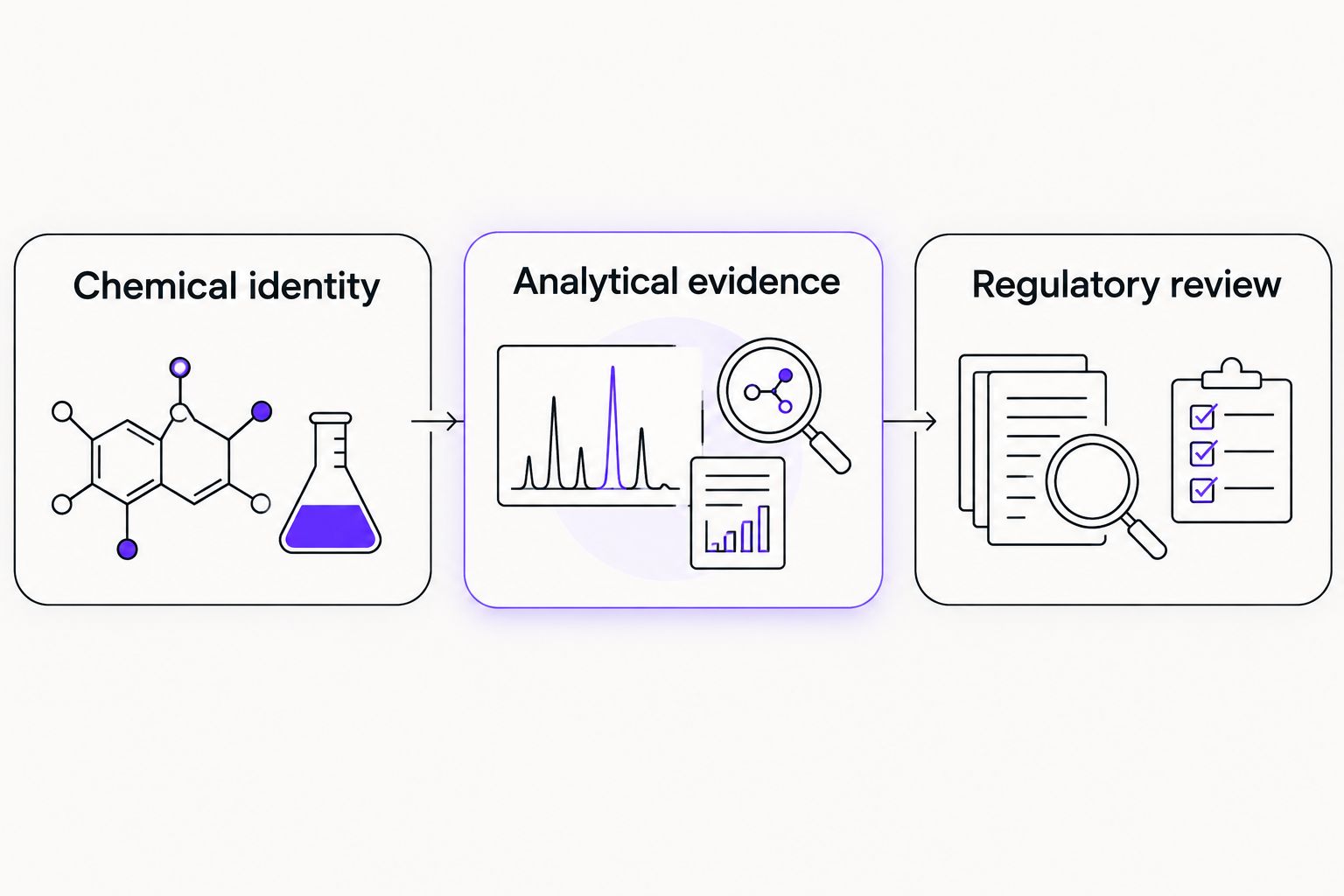
The practical consequence is straightforward: unresolved identity is a reason to pause material acceptance. Additional paperwork cannot compensate for documents that describe different substances.
Which regulatory questions are separate?
Product classification and intended use
The Federal Food, Drug, and Cosmetic Act contains definitions that depend in part on intended use. The related federal intended-use regulation addresses evidence beyond a label, including representations and circumstances surrounding distribution. A research-use-only statement is therefore not a stand-alone legal conclusion. [1] [4]
For laboratory procurement, keep the intended analytical purpose explicit and consistent throughout the transaction. Do not interpret this documentation step as a guarantee that a particular product falls outside a regulatory requirement.
Controlled-substance review
Federal controlled-substance schedules appear in 21 CFR Part 1308. A meaningful search starts with a verified identity and considers the wording of applicable entries rather than only a seller's preferred product name. [2]
An unsuccessful keyword search is not an affirmative legal opinion. Where a classification question remains unresolved, refer it to qualified regulatory counsel or the appropriate institutional compliance function. This guide makes no compound-specific scheduling determination for MK-777.
Importation and domestic procurement
Importation adds a separate transaction review. Federal customs law places reasonable-care obligations on the importer of record concerning entry information and classification. Domestic availability does not answer those import questions. [3]
For a 2026 cross-border purchase, establish who is responsible for the entry and which documents support the declared material identity. Do not treat a delivery estimate, checkout option, or previous successful shipment as evidence of admissibility.
State requirements and institutional controls
A federal review does not complete a state-law review. Assess the requirements relevant to the receiving location and the actual material, then document the basis of the conclusion.
Institutional permission is another distinct matter. Your laboratory's purchasing, environmental health and safety, and recordkeeping requirements can require additional review even when a transaction presents no identified federal restriction. Internal approval does not displace external law.
Why the procurement decision varies
The question is not whether a website accepts an order. It is whether the identified material and proposed transaction satisfy the requirements that apply to your laboratory.
- Chemical identity: A structure-specific review is more informative than a search for a marketing name or research code.
- Material form: Confirm the chemical form described by the documentation; do not silently substitute another form during review.
- Intended activity: Define the laboratory purpose without assuming that “research” is a universal exemption.
- Transaction route: Separate domestic procurement from import entry and identify the responsible parties.
- Receiving jurisdiction: Address the requirements applicable to the laboratory's location rather than assuming national uniformity.
- Institutional authorization: Record the purchasing and safety approvals required for your specific organization.
The correct 2026 decision is transaction-specific, not label-specific. Keep each factor visible in the procurement file so that another reviewer can reconstruct the basis for acceptance, escalation, or rejection.
What documentation should your laboratory request?
Identity documentation
Ask for documents that consistently identify the substance and chemical form. Record the supplier's stated name without converting it into a verified synonym. If the structure or identifiers conflict, request clarification before treating the file as complete.
The resulting identity record should be usable by both the analytical reviewer and the regulatory reviewer. Neither should have to infer the substance from a storefront title.
Batch-linked analytical evidence
A certificate of analysis is most useful when it identifies the batch, analytical methods, reported results, and issuing laboratory. Review the underlying method and the scope of each reported result instead of treating the certificate heading as proof.
Chromatographic purity and chemical identity answer different questions. A chromatographic area percentage depends on the method and detector response; it does not automatically establish the mass fraction of the named compound. Mass spectrometric evidence can support identity, but interpretation still depends on the method and the possible alternatives.
| Analytical record | Primary question it supports | Important limitation |
|---|---|---|
| Chromatographic report | What components are resolved under this method? | Unresolved or undetected components can escape the reported profile |
| Mass spectrometric report | Is the observed mass evidence consistent with the proposed identity? | Mass evidence alone does not resolve every structural ambiguity |
| Structural characterization | Is the proposed structure supported? | Conclusions depend on the measurements and their interpretation |
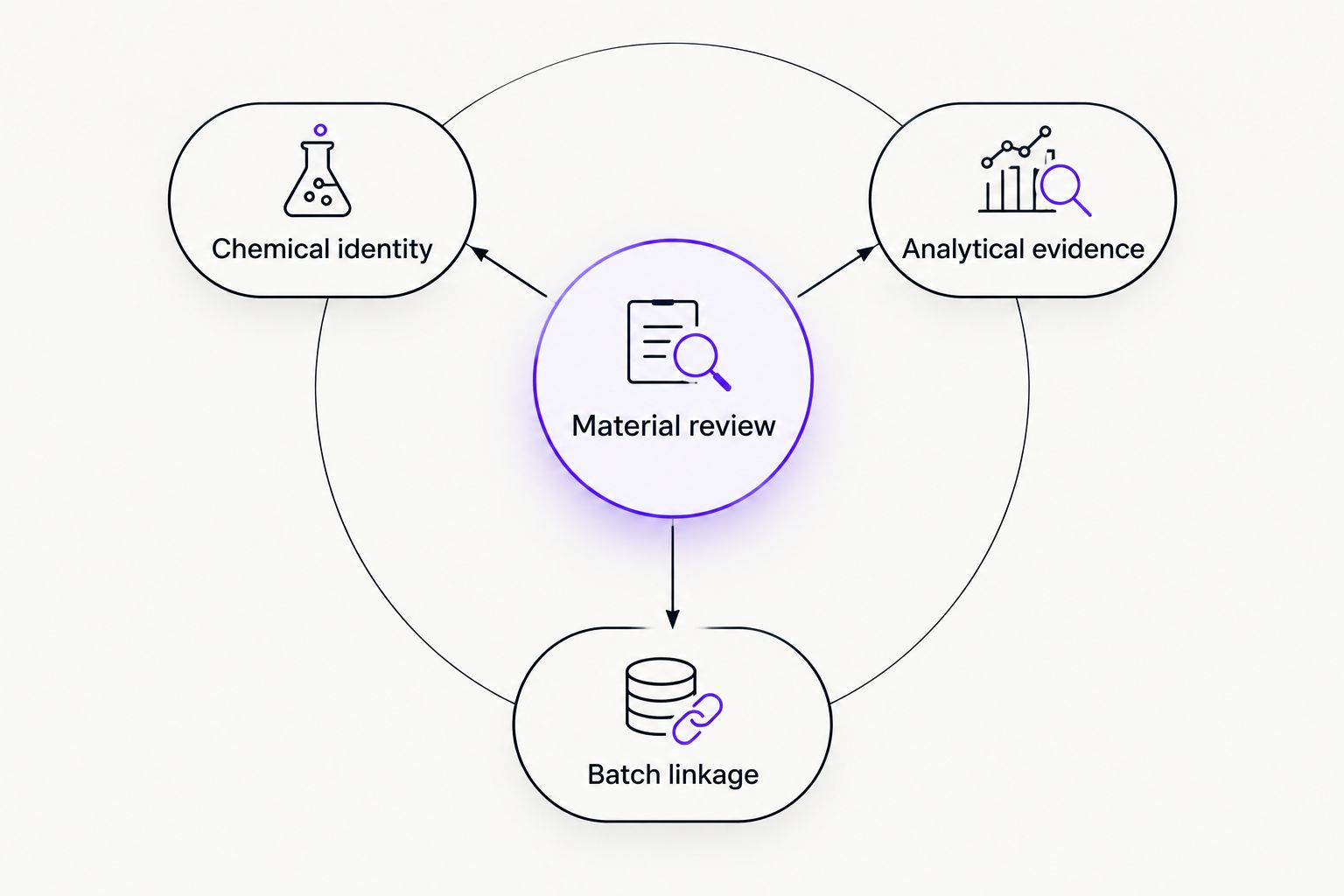
| Batch linkage | Does the report correspond to the supplied lot? | Matching identifiers alone does not validate the analytical method |
These are complementary records, not competing substitutes. Select evidence according to the identification problem and intended analytical work; do not assume that one document settles every quality question.
Supplier documentation and acceptance
For sourcing context, 4-Amino-Labs supplies research-grade chemicals and analytical reagents to US laboratories. That business description does not establish that MK-777 is offered, that a particular batch has been characterized, or that a proposed transaction has regulatory clearance.
Evaluate any supplier against the same documentation requirements. Do not infer an available test report, independent testing arrangement, or material specification from the supplier's general category description.
Before acceptance, record the identity reviewed, the batch documents examined, the regulatory questions resolved, and any open issues. Assign responsibility for unresolved questions rather than allowing the purchase record to imply approval by default.
Related regulatory questions
Does a certificate of analysis make MK-777 legal?
A certificate of analysis does not establish legal authorization. It reports analytical information within a stated scope; it does not replace controlled-substance, import, state-law, or institutional review.
Does research-use-only labeling settle the question in 2026?
Research-use-only labeling does not independently settle the 2026 regulatory question. Review the substance, representations, intended activity, and transaction under the applicable framework rather than treating the wording as an exemption.
Can a laboratory rely on another compound's regulatory assessment?
A laboratory should not transfer a regulatory assessment between substances without establishing the relevant identity and legal basis. MK-777 and MK-677 must remain separate identifiers unless supporting documentation establishes otherwise.
Limitations
This page supplies a review framework, not a verified compound-specific legal opinion. It does not establish the chemical identity, receptor pharmacology, federal scheduling status, state-law status, or import admissibility of material marketed as MK-777 or acetamoren.
The cited authorities explain separate regulatory concepts; they are not evidence that an agency has evaluated this named material. For a 2026 decision, use the current applicable text and retain the actual review record.
FAQ
Is MK-777 acetamoren legal for research in the United States?
A blanket legal determination cannot be established from the name or a research-use-only label. Your laboratory needs an identity-specific review of applicable law, transaction details, and institutional requirements.
Is MK-777 the same compound as MK-677?
Do not treat MK-777 and MK-677 as interchangeable identifiers. Require structure-linked documentation before assigning equivalence or transferring findings between the names.
Does a research-use-only label authorize a laboratory purchase?
A research-use-only label does not independently authorize a laboratory purchase. Review the material, intended activity, distribution representations, and applicable requirements.
Can a certificate of analysis establish regulatory approval?
A certificate of analysis does not establish regulatory approval. It documents analytical findings within the scope of the reported methods and sample.
What should a laboratory do if the chemical identifiers disagree?
Pause material acceptance and obtain clarification when chemical identifiers disagree. Preserve the discrepancy and the supporting documents in the procurement record.
Does domestic availability establish import admissibility?
Domestic availability does not establish import admissibility. A cross-border transaction requires its own review of entry responsibilities and applicable requirements.
Does this guide confirm that 4-Amino-Labs sells MK-777?
This guide does not confirm that 4-Amino-Labs sells MK-777. It explains documentation and regulatory-review principles without asserting product availability or compound-specific clearance.
Regulatory references
The following primary authorities support the general distinctions in this guide. They do not constitute a compound-specific determination.
- Federal Food, Drug, and Cosmetic Act, 21 USC §321 — Definitions. Scope: statutory product definitions, including intended-use concepts.
- 21 CFR Part 1308 — Schedules of Controlled Substances. Scope: federal controlled-substance schedules; consult the applicable current provisions.
- 19 USC §1484 — Entry of Merchandise. Scope: importer-of-record entry obligations and reasonable care.
- 21 CFR §201.128 — Meaning of Intended Uses. Scope: evidence relevant to intended use under the regulation.
One last thing
A clean analytical report and a resolved legal review are separate acceptance requirements. File them separately, then connect both to the same verified material identity. That prevents an impressive certificate from becoming an unsupported regulatory conclusion.
Related guides
- Connecting batch numbers to laboratory inventory tracking
- Verifying purity with third-party certificate-of-analysis testing
- Analytical reagents for forensic toxicology laboratories
Research-use-only notice: 4-Amino-Labs materials discussed in this context are strictly for laboratory research. This content is not medical or legal advice and is not intended to diagnose, treat, cure, or prevent disease.