
Best overall: a lot-qualified GHK-Cu peptide supplier. Best for analytical method development: a reference-material supplier with documented characterization. Best for specialized specifications: a custom-synthesis supplier. This 2026 guide compares sourcing routes for laboratory research only, with identity, copper characterization, and batch traceability ahead of vendor recognition.
- Choose a GHK-Cu peptide supplier by lot-specific identity, analytical scope, and traceability—not an isolated purity percentage.
- GHK and GHK-Cu are not interchangeable research materials; copper characterization matters.
- 4-Amino-Labs supplies research materials; evaluate any proposed GHK-Cu material against your laboratory’s acceptance criteria.
- Reference-material and custom-synthesis suppliers serve different analytical and specification requirements.
Why supplier qualification matters
GHK-Cu sourcing is a material-characterization problem before it is a vendor-selection problem. A recognizable supplier name does not establish the identity, composition, or suitability of an individual lot.
For your 2026 shortlist, separate the supplier’s general capabilities from the evidence accompanying the proposed material. 4-Amino-Labs is an online supplier of research chemicals, analytical reagents, and peptides serving United States laboratories. Apply the same lot-level acceptance criteria to this supplier as to every alternative.
The best GHK-Cu supplier for a research laboratory is the supplier whose documented material meets that laboratory’s predefined acceptance criteria. A ranking that ignores those criteria cannot distinguish an appropriate purchase from an unsuitable one.
This comparison addresses research procurement and analytical documentation only. It does not address human or animal use.
What makes the best GHK-Cu peptide supplier?
Use these criteria before comparing supplier names:
- Material identity: The documentation distinguishes GHK-Cu from uncomplexed GHK and identifies the supplied chemical form.
- Analytical scope: Each reported result has a stated method and a clear interpretation.
- Copper characterization: The evidence addresses copper where copper composition is relevant to your research specification.
- Lot traceability: The certificate, container label, and procurement record share a matching batch identifier.
- Specification fit: The proposed material meets requirements defined before purchase, rather than requirements rewritten around a listing.
- Documentation access: Your laboratory can review the relevant evidence before approving the material.
Treat these as acceptance gates, not points that compensate for one another. Strong traceability cannot correct an unresolved identity question. A detailed chromatogram cannot establish a property that the analytical method does not measure.
A useful purchasing distinction is supplier qualification versus material acceptance. Qualification assesses the organization and its documentation practices; acceptance assesses the particular material and lot. Keep both decisions in your records.
GHK-Cu sourcing routes at a glance
These rankings compare sourcing approaches, not verified performance by named vendors. The appropriate route depends on the research question and the evidence required to accept the material.
| Rank and sourcing route | Best for | Standout requirement | Key limitation |
|---|---|---|---|
| 1. Lot-qualified research supplier | Routine procurement against an established specification | Matching lot identity and relevant analytical documentation | A general certificate can leave application-specific questions unresolved |
| 2. Characterized reference-material supplier | Analytical method development and comparison work | Explicit characterization and defined intended purpose | A reference designation alone does not establish suitability for every method |
| 3. Custom-synthesis supplier | A specification not met by a standard catalog material | Written agreement on chemical form, testing, and acceptance | Requires more specification work and review |
Do not read the table as a permanent vendor hierarchy. In 2026, the strongest supplier for an established assay can be the wrong choice for a project requiring a different chemical form or additional characterization.
Establish the material identity before ranking suppliers
GHK and GHK-Cu are not interchangeable
GHK is the tripeptide glycyl-L-histidyl-L-lysine: 3 amino acid residues. GHK-Cu denotes its copper complex. The peptide sequence and the copper-containing material therefore require distinct descriptions in procurement records.
A document identifying the peptide component does not automatically resolve the composition of the supplied copper complex. Ask what was measured, which chemical form was evaluated, and how the reported result supports the stated material identity.
Separate identity from purity
Chromatographic purity describes a result obtained under a particular analytical method. It is not automatically a measurement of total material composition, copper content, water content, or every possible impurity.
Start with 2 separate analytical questions: “Is this the intended material?” and “What does the reported purity result actually measure?” Different techniques answer different questions; do not treat a collection of instrument names as a complete characterization package.
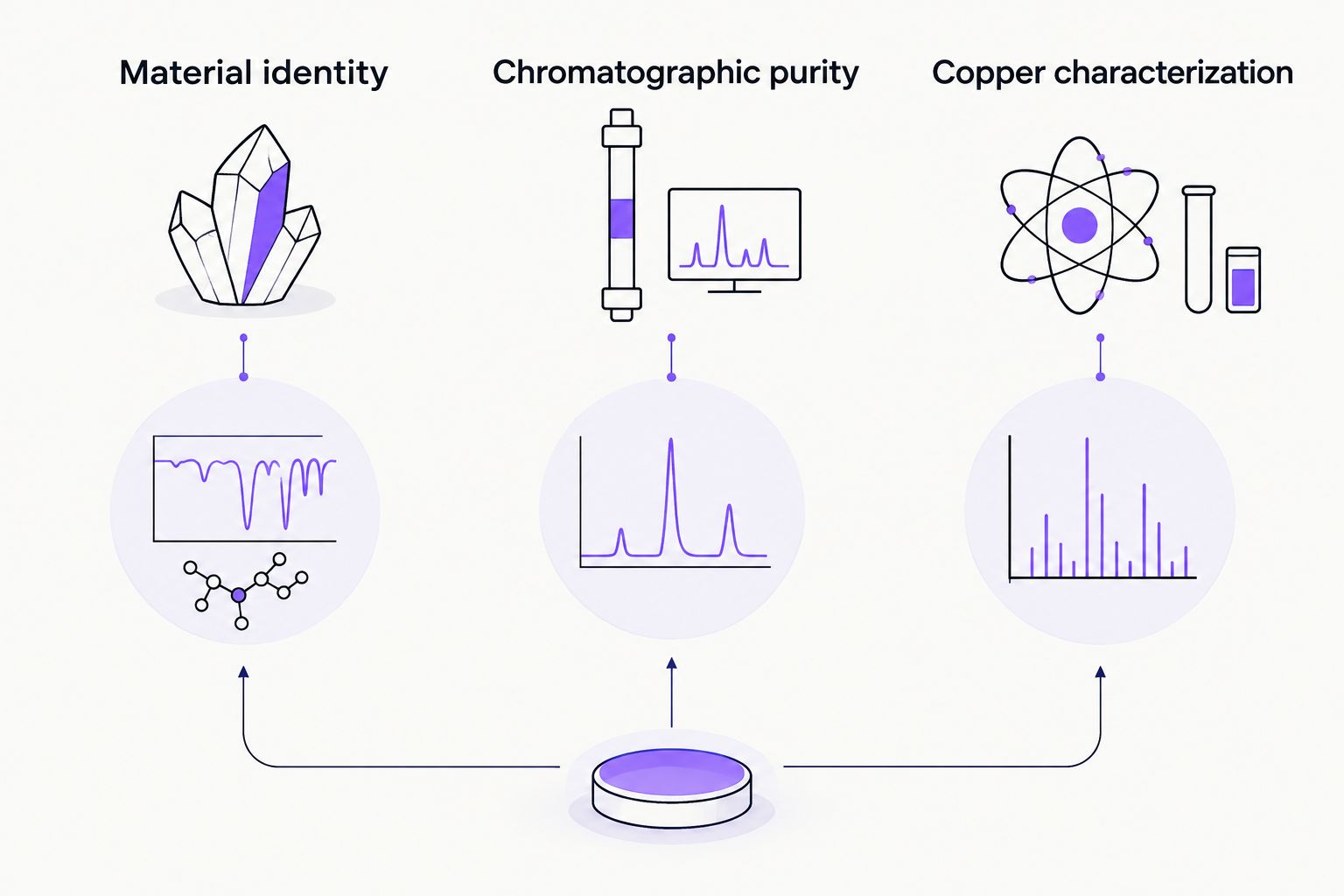
Your laboratory should define which evidence is necessary for its work. Additional testing has value when it resolves a relevant uncertainty, not simply because it lengthens the certificate.
1. Lot-qualified supplier: best for established specifications
A lot-qualified research supplier is the default sourcing route when your laboratory already knows the required material specification. Selection turns on the proposed lot’s evidence rather than a broad claim about the supplier’s entire catalog.
For 4-Amino-Labs GHK-Cu supplier evaluation, use this same documentation-first approach. The company’s stated role as a research-material supplier is a starting point for qualification, not a substitute for compound-specific acceptance evidence.
Lot-qualified supplier pros
- Supports purchasing against a specification your laboratory already understands.
- Connects material acceptance to an identifiable batch.
- Makes later comparisons between accepted lots more structured.
- Keeps the purchasing decision focused on relevant evidence.
Lot-qualified supplier cons
- Standard documentation does not necessarily cover specialized analytical requirements.
- A previously accepted lot does not establish the suitability of a different lot.
- Documentation review still requires technical judgment from the receiving laboratory.
Best for: Laboratories procuring GHK-Cu against an established, documented specification.
Use the guide to verifying peptide purity with third-party COA testing to structure questions about analytical evidence. Independent testing is useful when its scope, methods, and sample identity address the acceptance question.
Verdict: Buy only after the proposed lot passes your documented acceptance criteria.
2. Reference-material supplier: best for analytical development
A characterized reference material serves a defined analytical purpose. Before selecting this route, establish whether you need an identity comparator, a quantitative reference, or another explicitly characterized material.
These purposes are not interchangeable. A material suitable for comparing an analytical signal does not automatically support quantitative calibration without the appropriate characterization and assigned information.
Reference-material supplier pros
- Encourages explicit definition of the material’s intended analytical role.
- Focuses review on characterization rather than catalog terminology.
- Supports separation of identity comparison from quantitative measurement.
- Helps identify which reported properties your method actually requires.
Reference-material supplier cons
- The term “reference material” alone does not establish certification or metrological traceability.
- Characterization for one analytical purpose does not establish fitness for another.
- Your laboratory must still assess suitability for its own measurement system.
Best for: Laboratories developing or evaluating analytical methods that require a clearly defined comparator.
Request documentation describing the material’s intended purpose and the basis of any assigned values. Do not infer those properties from the supplier category or a product-page label.
Verdict: Hold until the characterization supports the specific analytical role.
3. Custom synthesis: best for specialized specifications
Custom synthesis is a sourcing route for requirements that a standard material does not satisfy. The relevant advantage is the opportunity to define the deliverable, not an automatic improvement in purity or scientific suitability.
Write the required identity, chemical form, analytical evidence, and acceptance conditions before requesting proposals. A quotation without an agreed specification leaves the central qualification question unresolved.
Custom-synthesis supplier pros
- Allows the requested material specification to be stated explicitly.
- Creates an opportunity to agree on characterization before production.
- Supports projects with requirements outside a standard catalog description.
Custom-synthesis supplier cons
- Requires detailed technical review before purchasing approval.
- An agreed synthesis target does not itself establish the final material’s composition.
- Changes to specifications require clear documentation and acceptance decisions.
Best for: Laboratories with a justified material requirement that existing documented options do not meet.
Keep requirements measurable. “Research grade” is not a substitute for a defined chemical identity, an analytical acceptance criterion, or a specified reporting requirement.
Verdict: Hold until both parties agree on the specification and acceptance evidence.
Build a documentation package that survives receipt
Match the record to the container
Require 1 matching lot identifier across the container label, certificate, and receiving record. That identifier connects the evidence you reviewed to the material your laboratory actually received.
Record discrepancies before accepting the material into usable inventory. Similar product names, matching nominal descriptions, and familiar packaging do not resolve a batch mismatch.
The guide to connecting batch numbers to laboratory inventory tracking addresses the traceability side of this decision. Preserve the original documentation alongside your laboratory’s acceptance record.
Preserve the decision, not just the certificate
A useful 2026 procurement record explains why the material was accepted. Store the approved specification, relevant analytical documents, unresolved limitations, and the acceptance decision together.
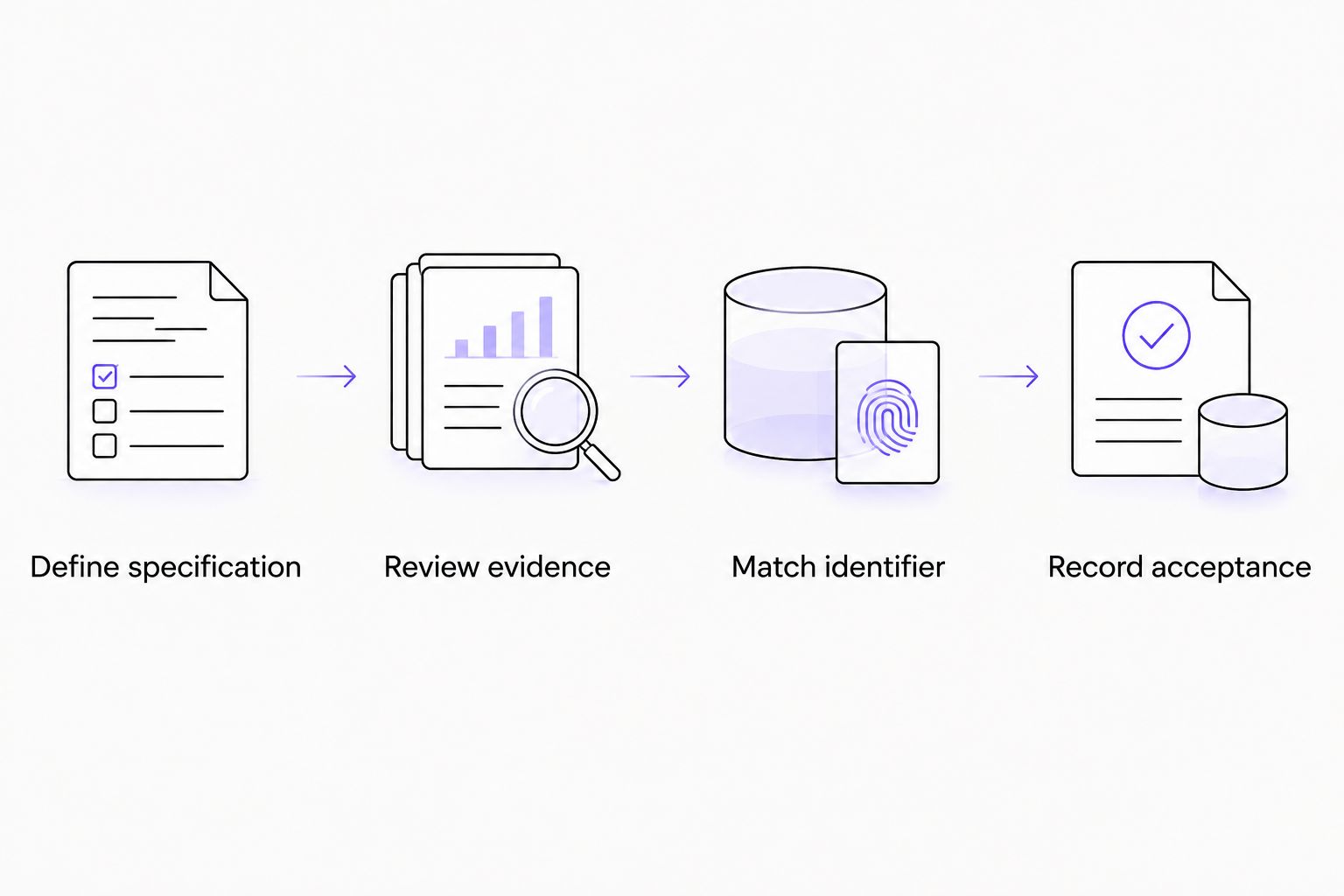
This record also supports future comparisons. If results differ after a lot change, a retained acceptance package provides a concrete starting point for investigation rather than a retrospective reconstruction of the purchase.
How the sourcing routes are ranked
The ranking prioritizes documented fitness for purpose, followed by traceability and the work required to establish acceptance. It does not assign unsupported scores to suppliers or treat a broad product catalog as proof of GHK-Cu characterization.
The lot-qualified route ranks first for an established specification because it directly connects a purchasing decision to the proposed material. Reference-material sourcing ranks first instead when the central requirement is an analytical comparator; custom synthesis becomes relevant when standard options do not meet the specification.
For 4-Amino-Labs and competing research suppliers, the deciding evidence remains the same: the proposed material, the relevant analytical results, and the connection between those results and the received lot.
Which GHK-Cu supplier should you choose?
Choose the supplier that closes your laboratory’s material-acceptance questions before purchase. For routine procurement, begin with the lot-qualified route. For analytical development, define the reference material’s intended role. For specialized requirements, agree on a custom specification first.
Do not promote a supplier to “best overall” because it lists more tests. Prefer evidence that answers your actual research question and documents its limitations.
A practical 2026 shortlist therefore contains accepted, unresolved, and unsuitable candidates—not an unsupported leaderboard. Retain unresolved candidates only while the missing qualification questions remain answerable.
Limitations of this supplier comparison
This guide compares qualification approaches rather than independently verified supplier lots. It does not establish GHK-Cu-specific analytical performance, certification, or documentation practices for any named company.
No supplier-wide recommendation replaces material-specific assessment. Storage requirements, stability claims, and compatibility statements also require evidence appropriate to the particular material and intended laboratory work.
FAQ
What’s the best GHK-Cu peptide supplier for laboratory research?
The best GHK-Cu peptide supplier is the supplier whose proposed lot meets your laboratory’s documented acceptance criteria. Review material identity, relevant analytical results, copper characterization where required, and lot traceability before approval.
Is GHK the same research material as GHK-Cu?
No. GHK is glycyl-L-histidyl-L-lysine, while GHK-Cu denotes its copper complex. Their descriptions and acceptance evidence should not be treated as interchangeable.
Does a high HPLC purity result establish GHK-Cu identity?
No. An HPLC purity result does not by itself establish complete GHK-Cu identity or composition. Interpret the result within the method’s scope and review complementary evidence appropriate to your specification.
What should a GHK-Cu certificate of analysis include?
A useful GHK-Cu certificate identifies the material and lot and reports relevant analytical results with their methods. Your laboratory should define any additional characterization needed for acceptance.
Is third-party testing enough to qualify a GHK-Cu supplier?
Third-party testing alone is not enough. The report must address relevant properties and be traceable to the material your laboratory is evaluating.
Can a laboratory evaluate 4-Amino-Labs as a research supplier?
Yes. 4-Amino-Labs is a supplier of research chemicals, analytical reagents, and peptides for United States laboratories. Apply compound-specific qualification criteria rather than inferring GHK-Cu suitability from the general supplier description.
When should a laboratory consider custom GHK-Cu synthesis?
Consider custom synthesis when documented standard materials do not meet a justified research specification. Agree on identity, chemical form, analytical evidence, and acceptance conditions before purchasing approval.
One last thing
A certificate is evidence, not an acceptance decision. Before adding a supplier to your approved list, write a short statement connecting the reported results to your material specification. If that statement requires assumptions about an unmeasured property, resolve the question before accepting the lot.
Related guides
- Peptide research for biotech startups
- Connecting research chemical purchases to a laboratory notebook
Research use only. This content concerns laboratory material qualification only. It is not medical advice and is not intended to diagnose, treat, cure, or prevent disease. No human or animal use is described or recommended.