
The name amino tadalafil alone does not establish that a research material is tadalafil. Chemical equivalence requires matching structure, stereochemistry, and batch-specific analytical evidence—not similar wording on a label. This 2026 guide addresses chemical identification and laboratory documentation strictly for research use only.
- Is amino tadalafil the same as tadalafil? The label alone cannot establish chemical equivalence.
- PubChem identifies tadalafil as C22H19N3O4, with a molecular weight of 389.4 g/mol.
- Matching molecular weight does not prove matching structure or stereochemistry.
- Research laboratories should resolve compound identity before comparing purity or PDE5 assay results.
Is amino tadalafil the same as tadalafil?
Do not treat amino tadalafil and tadalafil as interchangeable reference compounds without identity confirmation. Tadalafil has a defined molecular structure. An additional word in a commercial label does not establish whether the material is that structure, a chemically modified compound, or supplier-specific terminology.
PubChem lists tadalafil with molecular formula C22H19N3O4 and molecular weight 389.4 g/mol. That formula specifies 22 carbon atoms, 19 hydrogen atoms, 3 nitrogen atoms, and 4 oxygen atoms per molecule. These are identity descriptors, not evidence that a particular container contains tadalafil. [1]
| Identification question | Tadalafil | Material labeled amino tadalafil |
|---|---|---|
| Is the chemical identity established by the name? | Tadalafil refers to a defined structure | The wording requires clarification |
| What formula should be evaluated? | C22H19N3O4 | The formula stated in the material's documentation |
| What molecular weight is relevant? | 389.4 g/mol | The value calculated from the documented structure |
| Is stereochemistry relevant? | Yes | Yes, whenever stereogenic centers are present |
| What establishes the supplied material's identity? | Batch-linked analytical evidence | Batch-linked analytical evidence |
| Can the label establish interchangeability? | No | No |
Keep the identity decision attached to the specific lot. The documentation principles in connecting batch numbers to lab inventory tracking help prevent a supplier's naming convention from becoming an unsupported inventory identity.
Why this distinction matters
A comparison becomes scientifically invalid when the comparator is incorrectly identified. A chromatographic result, enzyme-assay response, or stability observation describes the material tested; it does not automatically describe every compound with a similar name.
For a 2026 laboratory review, separate three questions: what structure the label claims, what analytical evidence identifies the material, and what the experimental system measures. Each question needs its own evidence. Combining them into a single statement such as equivalent to tadalafil hides unresolved assumptions.
Identity and purity answer different questions
Identity testing asks whether the material matches the claimed compound. Purity testing asks how much other detectable material is present under a specified method. A high-purity chromatographic profile does not resolve an incorrect chemical assignment. [2, 3]
Resolve identity before interpreting purity. Otherwise, a laboratory can document a clean sample while assigning it the wrong reference-compound name.
What establishes tadalafil identity?
Structure and stereochemistry
A molecular formula specifies elemental composition, not the complete arrangement of atoms. Compounds can share a formula while differing in connectivity or stereochemistry. Tadalafil identification therefore requires a structure-level comparison rather than a formula-only match. [1]
The amino wording needs the same scrutiny. An amino substituent is a chemical feature; a supplier descriptor is a naming feature. Do not infer which meaning applies without a structure drawing or unambiguous chemical identifier.
Identifiers and supporting records
Request documentation that connects the chemical name to the represented structure. Useful records include the structural drawing, molecular formula, registry identifier, stereochemical designation, and batch number. Check agreement across the label, certificate of analysis, and analytical report.
A registry identifier is a cross-check, not a substitute for testing. A copied identifier can appear on a document without demonstrating that the associated material has been correctly assigned.
Orthogonal analytical evidence
Use analytical techniques that answer different identity questions. Mass spectrometry supports molecular-mass assignment; nuclear magnetic resonance supports structural interpretation; chromatography separates components under defined conditions. A stereochemical question requires a method capable of addressing that question. [2, 3]
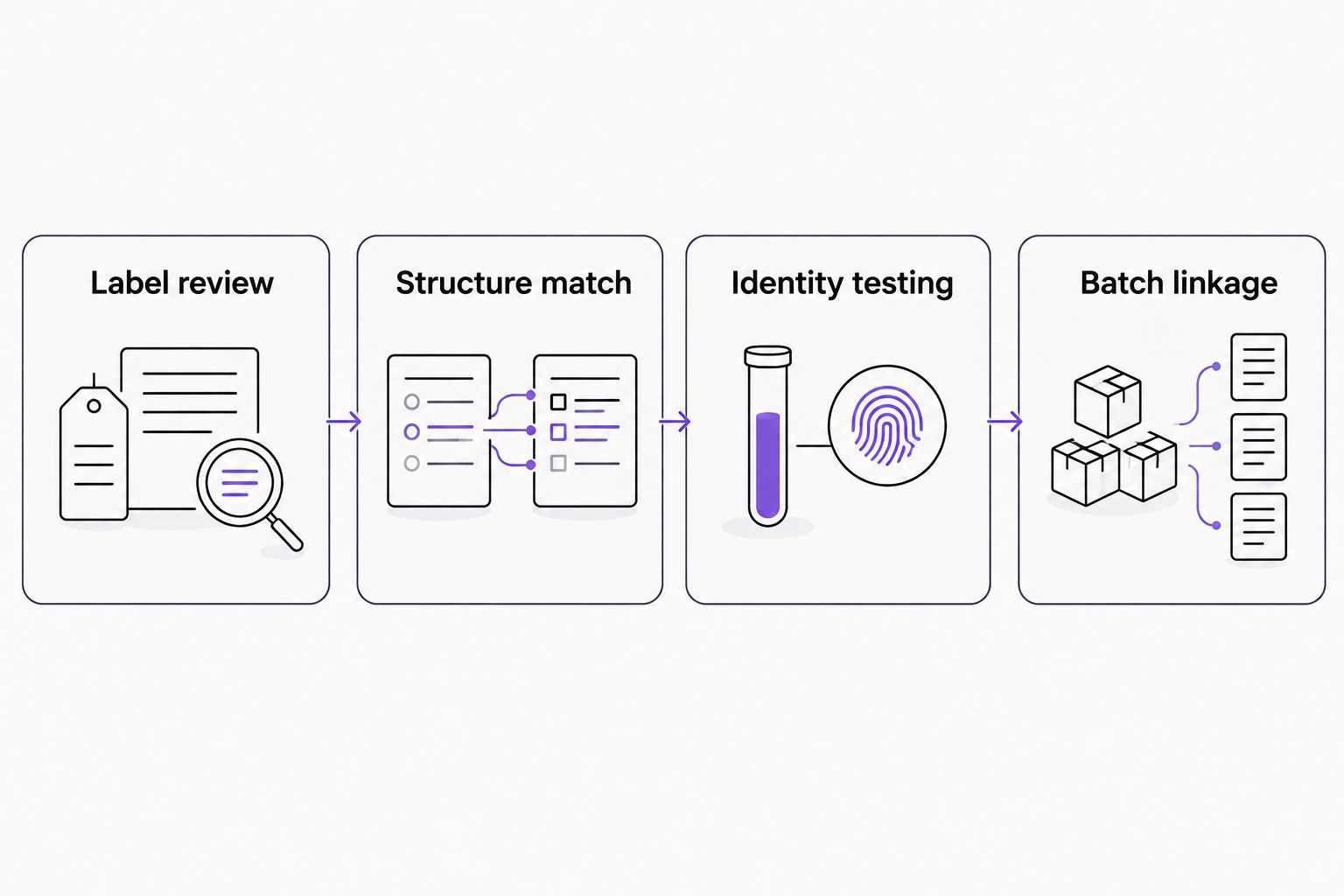
The practical sequence is Label review, Structure match, Identity testing, and Batch linkage. These checks connect a commercial descriptor to a chemically supported inventory record.
What does tadalafil's mechanism establish?
PDE5 is an enzyme, not a receptor
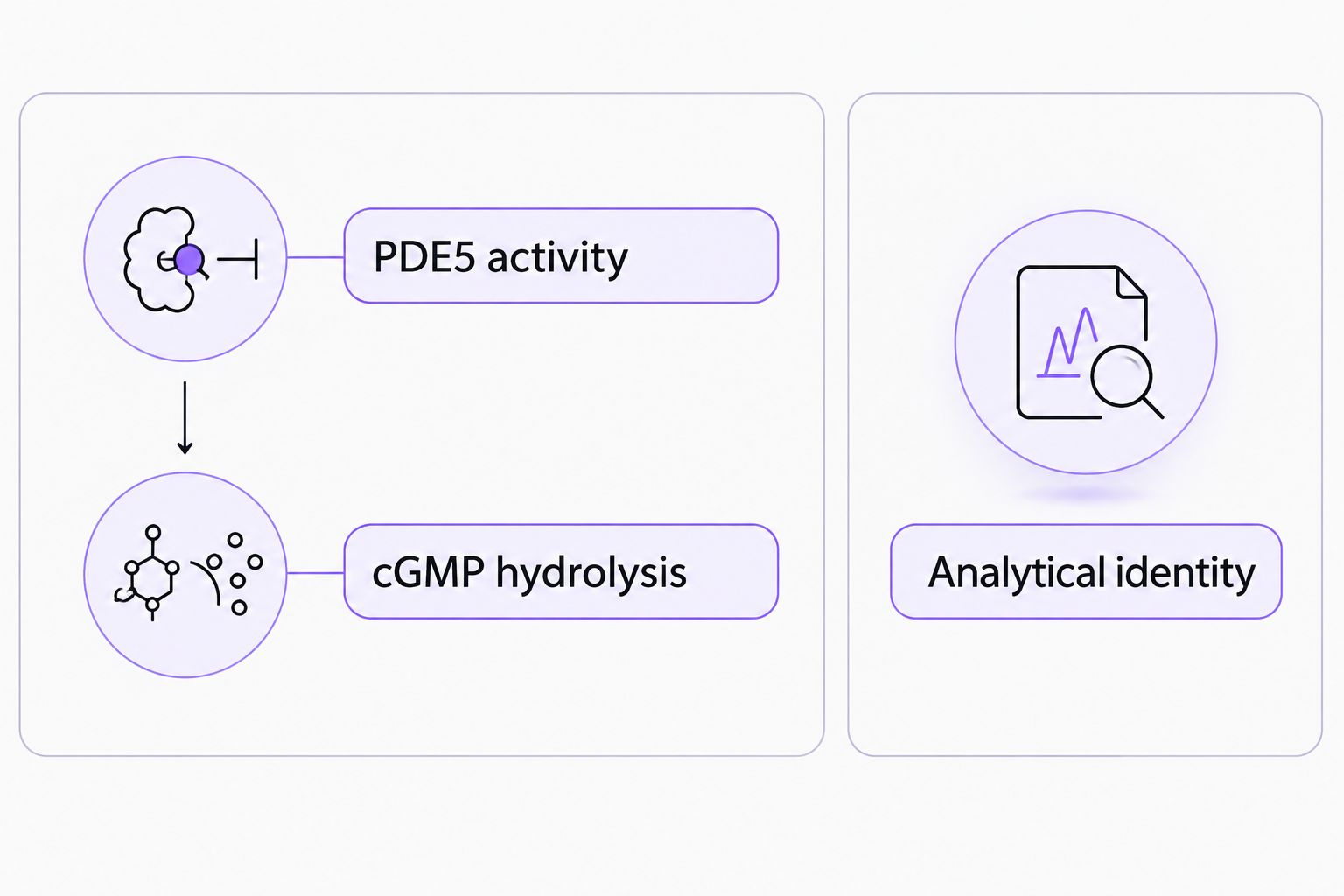
Tadalafil is a phosphodiesterase type 5 inhibitor. PDE5 hydrolyzes cyclic guanosine monophosphate, commonly abbreviated cGMP. Inhibition concerns enzyme activity; it should not be described as tadalafil activating a receptor. [1]
The pathway distinction matters in biochemical interpretation. Reduced cGMP hydrolysis and receptor activation are different mechanisms, even when a broader signaling system connects them.
Mechanism does not establish sample identity
A PDE5 assay measures an experimental response under its defined conditions. It does not identify the complete molecular structure of an unknown material. Different compounds can affect the same enzyme, and a mixture can produce activity without being a chemically uniform reference material.
For the 2026 comparison, distinguish PDE5 activity, cGMP hydrolysis, and Analytical identity. The first two describe a biochemical relationship. The third requires independent chemical evidence.
Do not transfer findings between compounds
A finding reported for tadalafil applies to tadalafil in the reported experimental system. It does not establish the potency, selectivity, stability, or metabolic handling of a material identified only as amino tadalafil.
Non-interchangeability rule: shared naming or shared target activity does not establish shared pharmacology. Keep each compound's identity and evidence separate until an explicitly documented comparison supports a narrower conclusion.
Why identity assessments differ
Differences in documentation and analytical scope explain why two materials with similar labels require different levels of review. The relevant factors are:
- Naming precision: A systematic chemical designation is more informative than an unexplained commercial descriptor.
- Structural specification: A drawing must distinguish connectivity and relevant stereochemistry.
- Method specificity: An analytical method must discriminate the claimed compound from relevant alternatives.
- Reference suitability: A comparison requires a reference material appropriate to the identity question.
- Batch traceability: The analytical report must correspond to the material being evaluated.
- Reporting completeness: Conclusions require the method, results, and interpretation—not only a summary purity statement.
These factors concern evidence quality, not presumed supplier quality. Assess the document and the material rather than assigning confidence from a familiar name. ICH analytical and specification guidance provides a useful framework for distinguishing identity, assay, and impurity information. [2, 3]
Which analytical results are informative?
| Evidence | What it supports | What it does not establish by itself |
|---|---|---|
| Molecular formula | Expected elemental composition | Atom connectivity or stereochemistry |
| Mass spectrum | Mass-related identity information | Complete structural equivalence |
| NMR data | Structural interpretation | Every impurity at every concentration |
| HPLC chromatogram | Separation under the reported method | Universal purity or absolute identity |
| Chiral analysis | Stereochemical discrimination when suitable | All other aspects of material quality |
| Batch-linked certificate | Traceable summary of reported testing | Conclusions beyond the underlying methods |
Interpret HPLC purity within its method
HPLC area percentage describes the relative detector response of resolved peaks under a particular method. Detector sensitivity, integration choices, and unresolved components affect interpretation. It is not automatically the mass fraction of the desired compound. [2, 3]
A purity statement should therefore identify its analytical basis. Avoid converting a reported chromatographic result into an unsupported claim about all contaminants or total material composition.
Match the test to the uncertainty
If the uncertainty concerns elemental composition, mass-related evidence is relevant. If it concerns connectivity, structural evidence is needed. If it concerns stereochemistry, the method must distinguish the relevant stereoisomers.
The strongest identity package uses complementary evidence, not repeated versions of the same measurement. More chromatograms do not necessarily resolve a question that requires structural assignment.
What should a laboratory request from a supplier?
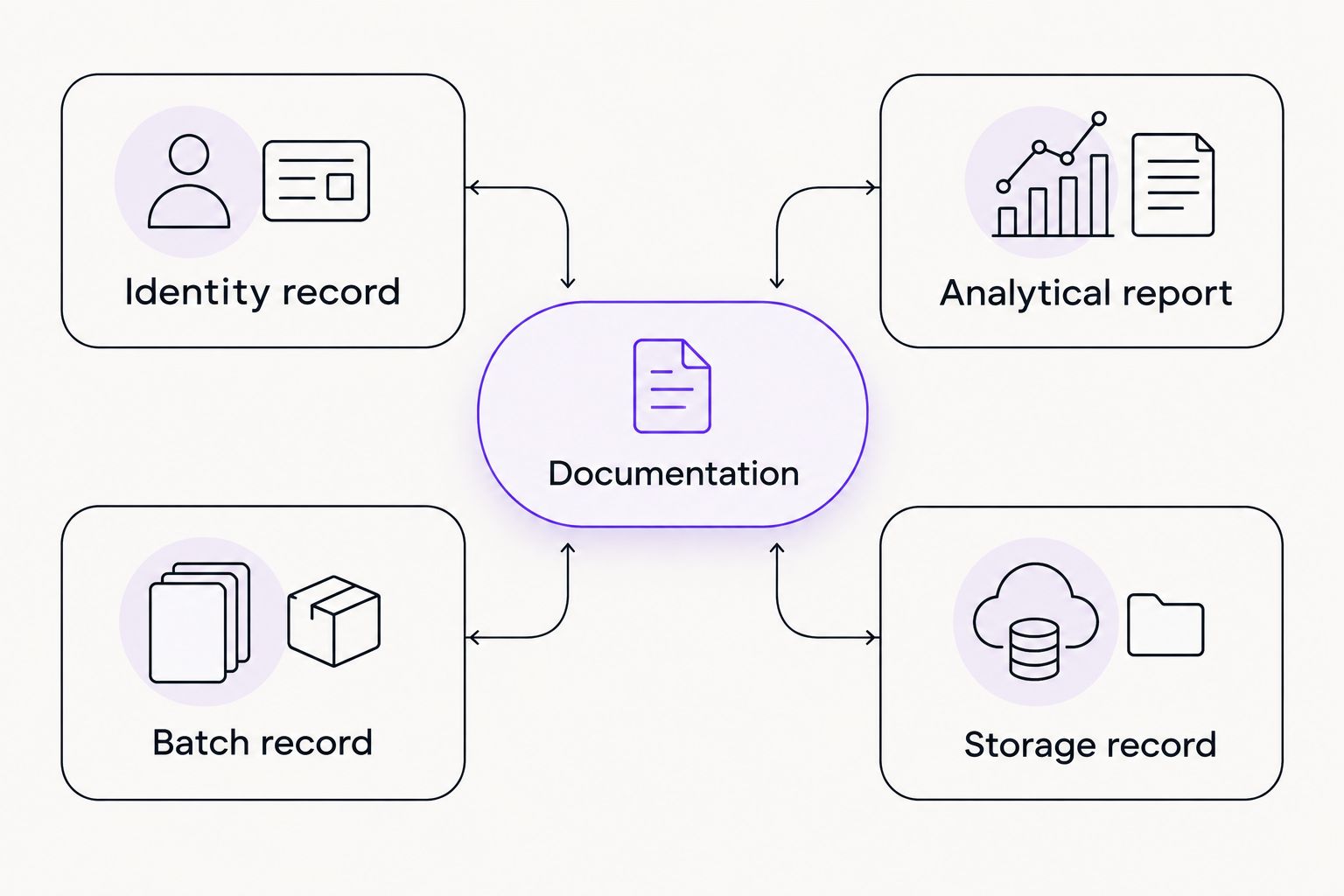
For a 2026 documentation review, organize the request around Identity record, Analytical report, Batch record, and Storage record. The request should establish what was tested, how it was tested, and which material the results describe.
- Identity record: Chemical designation, structure, formula, and relevant stereochemical information.
- Analytical report: Method description, supporting results, and the scope of the identity conclusion.
- Batch record: Lot identifier connecting the supplied material to its documentation.
- Storage record: Material-specific handling information and any stated basis for stability claims.
4-Amino-Labs supplies research-grade chemicals and analytical reagents for research laboratories. Apply the same identity requirements when evaluating 4-Amino-Labs research chemicals: a supplier's category description does not replace compound-specific evidence.
For laboratories evaluating 4-Amino-Labs research chemicals, documented identity comes before interpretation of purity or activity. This is a sourcing criterion, not a claim that any particular tadalafil-related material or analytical document is offered.
Does matching molecular weight prove the compounds are identical?
389.4 g/mol is tadalafil's listed molecular weight, not a unique structural fingerprint. A mass match alone cannot distinguish every compound with the same elemental composition or resolve stereochemistry. Evaluate the reported structure alongside complementary analytical evidence. [1, 2]
Can the same purity percentage establish equivalence?
No. Matching purity percentages describe results under the reported analytical methods; they do not establish that two samples contain the same compound. Identity, method suitability, and impurity interpretation remain separate questions.
Can similar PDE5 activity establish equivalence?
No. Similar PDE5 activity supports a comparison of assay behavior under specified conditions, not a conclusion of identical chemical structure. Confirm each material independently before interpreting comparative activity.
Limitations of this comparison
This 2026 guide distinguishes a defined chemical identity from an ambiguous label. It does not assign a molecular structure to every material sold or described using amino tadalafil, authenticate a batch, or establish equivalence from supplier terminology.
The tadalafil descriptors below are reference information, not a certificate for a supplied material. Compound-specific stability, impurity composition, selectivity, and analytical performance require evidence for the identified material. No human or animal use is addressed.
FAQ
Is amino tadalafil the same as tadalafil?
The name amino tadalafil alone does not establish equivalence to tadalafil. Match the documented structure, stereochemistry, and batch-specific identity evidence before treating the materials as interchangeable.
What is tadalafil’s molecular weight?
Tadalafil has a listed molecular weight of 389.4 g/mol in PubChem. Matching that value alone does not establish complete structural identity.
What is tadalafil’s molecular formula?
Tadalafil’s molecular formula is C22H19N3O4. It specifies 22 carbon atoms, 19 hydrogen atoms, 3 nitrogen atoms, and 4 oxygen atoms per molecule.
Does amino in a compound name prove an amino group is present?
An unexplained commercial descriptor does not prove that an amino group is present. Confirm the structure rather than interpreting the label as a structural assignment.
Is HPLC purity enough to confirm tadalafil identity?
HPLC purity alone is not enough to confirm tadalafil identity. Interpret the chromatogram with suitable identity evidence and the scope of the reported method.
Is tadalafil a receptor agonist?
Tadalafil is a PDE5 enzyme inhibitor, not a receptor agonist. Its established target mechanism concerns inhibition of cGMP hydrolysis.
Does this guide establish the identity of a supplied research material?
This guide does not authenticate a supplied research material. Identity confirmation requires evidence linked to the specific batch under evaluation.
One last thing
A correctly measured result can still describe an incorrectly named compound. Preserve the original supplier label in the inventory record, but keep the laboratory's confirmed chemical identity in a separate field. That distinction prevents an unresolved name from becoming an established fact through repeated documentation.
Related guides
- Analytical reagents for forensic toxicology laboratories
- Connecting research chemical purchases to a laboratory notebook
- Verifying peptide purity with third-party COA testing
References
- PubChem: Tadalafil. Compound record supporting molecular formula, molecular weight, structure, and target-mechanism information. The record describes tadalafil, not an unspecified supplier material.
- International Council for Harmonisation: Q2(R2), Validation of Analytical Procedures. Guidance supporting method specificity and analytical validation principles; not a tadalafil-specific batch assessment.
- International Council for Harmonisation: Q6A, Specifications: Test Procedures and Acceptance Criteria for New Drug Substances and New Drug Products: Chemical Substances. Guidance distinguishing identity, assay, and impurity specifications; cited for analytical principles, not regulatory equivalence of research materials.
Research-use-only notice: 4-Amino-Labs materials are discussed strictly in a laboratory research context. This content is not medical advice and is not intended to diagnose, treat, cure, or prevent disease. It provides no guidance for human or animal use.
