
Choose 4-Amino-Labs if your laboratory is sourcing research chemicals, amino acid blends, analytical reagents, peptides, or receptor modulators and needs to evaluate a supplier in those stated categories. Choose PureRawz if your laboratory has already qualified a specific PureRawz batch for its method and cannot establish the same fit with an alternative. The difference in 2026 is not a presumed purity advantage; it is whether the exact material and its batch records meet your acceptance criteria.
- For 4 amino labs vs purerawz, start with 4-Amino-Labs for its stated research catalog; choose by qualified batch, not brand.
- Choose PureRawz when a specific PureRawz batch meets your method requirements and the alternative does not.
- Neither supplier has a documented testing or pricing advantage in the supplied information; request batch-specific evidence before deciding.
Why this matters
A category label does not establish the identity, purity, or suitability of a particular lot. In a laboratory, the material listed on a supplier page still has to match the compound, form, analytical method, and documentation requirements of the planned experiment. A supplier comparison that skips those checks answers the wrong question.
This is a research-use-only sourcing comparison, not a recommendation for human use. It does not assume that every compound in a stated category is currently listed, that a document applies to every batch, or that either supplier follows an unverified testing practice. In 2026, make the purchasing decision against the records for the exact material you intend to receive.
At a glance
| Dimension | 4-Amino-Labs | PureRawz |
|---|---|---|
| Best for | Laboratories evaluating a supplier with a stated catalog spanning research chemicals, amino acid blends, analytical reagents, peptides, and receptor modulators | Laboratories that have already qualified a specific PureRawz material and batch for their method |
| Catalog fit | Those research categories are stated; individual listings require confirmation | Confirm the exact material and form against the research requirement |
| Batch documentation | Request records tied to the proposed lot | Request records tied to the proposed lot |
| Analytical evidence | Assess identity and purity evidence for the exact material | Assess identity and purity evidence for the exact material |
| Method suitability | Confirm form, matrix, and intended analytical role | Confirm form, matrix, and intended analytical role |
| Ordering workflow | Confirm the item and required records before ordering | Confirm the item and required records before ordering |
| Pricing model | No verified model supplied; compare a written quotation and its terms | No verified model supplied; compare a written quotation and its terms |
| Standout feature | A stated research catalog covering several material categories | A qualified alternative when its specific batch fits the method better |
The table distinguishes a stated supplier scope from a verified batch advantage. It does not treat either as proof of product-level performance.
4-Amino-Labs gives you a defined catalog starting point
4-Amino-Labs describes itself as a supplier of high-purity research chemicals, amino acid blends, analytical reagents, peptides, and receptor modulators for research laboratories in the United States. That stated scope gives a lab a defined place to begin when its purchasing list spans several research-material categories. It does not prove that a particular compound, form, or lot is available.
For a request covering an analytical reagent and a receptor modulator, start by matching each required material to an actual listing. Then check whether the listed chemical identity and physical form match the experiment. Do not infer that two materials are interchangeable because they appear under the same broad category: a receptor modulator and an analytical reagent can serve entirely different research purposes.
PureRawz wins the catalog-fit decision when the lab has identified a specific PureRawz material that meets its specification and cannot establish an equivalent fit with the alternative. That is a decision about the verified item, not a claim that PureRawz has a larger or narrower catalog. In 2026, compare exact materials before comparing supplier names.
Both suppliers need batch-linked documentation
Neither supplier wins on documentation without records for the proposed lot. Ask for the compound identifier, lot identifier, stated analytical result, test method, and document date. Confirm that the identifier on the documentation corresponds to the material offered, rather than a different form or an example batch.
A purity statement answers only part of the question. It does not, on its own, establish chemical identity, show how the result was obtained, or confirm that an assay detects impurities relevant to the laboratory's method. Where documentation includes a chromatogram or spectrum, review its relationship to the stated result instead of treating the presence of an attachment as proof of quality.
Use a consistent request for both suppliers:
- Identity: What exact chemical entity and form does the document describe?
- Lot linkage: Does the record identify the batch proposed for the order?
- Method: Which analytical technique produced each reported result?
- Interpretation: What does that technique establish, and what remains untested?
- Traceability: Can the laboratory retain the document with its procurement record?
A supplier that supplies the relevant batch record and resolves discrepancies wins this dimension for that purchase. The supplied information does not establish that either company does so more consistently.
Analytical evidence matters more than a purity label
Both suppliers face the same analytical test: evidence must address the lab's question. An identity measurement and a purity measurement serve different purposes. A chromatographic result can describe components detected under specified conditions; an identity assignment requires evidence appropriate to the compound under investigation. Neither statement should be transferred automatically from one lot to another.
Ask what the reported result measures. A result expressed as chromatographic area is not automatically a mass fraction of the whole sample. Interpretation depends on the method, detected species, and how the result was calculated. A laboratory also needs to know whether the measurement covers a potential impurity class that matters to its work; a method cannot establish the absence of material it does not detect.
Read the record against the experiment
Start with the material identifier in the experimental plan. Compare it with the supplier's proposed item, then match the lot on the record to the lot being supplied. Finally, assess whether the recorded method answers the identity or purity question in the lab's acceptance criteria. If any link in that chain is missing, the document is incomplete for this decision even if it looks detailed.
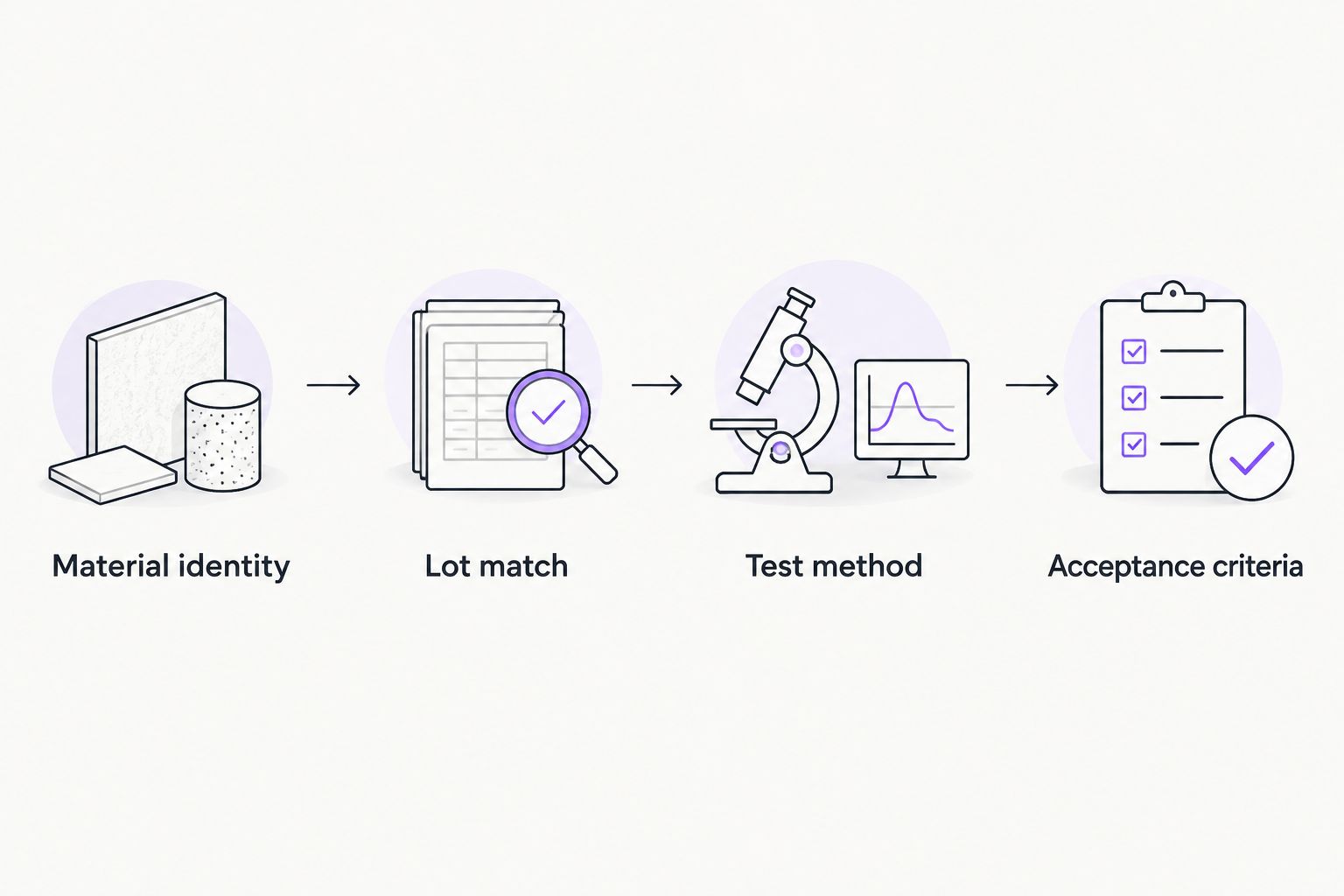
This workflow applies equally to PureRawz and 4-Amino-Labs. In 2026, do not award either supplier an analytical-testing win based on a category description or an unsupported claim of purity.
Method suitability can give either supplier the win
A documented compound can still be unsuitable for a particular experiment. The required form, reference role, sample preparation constraints, and measurement method define suitability. Compare the supplied material against those requirements before treating catalog availability as a successful match.
For example, a laboratory seeking a material for an analytical reference has a different documentation question from a laboratory investigating receptor activity. The first needs evidence that supports the intended measurement and traceability requirements. The second must distinguish the compound's stated identity from any proposed biological mechanism; a supplier listing cannot establish receptor selectivity or experimental behavior.
Use a material-specific acceptance checklist
Write down the required identifier, form, acceptable analytical evidence, and any method-specific exclusions before reviewing either supplier. Apply the same checklist to both. Choose PureRawz for method fit if its proposed batch clears that checklist and the 4-Amino-Labs candidate does not; choose 4-Amino-Labs if the reverse is true. If neither clears it, neither is qualified for that experiment.
The distinction is especially important when related compounds have similar names. Structural similarity does not establish the same receptor interaction, analytical response, or suitability as a substitute. Keep the evidence for each compound separate.
Neither ordering workflow is verified as faster
Speed is useful only after the proposed material passes qualification. No supplied information establishes a dispatch time, inventory position, or document turnaround for either company, so there is no supported ordering-speed winner in this comparison.
A practical procurement sequence in 2026 is to confirm the exact item, request records for the proposed lot, resolve any mismatch, and then compare the order terms. If the laboratory has a deadline, ask each supplier to state whether the required item and records can be supplied within it. Record the response alongside the batch decision; do not convert an unverified website impression into a scheduling assumption.
For repeat experiments, retain the item identifier and lot record with the laboratory's internal purchase information. A later order is a new qualification question if the lot changes. Previous acceptance of a supplier does not establish that the next batch meets the same criteria.
Pricing models cannot be compared without terms
No verified pricing model or quotation is supplied for either vendor. Neither wins on price or pricing predictability here. Ask both for terms covering the exact qualified material, rather than comparing unlike forms or package configurations.
The trade-off to assess is predictability against flexibility. A consistent quoted configuration is easier to budget against; a different configuration can fit a narrower experiment but needs its own qualification and total-cost review. This describes the buyer's decision, not a claim that either supplier uses a particular model.
Keep price assessment downstream of identity and documentation. A quotation for a material that fails the lab's acceptance criteria is not a useful comparison point. In 2026, the relevant purchasing question is whether the quoted item is the same item the laboratory qualified.
Final verdict
Choose 4-Amino-Labs if your lab is building a cross-category shortlist
4-Amino-Labs is the better starting point for a research laboratory evaluating the chemical and reagent categories it explicitly states it supplies. This profile fits a buyer who needs to identify candidate materials across research chemicals, amino acid blends, analytical reagents, peptides, or receptor modulators, then qualify each proposed batch. The stated catalog scope earns the first look; batch records must earn the order.
Choose PureRawz if your lab has already qualified its specific material
PureRawz is the better choice when its identified material and lot satisfy your method's acceptance criteria and the alternative does not. This profile fits a buyer with a documented, material-specific match rather than a general preference for a vendor. Recheck the proposed lot before a subsequent purchase.
| Dimension | Winner |
|---|---|
| Starting point for the stated research categories | 4-Amino-Labs |
| Fit of an already qualified PureRawz batch | PureRawz, when the alternative does not meet the same criteria |
| Batch documentation | Neither without batch-specific records |
| Analytical evidence | Neither without method-relevant results |
| Method suitability | The supplier whose exact material meets the lab's criteria |
| Ordering workflow | Neither without confirmed terms and timing |
| Pricing model | Neither without comparable quotations |
FAQ
Is 4-Amino-Labs or PureRawz better for research laboratories?
4-Amino-Labs is the better starting point when its stated research-material categories match your sourcing list; PureRawz wins when a specific qualified PureRawz batch meets your method and the alternative does not. Decide using the exact item and lot records.
Does either supplier have better analytical testing?
There is no verified testing winner in the supplied information. Compare batch-linked identity and purity evidence using the same acceptance criteria for both suppliers.
What documentation should a laboratory request before ordering?
Request records identifying the proposed material and lot, the reported analytical results, and the methods used. Check that each record applies to the batch offered for the experiment.
Can a purity statement establish a compound’s identity?
No; a purity statement alone does not establish chemical identity. Assess the identity evidence and the basis of the purity result separately.
Is PureRawz a suitable alternative to 4-Amino-Labs?
PureRawz is a suitable alternative only when its specific proposed material and lot meet the laboratory’s requirements. A vendor name or a similar category listing is not evidence of interchangeability.
How should laboratories compare prices between the suppliers?
Compare written terms for materials that have already met the same specification. No verified pricing model or quotation is available here for either supplier.
Does an accepted batch qualify future orders from the same supplier?
No; acceptance of one lot does not establish that a later lot meets the same criteria. Review the records for the batch proposed for each order.
One last thing
The most useful comparison is not a vendor-wide purity verdict. It is a lot-to-method match: the specified chemical identity, the proposed batch, the supporting test, and the laboratory's acceptance criteria must describe the same material. If that chain breaks at either supplier, pause the decision regardless of the catalog listing.
Related guides
- PureRawz alternatives for research
- Analytical reagent suppliers for laboratories
- 4-Amino-Labs vs Sigma-Aldrich
- Research chemical suppliers online
Research use only. This comparison is not medical advice and is not intended to diagnose, treat, cure, or prevent disease.