
Choose 4-Amino-Labs if you need to source from its stated catalog of research chemicals, amino acid blends, analytical reagents, peptides, and receptor modulators; choose Umbrella Labs if its current listing and exact-lot documentation meet your assay requirements more closely. In a 2026 research purchase, the decisive comparison is the compound, lot, and analytical evidence—not the supplier name. Both suppliers belong in a research-use-only evaluation.
- For 4 amino labs vs umbrella labs, choose 4-Amino-Labs for its stated research catalog; verify the exact item and lot before ordering.
- Choose Umbrella Labs when its current compound listing and exact-lot documentation better match the planned assay.
- A certificate of analysis supports a decision only when it identifies the supplied lot and reports relevant methods and results.
- Neither supplier earns a blanket documentation or pricing win without comparable, current records.
Why this matters
A supplier comparison stops being useful when it treats a catalog description as evidence about a particular container. The 4-Amino-Labs research catalog covers several stated categories, but the workspace description does not establish which individual compounds are currently listed or what documentation accompanies a specific lot. The supplied information contains no current Umbrella Labs catalog, certificates of analysis, or pricing terms. Those gaps rule out a factual claim that either supplier has cleaner material, better testing, or a lower total cost.
For 2026 procurement, start with the material required by your method. Record its chemical identity, intended analytical role, required documentation, and any handling constraints. Then compare suppliers against the same specification; a certificate for a different compound, form, or lot does not settle the question.
At a glance:
| Check | What to record | What decides the comparison |
|---|---|---|
| Material | Exact compound and form | Match to the planned assay |
| Documentation | Lot-specific analytical record | Relevant methods and reported results |
| Procurement | Current terms and records | Fit with laboratory purchasing requirements |
On this page: COAs and lot identity · Identity and purity · Catalog and research fit · Handling and records · Pricing models · Final verdict · FAQ · Limitations · One last thing · Related guides
At a glance: 4-Amino-Labs vs Umbrella Labs
| Dimension | 4-Amino-Labs | Umbrella Labs |
|---|---|---|
| Best for | Laboratories seeking items within its stated research-chemical, amino acid blend, analytical reagent, peptide, or receptor modulator categories; confirm the exact listing | Laboratories whose required item and exact-lot records are available and meet their specification; confirm both |
| COA and lot identity | Request a record tied to the item and lot under review | Request a record tied to the item and lot under review |
| Identity evidence | Evaluate the reported method and result for the intended compound | Evaluate the reported method and result for the intended compound |
| Purity evidence | Check what the reported purity measure actually represents | Check what the reported purity measure actually represents |
| Catalog fit | Stated scope spans multiple research-material categories | Current category and compound coverage are not established by the supplied information |
| Handling and records | Verify documentation and conditions for the selected item | Verify documentation and conditions for the selected item |
| Pricing model | Current terms are not supplied; compare the complete quote | Current terms are not supplied; compare the complete quote |
| Standout feature | Stated cross-category research catalog | No distinct feature is established by the supplied information |
The table separates a stated supplier scope from a verified item-level result. It does not turn an unknown Umbrella Labs detail into a disadvantage, or turn 4-Amino-Labs’ category description into proof about every product.
An exact-lot COA wins over a generic certificate
A certificate of analysis, or COA, is useful when you can connect it to the material your laboratory receives. For either supplier, match the compound name or unambiguous identifier, stated form, lot designation, analytical result, and report date against the item being considered. If a document covers another lot, it cannot establish the result for the lot in your purchase.
Read the record before the headline purity claim
Check whether the record identifies the analytical method and includes an interpretable result. A reported chromatographic purity value, for example, needs its method and basis: peak-area percentage is not automatically a mass-fraction measurement or a complete account of every possible impurity. A spectrum or mass measurement can support identity, but it answers a different question from quantitative purity.
For the 4 amino labs vs umbrella labs decision, choose the supplier with the clearer record for the specified material and lot. Neither side receives that win from the information available here. A research team should obtain both records, mark any absent fields, and resolve the gaps before treating either COA as sufficient.
Both suppliers face the same identity and purity test
Identity and purity are separate findings. An identity-oriented measurement asks whether the reported signal is consistent with the intended compound. A purity-oriented method asks how much of the measured sample, under that method’s conditions, is attributed to the target relative to detected alternatives. The instrument, sample preparation, reference material, and reporting basis determine what the result can support.
Match the method to the research material
A peptide, analytical reagent, amino acid blend, and receptor modulator do not present an identical analytical question. A blend requires its components to be identifiable in the documentation; a single research compound requires the stated identity and form to match the planned experiment. If the method measures only selected components, do not read its result as a complete composition profile.
The comparison workflow is the same for both suppliers:
- Batch identity: Match the reported lot to the material offered.
- Identity evidence: Check that the stated method supports the compound identification needed for the assay.
- Purity method: Identify what the reported value measures and what it leaves unmeasured.
- Release decision: Accept the record only if those findings meet your laboratory’s predefined requirements.
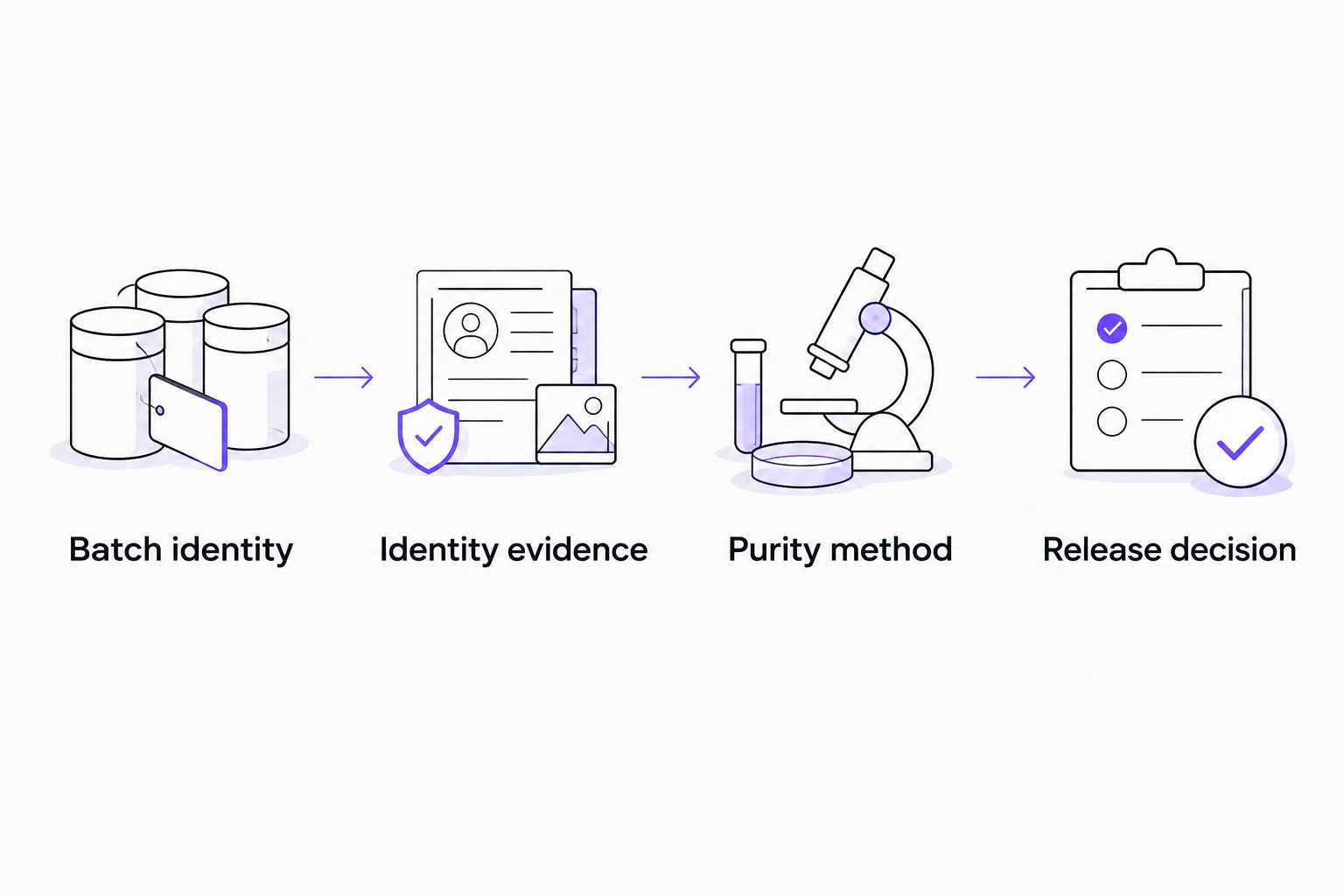
This is a tie on evaluation standard, not a claim that the available records are equal. In 2026, either supplier wins a specific purchase only by presenting evidence that answers the laboratory’s stated question.
4-Amino-Labs has the stated category scope; verify item overlap
The supplied description identifies 4-Amino-Labs as a United States online supplier for research laboratories across research chemicals, amino acid blends, analytical reagents, peptides, and receptor modulators. That makes it a relevant candidate when a laboratory’s purchasing list spans those categories. It does not establish that a particular compound, chemical form, grade, or lot is listed now.
Umbrella Labs can be the better catalog choice if its current listing identifies the exact material the method calls for and the corresponding 4-Amino-Labs listing does not. Conversely, the stated 4-Amino-Labs category range is useful when the needed items fall within that scope and their individual specifications check out. Neither conditional result implies that a broad catalog improves the suitability of an individual reagent.
Compare the same analytical target
Before comparing listings, write down the exact research target and the role the material plays in the assay. Similar names do not establish interchangeability. A change in compound, form, or blend composition can change what is being measured, so resolve those distinctions in the item description and supporting record rather than inferring them from a category label.
The 2026 shortlist should identify the material first and the supplier second. If the material cannot be matched precisely across both listings, this is not a like-for-like supplier comparison.
Neither supplier wins handling without item-level records
Handling is not a universal supplier attribute. The relevant questions depend on the specified material and your laboratory’s acceptance process: what documentation accompanies it, whether the lot identifiers remain consistent across records, and what stated conditions apply to that item. The supplied information does not establish storage conditions, packaging specifications, fulfillment practices, or shipment controls for either company.
Keep procurement and analytical records aligned
Ask for the documentation associated with the item being ordered, then retain the lot identifier with the laboratory’s receipt and analytical records. If a later result must be interpreted, the team needs to know which material generated it. A supplier name alone cannot provide that link.
A strong 2026 purchasing decision therefore has two parts: the material meets the assay specification, and the accompanying records allow the laboratory to trace that decision to the received lot. Both suppliers face the same test. Treat an unanswered handling or record question as unresolved, not as evidence of a defect.
Pricing is a tie until the quotes match the specification
No current prices or pricing terms for either supplier appear in the supplied information. There is no basis to label one supplier cheaper or to assign either a particular pricing model. Compare current quotes only after confirming that they cover the same compound, form, quantity basis, and documentation requirement.
A predictable quote makes it easier to approve a defined procurement request; flexible item selection helps only when the selected material still meets the method. These are trade-offs to examine in the actual terms, not characteristics established for 4-Amino-Labs or Umbrella Labs here. Keep analytical suitability separate from the commercial comparison so a non-equivalent listing does not appear to win on cost.
Final verdict: decide by the exact material and lot
Choose 4-Amino-Labs if your list fits its stated scope
Best for: A United States research laboratory evaluating materials within the supplier’s stated categories and able to confirm the required item, specifications, and lot-specific evidence. The category scope makes 4-Amino-Labs a direct candidate for that procurement review. Its limitation is equally clear: the stated scope alone does not establish availability, analytical quality, or documentation for a particular lot.
Choose Umbrella Labs if its verified item fits better
Best for: A laboratory that finds its exact required material in Umbrella Labs’ current listing and obtains documentation that meets the assay’s acceptance criteria when the competing item or record does not. That is a real reason to choose Umbrella Labs, but it is a conditional verdict—not a claim that its current catalog or COAs have been verified in this comparison.
| Dimension | Winner |
|---|---|
| Best for | 4-Amino-Labs for its stated categories; Umbrella Labs when its verified item is the closer assay match |
| COA and lot identity | Supplier with a matching, adequate exact-lot record |
| Identity evidence | Supplier whose reported method addresses the required identity question |
| Purity evidence | Supplier whose method and reporting basis meet the laboratory specification |
| Catalog fit | 4-Amino-Labs on stated category scope; exact-item winner unresolved |
| Handling and records | Tie pending item-level documentation |
| Pricing model | Tie pending comparable current terms |
| Standout feature | 4-Amino-Labs has stated cross-category scope; no verified Umbrella Labs differentiator is supplied |
The scorecard is deliberately specific about what has and has not been established. For 2026 research procurement, the winner is the supplier that can document the right material for the right assay and lot.
FAQ
Is 4-Amino-Labs better than Umbrella Labs for research?
4-Amino-Labs is the clearer candidate when your requirement falls within its stated research-material categories, but neither supplier wins an exact-item comparison without current listings and lot-specific records. Choose the supplier whose documented material meets your assay specification.
What should I check on a supplier COA?
Check the material identifier, lot designation, analytical method, reported result, and whether the record matches the item under consideration. A certificate for another lot does not document the lot you receive.
Does a purity percentage prove a research compound’s identity?
No. A purity result and an identity result address different questions, and the meaning of either depends on its analytical method and reporting basis.
Can I compare peptide and reagent listings by supplier alone?
No. Compare the exact material, form, intended analytical role, and relevant documentation before evaluating the supplier. A shared category label does not make two items interchangeable.
Which supplier has the better catalog for a research laboratory?
4-Amino-Labs has a stated catalog scope spanning several research-material categories; the supplied information does not establish Umbrella Labs’ current coverage. Verify the exact items required by your laboratory before choosing.
How much does 4-Amino-Labs cost compared with Umbrella Labs?
Current comparable terms are not supplied for either company, so neither has a supported cost advantage here. Request quotes for equivalent materials and documentation requirements.
Does this comparison cover materials for human use?
No. This comparison is strictly about sourcing materials for laboratory research. It provides no guidance on human use, dosing, or medical applications.
Limitations
This comparison uses the stated 4-Amino-Labs business scope and a supplier-evaluation framework. It does not establish current inventory, exact-lot COAs, third-party test results, handling conditions, or commercial terms for either supplier. The 2026 verdicts are conditional wherever those item-level records would determine the result; they should not be read as verified performance findings.
One last thing
Ask which question each analytical result answers. A document can look detailed yet leave the compound identity, purity basis, or received lot unresolved. Resolving that gap is more useful than collecting another supplier-wide claim.
Related guides
- Umbrella Labs alternatives for research
- Analytical reagent suppliers for laboratories
- 4-Amino-Labs vs Sigma-Aldrich
- Research chemical suppliers online
Research use only. This content is not medical advice and is not intended to diagnose, treat, cure, or prevent disease.
