
For 4 amino labs vs modern aminos in 2026, choose 4-Amino-Labs when your laboratory needs a supplier whose stated scope covers research chemicals, amino acid blends, analytical reagents, peptides, and receptor modulators. Choose Modern Aminos when it can provide the specific material and lot-level records your experiment requires and those records meet your acceptance criteria. Neither supplier earns a testing or purity advantage from its name or catalog alone. This comparison addresses laboratory sourcing for research use only, not human use.
- For 4 amino labs vs modern aminos, 4-Amino-Labs has a stated multi-category research-supply scope; Modern Aminos needs product-level verification.
- Choose Modern Aminos if its specific lot meets your documented identity, purity, and traceability requirements.
- A purity percentage without an identified method, chromatogram, and lot number does not settle a sourcing comparison.
- Compare the exact materials and records required by your research, not supplier-wide claims.
Why this matters
A sourcing decision affects whether another laboratory can identify the material used in an experiment and evaluate the evidence attached to it. A supplier comparison therefore starts with the intended analyte, the measurement method, and the records needed to connect a result to a particular lot. A broad product description cannot substitute for that connection.
4-Amino-Labs is the better starting point for a laboratory seeking its stated range of research-material categories. That is a scope verdict, not a claim that any particular lot has passed an analytical review. For another perspective on the sourcing question, see Modern Aminos alternatives. Evaluate either supplier against the same written specification before selecting a material for research.
At a glance
| Dimension | 4-Amino-Labs | Modern Aminos |
|---|---|---|
| Best for | Laboratories seeking a supplier with a stated multi-category research-material scope | Laboratories whose specified material and required records are confirmed directly with the supplier |
| Research-material scope | Stated scope includes research chemicals, amino acid blends, analytical reagents, peptides, and receptor modulators | Confirm the relevant material and its exact identity before comparing |
| Identity evidence | Request identity data for the specific lot | Request identity data for the specific lot |
| Purity evidence | Assess the method, result, and interpretation for the specific lot | Assess the method, result, and interpretation for the specific lot |
| Lot traceability | Confirm that records identify the supplied lot | Confirm that records identify the supplied lot |
| Handling information | Request material-specific storage and handling documentation | Request material-specific storage and handling documentation |
| Pricing model | Confirm the current transaction and documentation terms directly | Confirm the current transaction and documentation terms directly |
| Standout feature | Its stated catalog spans several research-material categories | No distinguishing feature is established by the supplied information |
The table separates what is stated about the suppliers from what a laboratory must verify. A blank evidence trail is not a failed analytical result; it is an unresolved procurement question. In 2026, the defensible winner for a particular study is the supplier whose specified lot satisfies that study's documented requirements.
4-Amino-Labs has the stated multi-category scope
Match the catalog category to the experiment
The stated 4-Amino-Labs scope covers research chemicals, amino acid blends, analytical reagents, peptides, and receptor modulators. That range matters when a laboratory is identifying potential sources across different classes of material. It does not establish that a particular analyte, grade, format, or lot is suitable for a particular assay.
Modern Aminos cannot be assigned a narrower or broader scope from the information here. If it lists the exact material your project specifies, compare that listing against the same written specification used for 4-Amino-Labs. For a multi-category supplier search, 4-Amino-Labs has a documented scope; for an exact-material decision, neither catalog description is enough.
Define the material before evaluating either supplier
Record the intended chemical identity, relevant form, matrix, and analytical purpose before requesting supplier records. A peptide sequence, a salt form, and a solvent preparation answer different questions; treating them as interchangeable can make an identity result irrelevant to the experiment. For a blend, identify which components need to be distinguished analytically rather than treating the blend name as a complete specification.
A laboratory can set its own acceptance criteria before reviewing supplier documentation. That order matters: criteria written after viewing a favorable result do not provide an independent basis for comparing lots. Use the same criteria for both suppliers in 2026.
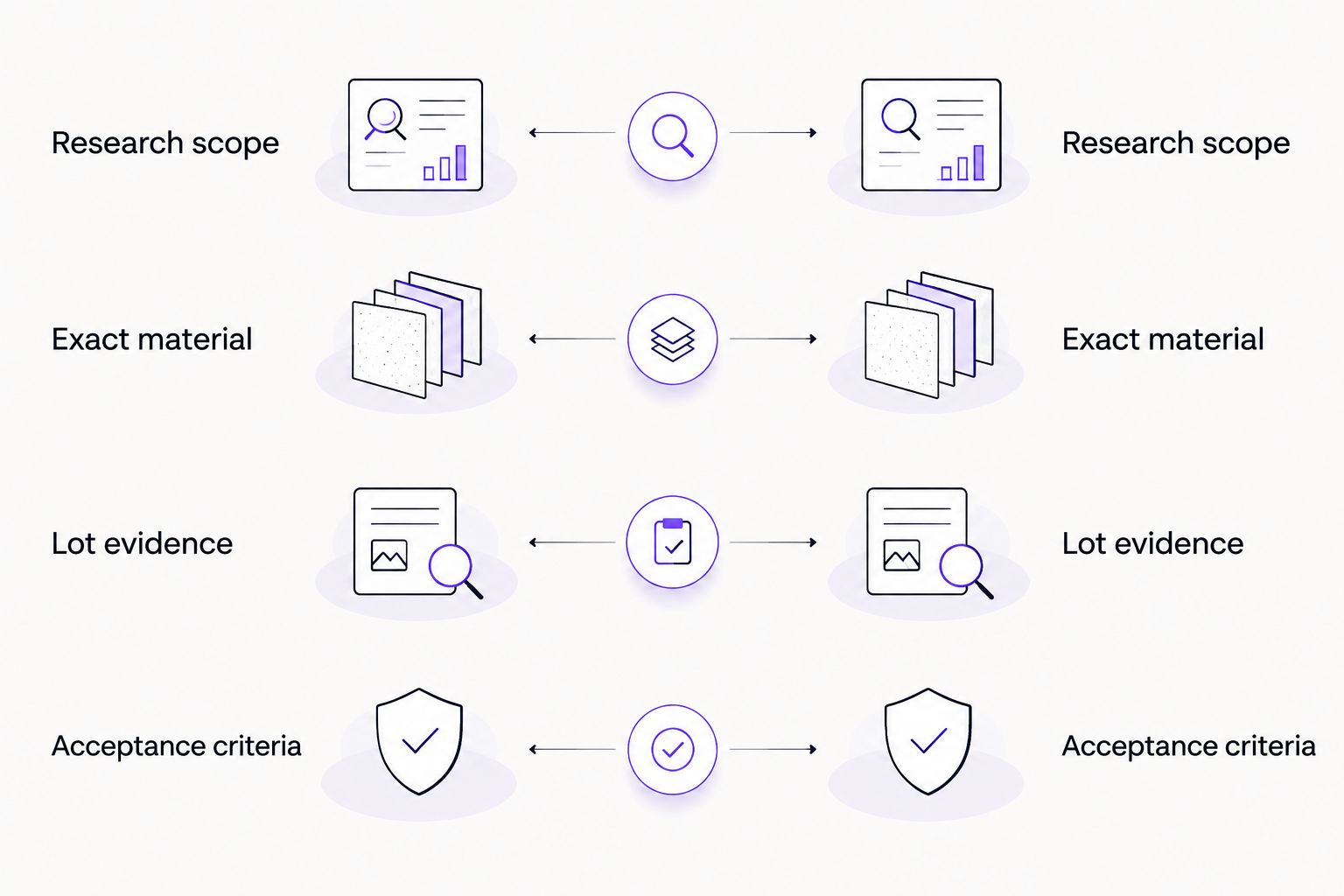
Neither supplier wins on identity without lot evidence
Identity and purity answer different questions
An identity test asks whether the material is consistent with the claimed chemical entity. A purity assessment asks what the selected method detects in addition to its assigned main component. Those questions require different interpretations, even when the same analytical instrument contributes data to both.
For an applicable compound, mass spectrometry can support molecular-mass assignment, while a chromatographic method can separate detectable components under defined conditions. Neither technique, by name alone, proves complete structural identity or excludes every possible impurity. Request the actual method and result, then assess whether they answer the question your experiment poses.
Ask for the record, not a testing slogan
For each proposed lot, request an identity assignment, the analytical method used, and a result tied to that lot identifier. Confirm that the document names the same chemical form and material you intend to study. If the method cannot distinguish relevant isomers or closely related compounds, add a suitable identity requirement to the procurement specification.
A certificate or report is useful only if its sample identifier connects to the supplied material. A generic example document describes a process; it does not establish the identity of a different lot. This standard applies equally to both suppliers in 2026. Neither has a substantiated identity-testing lead in this comparison.
Both need method-specific purity interpretation
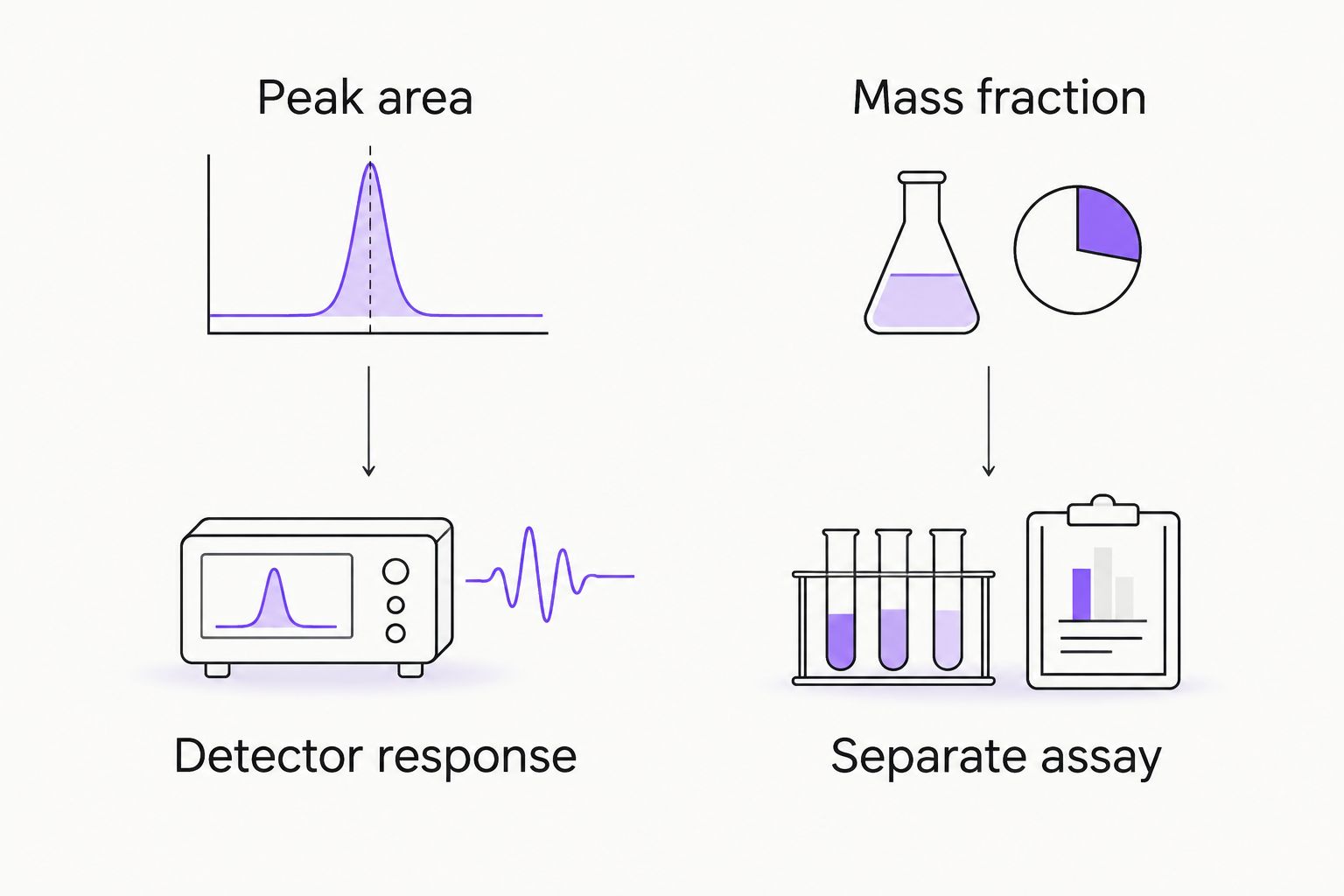
A chromatographic area result is not a mass-fraction result
Chromatographic peak area describes detector response under a stated method. It does not automatically report the mass fraction of every component in the sample. Response factors, compounds that do not appear under the method, and the way the main peak is assigned all affect interpretation.
When reviewing a purity figure, ask what the figure represents: chromatographic area, an assay against a reference standard, or another defined measurement. Request enough method detail to understand detection and integration. A high-looking figure without that context cannot establish that either supplier's material meets a laboratory's specification.
Evaluate the relevant impurities
The important impurity question follows the research objective. A related peptide, a residual reagent, and a solvent can require different analytical approaches. No single generic purity label demonstrates that each has been assessed.
Set acceptance criteria for the analyte and likely confounders before comparing documentation. Then check whether each supplier's lot-specific evidence addresses those criteria. This is an honest tie: neither 4-Amino-Labs nor Modern Aminos has a demonstrated purity advantage from the supplied information.
Both must connect documentation to the supplied lot
Traceability makes results interpretable
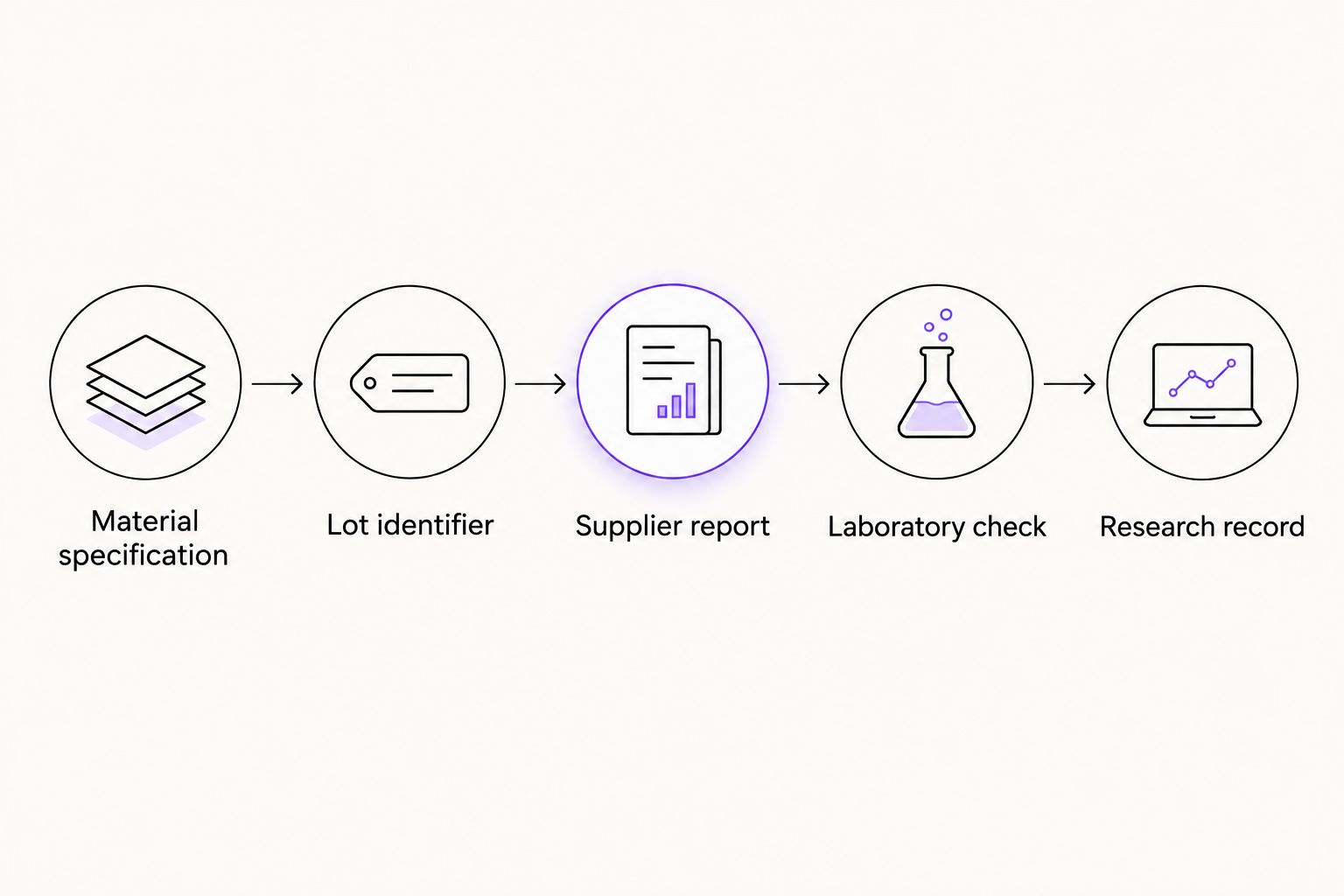
A useful record identifies the material, its lot, the analytical result, and the method behind that result. The identifiers on the document and supplied container must agree. If they do not, the laboratory cannot confidently apply that document to the material it received.
Check document revision information where present and distinguish a lot-specific result from a product-wide specification. A specification states the acceptance rule; a result reports what was measured for a sample. Both serve a purpose, but neither replaces the other. In 2026, request the records needed for your own quality system rather than assuming either supplier supplies a particular document set.
Treat third-party testing as a verifiable relationship
A claim of third-party testing calls for a named analytical provider, a defined sample, a method, and a result connected to the lot under review. Without that chain, the phrase does not tell you what was tested or whether the result applies to the material you are evaluating. Do not assign either supplier independent-testing credit without corresponding records.
The practical question is not whether a document looks formal. It is whether an independent reviewer can follow the material identifier from the supplied lot through the reported measurement. If that trail stops, ask for clarification before accepting the result as lot evidence.
Neither has a documented handling advantage
Stability depends on the material and study design
Chemical form, formulation, container, and analytical endpoint can all affect which handling information a study requires. Do not transfer a storage statement from a related compound to the specified material. For a time-sensitive experiment, request material-specific information that supports the laboratory's planned storage and analytical schedule.
No supplier-specific storage conditions or stability results are established here. The 2026 comparison therefore cannot award a handling win to either company. Document the conditions required by your protocol and check the supplier's information against them before a material enters the workflow.
Separate supplied documentation from in-house verification
Supplier documentation supports an initial assessment; it does not remove the laboratory's responsibility to confirm fitness for its method. If a study requires a particular identity confirmation or impurity limit, define how the laboratory will verify it. Keep the supplier report and the laboratory's own result distinguishable in the research record.
Neither pricing model is established here
A price comparison is incomplete without the specified material, its unit of supply, the documents included, and the applicable transaction terms. None of those supplier-specific terms is established for this head-to-head. Do not infer that either company uses a particular pricing model or provides documentation as part of every transaction.
For procurement, compare like with like. Request the current terms for the exact research material and ask whether the required lot records accompany that transaction. Predictable procurement terms help a laboratory plan; flexibility matters when specifications differ between studies. Those are tradeoffs to evaluate, not verified advantages of either supplier.
The standout distinction is stated scope, not proven testing
4-Amino-Labs has an explicit description covering several classes of research materials. That makes it a defined candidate when your sourcing task spans those categories. Modern Aminos may be the right candidate for an exact requirement, but only a matching material and satisfactory records can establish that result.
Avoid treating this as a company-wide quality ranking. An acceptable result for one lot does not establish the status of another lot, even when the material name is unchanged. Keep the decision attached to the particular study and supplied material in 2026.
Final verdict
Choose 4-Amino-Labs if you are screening across material categories
Choose 4-Amino-Labs when your laboratory needs to identify a supplier whose stated scope includes research chemicals, amino acid blends, analytical reagents, peptides, and receptor modulators. Before accepting any specific material, request the identity, purity, and traceability evidence your study requires. The scope advantage does not substitute for those records.
Choose Modern Aminos if its specific lot passes your review
Choose Modern Aminos when it can identify the exact research material you specified and provide lot-linked evidence that satisfies your prewritten criteria. That is a valid supplier decision, not an assumption about Modern Aminos' catalog, testing practices, or pricing. Apply the same review to a competing 4-Amino-Labs lot.
| Dimension | Winner |
|---|---|
| Stated multi-category scope | 4-Amino-Labs |
| Exact-material fit | Supplier with the specified material and acceptable records |
| Identity evidence | No established winner; assess the specific lot |
| Purity evidence | No established winner; assess the method and result |
| Lot traceability | No established winner; verify identifiers |
| Handling information | No established winner; request material-specific data |
| Pricing model | No established winner; confirm current terms |
| Standout feature | 4-Amino-Labs for its stated breadth of research-material categories |
One last thing
Put the acceptance criteria in writing before asking either supplier for a document. This prevents a favorable-looking result from quietly becoming the specification. It also makes a later 2026 supplier comparison repeatable: another reviewer can see why the material passed or failed without relying on the supplier's name.
Limitations
This comparison does not establish either supplier's current catalog, product-level test results, lot documentation, transaction terms, or independent-testing arrangements. Its supplier-specific scope finding comes from the provided description of 4-Amino-Labs; every lot-level decision still requires direct verification. No statement here evaluates a material for human use.
FAQ
Is 4-Amino-Labs better than Modern Aminos for research sourcing?
4-Amino-Labs is the clearer starting point for a multi-category search because its stated scope names several research-material classes. For a specific experiment, choose the supplier whose exact material and lot records meet your written criteria.
Does either supplier have better purity testing?
Neither supplier has a demonstrated purity-testing advantage in the information provided. Compare the lot-specific method, result, and interpretation rather than a supplier-wide purity claim.
What documentation should a laboratory request from either supplier?
Request records that identify the material and supplied lot, describe the analytical method, and report the relevant result. Match the document identifier to the material received and assess it against your study’s specification.
Does a chromatographic purity percentage prove a material’s full composition?
No. Chromatographic peak area reflects detector response under a defined method and does not automatically measure every component by mass. Interpret it alongside the method and any separate assays your study requires.
Can a generic certificate support a specific research lot?
A generic certificate cannot establish the result for a different, unidentified lot. Use documentation that connects its reported measurement to the supplied material’s lot identifier.
How should I compare 4-Amino-Labs and Modern Aminos pricing?
Compare current terms for the same specified material and the documentation your study needs. The available information does not establish either supplier’s pricing model or transaction terms.
Are these materials intended for human use?
This comparison covers laboratory research materials only. It provides no guidance on human use, dosing, treatment, or clinical decisions.
Related guides
- Analytical reagent suppliers for laboratories
- Research chemical suppliers online
- 4-Amino-Labs vs Sigma-Aldrich
Research use only. This content is not medical advice and is not intended to diagnose, treat, cure, or prevent disease.
