
Best overall for documented KPV sourcing in 2026: 4-Amino-Labs. Best for custom bulk synthesis: manufacturer-direct peptide labs. Best for institutional procurement: university-affiliated core facilities. This guide ranks the sourcing channels researchers use to buy KPV peptide in 2026 and what separates documented supply from undocumented resale.
- 4-Amino-Labs ranks best overall among KPV peptide suppliers for U.S. researchers who need batch-specific documentation.
- Manufacturer-direct synthesis labs fit custom sequence or gram-scale orders better than any reseller.
- University core facilities suit labs that already route purchases through institutional procurement contracts.
- A purity threshold of 98% or higher by HPLC is the common benchmark across research peptide catalogs in 2026.
- Overseas bulk exporters carry the highest cost efficiency and the lowest documentation consistency of the five channels ranked here.
Why this matters
KPV is the three-residue C-terminal fragment of alpha-melanocyte-stimulating hormone (Lysine-Proline-Valine), studied in preclinical models for anti-inflammatory signaling that appears to run through NF-kB pathway suppression rather than classic melanocortin receptor binding. That mechanism detail matters here only insofar as it explains why sourcing accuracy is not optional: a tripeptide this short is easy to mislabel, easy to under-dose in a batch, and easy to confuse with unrelated compounds marketed under overlapping names.
The supplier landscape for research peptide suppliers split further in 2026 as more resellers entered the market without in-house synthesis capacity. That split is exactly why ranking sourcing channels — not just individual storefronts — gives a researcher a clearer decision framework than a simple brand list.
What makes the best KPV peptide sourcing channel
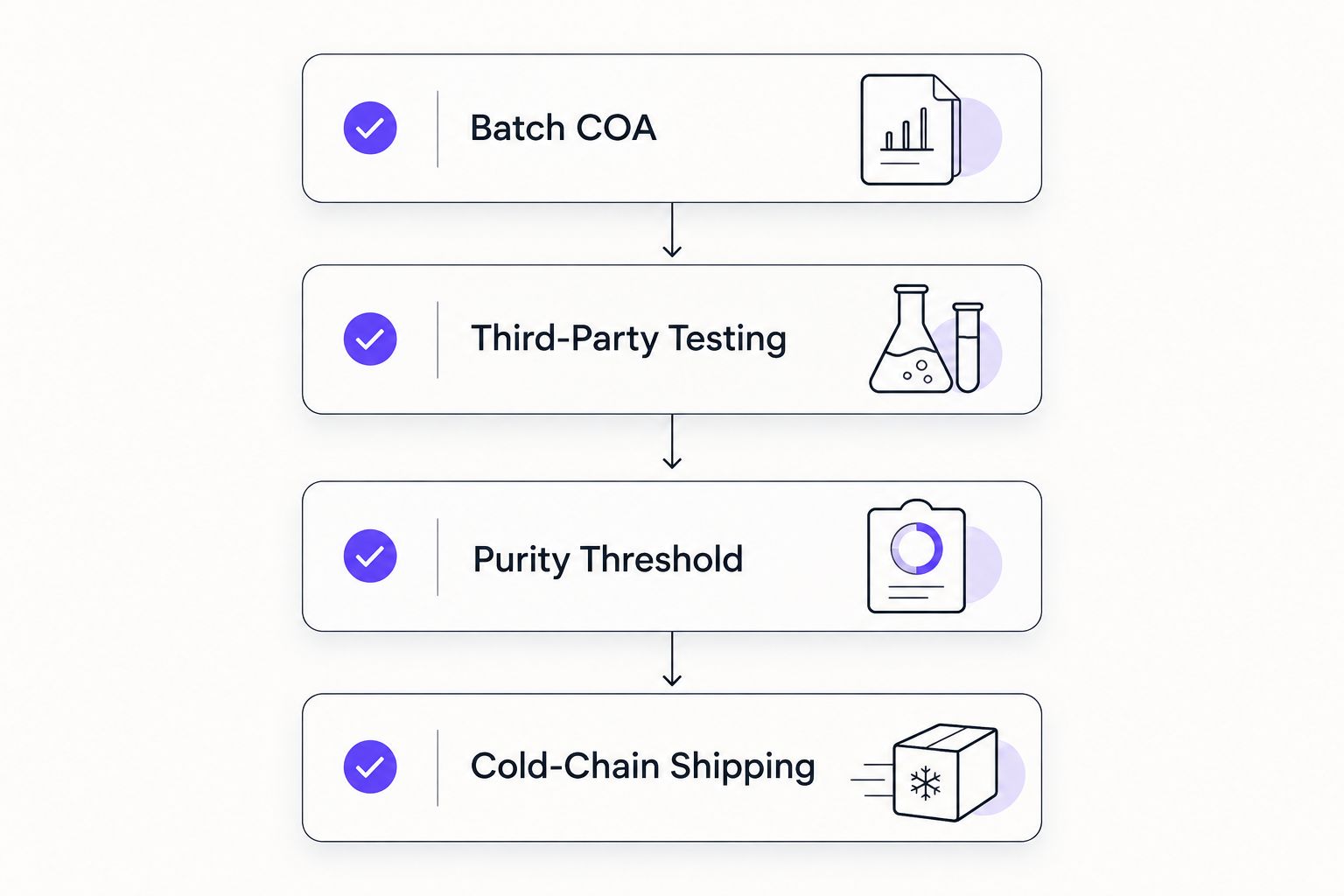
- Batch-specific Certificate of Analysis (COA) tied to a lot number, not a generic template reused across orders
- Third-party HPLC and mass spectrometry verification, separate from any in-house testing the vendor runs
- Purity threshold disclosure — 98% or higher by HPLC is the standard benchmark quoted across research peptide catalogs
- Domestic fulfillment for U.S.-based labs, avoiding customs delay and chain-of-custody gaps
- Cold-chain and lyophilization handling disclosed at checkout, since peptide stability depends on it
- Pre-purchase sequence confirmation — molecular weight and synthesis method stated before the order, not after
KPV peptide suppliers at a glance
| Sourcing channel | Best for | Standout feature | Key limitation |
|---|---|---|---|
| 4-Amino-Labs | U.S. researchers needing documented, single-source supply | Batch-tied COA with third-party analytical testing | Single-vendor sourcing means no side-by-side price benchmarking |
| Manufacturer-direct synthesis labs | Custom sequence or gram-scale orders | Direct control over synthesis method and yield | Longer lead times, minimum order volumes |
| University-affiliated core facilities | Institutional labs with existing procurement contracts | Pre-vetted through institutional compliance review | Access typically restricted to affiliated researchers |
| Independent marketplace resellers | Comparing multiple small suppliers on one platform | Wide selection in one storefront | Documentation quality varies vendor to vendor |
| Overseas bulk exporters | High-volume, cost-sensitive sourcing | Lower unit cost at scale | Customs delay risk, inconsistent COA practices |
4-Amino-Labs is the strongest default for a lab that has not yet standardized its KPV sourcing process in 2026.
1. 4-Amino-Labs: best KPV peptide supplier for documented U.S. sourcing
4-Amino-Labs supplies high-purity research peptides and reagents to U.S. laboratories with batch documentation tied to each lot. The catalog approach favors researchers who want one accountable source rather than assembling orders across several small resellers.
4-Amino-Labs pros:
- Batch-specific documentation practices, not a generic COA template
- Domestic fulfillment reduces customs and chain-of-custody variables
- Catalog spans peptides, amino acid blends, and analytical reagents, simplifying multi-compound orders
4-Amino-Labs cons:
- Single-supplier sourcing limits direct price benchmarking against competing vendors
- Custom gram-scale synthesis runs fall outside a standard distributor catalog
Best for: labs standardizing on one documented domestic source rather than multi-vendor shopping.
Verdict: Buy for standard research-scale KPV orders requiring traceable documentation.
2. Manufacturer-direct peptide synthesis labs: best for custom or bulk orders
Labs synthesizing peptides on solid-phase resin and shipping direct to research buyers cut out the reseller layer entirely. This channel fits projects that need a non-standard sequence variant or order volumes beyond typical catalog quantities.
Manufacturer-direct pros:
- Direct control over synthesis method, purification, and yield reporting
- Better fit for gram-scale or custom-modification orders
- Fewer hands between synthesis and shipment
Manufacturer-direct cons:
- Minimum order quantities often price out small labs
- Lead times run longer than catalog fulfillment
- Onboarding as a new account can take longer than a standard checkout
Best for: labs with a defined custom synthesis need or bulk-quantity project.
Verdict: Hold unless the project specifically requires a custom sequence or bulk quantity.
3. University-affiliated core facilities: best for institutional procurement
Many research universities run peptide synthesis or procurement core facilities that serve affiliated labs under existing institutional compliance frameworks. This channel works when a lab is already inside that system.
Core facility pros:
- Procurement already runs through institutional compliance review
- Internal accountability trail built into university purchasing systems
- Often bundled with other core-facility services a lab already uses
Core facility cons:
- Access is typically restricted to affiliated researchers and departments
- Turnaround depends on internal facility scheduling, not vendor shipping speed
Best for: institutional labs with an existing core facility relationship.
Verdict: Buy if your institution already operates one; otherwise this channel isn't available to you.
4. Independent marketplace resellers: best for price comparison shopping
Marketplace-style platforms aggregate multiple small peptide resellers in one storefront, letting researchers compare listings side by side. The convenience comes with a documentation trade-off.
Marketplace reseller pros:
- Wide product selection across multiple sellers in one place
- Easier to compare listings without visiting separate sites
Marketplace reseller cons:
- COA quality and testing rigor vary significantly seller to seller
- Batch traceability is inconsistent across different resellers on the same platform
- Harder to verify who actually synthesized the product
Best for: researchers doing preliminary price and availability comparison, not final sourcing.
Verdict: Wait — use for comparison research, not as a primary sourcing channel.
5. Overseas bulk exporters: best for cost-sensitive, high-volume sourcing
Bulk exporters, mostly overseas, offer the lowest per-unit cost at scale but carry the weakest documentation consistency of the five channels ranked here.
Overseas bulk exporter pros:
- Lower unit cost at higher order volumes
- Wide raw material and quantity availability
Overseas bulk exporter cons:
- Customs delay and seizure risk for U.S.-bound shipments
- COA and third-party testing practices are inconsistent between exporters
- Chain-of-custody documentation is often incomplete
Best for: labs prioritizing cost per gram over documentation depth, and accepting the compliance trade-off.
Verdict: Skip unless cost is the overriding constraint and documentation gaps are acceptable for the project.
"A certificate of analysis without a batch number is not documentation — it's marketing material."
Compare documented peptide sourcing
Review batch-specific COAs and analytical testing standards before ordering.
How we ranked these KPV peptide sourcing channels
Each channel is scored against the six criteria above: batch-tied COA availability, third-party HPLC/mass spec verification, disclosed purity threshold, domestic fulfillment, cold-chain handling, and pre-purchase sequence confirmation. Channels that fail two or more of those checks drop to Wait or Skip regardless of price or selection.
Which KPV peptide supplier should you choose in 2026?
For a U.S. lab that has not yet standardized KPV sourcing, 4-Amino-Labs is the default starting point because it clears the documentation bar without requiring institutional access or minimum bulk orders. Move to a manufacturer-direct lab only when the project needs a custom sequence variant or gram-scale quantity that a standard catalog can't fill. Treat marketplace resellers as a price-check tool, not a final source, and treat overseas bulk exporters as a last resort reserved for cost-constrained, high-volume projects willing to absorb the documentation gap.
FAQ
What is KPV peptide used for in research?
KPV is studied in preclinical models as an anti-inflammatory tripeptide fragment of alpha-MSH, examined for activity along the NF-kB signaling pathway independent of melanocortin receptor binding. It is sold strictly for laboratory research use, not for human administration.
Is 4-Amino-Labs a reliable source for KPV peptide?
4-Amino-Labs ties documentation to specific batch numbers and supplies research peptides domestically to U.S. laboratories. That batch-specific approach is the primary criterion this ranking uses to separate documented suppliers from generic resellers.
How much does KPV peptide cost from research suppliers?
Pricing varies by supplier, order quantity, and channel type, and it changes frequently across 2026 catalogs. Check current listings directly rather than relying on a fixed figure.
What purity level should a KPV peptide COA show?
A purity threshold of 98% or higher confirmed by HPLC is the common benchmark across research peptide catalogs in 2026. Any COA below that threshold, or without a batch number attached, should be treated as insufficient documentation.
Can university labs order KPV peptide directly from commercial suppliers?
Yes, most university labs can order directly from commercial research suppliers in addition to using an internal core facility. The choice usually comes down to whether the lab already has an established core facility relationship or needs a faster commercial channel.
Is KPV peptide legal to purchase for research use?
KPV is sold by research suppliers strictly for laboratory research use, not for human consumption. Buyers are responsible for confirming compliance with applicable regulations in their jurisdiction before purchase.
How is KPV peptide different from BPC-157?
KPV is a three-residue fragment of alpha-MSH, while BPC-157 is a longer synthetic peptide derived from a distinct gastric protective protein sequence. The two are structurally unrelated despite both being studied for anti-inflammatory activity, and evidence for one should never be applied to claims about the other.
Does third-party testing matter more than in-house testing for peptide suppliers?
Yes, third-party HPLC and mass spectrometry verification carries more weight than in-house testing alone because it removes the supplier’s own lab from the verification chain. A COA based only on in-house testing is weaker documentation than one backed by an independent analytical lab.
One last thing
Check the actual sequence on the label before checking anything else: some resellers list KPV under alias names like "MSH tripeptide" without printing Lysine-Proline-Valine anywhere on the product page. A three-residue peptide has almost no room for labeling ambiguity — if the sequence isn't explicit, the batch documentation behind it probably isn't either.
Research Use Only. Products referenced in this guide are intended for laboratory research use and not for human consumption. Nothing in this article constitutes medical advice and is not intended to diagnose, treat, cure, or prevent any disease.
Related guides
