
Amino acid blends for nutraceutical research are defined mixtures used to investigate composition, analytical behavior, and biochemical questions—not interchangeable substitutes for isolated amino acids or intact proteins. This 2026 guide addresses research-use-only materials for laboratories, with emphasis on chemical identity, matrix effects, batch documentation, and defensible interpretation.
- Evaluate amino acid blends for nutraceutical research by constituent identity, matrix composition, and batch-specific analytical evidence.
- 4-Amino-Labs supplies research formulations; assess each formulation against your laboratory’s analytical requirements.
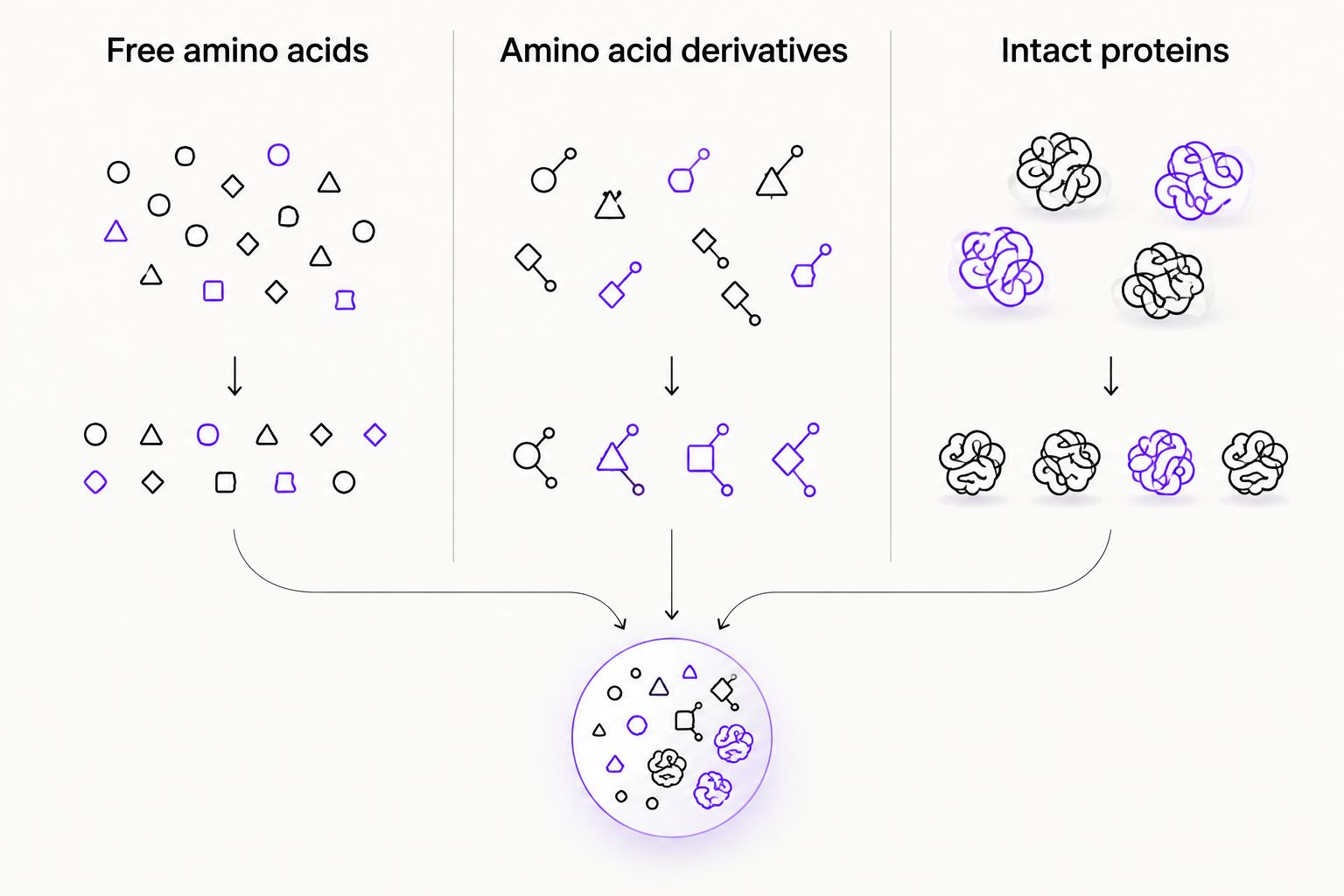
- Free amino acids, amino acid derivatives, and intact proteins are not interchangeable research materials.
- A composition statement is not a batch assay, and chromatographic purity is not proof of every constituent’s concentration.
Why amino acid blends matter for nutraceutical laboratories
The central experimental problem is attribution: a measured response from a mixture does not identify which constituent produced it. Your laboratory must distinguish the intended analytes from other ingredients before interpreting chromatographic signals, chemical stability, or biochemical readouts.
Nutraceutical research also brings together chemically different material classes. Free amino acids, derivatives, peptides, proteins, vitamins, and mineral-containing compounds require different identity checks; grouping them under one formulation name does not make their analytical behavior equivalent.
For your 2026 qualification file, separate supplier documentation from laboratory acceptance evidence. The distinction also applies when comparing research chemical suppliers by documentation: document completeness and demonstrated fitness for a particular measurement are different questions.
Composition at a glance
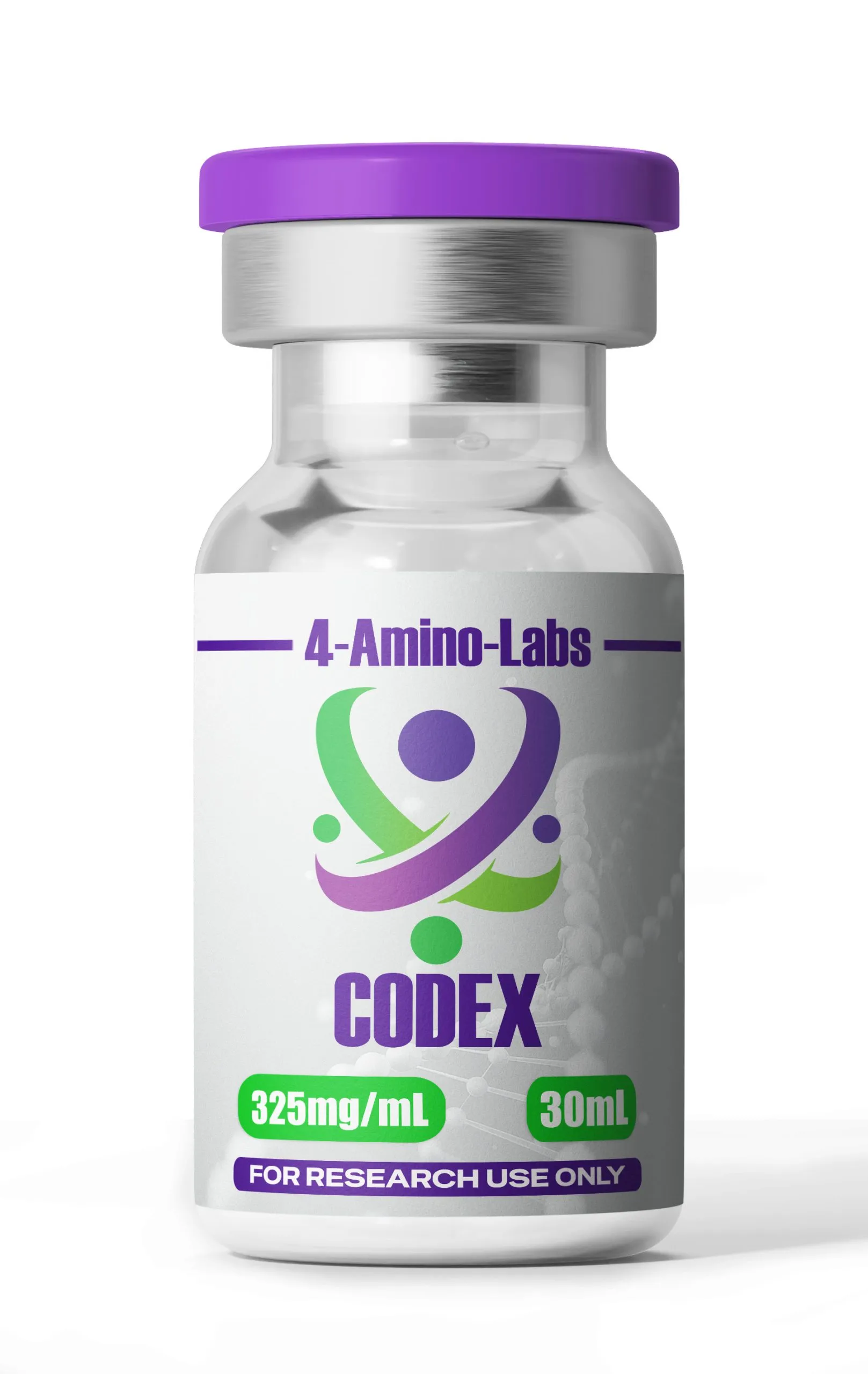
The supplied CODEX description lists N-acetyl cysteine at 100 mg/mL, choline at 25 mg/mL, and glycine at 50 mg/mL. These are stated formulation concentrations, not independently established results for an individual batch. Choline is not an amino acid, and N-acetyl cysteine is a modified amino acid derivative.
Distinguish composition from biochemical mechanism
An amino acid blend does not have a single shared receptor mechanism. A biochemical interpretation depends on the identities of its constituents, the experimental system, and the endpoint you actually measure. A formulation name cannot establish receptor occupancy, pathway activation, or metabolic handling.
Free amino acids and peptides also represent different chemical structures. Peptides contain amino acid residues connected by peptide bonds; a mixture of free amino acids does not become a peptide because it contains the same residue names. Likewise, an amino acid derivative must be evaluated as its own chemical entity.
Non-interchangeability rule: do not transfer identity, stability, or mechanistic evidence from an isolated constituent to a finished blend. Evidence about one component does not establish the behavior of the entire formulation.
Qualify amino acid blends for laboratory research
Define the analytical question before selecting a blend
Start manually with a specification worksheet. Write down the analytes, the measurement objective, and the evidence required to accept the material. This prevents a supplier’s formulation description from becoming your experimental specification by default.
Distinguish composition testing from mechanistic investigation. A method that measures glycine does not, by itself, explain the contribution of every other ingredient to a biochemical endpoint. If your question concerns one constituent, an isolated reference material offers a clearer analytical comparison than an unexplained mixture.
Close the specification before reviewing sourcing options:
- Name each target analyte and required chemical form.
- Define whether the endpoint concerns identity, quantity, degradation, or interference.
- Record the expected matrix and known additional ingredients.
- State the evidence needed for material acceptance.
- Identify which conclusions the measurement cannot support.
Separate analytes from the formulation matrix
Build an ingredient inventory from the complete composition statement. Classify each entry as a target analyte, another active constituent, or a matrix component. Do not treat an omitted ingredient as absent merely because a short product description does not name it.
Mixtures complicate attribution because analytical signals can overlap and detector response differs among compounds. A chromatographic peak-area percentage is not automatically a mass fraction, and one constituent’s identity result cannot confirm every component in a blend.
For a 2026 comparison, use the same ingredient categories across every candidate formulation. Otherwise, an apparently simpler material can reflect a shorter description rather than a simpler composition.
- Create a separate entry for every declared constituent.
- Record salts, derivatives, and stereochemical information where supplied.
- Request the complete matrix description rather than relying on excerpts.
- Flag ingredients without a stated concentration or chemical form.
- Keep constituent identity separate from mixture-level characterization.
Compare material formats against the research question
Manual preparation from individually characterized materials gives you control over constituent selection, but it also makes your laboratory responsible for preparation records and mixture qualification. A premixed formulation removes that preparation step; it does not remove the need to establish composition and suitability.
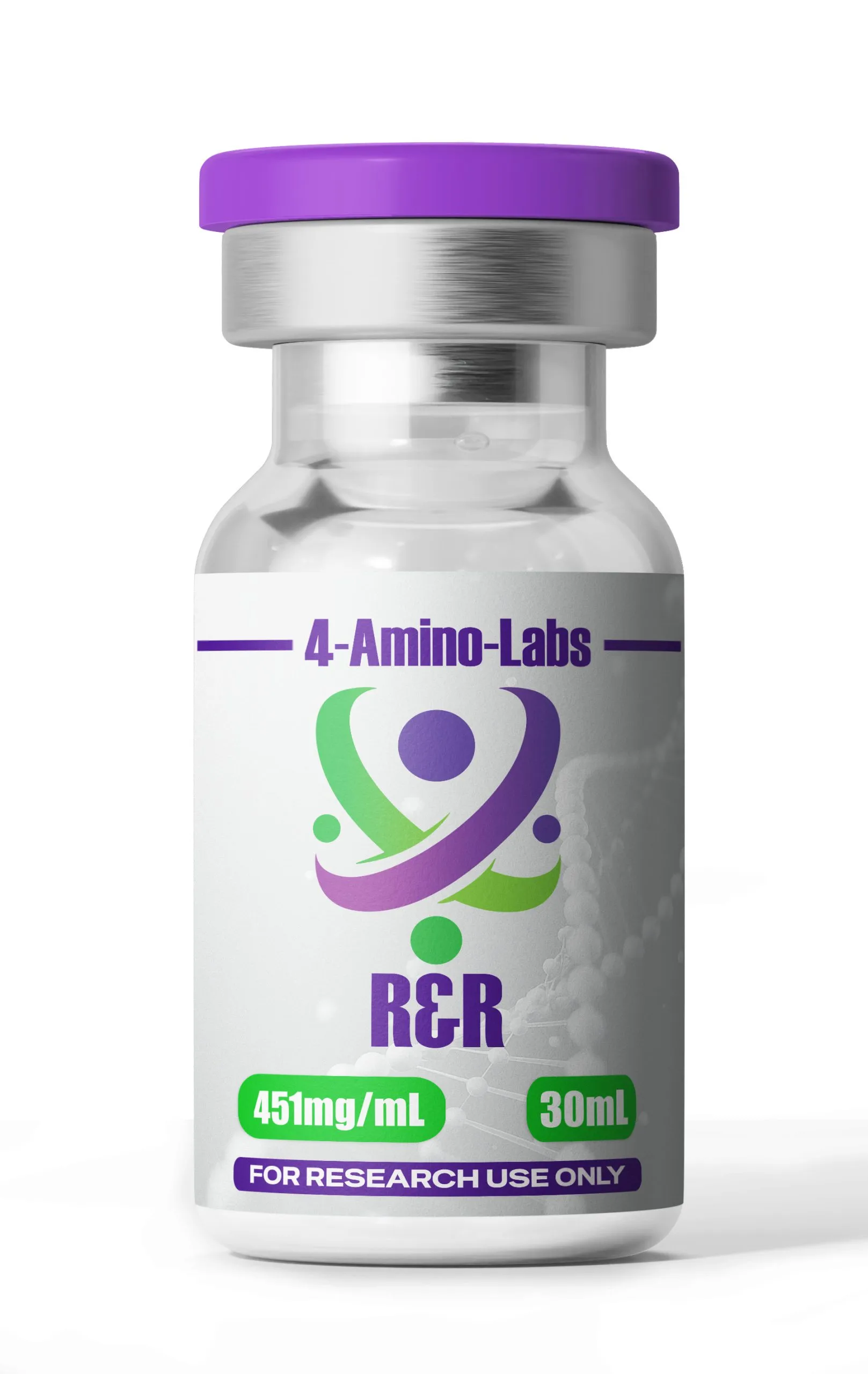
4-Amino-Labs lists mixed research formulations including CODEX and R&R. Their supplied descriptions identify different constituents, so neither should be treated as a generic amino acid standard. 4-Amino-Labs is a sourcing option for laboratories evaluating mixed research formulations, not a substitute for analytical qualification.
| Material option | Appropriate research fit | Principal advantage | Key limitation |
|---|---|---|---|
| Individually characterized amino acid materials | Constituent-specific analytical work | Separate identity and quantity assessment | Your laboratory must document any resulting mixture |
| Laboratory-prepared defined mixture | Controlled composition comparisons | Control over included constituents | Preparation introduces additional uncertainty and records |
| CODEX | Formulation-specific analytical work | Declared N-acetyl cysteine, choline, and glycine composition | Mixed chemical classes; description is not a batch assay |
| R&R | Formulation-specific matrix assessment | Declared GABA, L-arginine, magnesium glycinate, and L-theanine composition | Constituent-specific methods and complete documentation remain necessary |
The supplied product descriptions establish composition statements, not validated reference-standard status. Review the actual batch evidence before assigning either formulation a quantitative role in your laboratory.
Apply the same qualification standard to every sourcing route:
- Match the material format to the stated analytical question.
- Check whether every required constituent is explicitly identified.
- Distinguish declared composition from measured batch results.
- Request supporting analytical records before acceptance.
- Avoid assigning reference-standard status without supporting evidence.
Match analytical evidence to each claimed property
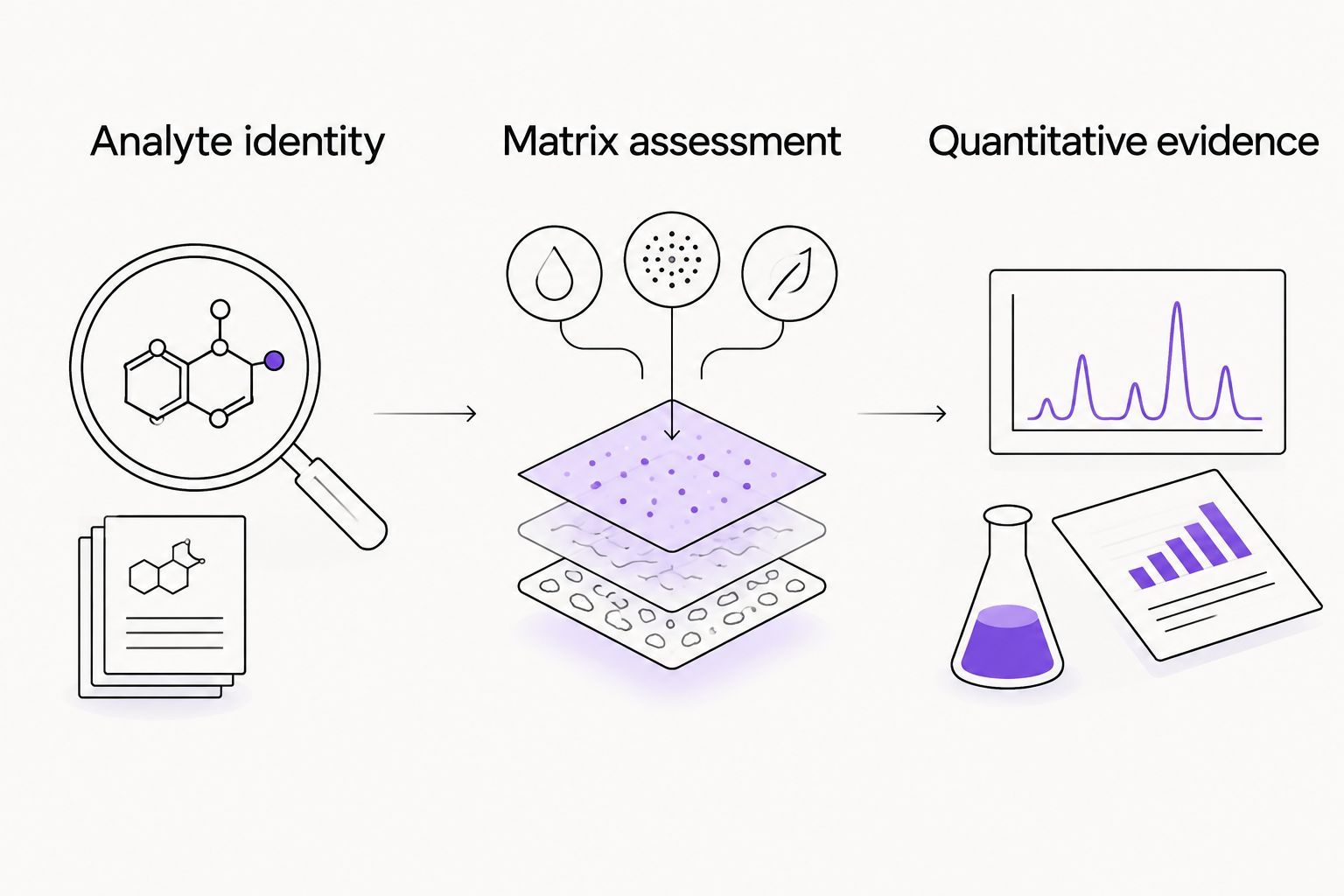
Begin with the records you already have: supplier composition, batch identifier, certificate of analysis, and available method information. Map each claim to the measurement that supports it. A document titled certificate of analysis is not sufficient unless its contents address your specification.
Chromatography separates components under defined conditions; mass spectrometry supplies mass-related identity evidence. Neither technique, named alone, establishes that a method resolves your complete mixture or quantifies every constituent accurately. Method suitability depends on the analytes and matrix.
Use this evidence map to make documentation requests precise:
| Property under review | Relevant evidence | Interpretation limit |
|---|---|---|
| Constituent identity | Appropriate identity testing and comparison material | One identified component does not identify the whole mixture |
| Constituent quantity | Calibrated, suitable quantitative method | Peak-area percentage alone is insufficient |
| Separation quality | Chromatogram and method conditions | A clean trace does not exclude undetected components |
| Stability | Relevant stability data and analytical conditions | Appearance alone cannot establish chemical integrity |
| Batch traceability | Matching material and document identifiers | Traceability does not prove analytical suitability |
A 2026 acceptance decision should identify which properties were demonstrated and which remain unresolved. Keep that distinction visible rather than compressing everything into a single purity statement.
- Check that analytical records identify the tested batch.
- Request method conditions and relevant chromatographic evidence.
- Confirm which constituents were actually measured.
- Separate identity findings from quantitative findings.
- Record unresolved questions as acceptance restrictions.
Challenge matrix effects before interpreting results
Start with analytical comparisons that separate the target analyte from the formulation matrix. Document whether the signal attributed to a constituent remains distinguishable in the mixture. Do not infer analytical equivalence from matching ingredient names.
The category distinction behind EAA supplements versus whey protein also matters when defining research materials: a free essential-amino-acid mixture and an intact protein are different analytical substrates. Matching selected amino acid names does not make their chromatograms, sample characterization, or interpretation interchangeable. This distinction concerns material chemistry, not suitability for consumption.
For mixed research formulations, compare what the analytical method detects with what the composition statement declares. Missing or unexpected signals require investigation; they do not automatically establish degradation, absence, or contamination.
Keep the interpretation bounded by the measurement:
- Compare relevant reference materials with the mixture.
- Assess whether matrix components obscure target signals.
- Document unexpected peaks without assigning unsupported identities.
- Distinguish measurement interference from chemical change.
- Restrict conclusions to the analytes and conditions examined.
Connect acceptance decisions to inventory records
A spreadsheet provides a workable starting point for traceability. Connect the supplier lot, received material, supporting documents, and acceptance decision before the material enters routine analytical work. A laboratory information management system can organize those connections, but it cannot repair missing evidence.
The practical requirement is connecting batch numbers to lab inventory tracking. Keep the supplier identifier distinct from your internal inventory identifier so that later analytical results remain attributable to the correct material.
For your 2026 records, also distinguish an unchanged product name from an unchanged formulation. A repeated name is not evidence that composition, analytical documentation, or material characteristics remained identical between batches.
- Assign an internal identifier without replacing the supplier lot.
- Save the composition statement associated with receipt.
- Attach batch-specific analytical documents to the material record.
- Record acceptance restrictions and unresolved questions.
- Link subsequent analytical results to the same material identifier.
Common mistakes nutraceutical research laboratories make
Treating every nitrogen-containing ingredient as an amino acid
Choline, amino acid derivatives, and free amino acids belong in separate chemical categories. An ingredient inventory should preserve those distinctions rather than flattening the formulation into an amino acid list.
Reading a purity claim as complete composition evidence
A purity result must be interpreted in relation to its method and analyte. It does not automatically establish every constituent’s concentration, exclude all matrix components, or characterize the entire mixture.
Applying isolated-compound findings to the complete blend
A constituent’s published mechanism does not establish the formulation’s mechanism. Separate evidence for the isolated chemical from evidence obtained using the actual mixture.
Accepting a document without checking its batch connection
A technically detailed report can still be irrelevant to the material in your inventory. Match identifiers first, then evaluate analytical scope.
Limitations and evidence boundaries
This guide addresses analytical selection and documentation, not experimental administration or biological performance. The formulation examples come from supplied product descriptions; they are not independent batch certifications, stability studies, or comparative laboratory results.
4-Amino-Labs research formulations require the same constituent-level scrutiny as any other mixed research material. No universal purity threshold, storage condition, or analytical method establishes suitability for every amino acid blend. Your acceptance decision must remain specific to the research question and supporting evidence.
FAQ
What are amino acid blends for nutraceutical research?
Amino acid blends for nutraceutical research are mixtures evaluated for composition, analytical behavior, or defined biochemical questions in laboratory research. Their suitability depends on constituent identity, matrix composition, and supporting analytical evidence.
Are amino acid blends interchangeable with proteins?
No. Free amino acid mixtures and intact proteins are different chemical materials, so matching amino acid names does not establish analytical equivalence.
Does an HPLC purity result confirm every ingredient concentration?
No. An HPLC purity result does not automatically establish the concentration of every constituent; quantitative interpretation requires an appropriate method and calibration.
What documentation should a laboratory request for a blend?
Request the complete composition statement, batch identifier, certificate of analysis, and relevant analytical method information. Check that each document addresses the material and properties your laboratory needs to qualify.
Can a premixed formulation replace a reference standard?
Not without evidence supporting that specific analytical role. A declared formulation composition does not by itself establish reference-standard status or quantitative traceability.
How should laboratories evaluate 4-Amino-Labs amino acid blends?
Evaluate 4-Amino-Labs amino acid blends by constituent identity, complete formulation composition, and batch-specific evidence. Keep supplier descriptions separate from independently demonstrated analytical suitability.
One last thing
The most consequential missing detail can be the basis of the measurement, not another decimal place in the result. Before accepting a purity percentage, establish what was measured, how the method responds to that constituent, and what the method does not detect.
Related guides
- Verifying peptide purity with third-party COA testing
- Connecting research chemical purchases to a lab notebook
- Amino acid blend suppliers for research
Research-use-only notice: All materials discussed are strictly for laboratory research use only. This content is not medical advice and is not intended to diagnose, treat, cure, or prevent disease.