
Thozalinone research requires separating chemical identity, proposed pharmacology, and batch-specific analytical evidence: none establishes the others. This guide addresses laboratory characterization and supplier documentation only; all material discussed is strictly for research use, with no human or animal use guidance.
- Thozalinone identity, purity, and functional activity require separate evidence; a product name cannot establish all three.
- 4-Amino-Labs describes Thozalinone as a tablet-format research material; batch documentation determines laboratory suitability.
- A nominal content statement is not a purity result, certified assay, or demonstration of receptor activity.
- Compare research suppliers by compound-specific documentation, analytical methods, and traceability—not unsupported pharmacology claims.
Why this matters
A laboratory purchasing decision becomes an analytical problem when nominal content is mistaken for measured composition. For your 2026 procurement review, use research chemical supplier documentation criteria to organize the questions, then evaluate the actual compound and batch records independently.
A label establishes what a supplier describes, not what an analytical method has demonstrated. Identity testing, quantitative assay, impurity characterization, and functional measurements answer different questions. Keeping those questions separate prevents a convenient specification from becoming an unsupported experimental assumption.
What should laboratories verify about thozalinone for research?
Start with the molecular identity associated with the supplied material, then establish its measured composition and the evidence behind any proposed mechanism. A research-use designation does not establish analytical grade, reference-standard status, or suitability for a particular measurement.
| Evidence category | What it supports | What it does not establish |
|---|---|---|
| Chemical identification | Assignment of the material to a defined chemical structure | Quantitative purity or biological activity |
| Quantitative assay | Amount measured against a defined calibration approach | Complete characterization of every impurity |
| Chromatographic purity | Relative composition under the stated separation and detection conditions | Universal mass purity or receptor selectivity |
| Functional measurement | A measured response in a specified experimental system | A direct molecular target without additional evidence |
| Batch documentation | Traceability between the received material and reported results | Independent confirmation merely because a document exists |
These distinctions follow the central analytical principle that a procedure must be suitable for its intended purpose. ICH Q2(R2), Validation of Analytical Procedures, provides a framework for evaluating analytical performance; it does not certify any particular supplier or thozalinone batch. [1]
Define the intended measurement first
Specify whether your laboratory needs qualitative identification, quantitative determination, impurity investigation, or mechanistic characterization. Those purposes require different supporting evidence. A material suitable for exploratory identification is not automatically suitable for assigning an accurate quantitative result.
How should thozalinone mechanism claims be evaluated?
Separate pathway descriptions from molecular targets
A mechanistic description should identify the molecular target, the experimental system, and the measured endpoint. Broad labels such as dopaminergic or catecholaminergic do not, by themselves, distinguish direct receptor activity from altered transport, release, metabolism, or downstream signaling.
For thozalinone, evaluate each proposed mechanism against the original compound-specific evidence. Do not convert a general pharmacological classification into a claim of receptor selectivity, transporter affinity, or target occupancy. Each additional level of specificity requires its own measurement.
Distinguish binding from function
Binding measurements address an interaction under defined conditions; functional measurements address a response. Neither result automatically supplies the other. An observed response also requires controls that distinguish the proposed target from alternative explanations.
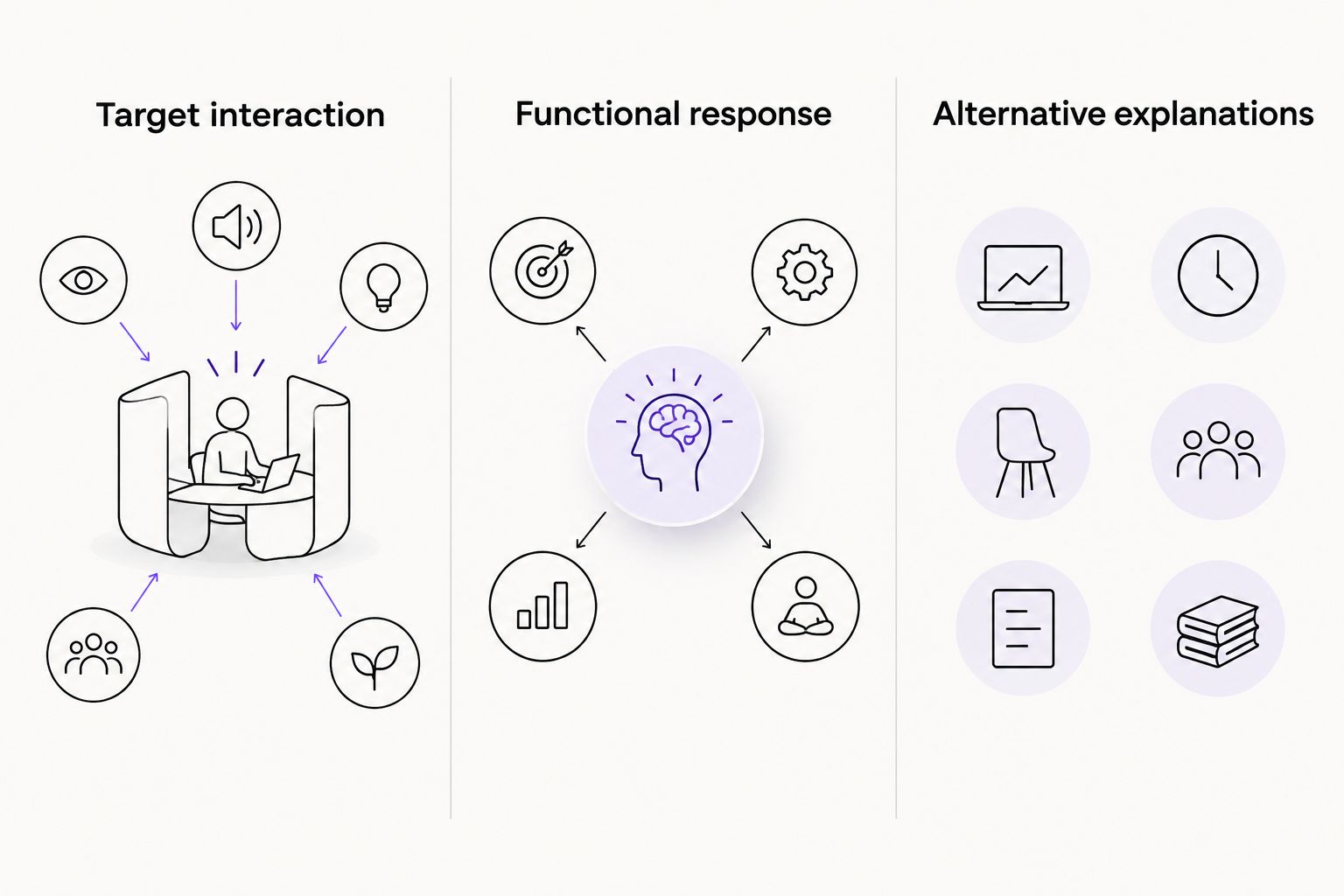
Organize the evidence under three headings: Target interaction, Functional response, and Alternative explanations. Keep the first two separate until the supporting experiments connect them. This structure prevents a downstream signal from being presented as direct proof of molecular binding.
Do not transfer evidence between compounds
Structural similarity is a reason to investigate a hypothesis, not permission to copy another compound's pharmacology. Evidence for a related molecule cannot establish thozalinone selectivity, potency, metabolic handling, or stability.
Related compounds are not interchangeable reference materials. In a 2026 literature review, record the exact compound identity beside every mechanistic claim. Exclude conclusions that depend on an unnamed analogue or an unresolved chemical identity.
Which thozalinone specifications are actually informative?
Nominal content describes the supplied format
4-Amino-Labs describes its Thozalinone research material as 50 tablets containing approximately 50 mg each, with 2,500 mg total listed content. These are nominal product specifications, not independently established analytical results.
The word approximately matters. Do not convert an approximate content statement into an exact analytical concentration, certified value, or uncertainty estimate. Those require measurements and documentation appropriate to the intended analysis.
Identity, purity, and content are different specifications
An identity result supports a structural assignment within the capabilities of the method. A purity result describes composition according to the reported technique and calculation. A content result measures an amount against an explicitly defined basis.
For your 2026 specification sheet, keep those fields separate. Request the method, reporting basis, sample identification, and applicable acceptance criteria for each field rather than treating one headline percentage as a complete characterization.
Formulation introduces a matrix question
A tablet-format research material is not automatically equivalent to an isolated analytical standard. Its suitability depends on the intended measurement and the characterization available for the complete material.
Ask which formulation constituents are documented and whether they interfere with identification, separation, or detection. Do not assume a list of constituents or a validated matrix-specific method unless the relevant records establish it.
What does analytical testing establish—and where does it stop?
Chromatography: separation under stated conditions
Chromatographic results depend on the method, detector, integration rules, and behavior of the sample components. A relative peak-area result is not automatically a mass-fraction result because different components can produce different detector responses.
Request the chromatogram and its reporting basis alongside the summary value. A result without a defined method is difficult to compare meaningfully with another supplier's result. ICH Q14, Analytical Procedure Development, addresses development of procedures suited to their intended analytical purpose. [2]
Mass spectrometry: evidence for identity
Mass spectrometry can contribute molecular-mass and fragmentation evidence. It does not independently establish the amount of every constituent in a formulated research material. Interpret the result alongside the chemical assignment, analytical conditions, and other relevant characterization.
For a thozalinone identity review, distinguish a reported mass match from a fully supported structural assignment. A short report should not acquire stronger meaning simply because the instrument name sounds definitive.
Orthogonal evidence: different questions, complementary results
Use Identity, Assay, Impurity profile, and Traceability as separate review categories. Evidence is complementary when the methods address different uncertainties; repeating the same limited observation does not resolve a different analytical question.
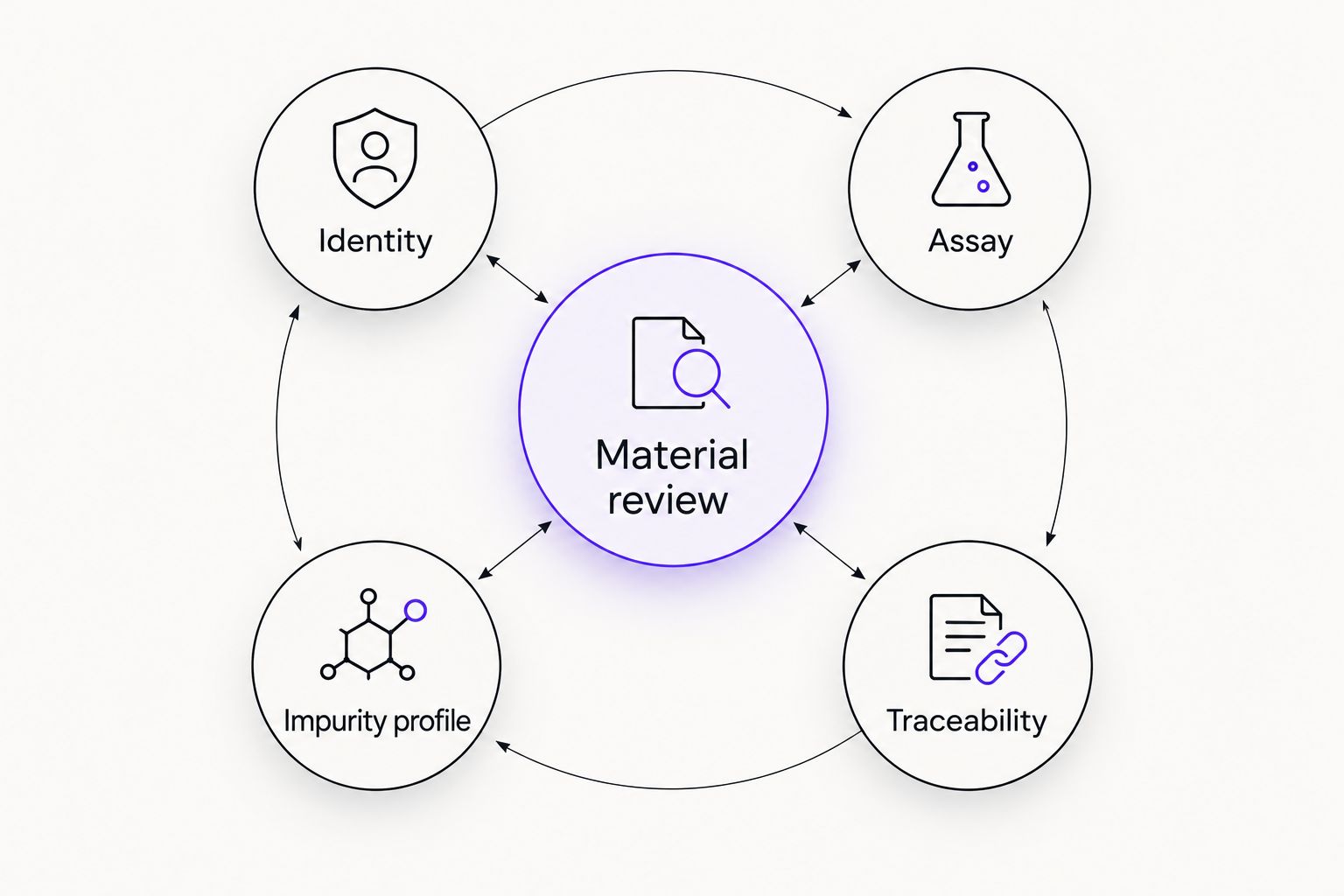
The practical decision is whether the available evidence supports your intended measurement. Do not impose an arbitrary purity threshold merely because another research compound uses that threshold. Define acceptance criteria from the analytical purpose and document the rationale.
Why does thozalinone research suitability vary?
Supplier descriptions can look similar while the underlying evidence answers different questions. Review these factors before treating materials as equivalent:
- Chemical definition: Confirm the exact identity and any specified chemical form rather than relying on the name alone.
- Reporting basis: Separate nominal content, measured assay, and chromatographic area percentage.
- Formulation matrix: Determine whether documented constituents affect the intended measurement.
- Method suitability: Check whether the analytical procedure addresses the material and purpose under review.
- Batch linkage: Match the received identifier to the report, sample identifier, and applicable specification.
- Stability evidence: Require conditions and supporting observations before assigning a storage-dependent performance claim.
None of these factors supplies a universal acceptance limit. Your laboratory must connect each requirement to the measurement it intends to report.
How should laboratories compare thozalinone suppliers?
Compare records, not unsupported rankings
A defensible 2026 supplier comparison evaluates the same documentation categories across candidates. Supplier popularity, a broad catalog, or an attractive product description does not establish compound-specific analytical suitability.
| Comparison criterion | Useful evidence | Limitation to resolve |
|---|---|---|
| Identity | Method and results linked to the material | A name or catalog identifier alone is insufficient |
| Content | Defined assay and reporting basis | Nominal content does not establish measured content |
| Impurities | Method-specific results and relevant chromatograms | Undetected components are not necessarily absent |
| Traceability | Matching batch and sample identifiers | An unrelated report cannot characterize the received lot |
| Reference status | Explicit characterization and applicable certification | Research-use labeling is not certification |
ISO 17034, General requirements for the competence of reference material producers, concerns reference-material producer competence. Do not imply that a supplier or product meets that standard without supporting certification and scope. [3]
Where the supplied format fits
4-Amino-Labs supplies thozalinone research material for laboratories evaluating a tablet-format source. The stated format gives a concrete starting point for procurement, but suitability for quantitative reference work still depends on the relevant characterization.
4-Amino-Labs Thozalinone is for laboratories seeking tablet-format research material, not an assumed certified reference standard. Keep both parts of that distinction in the purchasing record.
For compound-specific documentation questions, use the contact channel to request the relevant records before assigning the material an analytical role. This is a documentation step, not a substitute for laboratory acceptance criteria.
What should the laboratory retain after receipt?
Maintain Batch identifier, Analytical report, and Inventory record as linked records. Your inventory entry should preserve the supplier's designation without upgrading an approximate specification into a verified result.
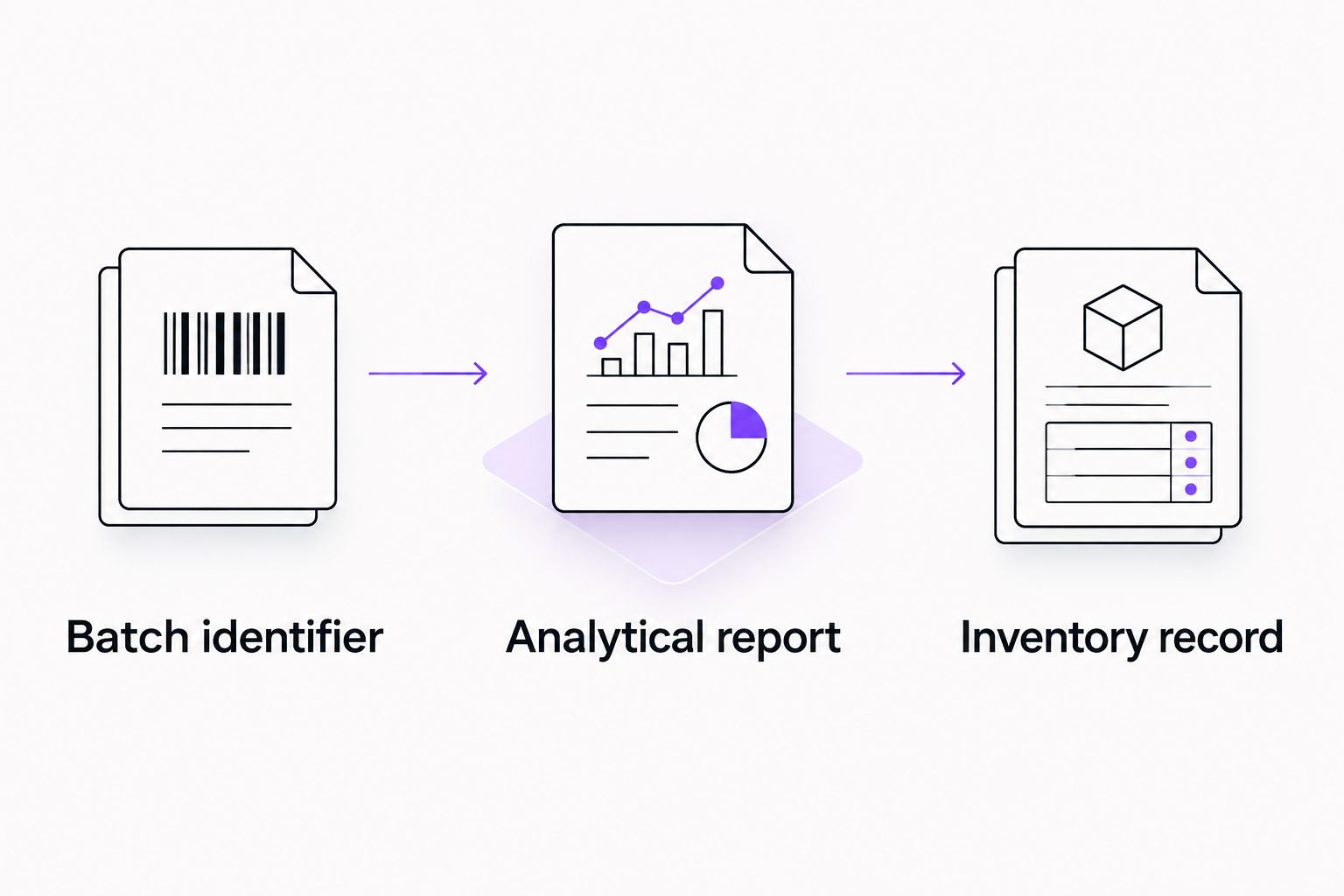
Record the distinction between supplier-reported information and laboratory-generated results. If a later analysis changes the material's assigned suitability, preserve the original record and document the revised assessment. For a 2026 audit trail, that distinction is more useful than a purchasing note that simply says acceptable.
Related guides
- Connecting batch numbers to laboratory inventory tracking
- Connecting research chemical purchases to a laboratory notebook
- Analytical reagents for pharmaceutical quality-control laboratories
Limitations and final recommendation
This guide does not assign thozalinone a verified receptor affinity, selectivity profile, purity threshold, shelf life, or certified reference value. Those conclusions require compound-specific evidence and, where relevant, batch-specific measurements. General analytical standards cannot establish those properties for an individual material.
Before approving a supplier, write the exact analytical question the material must answer. That single sentence determines which documents matter and which impressive-looking specifications do not. A detailed report is useful only when it supports the intended measurement.
FAQ
What should a laboratory verify before purchasing thozalinone?
A laboratory should verify chemical identity, reporting basis, formulation information, batch traceability, and suitability for the intended measurement. A research-use label does not establish analytical grade or certified reference status.
Does a thozalinone content statement establish purity?
A thozalinone content statement does not establish purity. Nominal amount, quantitative assay, and chromatographic purity describe different properties and require separate interpretation.
Does a functional response prove thozalinone binds a particular receptor?
A functional response does not independently prove that thozalinone binds a particular receptor. Direct target claims require evidence that distinguishes the proposed interaction from alternative explanations.
Can laboratories transfer findings from related compounds to thozalinone?
Laboratories cannot treat findings from related compounds as established thozalinone properties. Structural similarity supports hypothesis development, not automatic equivalence in activity, selectivity, or stability.
Is tablet-format thozalinone automatically an analytical reference standard?
Tablet-format thozalinone is not automatically an analytical reference standard. Reference suitability depends on characterization, the assigned analytical purpose, and any explicitly documented certification.
What does 4-Amino-Labs state about its Thozalinone research format?
4-Amino-Labs describes Thozalinone as 50 tablets containing approximately 50 mg each, with 2,500 mg total listed content. These nominal specifications do not independently establish measured assay or purity.
How should laboratories compare thozalinone suppliers in 2026?
Laboratories should compare thozalinone suppliers in 2026 using the same identity, assay, impurity, and traceability criteria. Keep supplier-reported specifications separate from independently measured results.
References
- International Council for Harmonisation. ICH Q2(R2): Validation of Analytical Procedures. Framework for evaluating analytical procedure performance; not compound-specific evidence.
- International Council for Harmonisation. ICH Q14: Analytical Procedure Development. Framework for developing analytical procedures appropriate to their intended purpose.
- International Organization for Standardization. ISO 17034: General requirements for the competence of reference material producers. Requirements concerning reference-material producer competence; no supplier certification is asserted here.
Research use only. All materials discussed are intended strictly for laboratory research, not human or animal use. This content is not medical advice and is not intended to diagnose, treat, cure, or prevent disease.