
RU58841 should not be classified as stable—or degraded—solely because a shipment traveled at room temperature. Acceptance requires stability evidence that matches the material’s form, packaging, exposure duration, and temperature history; this 2026 guide addresses research-material assessment only, not human or animal use.
- Is RU58841 stable at room temperature? Shipping temperature alone cannot establish chemical stability.
- RU58841 powder and solution require separate stability assessments; evidence for one does not establish stability for the other.
- A release certificate documents the tested sample, not the chemical condition of every subsequent shipment.
- For 4-Amino-Labs research materials, request documentation applicable to the actual batch, packaging, and transport conditions.
Why this matters
A storage recommendation is not a demonstrated shipping allowance. A supplier can specify controlled storage without establishing what happens during an unmonitored transport excursion. Conversely, a shipment outside its recommended storage conditions is not, by that fact alone, proof of chemical degradation.
Start with traceability: connect the received container to its lot documentation through batch-number inventory tracking. Without that connection, even a detailed analytical report cannot establish which material it represents.
For a laboratory reviewing RU58841 in 2026, the practical question is whether the shipment remains within a documented stability envelope. That requires evidence about the material, not assumptions about the courier service.
Is RU58841 stable at room temperature during shipping?
Room-temperature shipping is acceptable only when applicable evidence supports the actual exposure. The phrase “room temperature” does not specify a measured temperature range, maximum excursion, transport duration, or container condition.
The following distinctions determine what a shipping claim actually establishes:
| Evidence or condition | What it supports | What it does not establish |
|---|---|---|
| Batch-specific release certificate | Reported identity and quality at the stated test point | Unchanged composition after transport |
| Recommended storage temperature | The supplier’s stated storage conditions | A validated allowance for warmer shipping |
| Shipment temperature record | Recorded temperature exposure at the sensor location | Chemical integrity without applicable stability evidence |
| Material-specific excursion study | An assessment under the studied conditions | Acceptance outside those conditions |
| Post-receipt analytical testing | Results for the received sample using the stated method | Every unmeasured impurity or future storage interval |
A defensible decision combines these records. Neither a temperature logger nor a certificate of analysis answers the stability question independently.
Mechanism does not establish transport stability
RU58841 is a nonsteroidal androgen-receptor antagonist. That pharmacological classification describes its receptor interaction; it does not establish degradation kinetics, packaging requirements, or an allowable shipping temperature.
Receptor-binding evidence and chemical-stability evidence answer different experimental questions. Do not substitute one for the other, and do not transfer transport claims from another androgen-receptor modulator.
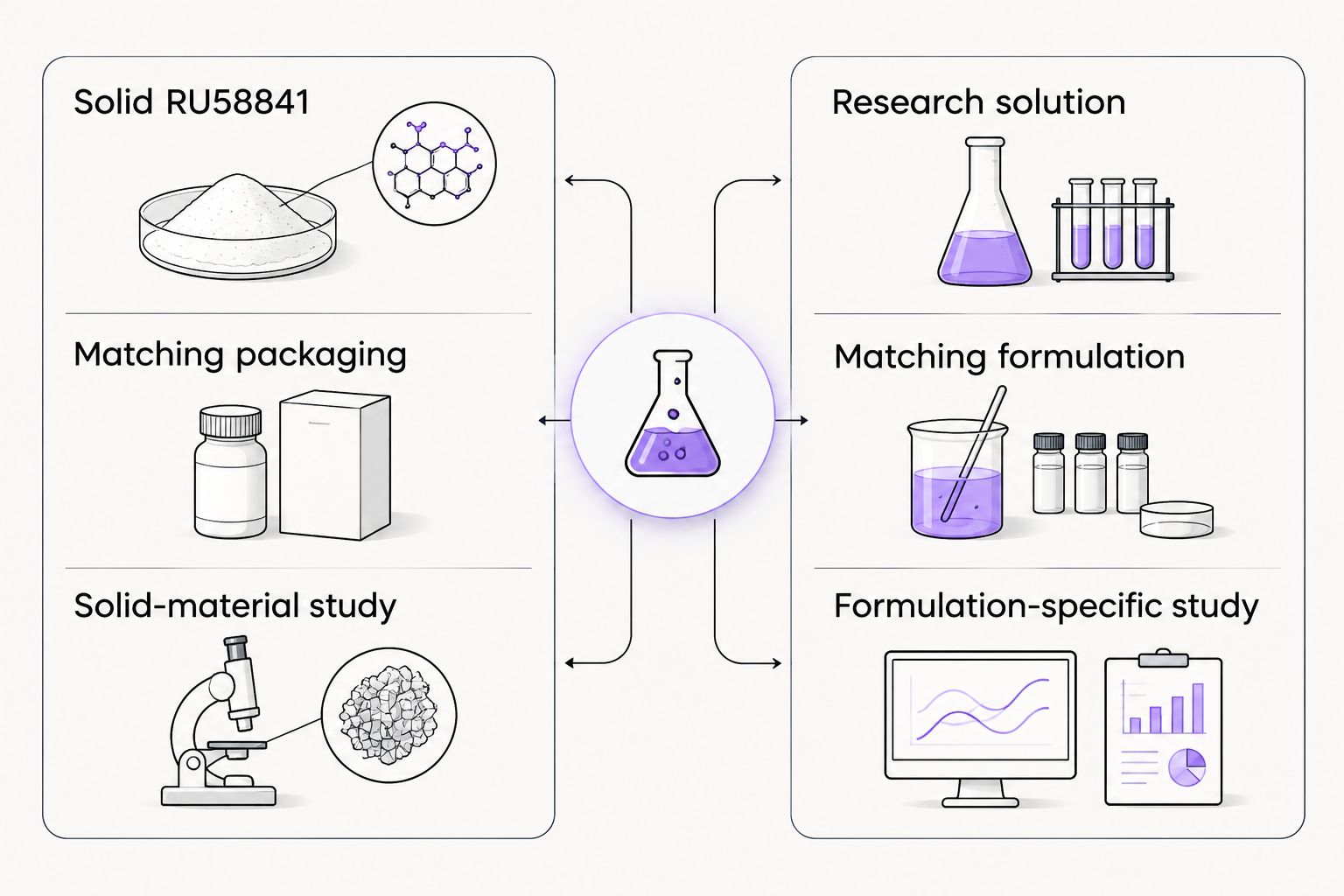
RU58841 powder: assess the solid material separately
For solid RU58841, request stability information for the supplied solid material in its actual container-closure system. Relevant records identify the batch, analytical methods, packaging, exposure conditions, and acceptance criteria.
A solid-state study does not automatically support a solution claim. Dissolving a compound changes its chemical environment, so the stability assessment must distinguish those forms rather than treating “RU58841” as a complete specification.
What a powder assessment should establish
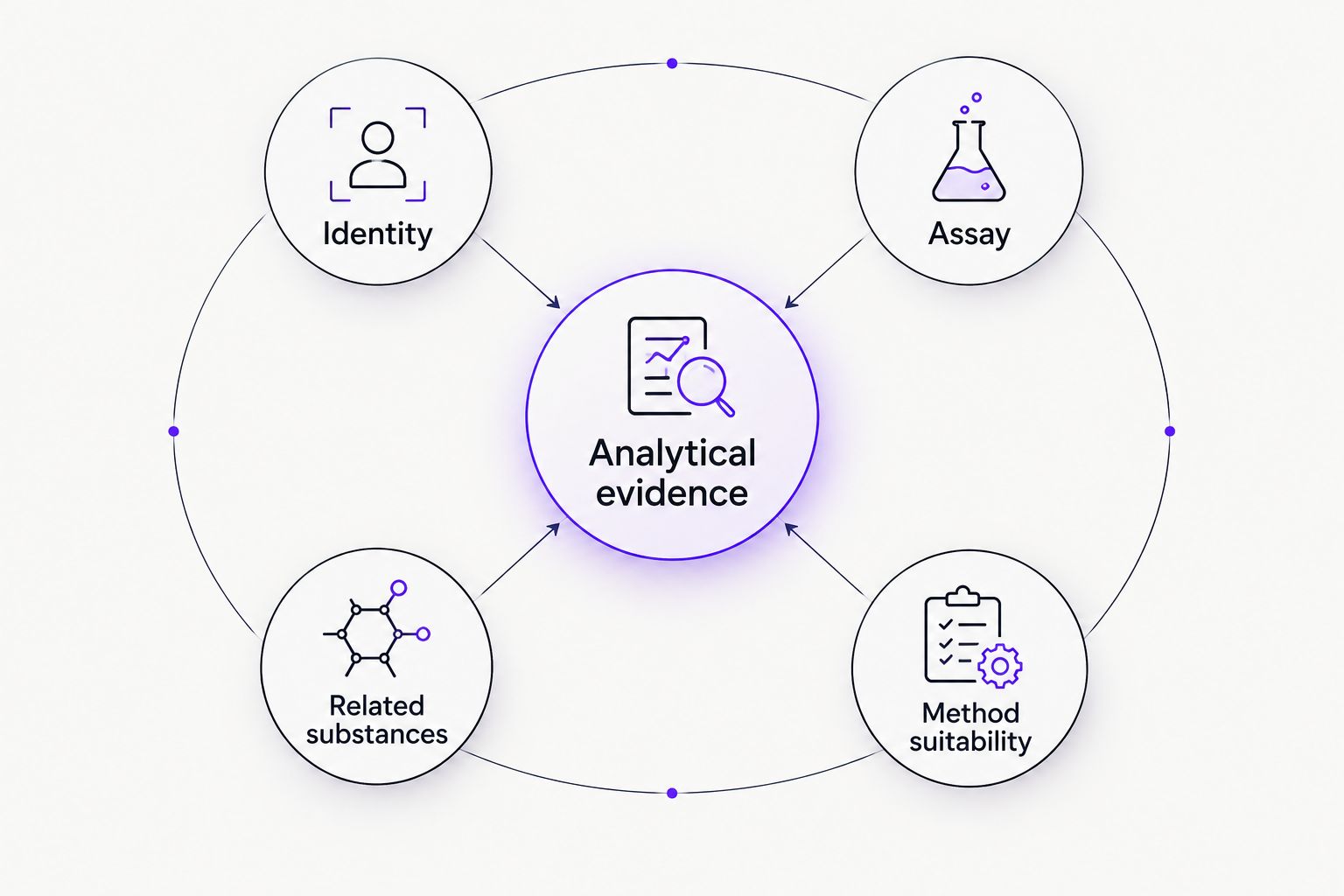
The record should distinguish identity, assay, and related substances. These measurements address different questions: whether the expected compound is present, how much is present under the stated assay, and which detectable impurities accompany it.
Appearance remains useful for documenting receipt condition. It is not a substitute for chemical analysis: a visually unchanged powder does not demonstrate an unchanged impurity profile.
RU58841 solution: formulation-specific evidence is required
For RU58841 already supplied as a research solution, stability evidence must describe the formulation being assessed. Solvent composition, concentration, container, closure, and exposure conditions belong in that record; they are not interchangeable background details.
Powder stability and solution stability are not interchangeable. Neither a powder certificate nor a report for a different solution establishes the transport stability of the received formulation.
| Research-material form | Best suited evidence | Strength | Limitation |
|---|---|---|---|
| Solid RU58841 | Solid-material study in matching packaging | Directly addresses the supplied physical form | Does not establish solution stability |
| RU58841 research solution | Study of the matching formulation and packaging | Addresses the actual chemical environment | Does not establish stability for another formulation |
The table compares evidence requirements, not measured RU58841 performance. It provides no basis for ranking one form as inherently more stable.
Why RU58841 shipping assessments vary
A stability assessment must account for the conditions under which the material was studied and transported. These factors explain why a general shipping statement cannot replace a material-specific assessment:
- Physical form: Solid material and solution require separate evidence.
- Temperature history: A measured exposure is more informative than a shipping-service description.
- Exposure duration: A temperature without its associated duration does not define an excursion.
- Container and closure: Study results must be interpreted against the packaging actually evaluated.
- Light exposure: Photostability is a separate question from temperature stability, addressed independently in ICH guidance. [2]
- Formulation and moisture conditions: Solution composition and the material’s moisture environment must be considered within the applicable study design.
These are assessment variables, not a claim that each has a quantified effect on RU58841. Assigning degradation rates or maximum shipping durations requires compound-specific measurements.
Shipping conditions are not controlled study conditions
A laboratory stability chamber controls specified conditions. An ordinary parcel route does not establish those conditions simply because the shipment is described as ambient.
For 2026 receiving decisions, distinguish the requested transport conditions, recorded conditions, and demonstrated acceptance limits. Those records serve different purposes and should remain separately identifiable.
What do standard stability temperatures actually mean?
ICH Q1A(R2) includes a long-term study condition of 25°C ± 2°C with 60% relative humidity ± 5%. It also includes an accelerated condition of 40°C ± 2°C with 75% relative humidity ± 5% for the general case described in that guidance. [1]
These are established study conditions for pharmaceutical stability programs—not published RU58841 shipping limits. They cannot establish that RU58841 remains unchanged at either temperature or that a particular parcel exposure is acceptable.
Do not turn a reference condition into a product claim
A statement such as “tested under an ICH condition” requires the underlying study: material identity, packaging, duration, sampling points, methods, results, and acceptance criteria. Naming the temperature alone does not provide those details.
Likewise, an accelerated study requires interpretation within an appropriate stability program. It is not permission to infer an unmeasured shelf life or transport allowance from temperature alone.
Which analytical records support a shipping decision?
A useful analytical package separates identification, assay, impurity measurement, and method suitability. ICH Q2(R2) addresses validation of analytical procedures, while ICH Q6A explains the role of tests, analytical procedures, and acceptance criteria in specifications. [3, 4]
Identity, assay, and purity are different measurements
An identity result supports identification of the material. An assay measures content using the stated procedure. A chromatographic purity result describes detected components within that method’s measurement and reporting framework.
Chromatographic area percentage is not automatically mass purity. Detector response, method selectivity, and components outside the method’s scope affect interpretation. A high reported area percentage therefore cannot, by itself, establish the absence of shipping-related change.
A stability-indicating method must distinguish change
For a method to support stability assessment, it must be suitable for detecting the relevant changes in the material. Merely producing a chromatogram does not demonstrate that degradation products are separated from the parent compound.
Ask whether the documentation establishes specificity, appropriate reference materials, and the reporting basis. Where post-receipt results are compared with release results, differences in methods or reporting conventions must also be considered.
How should a laboratory assess an incoming shipment?
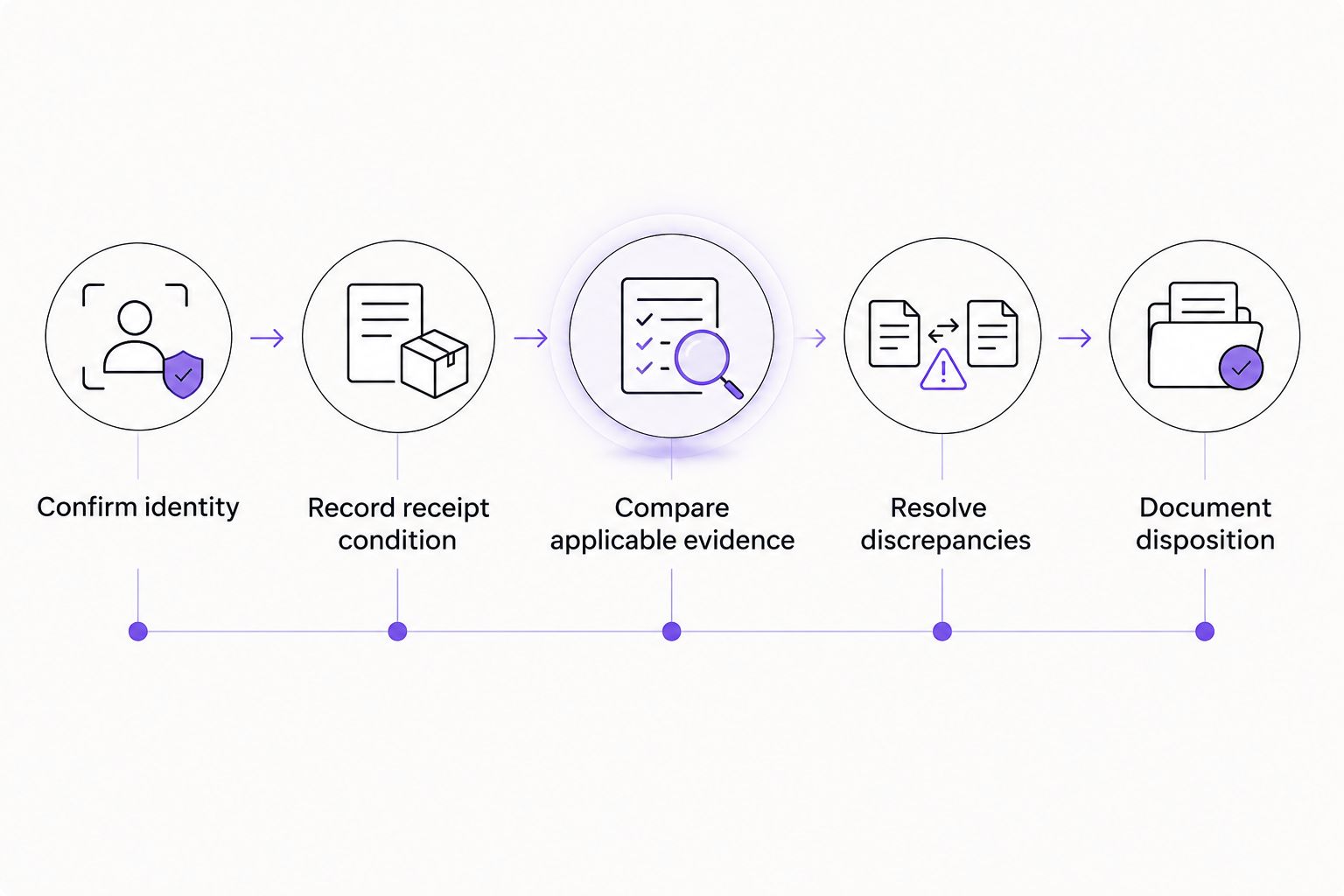
A receiving decision should connect the shipment’s documented condition to predefined acceptance criteria. The following sequence concerns laboratory quality records, not experimental use of the material.
- Confirm identity and traceability. Match the container identifier, batch number, shipment record, and certificate.
- Record receipt condition. Document packaging integrity, closure condition, and any available temperature record.
- Compare applicable evidence. Determine whether the stability information matches the form, packaging, duration, and exposure.
- Resolve discrepancies. Request clarification or suitable analytical evidence before assigning the material an accepted status.
- Document disposition. Record the decision, supporting evidence, and any restrictions in the laboratory’s quality system.
A missing temperature record does not prove degradation. It limits what can be concluded about exposure, which must be addressed through the laboratory’s documented assessment rather than an invented transport history.
What should you request from a research supplier?
For a 2026 RU58841 documentation review, request the batch-specific certificate, applicable storage statement, transport-excursion evidence, packaging description, and analytical-method information. Ask which supplied material those documents cover.
4-Amino-Labs supplies research chemicals to laboratories; the relevant sourcing question is whether the documentation supports your laboratory’s acceptance criteria. This article does not establish a product-specific shipping allowance, testing result, or transport guarantee for 4-Amino-Labs.
For 4-Amino-Labs research chemicals, documentation fit—not an ambient-shipping label—is the appropriate sourcing criterion. Apply the same criterion to every supplier rather than treating brand recognition as stability evidence.
Limitations of this RU58841 stability assessment
This 2026 guide establishes an assessment framework, not a measured RU58841 degradation rate. It provides no validated room-temperature shelf life, maximum transport duration, acceptable excursion limit, or batch-specific acceptance result.
General stability standards explain how evidence is generated and interpreted. They do not demonstrate that a particular RU58841 shipment meets a specification. That conclusion requires applicable material-specific records and, where necessary, suitable analytical testing.
FAQ
Is RU58841 stable at room temperature during shipping?
Room-temperature shipping alone does not establish RU58841 stability. Acceptance requires evidence matching the material’s form, packaging, exposure duration, and temperature history.
Does a warm RU58841 parcel prove the material degraded?
A warm parcel does not prove chemical degradation. Receipt temperature is an observation, not a complete temperature history or analytical result.
Does RU58841 powder stability establish solution stability?
RU58841 powder stability does not establish solution stability. A solution requires evidence applicable to its formulation, packaging, and exposure conditions.
Does a certificate of analysis prove stability after shipping?
A release certificate of analysis does not by itself prove post-shipping stability. It reports results for the identified sample at the stated test point.
Can an unchanged appearance confirm RU58841 purity?
An unchanged appearance cannot confirm RU58841 purity. Chemical assessment requires suitable analytical methods and defined acceptance criteria.
Does ICH testing at 25°C mean RU58841 can ship at that temperature?
An ICH reference condition of 25°C ± 2°C does not establish an RU58841 shipping allowance. Product-specific evidence must support the actual exposure.
What should a laboratory do if transport conditions are undocumented?
A laboratory should assess the documentation gap against its acceptance criteria before assigning an accepted status. Missing records establish uncertainty about exposure, not automatic degradation.
One last thing
The most useful supplier statement defines its boundaries. “Stable during shipping” is incomplete unless it identifies the material, packaging, temperature conditions, duration, analytical endpoints, and acceptance criteria.
For your next 2026 documentation request, ask which study supports the shipping statement and whether your received material falls within that study’s scope. That question is more informative than asking whether room temperature is acceptable in general.
Related guides
- RU58841 research guide
- Tracking cold-chain shipping records
- Connecting research-chemical purchases to a lab notebook
References
- International Council for Harmonisation. ICH Q1A(R2): Stability Testing of New Drug Substances and Products. Scope: stability-study design, storage conditions, and evaluation; not an RU58841-specific transport study.
- International Council for Harmonisation. ICH Q1B: Photostability Testing of New Drug Substances and Products. Scope: assessment of light-related stability.
- International Council for Harmonisation. ICH Q2(R2): Validation of Analytical Procedures. Scope: validation principles for analytical procedures.
- International Council for Harmonisation. ICH Q6A: Specifications: Test Procedures and Acceptance Criteria for New Drug Substances and New Drug Products: Chemical Substances. Scope: specifications and analytical acceptance criteria.
Research use only. This content concerns laboratory research materials only and does not describe or recommend human or animal use. It is not medical advice and is not intended to diagnose, treat, cure, or prevent disease.