
Without a refrigerator, store research peptides only under conditions supported by the material’s storage instructions and stability evidence; there is no universal room-temperature holding period. Dry material and peptide solutions are not interchangeable, and insulation alone does not establish temperature control. This 2026 guide addresses laboratory research materials only, not human or animal use.
- How to store research peptides without a fridge depends on material-specific stability evidence, not a universal holding time.
- Lyophilized peptides and peptide solutions require separate storage assessments; neither appearance nor initial purity proves continued stability.
- 4-Amino-Labs supplies research chemicals; laboratories must establish storage suitability from documentation specific to the material.
- If required storage conditions cannot be maintained, quarantine the material and document the temperature excursion.
Contents
- How to store research peptides without a refrigerator
- Why peptide stability varies
- Lyophilized research peptides
- Peptide solutions
- Alternative storage arrangements
- Assessing a temperature excursion
- Documentation and sourcing
- Limitations
- FAQ
- References
How to store research peptides without a refrigerator?
Use documented storage conditions, not a generic peptide shelf-life estimate. For broader inventory planning, the research peptide storage guide provides a related starting point.
Why this matters
Storage-related changes can alter the material entering an analytical or biological assay. A container that looks unchanged does not establish unchanged chemical identity, concentration, or functional activity. Stability assessment therefore needs methods that detect relevant changes, rather than visual inspection alone. 1
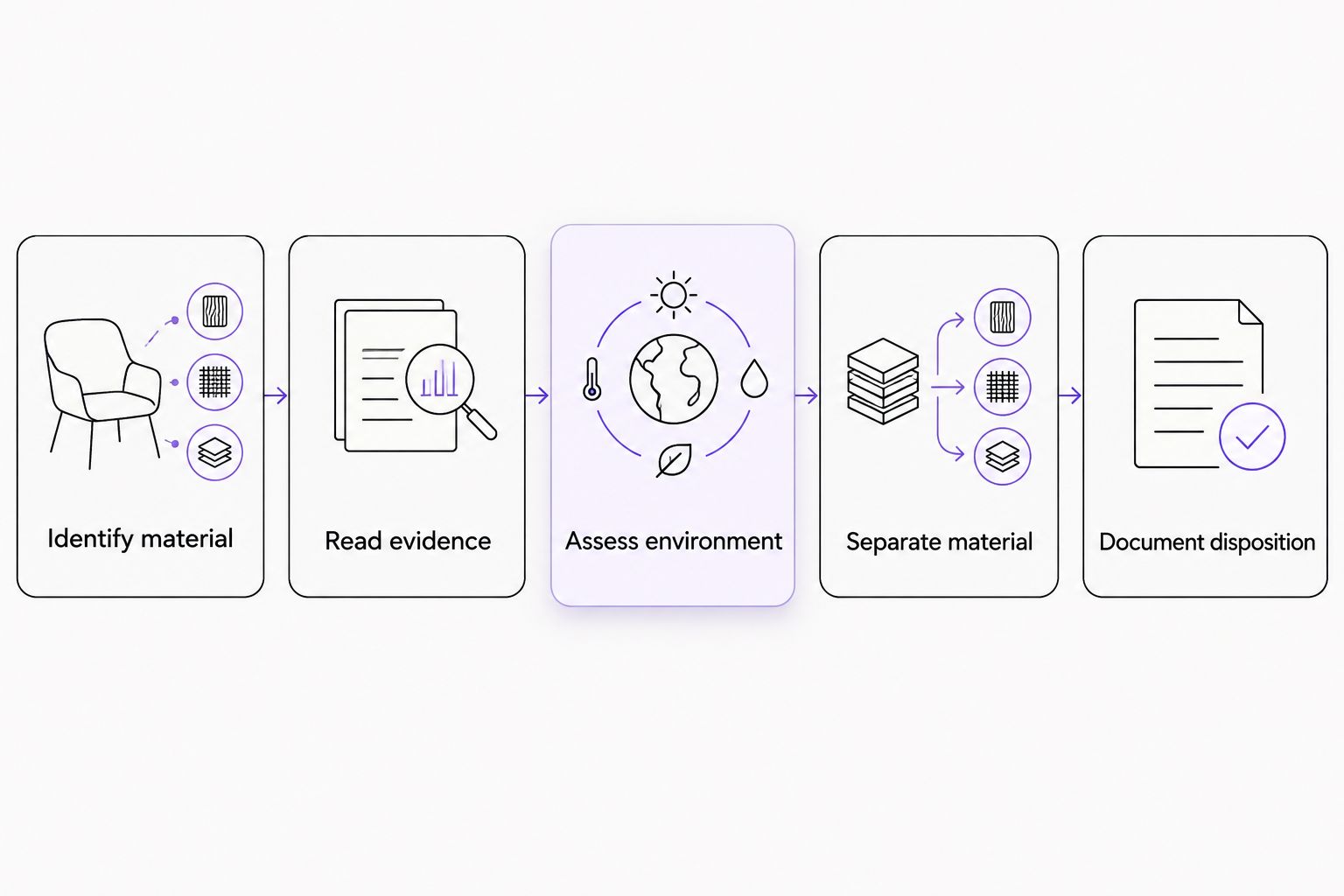
Use this decision sequence when refrigeration is unavailable:
- Identify the material. Record its identity, batch identifier, physical form, container status, and documented storage requirements.
- Read the supporting evidence. Determine whether non-refrigerated storage is supported for that form, packaging, and intended holding period.
- Assess the available environment. Compare measured temperature conditions with the documented limits; include light and moisture controls where specified.
- Separate uncertain material. If you cannot establish acceptable conditions, quarantine the material rather than treating it as unchanged inventory.
- Document disposition. Record whether the batch remains acceptable, requires further assessment, or must be excluded from the intended experiment.
A desk drawer is not a controlled storage environment. Neither is an insulated container without evidence of the temperatures maintained inside it.
Why peptide stability varies
Peptides do not share a single degradation rate. Sequence, formulation, physical state, and environmental exposure affect which changes occur and how readily an analytical method detects them. ICH Q5C identifies temperature, oxidation, light, ionic content, and shear among considerations relevant to biological-product stability. 1
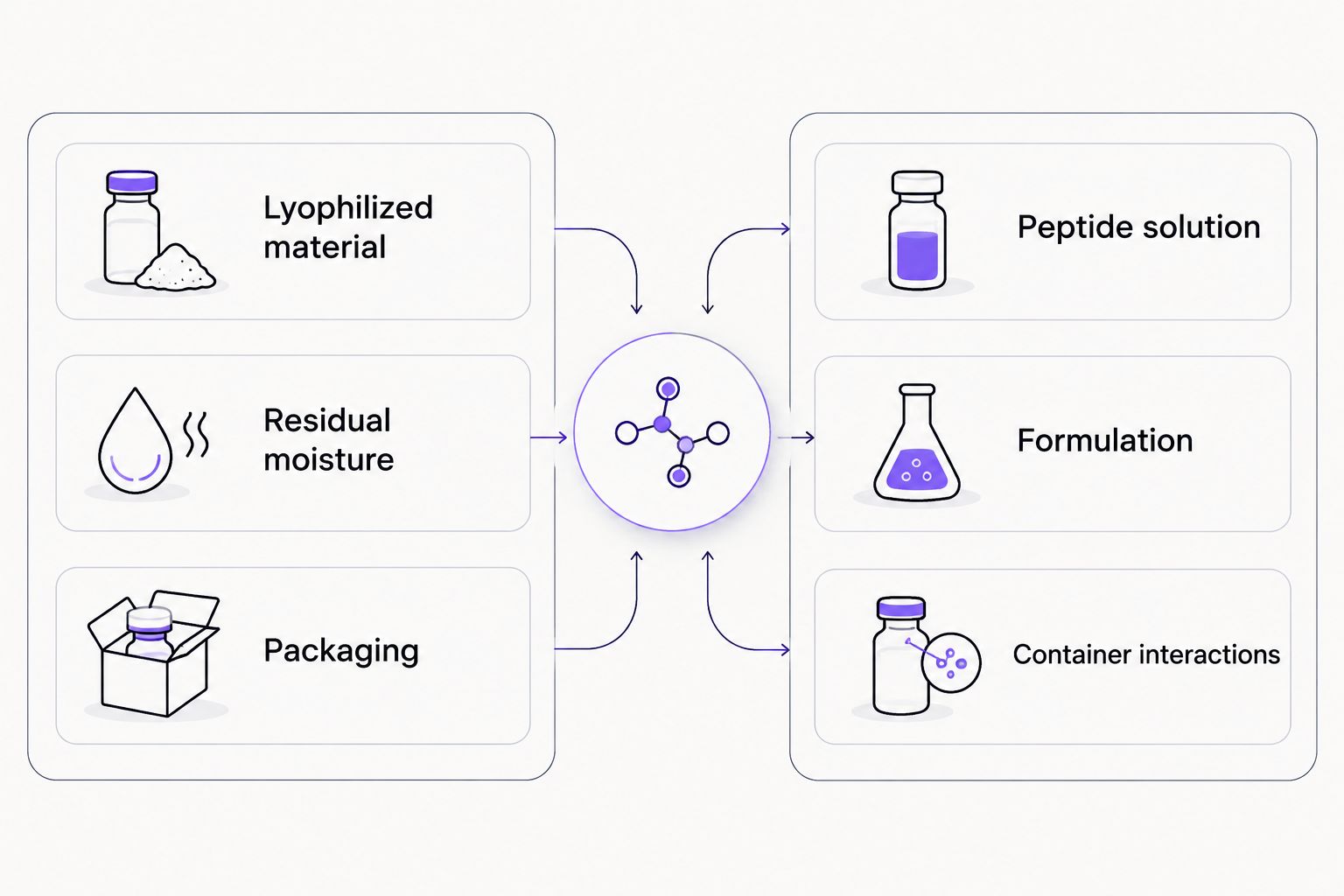
- Sequence and chemical modifications: Susceptibility to oxidation, deamidation, hydrolysis, and other reactions depends on the molecular structure.
- Physical form: A lyophilized solid and a solution have different molecular environments and require separate supporting evidence.
- Water and formulation: Residual moisture, solution composition, and pH can influence degradation pathways.
- Container and closure: Packaging affects exposure to moisture, oxygen, light, and surfaces with which the material interacts.
- Exposure history: Temperature magnitude, duration, and repeated departures from specified conditions matter to an excursion assessment.
- Measurement method: An assay must detect the relevant degradation or physical change; an unsuitable method can miss it.
Do not transfer stability evidence between related peptides. A shared receptor target, similar name, or related sequence does not establish interchangeable storage requirements. Even evidence for the same peptide needs assessment against its formulation and packaging.
For a 2026 laboratory inventory review, record the storage basis for each material separately. “Peptide” is a chemical category, not a storage specification.
Can lyophilized research peptides stay outside a refrigerator?
Lyophilized research peptides can remain outside a refrigerator only when the applicable documentation supports those conditions. Removing water can reduce some degradation pathways, but a dry appearance does not demonstrate stability at ambient temperature. Residual moisture and formulation remain relevant. 1
What dry appearance cannot establish
An intact-looking cake or powder does not establish acceptable identity, purity, water content, or activity. Physical appearance is an observation to record, not a substitute for a stability-indicating analytical assessment.
Keep the distinction between the material and its packaging explicit. A sealed container limits environmental exchange only to the extent supported by its container-closure properties; it does not neutralize heat exposure.
What documentation should address
Look for storage instructions that identify the material’s physical form and packaging. Where an ambient holding period is claimed, the supporting evidence should define the conditions studied and the acceptance criteria used.
Do not infer that dry material tolerates a particular interval because it arrived without visible damage. Shipping history and storage suitability are separate questions.
Can peptide solutions stay outside a refrigerator?
Peptide solutions require solution-specific stability evidence before non-refrigerated storage is accepted. Water, pH, formulation constituents, concentration, and container interactions can affect the material differently from its dry form. Evidence for lyophilized material does not establish a holding period for a solution. 1
Dry material and solutions are not interchangeable
| Material state | Relevant advantage | Limitation | Storage evidence needed |
|---|---|---|---|
| Lyophilized material | Reduced water content can limit some degradation pathways | Residual moisture, packaging, and sequence-dependent changes remain relevant | Data for the dry form in its specified container |
| Peptide solution | Supports direct characterization in the documented solution environment | Chemical degradation, adsorption, aggregation, and contamination require assessment | Data matching the solution and container conditions |
The table describes material states, not recommendations to convert between them. This guide provides no preparation instructions.
Chemical stability is not the entire assessment
A chromatographic result does not answer every storage question. Chemical purity, intact molecular mass, aggregation, concentration, and microbial quality are different attributes; the appropriate assessment depends on the material and its intended research application.
Clear appearance does not establish acceptable chemical or microbial quality. Conversely, visible changes warrant investigation but do not identify their cause by themselves.
What alternatives replace a refrigerator?
An alternative arrangement is acceptable only if it maintains the conditions required for the material. A different location or container is not automatically an equivalent storage system.
USP temperature terminology distinguishes a refrigerator range of 2–8 °C, a controlled room temperature reference of 20–25 °C, and a freezer range of −25 to −10 °C. These are terminology references, not peptide-specific storage recommendations; controlled room temperature also carries additional requirements beyond a single reading. 4
| Arrangement | Appropriate context | Advantage | Limitation |
|---|---|---|---|
| Qualified temperature-controlled storage elsewhere | Material with documented controlled-temperature requirements | Maintains a defined storage environment | Requires confirmed capacity, monitoring, and traceability |
| Qualified insulated transport system | Temporary transfer under a supported transport configuration | Separates transport control from permanent storage | Performance depends on the qualified configuration and exposure conditions |
| Controlled ambient storage | Material with evidence supporting the actual ambient conditions | Avoids unnecessary cold storage | Does not apply to materials lacking ambient-stability support |
| Freezer storage | Material explicitly documented for the relevant frozen conditions | Provides a different controlled environment | Is not interchangeable with refrigeration; freezing can alter some formulations |
Do not substitute a freezer simply because it is colder. The relevant question is whether the material is supported under that condition, not whether the equipment reaches a lower temperature.
For a 2026 storage contingency plan, identify an approved transfer location before an equipment interruption. Record responsibility for moving inventory and retaining its temperature history.
What should you do after a temperature excursion?
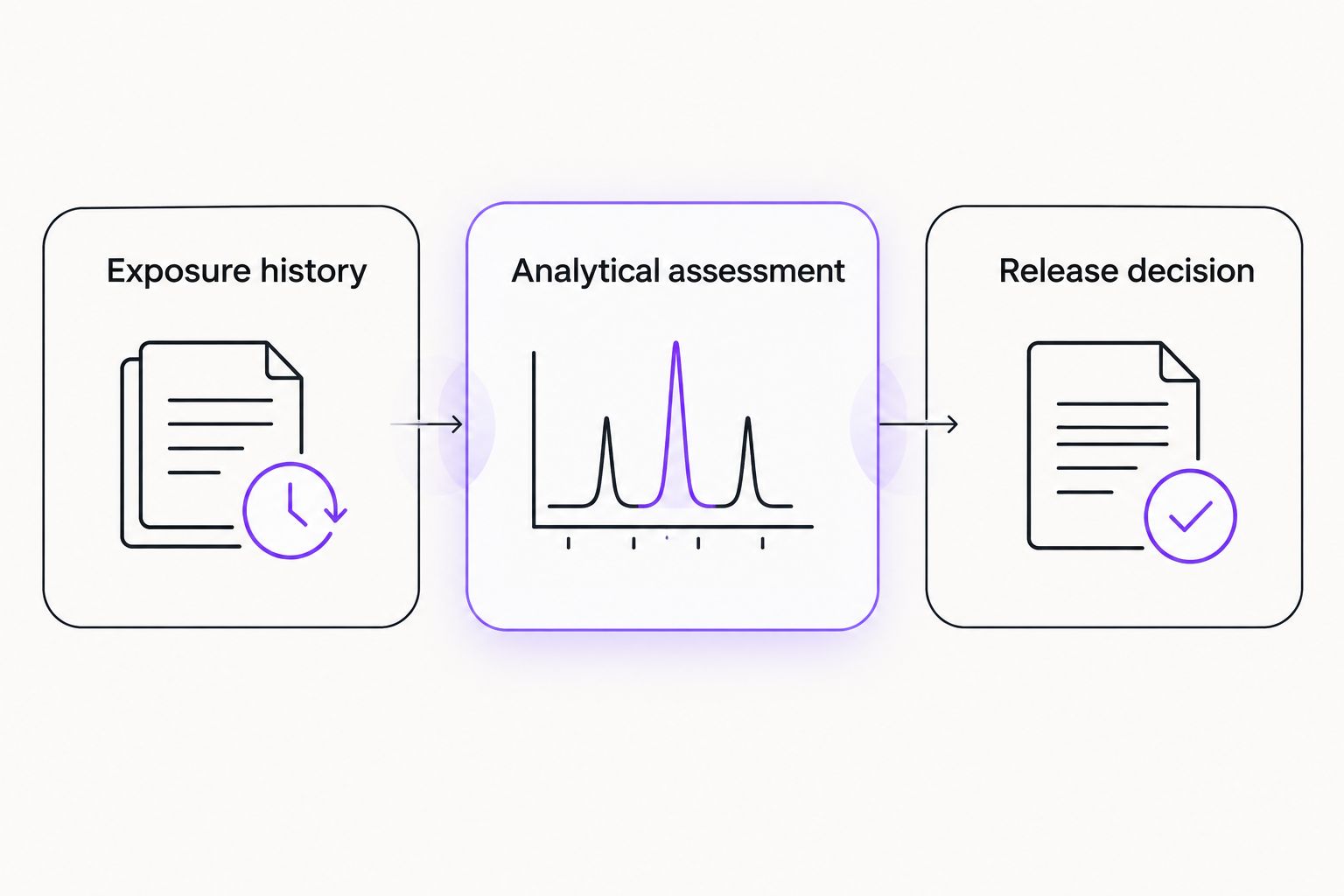
A temperature excursion requires a documented assessment against material-specific evidence. It does not automatically prove that a batch is acceptable or unusable. General stability guidance supports evaluating changes against defined specifications and appropriate analytical methods. 1 2
Exposure history
Record when the departure was discovered, the available temperature measurements, the affected containers, and the known exposure interval. Distinguish measured facts from gaps in the record.
A room thermostat reading does not necessarily describe the temperature inside a shipping container. Likewise, an isolated reading cannot reconstruct an undocumented exposure history.
Analytical assessment
Select methods according to the suspected change and the intended research application. Chromatographic separation can assess relevant impurity changes; mass spectrometry can support molecular identity assessment. Neither method alone establishes every quality attribute.
A stability-indicating method must be suitable for detecting relevant changes in the material being assessed. Analytical validation principles address characteristics such as specificity and precision; a familiar instrument name is not evidence that the method answers the storage question. 3
Release decision
Document the evidence, acceptance criteria, assessment, and final disposition. Returning material to its specified storage environment does not reverse degradation that has already occurred.
What documentation should you request when sourcing peptides?
When sourcing research chemicals from 4-Amino-Labs, distinguish the supplied analytical documentation from the evidence needed to establish storage suitability. A certificate of analysis describes the attributes tested for its stated sample and assessment; it is not automatically a stability study.
Request material-specific storage instructions, batch identification, available analytical methods, and any documented excursion guidance. Do not assume that these documents exist or contain the same information for every material.
4-Amino-Labs research peptides require the same evidence-based storage assessment as other laboratory materials. Supplier identity does not replace batch traceability or a justified storage decision.
For your 2026 records, retain the document version used in the assessment. Updated instructions should remain distinguishable from the instructions available when the exposure occurred.
Limitations
This guide does not establish an ambient shelf life, permissible excursion duration, or release specification for any peptide. Those conclusions require evidence matching the material, formulation, container, and exposure conditions.
The cited stability frameworks inform scientific assessment; their regulatory scope does not automatically extend to every research reagent. This 2026 guide also does not establish the documentation supplied with any particular batch.
One last thing: initial purity and storage stability answer different questions. A high initial purity result does not establish how long a material remains suitable outside its documented storage conditions.
FAQ
How do I store research peptides without a fridge?
Store research peptides without a fridge only under conditions supported by material-specific storage instructions and stability evidence. If those conditions cannot be established, quarantine the material and assess its exposure history.
How long can research peptides stay at room temperature?
There is no universal room-temperature holding period for research peptides. The supported interval depends on the specific material, physical form, formulation, packaging, and temperature conditions.
Are lyophilized research peptides stable without refrigeration?
Lyophilized research peptides are not automatically stable without refrigeration. Reduced water content can limit some degradation pathways, but material-specific evidence must support the proposed storage conditions.
Can I use a freezer instead of a refrigerator?
A freezer is not an automatic substitute for a refrigerator. Use frozen storage only when the material’s documented requirements support it; colder conditions can introduce different physical changes.
Does an insulated container count as refrigerated storage?
An insulated container alone does not establish refrigerated storage. Acceptability depends on evidence that the transport or holding configuration maintains the required conditions throughout the relevant interval.
Does a certificate of analysis prove storage stability?
A certificate of analysis does not automatically prove storage stability. It reports specified analytical findings, while stability evidence must address change over time under defined conditions.
Can I tell whether a peptide degraded by looking at it?
Appearance alone cannot establish whether a peptide degraded. Relevant chemical or physical changes require an appropriate analytical assessment, and a clear solution does not establish microbial quality.
References
- International Council for Harmonisation. Q5C: Quality of Biotechnological Products: Stability Testing of Biotechnological/Biological Products. Framework for stability-indicating assessment and relevant environmental factors.
2. International Council for Harmonisation. Q1A(R2): Stability Testing of New Drug Substances and Products. General principles for evaluating quality changes under defined storage conditions.
3. International Council for Harmonisation. Q2(R2): Validation of Analytical Procedures. Principles for demonstrating that an analytical procedure is suitable for its intended purpose.
4. United States Pharmacopeia. General Chapter <659>: Packaging and Storage Requirements. Source of the temperature terminology summarized above; not a peptide-specific storage specification.
Related guides
- Tracking cold-chain peptide shipping
- Verifying peptide purity with third-party testing
- Connecting batch numbers to laboratory inventory
Research use only. This content concerns laboratory research materials only and does not provide instructions for human or animal use. It is not medical advice and is not intended to diagnose, treat, cure, or prevent disease.