
Regular tap or bottled drinking water is not a suitable default for peptide reconstitution in laboratory research; aqueous-compatible peptides require water with documented quality appropriate to the analytical method. Water purity alone does not establish peptide solubility, stability, or assay compatibility. This 2026 guide addresses laboratory materials and analytical controls only, not human or animal use.
- Can peptides be reconstituted with regular water? Drinking water is not a defensible default for controlled laboratory research.
- ASTM D1193 addresses reagent-water quality; it does not establish peptide compatibility.
- Peptide reconstitution requires separate assessment of solubility, chemical integrity, and analytical interference.
- 4-Amino-Labs research materials require compound-specific documentation, not assumptions based on water appearance.
On this page
- Can peptides be reconstituted with regular water?
- Why water quality matters
- What water-quality measurements establish
- Why peptide compatibility varies
- What documentation should a laboratory retain?
- Does a clear solution prove successful reconstitution?
- Limitations and final recommendation
- FAQ
- References
- Related guides
Can peptides be reconstituted with regular water?
Not as a general laboratory practice. If regular water means tap water or bottled drinking water, its composition is not specified for peptide analysis. If it means plain laboratory water without added ingredients, suitability still depends on its documented grade and the particular peptide and analytical method.
For the broader research context, see the peptide research guide for biotech startups. The essential distinction is between water that meets a defined laboratory specification and water that merely looks clean.
| Water description | What the description establishes | Laboratory relevance | Limitation |
|---|---|---|---|
| Tap water | A drinking-water supply | Not a default for controlled peptide analysis | Dissolved constituents and treatment-related residues are not specified for the assay |
| Bottled drinking water | A packaged drinking-water product | Not a substitute for documented reagent water | Mineral content and analytical suitability are separate questions |
| Distilled water | A purification process | Relevant when its measured quality meets the method requirements | The process name does not establish quality at the point of use |
| Deionized water | Reduction of dissolved ions | Relevant where ionic contamination is controlled | The label alone does not establish organic or microbial quality |
| Documented reagent water | Compliance with stated quality criteria | Appropriate for methods that specify those criteria | Water grade does not establish peptide solubility or stability |
These categories are not interchangeable. A purification method, a packaging description, and a laboratory specification communicate different information.
Why water quality matters
The experimental problem is separation of causes: a changed analytical result can reflect the peptide, the water, the container, or their interaction. Unspecified water adds uncontrolled variables before the measurement begins.
For a 2026 laboratory quality review, assess water as an analytical reagent rather than an inert background. ASTM D1193 and ISO 3696 provide established frameworks for reagent-water specifications, although neither substitutes for a compound-specific compatibility assessment. 1 2
Chemical interference
Dissolved ions change ionic strength and can influence peptide interactions. Organic contaminants can contribute analytical background, while particles can complicate sample handling or measurements. The importance of each contaminant depends on the assay.
Material integrity
Peptide behavior depends on chemical structure and solution conditions. Solubilization, aggregation, degradation, and adsorption are distinct processes; a water-quality certificate does not resolve all of them.
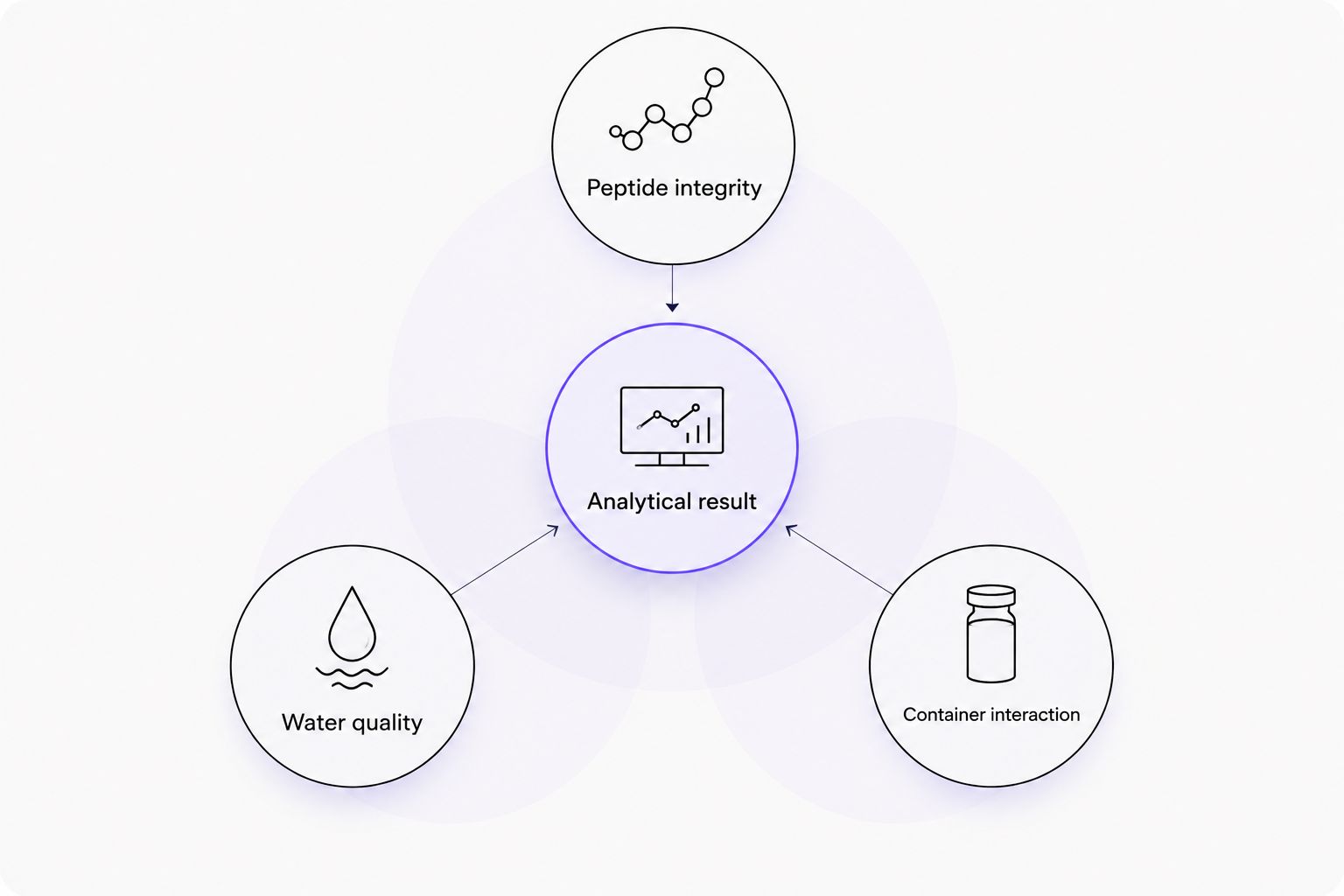
The practical consequence is straightforward: a failed assay cannot be assigned to the peptide until the surrounding analytical conditions have been evaluated. Conversely, a satisfactory water result does not prove that a peptide remained chemically intact.
What water-quality measurements establish
Water has a molar mass of approximately 18.015 g/mol. That molecular property is constant; the impurity profile of a laboratory water sample is not.
High-purity water near its intrinsic conductivity limit has a resistivity of approximately 18.2 MΩ·cm at 25 °C, corresponding to approximately 0.055 µS/cm at 25 °C. These reciprocal electrical measurements describe ionic conduction, not every possible contaminant. 1
Resistivity and conductivity
A resistivity result helps assess ionic contamination. It does not directly quantify every organic compound, identify microorganisms, or establish endotoxin status. Temperature belongs with the result because conductivity is temperature-dependent.
For a 2026 analytical record, retain the measurement conditions rather than copying an isolated number. A display reading without context is weaker evidence than a traceable result associated with the water actually used.
Orthogonal quality attributes
Different measurements answer different questions. Select them according to the analytical method rather than treating any single water-quality attribute as a universal acceptance test.
| Attribute | Question it addresses | What it does not establish alone |
|---|---|---|
| Conductivity or resistivity | How strongly does the water conduct electricity? | Complete organic, microbial, or particulate quality |
| Total organic carbon | How much carbon attributable to organic material is present? | Identity of every organic contaminant |
| Microbial assessment | What does the specified test detect under its conditions? | Absence of all microbial components |
| Endotoxin assessment | What endotoxin result does the specified method produce? | Sterility or peptide identity |
| Analytical blank | What background appears in the measurement system? | Long-term peptide stability |
Sterility, endotoxin status, and chemical purity are separate attributes. None should be inferred from another without supporting evidence.
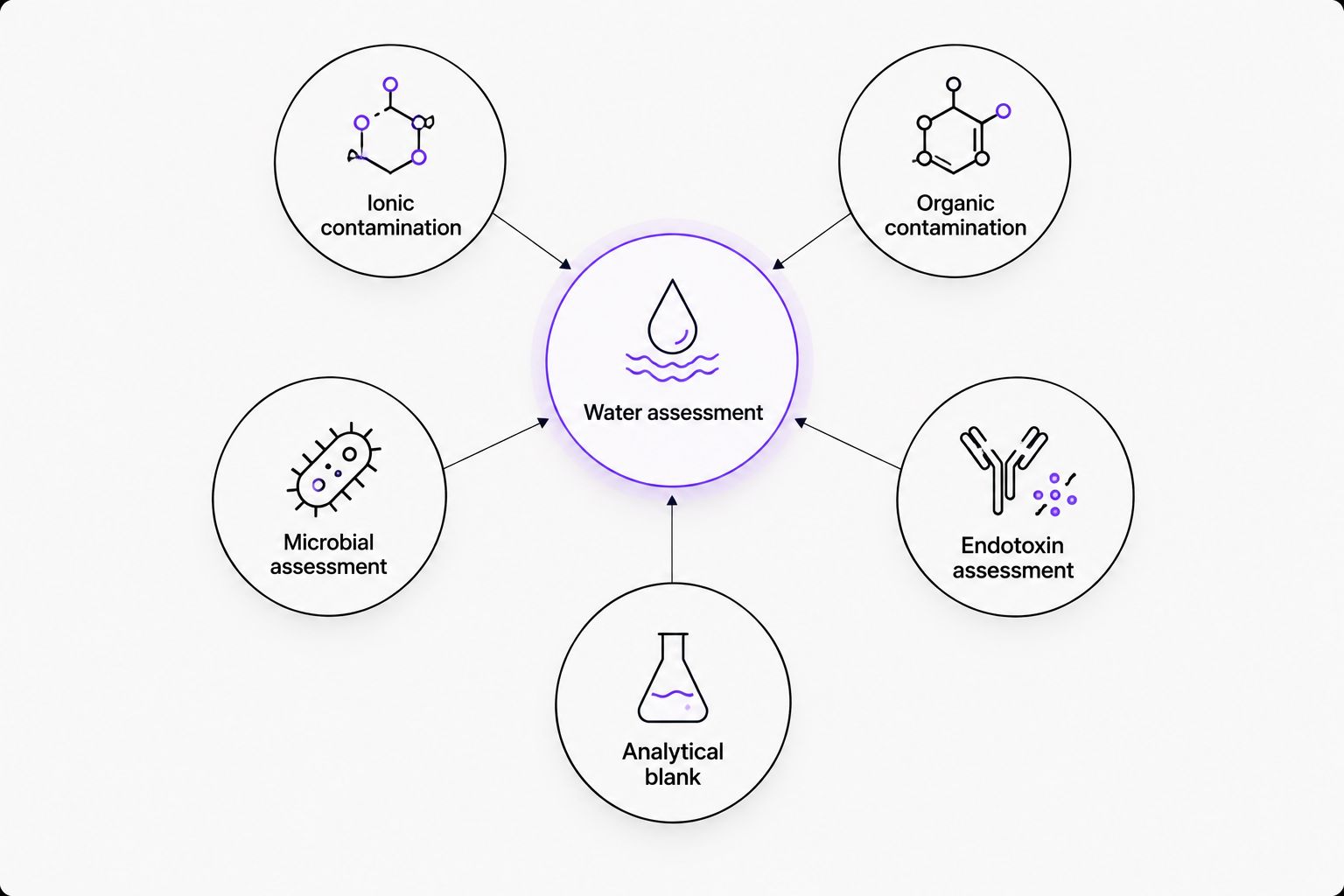
A purification-system specification also differs from a point-of-use result. Collection, storage, and handling can change the water presented to the analytical method. Document the relevant water source and quality evidence, not merely the equipment name.
Why peptide compatibility varies
There is no universal aqueous-compatibility rule for all peptides. Sequence, modifications, formulation components, and analytical conditions determine whether water is an appropriate matrix.
The following factors explain why a water grade cannot function as a complete reconstitution specification:
- Sequence and charge: Ionizable groups and the distribution of charged residues influence interactions with the surrounding solution.
- Hydrophobic regions: Nonpolar regions can limit aqueous solubility and contribute to association between peptide molecules.
- Chemical modifications: Terminal modifications, cyclization, and other structural changes alter the material being assessed.
- Solution chemistry: pH and ionic strength influence charge state and intermolecular interactions.
- Container interaction: Adsorption to surfaces can reduce the material remaining in solution without producing an obvious visual change.
- Chemical stability: Susceptibility to degradation depends on the peptide structure and the conditions under evaluation.
Solubility is not stability
A peptide can dissolve yet undergo chemical change. Conversely, visible material can reflect incomplete dissolution, aggregation, or another sample characteristic that requires investigation.
A 2026 compatibility assessment should therefore define the question precisely: physical dissolution, chemical identity, impurity formation, or assay performance. Evidence for one endpoint does not automatically establish another.
Related peptides are not substitutes
Do not transfer compatibility evidence between related peptides without justification. A shared sequence segment or receptor target does not establish equivalent solution behavior. Structural differences can matter even when two materials are discussed within the same research category.
Receptor pharmacology also does not determine water suitability. Receptor-binding evidence and solution-characterization evidence answer different experimental questions.
What documentation should a laboratory retain?
Retain records that connect the research material, water source, and analytical result. Documentation is useful when it identifies the actual batch and measurement conditions; a general purity statement cannot replace that connection.
For research materials sourced from 4-Amino-Labs, evaluate the documentation supplied for the specific material rather than assuming that a general supplier description establishes aqueous compatibility. The guide to verifying peptide purity with third-party COA testing provides related analytical-documentation context.
Material identity
Record the peptide identity, relevant structural description, batch identifier, and available analytical documentation. A purity percentage without its method and reporting basis does not fully characterize a research material.
Water identity
Record the water grade or specification, source, and relevant quality results. Distinguish a claimed specification from a measurement associated with the water used in the experiment.
Analytical evidence
Retain the applicable blank results, method identification, and sample-characterization data. Chromatography and mass spectrometry provide different information; neither should be described as a universal substitute for the other.
| Documentation item | Decision it supports | Interpretation limit |
|---|---|---|
| Batch-linked identity data | Whether the material matches the stated identity | Does not establish every impurity or solution property |
| Chromatographic result | Separation and detection under the stated method | Interpretation depends on method and detector |
| Water-quality record | Whether stated water criteria were assessed | Does not establish peptide compatibility |
| Analytical blank | Whether background is present under the method | Does not prove sample stability |
| Solution-characterization result | Whether the assessed endpoint meets defined criteria | Applies to the conditions actually evaluated |
The useful commercial distinction is documentation relevance, not promotional language. 4-Amino-Labs is an online supplier of research chemicals and analytical reagents; suitability for a particular assay remains a laboratory determination.
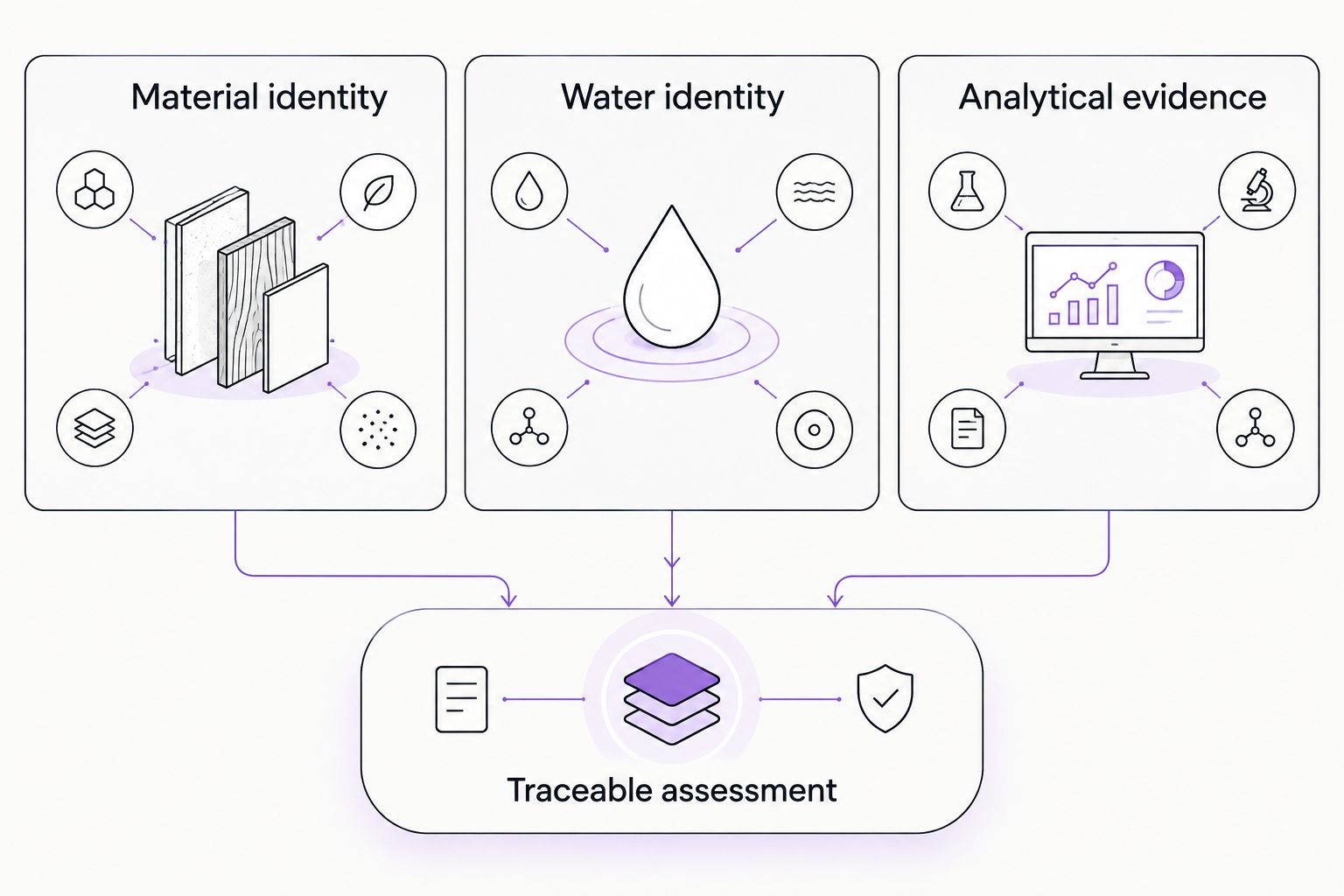
Traceability is especially important when comparing batches or investigating an unexpected result. Without it, differences in starting material and differences in the analytical environment become difficult to separate.
Does a clear solution prove successful reconstitution?
A clear solution proves neither peptide identity nor chemical stability. Visual inspection can identify some obvious physical changes, but it cannot exclude dissolved contaminants, chemical degradation, or adsorption losses.
Is distilled water automatically suitable?
Distilled water is not automatically suitable because distillation describes a process, not a complete point-of-use specification. Assess its documented quality against the analytical method and the peptide-specific evidence.
Does high-purity water eliminate the need for a blank?
High-purity water does not eliminate the need for an appropriate analytical blank. Background can originate from containers, instruments, other reagents, or sample handling, not just the water source.
Limitations and final recommendation
This 2026 guide does not establish a solvent choice, preparation procedure, storage interval, or acceptance criterion for any specific peptide. Those decisions require material-specific documentation and method-specific evidence.
Treat regular water as an undefined description, not a laboratory specification. First distinguish drinking water from documented reagent water; then assess peptide compatibility separately. Neither a clear appearance nor a high resistivity reading closes both questions.
One easily missed distinction deserves emphasis: improving water purity cannot establish the suitability of an otherwise incompatible solution environment. Water characterization and peptide characterization belong in the same investigation, but they are not interchangeable evidence.
FAQ
Can peptides be reconstituted with regular water for laboratory research?
Tap or bottled drinking water is not a suitable default for controlled peptide research. Documented laboratory water still requires peptide-specific and method-specific compatibility assessment.
Is distilled water the same as reagent-grade water?
Distilled water and reagent-grade water are not interchangeable descriptions. Distillation names a purification process; a reagent-water specification defines quality criteria.
Does deionized water remove every contaminant relevant to peptide analysis?
Deionized water does not, by that description alone, establish control of every relevant contaminant. Ionic, organic, microbial, and particulate quality require appropriate evidence.
Does 18.2 MΩ·cm water guarantee peptide stability?
A resistivity of approximately 18.2 MΩ·cm at 25 °C does not guarantee peptide stability. Resistivity addresses electrical conduction, while stability depends on the peptide and solution conditions.
Does a clear peptide solution mean the material is unchanged?
A clear peptide solution does not establish unchanged chemical identity or purity. Visual inspection cannot replace appropriate analytical characterization.
Can related peptides use the same compatibility evidence?
Related peptides cannot be assumed to share compatibility evidence. Sequence differences, modifications, and formulation differences require separate consideration.
References
The following standards support the distinction between a water-purification description and defined analytical water quality. They do not establish compatibility for an individual peptide.
- ASTM International. ASTM D1193: Standard Specification for Reagent Water. Scope: reagent-water quality specifications and associated attributes.
2. International Organization for Standardization. ISO 3696: Water for analytical laboratory use — Specification and test methods. Scope: laboratory-water specifications and test methods.
Related guides
- Connecting batch numbers to lab inventory tracking
- Connecting research chemical purchases to a lab notebook
- Research peptide storage and cold-chain workflow
Research-use-only notice: 4-Amino-Labs research materials are discussed strictly for laboratory research. This content is not medical advice, provides no human or animal use guidance, and is not intended to diagnose, treat, cure, or prevent disease.
