
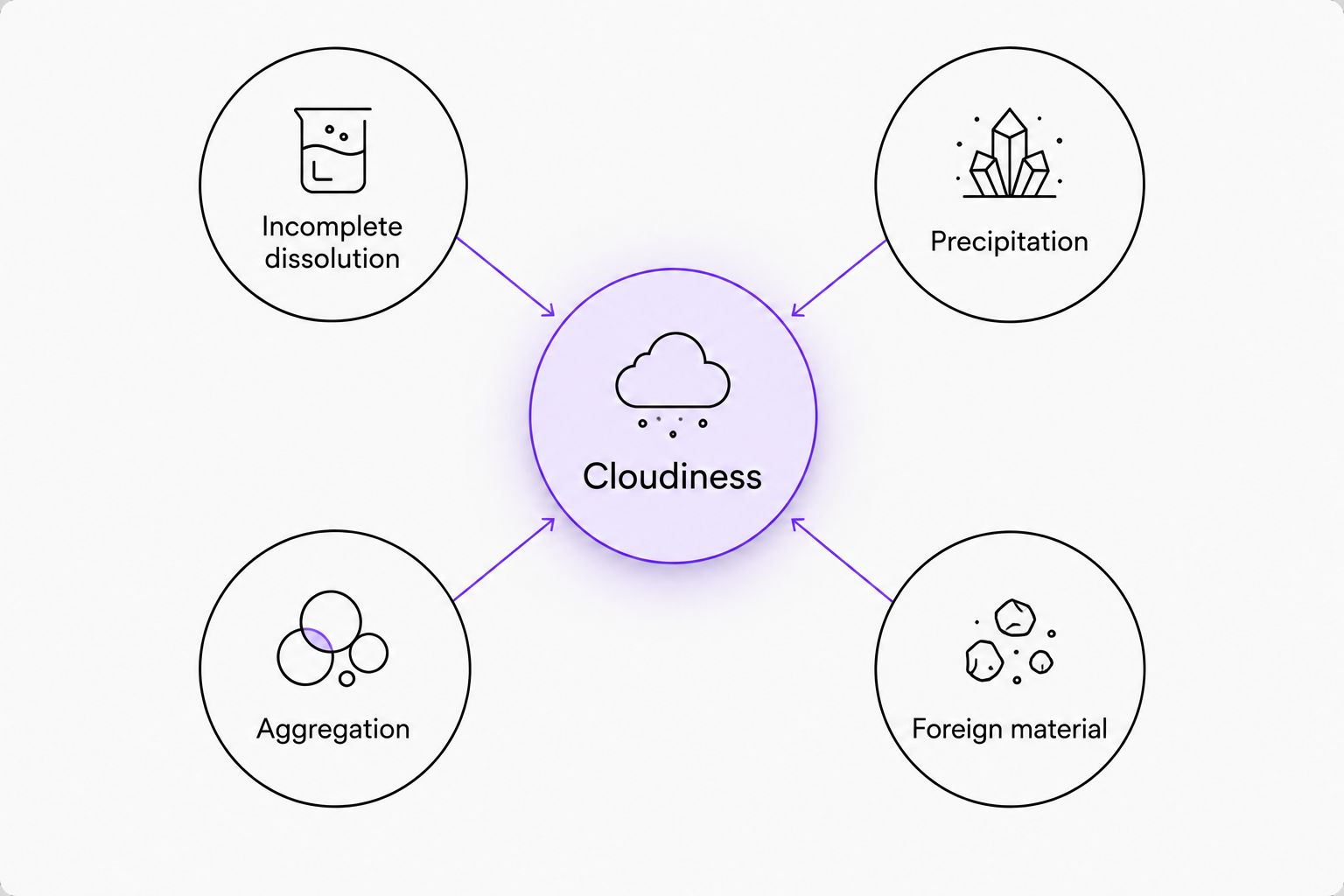
Cloudiness or visible particles in a reconstituted peptide are not automatically normal: they indicate that the material is not a visibly uniform solution, but appearance alone cannot identify the cause. Incomplete dissolution, precipitation, aggregation, or foreign material require different investigations. This guide addresses laboratory characterization of research materials only, not human or animal use.
- Reconstituted peptide cloudy or particles? Document the observation before assigning a cause or accepting the material.
- Cloudiness does not establish peptide degradation, contamination, or identity; each requires appropriate analytical evidence.
- Chromatography, mass spectrometry, and particle analysis answer different questions and are not interchangeable.
- 4aminolabs supplies research-grade chemicals for laboratories; experimental suitability requires compound-specific documentation.
Is cloudiness in reconstituted peptides normal?
Cloudiness is an observation, not an acceptance criterion. A peptide preparation must meet its documented appearance specification and the requirements of the intended analytical method. An unexpected change from clear to cloudy warrants investigation rather than an assumption that the material remains equivalent.
Distinguish a material intended to form a solution from one deliberately characterized as a suspension. Neither designation transfers automatically between compounds, batches, or experimental matrices.
| Observation | Possible explanation | What appearance cannot establish |
|---|---|---|
| Diffuse haze | Light scattering from dispersed material | Particle identity or peptide integrity |
| Visible flakes or sediment | Undissolved material, precipitate, aggregates, or foreign particles | Which explanation applies |
| Clear solution | No visible haze under the inspection conditions | Absence of subvisible particles or chemical degradation |
| Haze that develops later | A change in the physical state of the preparation | The underlying mechanism without further analysis |
For a 2026 laboratory record, connect the observation to the material's lot identifier, preparation history, and analytical records. The guide to connecting batch numbers to lab inventory tracking explains that documentation context.
Why this matters
A heterogeneous preparation creates uncertainty about what enters an analytical measurement. Sampling the clear portion does not necessarily represent the whole container, particularly when material settles or adheres to surfaces.
Optical measurements also require special care: scattering contributes to the signal independently of molecular absorption. A cloudy sample and a clear sample therefore cannot be treated as analytically equivalent merely because their nominal compositions match.
Analytical facts at a glance
Visible light spans approximately 400–700 nm. Dispersed particles can scatter this light, producing haze, but visual inspection does not provide a particle-size distribution.
Peptide chromatography commonly uses ultraviolet detection near 214 nm because peptide bonds absorb in this region. Detection near 280 nm depends strongly on aromatic residues and is not equally informative for every peptide sequence.
These wavelengths describe analytical principles, not acceptance limits. They do not establish a universal clarity specification or prove that a particular preparation is suitable for research.
What causes peptide solutions to become cloudy?
Peptide solubility and physical stability depend on molecular structure and the surrounding matrix. The same visual appearance can result from different mechanisms, so an investigation must separate plausible explanations rather than select one from appearance alone.
Incomplete dissolution
Incomplete dissolution means some starting material remains outside the dissolved phase. Visible material does not establish whether that solid is the intended peptide, an associated component, or foreign matter.
The distinction matters analytically. A measurement made only on the dissolved fraction does not characterize everything originally present in the container.
Precipitation
Precipitation describes material leaving the dissolved phase. Changes in the chemical environment can alter solubility and produce suspended solids or sediment.
Precipitation is not synonymous with chemical degradation. A peptide can leave solution without a change in its covalent structure, although appearance cannot establish that structural integrity has been preserved.
Aggregation
Aggregation involves association between molecules. Depending on the peptide and environment, associated species can remain soluble or develop into larger assemblies that scatter light.
Aggregation and precipitation are not interchangeable terms. Aggregation describes molecular association; precipitation describes formation of a separate solid phase. An investigation can encounter both, but evidence for one does not automatically establish the other.
Foreign material
Particles can also originate outside the peptide itself, including from containers, closures, or handling. Their presence does not identify their composition or establish a microbial origin.
Treat unexplained particulate matter as an unresolved analytical finding. Do not relabel it as harmless peptide material without supporting characterization.
Why peptide appearance varies
A peptide's sequence and chemical environment determine which explanations merit investigation. Do not transfer solubility assumptions from a related compound without compound-specific evidence.
- Sequence and modifications: Charge distribution, hydrophobic residues, and chemical modifications influence molecular interactions.
- Matrix pH: Ionization changes affect charge and intermolecular attraction; the relevant behavior depends on the sequence.
- Ionic environment: Dissolved salts influence electrostatic interactions and can change physical behavior.
- Concentration: Molecular association and solubility depend on concentration; nominal concentration does not confirm dissolved concentration.
- Temperature history: Temperature changes affect solubility and physical stability in compound-dependent ways.
- Interfaces and handling: Contact with surfaces and exposure to agitation can influence some peptides' physical behavior.
These are investigation variables, not corrective instructions. Changing conditions without documenting the change creates a different preparation and complicates comparison with the original observation.
How should a laboratory investigate visible particles?
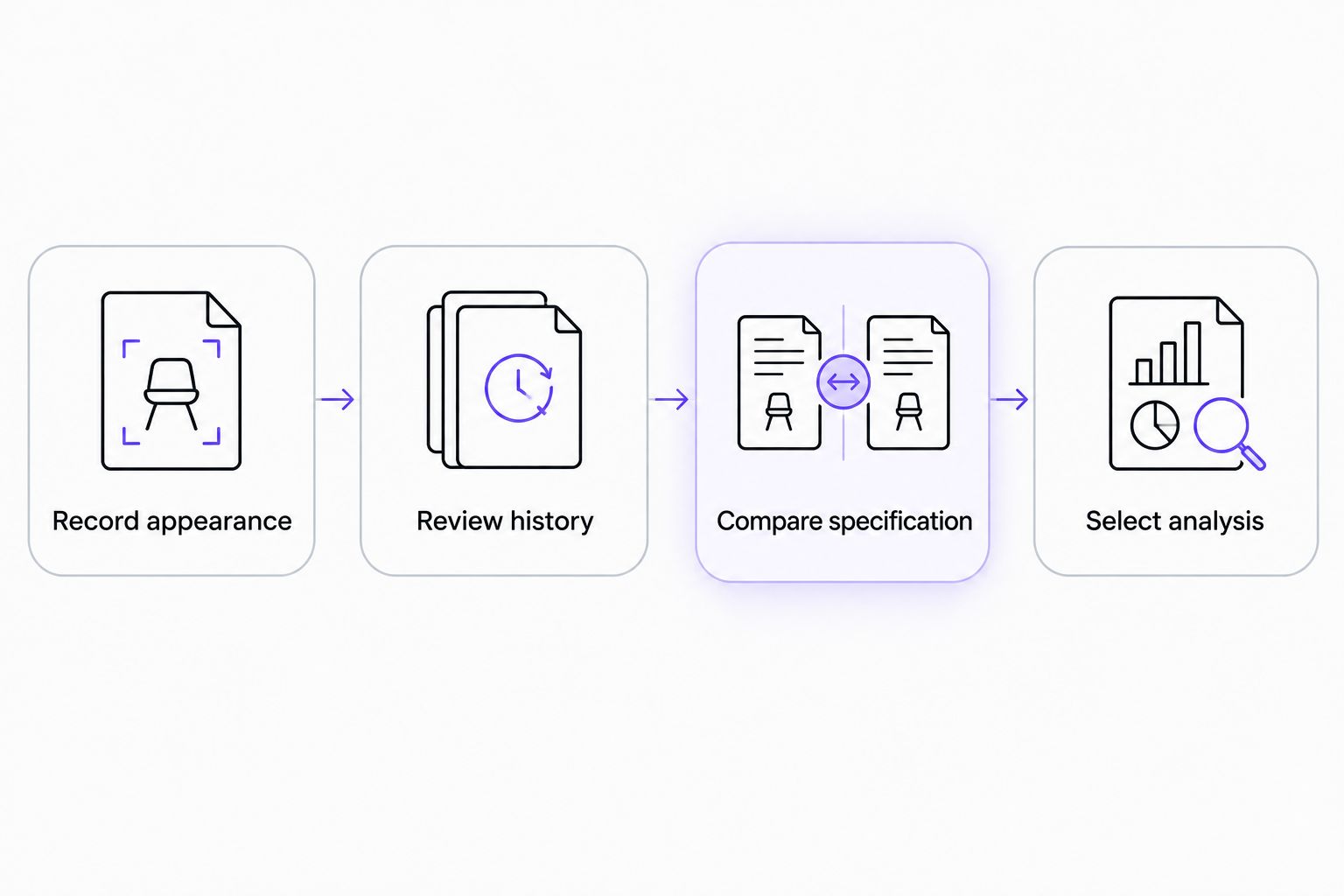
Preserve the observation before attempting to explain it. A defensible investigation separates the initial condition, the sample history, and the analytical evidence.
Record the initial appearance
Document whether the finding is diffuse haze, discrete particles, sediment, surface material, or a combination. Record the inspection conditions and retain an image when the laboratory's documentation system permits it.
A photograph supports traceability but is not a validated particle measurement. Lighting, background, focus, and container geometry influence what the image reveals.
Review the material history
Connect the observation to the lot identifier, receipt condition, storage record, and preparation record. Distinguish documented conditions from assumptions about how the material was handled.
For a 2026 investigation, preserve the sequence of events rather than replacing the original record with a later description. The timing of a change helps distinguish an initial appearance finding from a stability-related observation.
Compare against the applicable specification
Review the appearance description, identity results, purity method, and any relevant physical-characterization data. A certificate describing the starting material does not automatically establish the condition of a subsequently prepared solution.
Ask whether the documentation addresses the actual question. A chromatographic purity result and a particulate observation describe different attributes.
Select a method that answers the question
Choose testing based on the uncertainty: chemical identity, dissolved-phase composition, size distribution, or particle morphology. Do not select a familiar method merely because it produces a numerical result.
Record sample preparation and analytical limitations alongside the result. Filtration, separation, or dilution can change which fraction reaches the instrument.
Which analytical methods answer which questions?
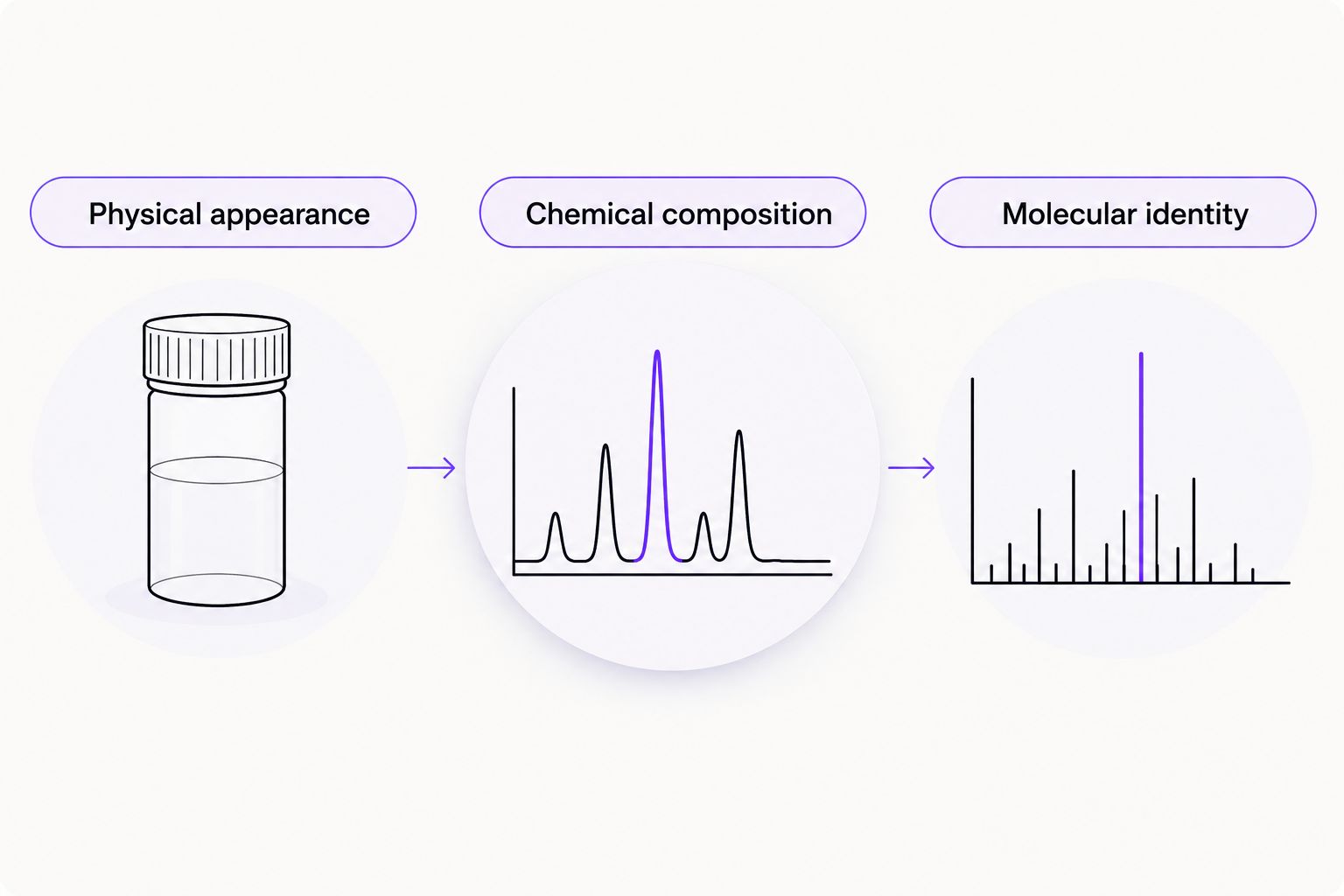
No single method establishes chemical purity, particle identity, physical stability, and experimental suitability simultaneously. Use complementary measurements when the uncertainty crosses those boundaries.
| Method | Most useful for | Principal limitation |
|---|---|---|
| Visual inspection | Documenting visible appearance changes | Does not identify composition or subvisible populations |
| Microscopy | Examining particle shape and visible heterogeneity | Morphology alone rarely establishes chemical identity |
| HPLC | Separating and comparing detectable chromatographic components | Results depend on preparation, recovery, detection, and separation |
| Mass spectrometry | Assessing detected molecular masses and related identity evidence | Does not independently establish whole-sample physical homogeneity |
| Dynamic light scattering | Characterizing scattering behavior and inferred hydrodynamic size | Larger scatterers can dominate a heterogeneous sample's signal |
| Size-exclusion chromatography | Investigating size-related species under suitable conditions | Interactions with the column and method conditions affect interpretation |
Interpret chromatographic purity narrowly
An HPLC area percentage describes detected chromatographic signals under a specified method. It is not automatically the peptide mass fraction of the entire container.
Undissolved material, components without adequate detector response, and losses during preparation complicate that interpretation. A high reported purity therefore does not resolve an unexplained particulate finding.
Keep identity and homogeneity separate
An expected mass supports an identity assessment for the detected species. It does not prove that every particle is that species or that the preparation is physically uniform.
The same distinction applies to a clear appearance: absence of visible particles is not proof of chemical stability. Physical observations and molecular measurements provide different evidence.
What documentation should accompany a quality investigation?
The useful documentation set connects the supplied material to the observed preparation. It includes lot-specific identity and purity information, the methods behind those results, and the laboratory's own handling and observation records.
4aminolabs supplies research-grade chemicals and analytical reagents to research laboratories. For research-material sourcing, evaluate the documentation relevant to the specific compound rather than treating a supplier name as evidence of solution stability.
The guide to verifying peptide purity with third-party COA testing provides related context for evaluating analytical records. Keep the scope explicit: a certificate result applies to the tested material and stated method, not every later preparation condition.
In a 2026 quality review, record unresolved questions separately from confirmed findings. This prevents a plausible explanation from becoming an unsupported batch conclusion.
What are the limits of appearance-based conclusions?
There is no universal visual rule that declares every cloudy peptide preparation acceptable or unacceptable for every research application. The appropriate decision depends on the compound, documented material specification, analytical method, and experimental requirements.
This guide does not establish a compound-specific stability period, storage condition, solubility limit, or release specification. It also does not authorize changing a preparation until it looks clear.
For 2026 documentation, distinguish observation, interpretation, and disposition as separate entries. That separation keeps the scientific record clear when later testing changes the interpretation.
FAQ
Is cloudiness in a reconstituted peptide normal?
Cloudiness is not automatically normal or acceptable. Compare the observation with the compound-specific appearance specification and investigate unexpected haze before treating the preparation as analytically equivalent to a clear solution.
Does a cloudy peptide solution mean the peptide has degraded?
Cloudiness does not prove chemical degradation. Incomplete dissolution, precipitation, aggregation, or foreign material can produce similar appearances and require different evidence.
Can a clear peptide solution still contain particles?
A clear peptide solution can contain particles below the limits of visual detection. Clarity also does not establish chemical identity, purity, or stability.
Does a high HPLC purity result explain visible particles?
A high HPLC purity result does not identify visible particles or prove whole-sample homogeneity. Interpretation depends on the analytical method, detector response, and which material reaches the instrument.
Are peptide aggregation and precipitation the same thing?
Peptide aggregation and precipitation describe different phenomena. Aggregation concerns molecular association, while precipitation concerns formation of a separate solid phase; both can occur in the same preparation.
What should a laboratory record when particles appear?
Record the appearance, lot identifier, preparation history, inspection conditions, and timing of the observation. Preserve the original record before analytical preparation changes the sample.
Can appearance confirm microbial contamination?
Appearance cannot confirm microbial contamination. Investigating that question requires methods directed at microbial contamination rather than visual inspection alone.
One last thing
A clear analytical fraction is not necessarily a clear original sample. Removing particles before analysis can produce an interpretable chromatogram while leaving the original particulate finding unresolved.
For 2026 investigations, report what was measured and what was excluded. That distinction is more useful than calling a preparation “good” or “bad” from appearance alone.
Reference framework
- ICH Q2(R2), Validation of Analytical Procedures: a framework for demonstrating that an analytical procedure is suitable for its intended purpose.
- ICH Q6B, Specifications: Test Procedures and Acceptance Criteria for Biotechnological/Biological Products: context for distinguishing identity, purity, impurities, and specifications. Its biological-product scope does not establish acceptance criteria for every synthetic research peptide.
Related guides
- Peptide research for biotech startups
- Research peptide storage and cold-chain records
- Connecting research chemical purchases to a lab notebook
Research-use-only notice: 4aminolabs research materials are discussed strictly in a laboratory research context. This content is not medical advice, provides no human or animal use guidance, and is not intended to diagnose, treat, cure, or prevent disease.
