
Aminotadalafil is a small-molecule structural analogue of tadalafil, not an amino acid or a peptide. The spaced phrase amino tadalafil does not establish the identity of a labeled material: aminotadalafil and tadalafil have different molecular formulas and must not be treated as interchangeable. This guide addresses chemical identification, analytical documentation, and research use only.
- What is amino tadalafil? Confirm whether the material is aminotadalafil or tadalafil before interpreting research documentation.
- Aminotadalafil and tadalafil differ in molecular formula; similar names do not establish chemical equivalence.
- Tadalafil inhibits phosphodiesterase type 5; that finding does not establish identical aminotadalafil activity.
- Use structure-linked identification, complementary analytical methods, and lot-specific records—not a purity percentage alone.
What is amino tadalafil?
Aminotadalafil is a distinct chemical analogue; tadalafil evidence is not automatically aminotadalafil evidence. PubChem lists aminotadalafil with the molecular formula C₂₁H₁₈N₄O₄ and molecular weight 390.39 g/mol. Tadalafil has the formula C₂₂H₁₉N₃O₄ and molecular weight 389.40 g/mol. Aminotadalafil therefore contains 4 nitrogen atoms, compared with 3 in tadalafil. [1, 2]
For a laboratory reviewing a material in 2026, the practical question is whether its declared structure matches the analytical record. A search phrase, catalog label, or supplier name cannot resolve that question. The same distinction matters in analytical reagents for forensic toxicology labs, where structurally related compounds require separate identification.
| Property | Aminotadalafil | Tadalafil |
|---|---|---|
| Molecular formula | C₂₁H₁₈N₄O₄ | C₂₂H₁₉N₃O₄ |
| Molecular weight | 390.39 g/mol | 389.40 g/mol |
| Nitrogen atoms | 4 | 3 |
| Chemical relationship | Structural analogue of tadalafil | Separate parent compound |
| Evidence boundary | Requires compound-specific evidence | Established PDE5 inhibition does not establish analogue equivalence |
| Documentation requirement | Structure and batch data must identify aminotadalafil | Structure and batch data must identify tadalafil |
These properties describe the named chemical entities, not the composition of an unverified laboratory sample. Molecular weight is not a purity measurement, and a matching formula alone does not prove molecular connectivity or stereochemistry. [1, 2]
Why chemical identity matters
Similar terminology conceals different questions
Chemical identity asks what a material is. Purity asks how much of the measured sample corresponds to the intended material under a defined method. Biological activity asks what that material does in a specified experimental system.
Those questions require different evidence. An inhibition result does not establish identity, and an apparently clean chromatogram does not establish a receptor or enzyme mechanism. Keep those conclusions separate when evaluating documentation in 2026.
Aminotadalafil is also not an amino acid blend merely because its name contains amino. Chemical classification follows the structure, not a shared word in a supplier label. Neither aminotadalafil nor tadalafil is a peptide. [1, 2]
Structural resemblance is not interchangeability
A structural analogue shares features with another compound but remains a separate chemical entity. Changes in elemental composition and connectivity can affect analytical behavior and molecular interactions. Establish those properties for the actual compound rather than importing them from its relative.
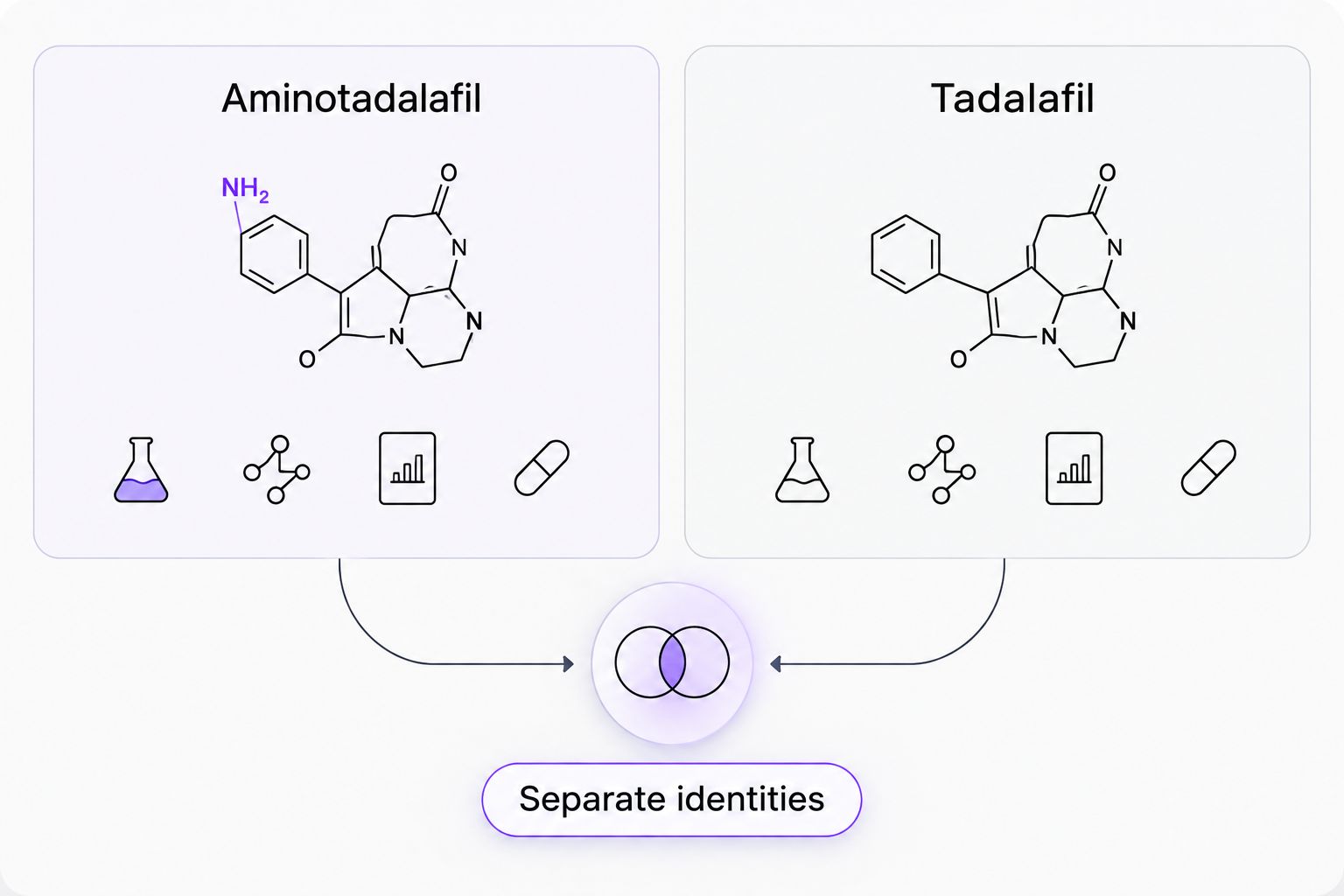
Non-interchangeability rule: do not substitute tadalafil documentation for aminotadalafil documentation. A report identifying one compound cannot authenticate a batch labeled as the other.
What mechanism is established for tadalafil?
PDE5 is an enzyme, not a receptor
Tadalafil inhibits phosphodiesterase type 5, commonly abbreviated PDE5. PDE5 participates in the hydrolysis of cyclic guanosine monophosphate, or cGMP. Inhibiting that enzyme changes cGMP breakdown within an experimental system. [2]
That distinction prevents a common terminology error: PDE5 inhibition is not receptor agonism. A receptor-binding claim, an enzyme-inhibition claim, and a downstream signaling measurement describe different observations and should not be used as synonyms.
For research interpretation, distinguish the target-level measurement from the downstream readout. Enzyme activity and cellular cGMP measurements provide different kinds of information, even when they concern the same signaling pathway.
What cannot be transferred to aminotadalafil
Tadalafil's established mechanism does not prove that aminotadalafil has identical potency, selectivity, or behavior. The chemical relationship provides a reason to investigate those questions, not an answer to them.
A compound-specific activity claim needs a defined assay, an identified test material, and results attributable to that compound. Without those elements, describing aminotadalafil as equivalent to tadalafil overstates the evidence.
This 2026 guide therefore separates established tadalafil pharmacology from aminotadalafil identity. It does not assign an inhibition constant, selectivity ratio, stability interval, or biological effect to aminotadalafil.
Which analytical evidence establishes identity?
Structure-linked records
Start with a declared structure and unambiguous chemical identifiers. Check that the name, molecular formula, structure representation, and any registry identifier describe the same entity. A consistent-looking document still requires comparison with the actual batch data.
Stereochemistry belongs in this review. Two materials can share an elemental formula while differing in spatial arrangement, so formula matching is a preliminary check rather than complete authentication.
Complementary analytical methods
Use complementary evidence rather than asking one method to answer every question. Chromatography, mass spectrometry, and nuclear magnetic resonance provide different information; their findings should support a consistent identity assignment.
| Method | Useful evidence | Important limitation |
|---|---|---|
| HPLC | Separation behavior and method-dependent peak-area information | Retention time or area alone does not prove structure |
| Mass spectrometry | Ion masses and, where available, fragmentation information | Matching mass alone does not resolve every structural alternative |
| NMR spectroscopy | Evidence about molecular connectivity and chemical environments | Interpretation requires suitable data quality and structural expertise |
| Chiral analysis | Evidence concerning stereoisomer separation or composition | An achiral purity method does not establish stereochemical purity |
These are complementary analytical approaches, not substitutes selected solely by convenience. The appropriate combination depends on the identity claim and the uncertainties the laboratory must resolve.
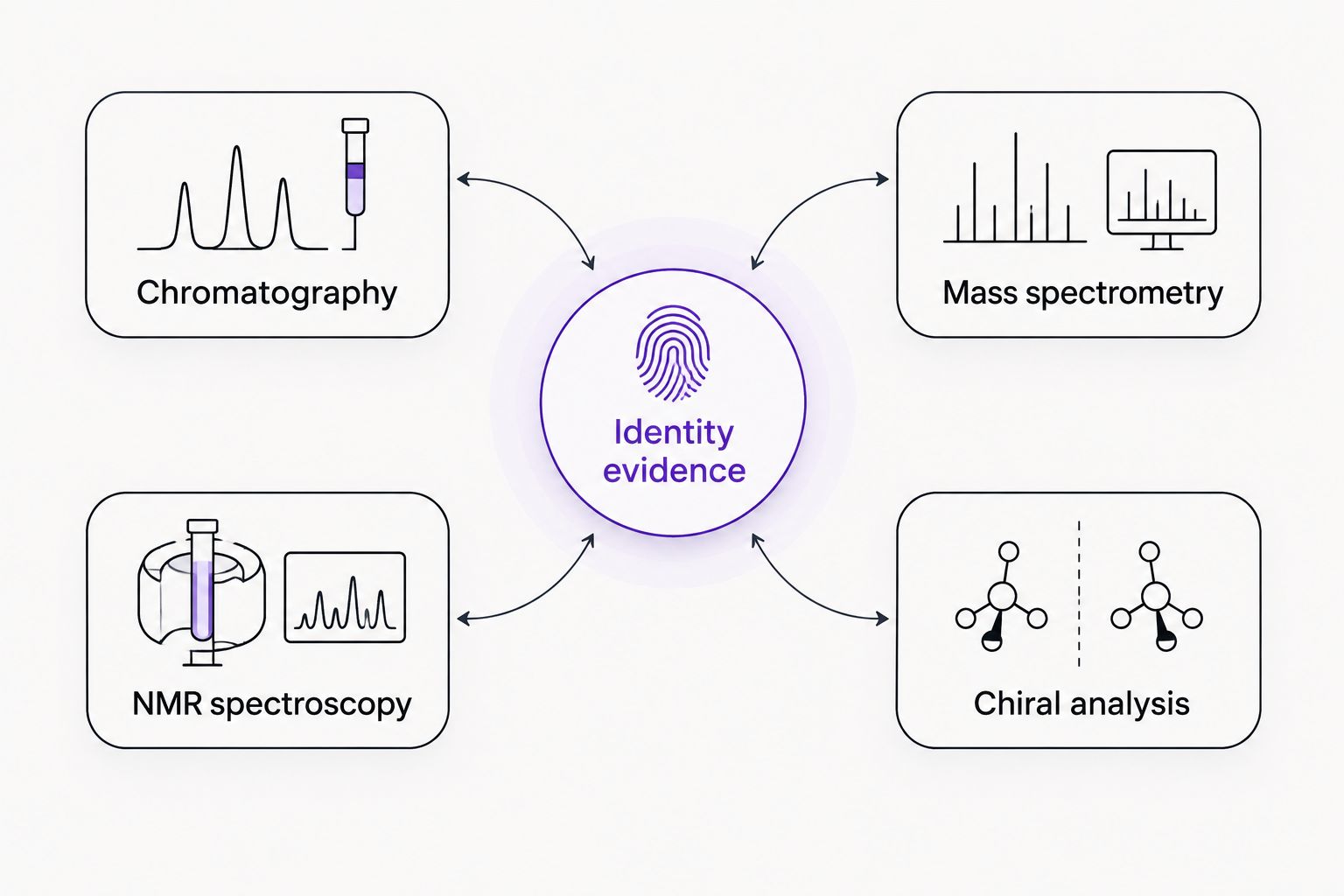
Molecular weight is not a complete identification result
The molecular weights 390.39 g/mol and 389.40 g/mol distinguish the listed neutral chemical entities. They are not interchangeable with every mass-to-charge value reported by an instrument. Ionization, charge state, and adduct formation affect the ions observed during mass spectrometry.
Read the ion assignment and acquisition context alongside the reported signal. A mass value without an explained assignment is weaker evidence than an interpretable spectrum tied to the declared structure.
Why analytical conclusions vary
Differences between reports can reflect the sample, the analytical method, or the way the result is expressed. Review these factors before accepting a comparison:
- Declared identity: aminotadalafil and tadalafil require different structure-linked assignments.
- Method selectivity: separation conditions determine which components a chromatographic method resolves.
- Detector response: different compounds do not necessarily generate equivalent responses.
- Calculation basis: peak-area percentage and mass fraction answer different questions.
- Stereochemical scope: an achiral result does not establish stereoisomer composition.
- Sample traceability: a report must correspond to the lot and sample under review.
These factors explain why identical-looking purity statements need not carry identical evidentiary weight. Ask what the number measures before using it to accept or reject a material.
How should laboratories evaluate batch documentation?
Connect the report to the material
A certificate of analysis should be evaluated as a batch-linked analytical record, not as a general assurance. Check the compound identity, lot identifier, analysis date, method description, and relationship between the certificate and supporting data.
For laboratory sourcing through 4-Amino-Labs, apply the same documentary criteria used for any research chemical supplier. The supplier name does not replace chemical authentication, and this article does not certify a particular batch or analytical result.
Separate a purity statement from its supporting evidence
A chromatographic peak-area percentage describes the integrated response under the stated method. It does not automatically establish the mass fraction of the intended compound, account for every impurity, or demonstrate the absence of residual solvents.
Water content, residual solvents, inorganic material, and unidentified components require appropriate analytical consideration. A single purity figure should not be presented as proof that every relevant quality attribute has been measured.
Request the evidence behind the claim. A usable record explains how the result was obtained and which conclusions that method supports.

Preserve traceability after receipt
Record the lot identifier and associated documentation in the laboratory's inventory and notebook systems. Preserve the original report rather than transcribing only its headline purity result. That keeps the method and identity context available during later review.
For 2026 documentation reviews, retain the distinction between supplier-provided information and independently generated laboratory findings. Both can inform assessment, but they are not the same source of evidence.
Is amino tadalafil an amino acid or peptide?
Aminotadalafil is neither an amino acid nor a peptide. Its molecular formula, C₂₁H₁₈N₄O₄, describes a small organic molecule rather than an amino acid sequence. [1]
The amino wording does not establish membership in an amino acid product category. Classify the material using its declared structure and confirmed identity.
Is aminotadalafil the same as tadalafil?
Aminotadalafil is not tadalafil: its listed molecular weight is 390.39 g/mol, while tadalafil's is 389.40 g/mol. Their formulas also differ, so they require separate identity assignments. [1, 2]
Do not transfer analytical specifications or pharmacological conclusions between them without compound-specific evidence. This remains the central interpretation rule for laboratory assessments in 2026.
What should you check before accepting an identity claim?
Check the structure before interpreting the activity claim. First establish which compound the documentation names, then assess whether the analytical data support that assignment.
A practical review separates three decisions: whether the material is identified, whether its measured quality attributes fit the research requirement, and whether the cited literature concerns that exact compound. Passing one decision does not automatically satisfy the others.
4-Amino-Labs supplies research chemicals and analytical reagents. For research-chemical sourcing from 4-Amino-Labs, the relevant next step is review of the actual material documentation—not an assumption that a similarly named compound has matching properties.
Related guides
- Connecting batch numbers to lab inventory tracking
- Connecting research chemical purchases to a lab notebook
- Analytical reagent suppliers for laboratories
Limitations of this guide
This guide distinguishes named chemical entities and explains analytical interpretation. It does not authenticate a supplied sample, establish aminotadalafil potency, or provide compound-specific storage conditions.
PubChem identity records describe chemical entities; they do not certify commercial lots. Likewise, the discussion of tadalafil's PDE5 mechanism does not establish equivalent aminotadalafil activity. Neither compound should be assigned properties solely because its name resembles the other.
FAQ
What is amino tadalafil?
Aminotadalafil is a structural analogue of tadalafil, but the spaced phrase amino tadalafil does not authenticate a labeled material. Confirm the declared structure and batch-linked analytical identity before interpreting research documentation.
Is aminotadalafil the same chemical as tadalafil?
No. Aminotadalafil has the formula C₂₁H₁₈N₄O₄ and molecular weight 390.39 g/mol; tadalafil has the formula C₂₂H₁₉N₃O₄ and molecular weight 389.40 g/mol.
Is aminotadalafil an amino acid or a peptide?
No. Aminotadalafil is a small organic molecule, not an amino acid or peptide. The amino wording does not establish an amino acid sequence or blend.
Does tadalafil act on a receptor?
Tadalafil’s established mechanism is inhibition of the PDE5 enzyme, not receptor agonism. PDE5 participates in cGMP hydrolysis, so enzyme inhibition and downstream signaling measurements describe different observations.
Does tadalafil research prove aminotadalafil has the same activity?
No. Structural relationship does not establish identical potency, selectivity, or experimental behavior. Aminotadalafil claims require evidence identifying and evaluating aminotadalafil itself.
Does an HPLC purity result prove chemical identity?
No. An HPLC purity result is method-dependent and does not independently prove molecular structure. Review complementary identity evidence and the basis of the reported percentage.
What documentation should accompany a research material?
Documentation should connect the declared chemical identity to the specific lot and its analytical results. Review the method, analysis date, supporting data, and any limitations relevant to the research question.
References
- National Center for Biotechnology Information. PubChem: Aminotadalafil. Chemical identity record; scope: molecular formula, molecular weight, and structure.
- National Center for Biotechnology Information. PubChem: Tadalafil. Chemical identity and pharmacology record; scope: molecular formula, molecular weight, and PDE5 inhibition.
Research-use-only notice
This 2026 article concerns chemical identity and laboratory analytical assessment only. 4-Amino-Labs research materials are discussed strictly for research use, not human or animal use. This content is not medical advice and is not intended to diagnose, treat, cure, or prevent disease.
