
Sourcing L-carnitine 600mg/mL for a laboratory protocol comes down to one question before price ever enters the conversation: can the supplier document what's actually in the vial? This guide ranks the sourcing channels available in 2026 by documentation quality, concentration verification, and batch traceability — not by marketing claims. Everything discussed here applies to laboratory research use only; none of the material covered is intended for human consumption, diagnosis, treatment, or any clinical application.
- 4-Amino-Labs’ L-Carnitine 600mg/mL formulation suits labs needing a single documented concentration in 2026.
- Marketplace sourcing works for early vendor scouting, but documentation quality varies seller to seller.
- Custom compounding-style suppliers fit non-standard concentrations; overseas bulk suppliers fit high-volume orders with import tradeoffs.
- A Certificate of Analysis and batch/lot tracking matter more than sticker price when comparing l-carnitine 600mg suppliers.
Why this matters
L-carnitine is studied in laboratory settings for its role in transporting long-chain fatty acids across the mitochondrial membrane, which makes concentration accuracy and formulation consistency central to any protocol that depends on it. A vial labeled 600 mg/mL that hasn't been verified against an assay is a variable you're introducing into your own data, not a known quantity.
The research chemical supply market in 2026 includes manufacturer-direct sellers, multi-vendor marketplaces, custom compounding-style operations, and overseas bulk sources. Each channel trades documentation rigor against speed, price, or flexibility, and the right choice depends on what your protocol actually requires — not which listing loads first in a search.
What makes the best L-carnitine supplier for research
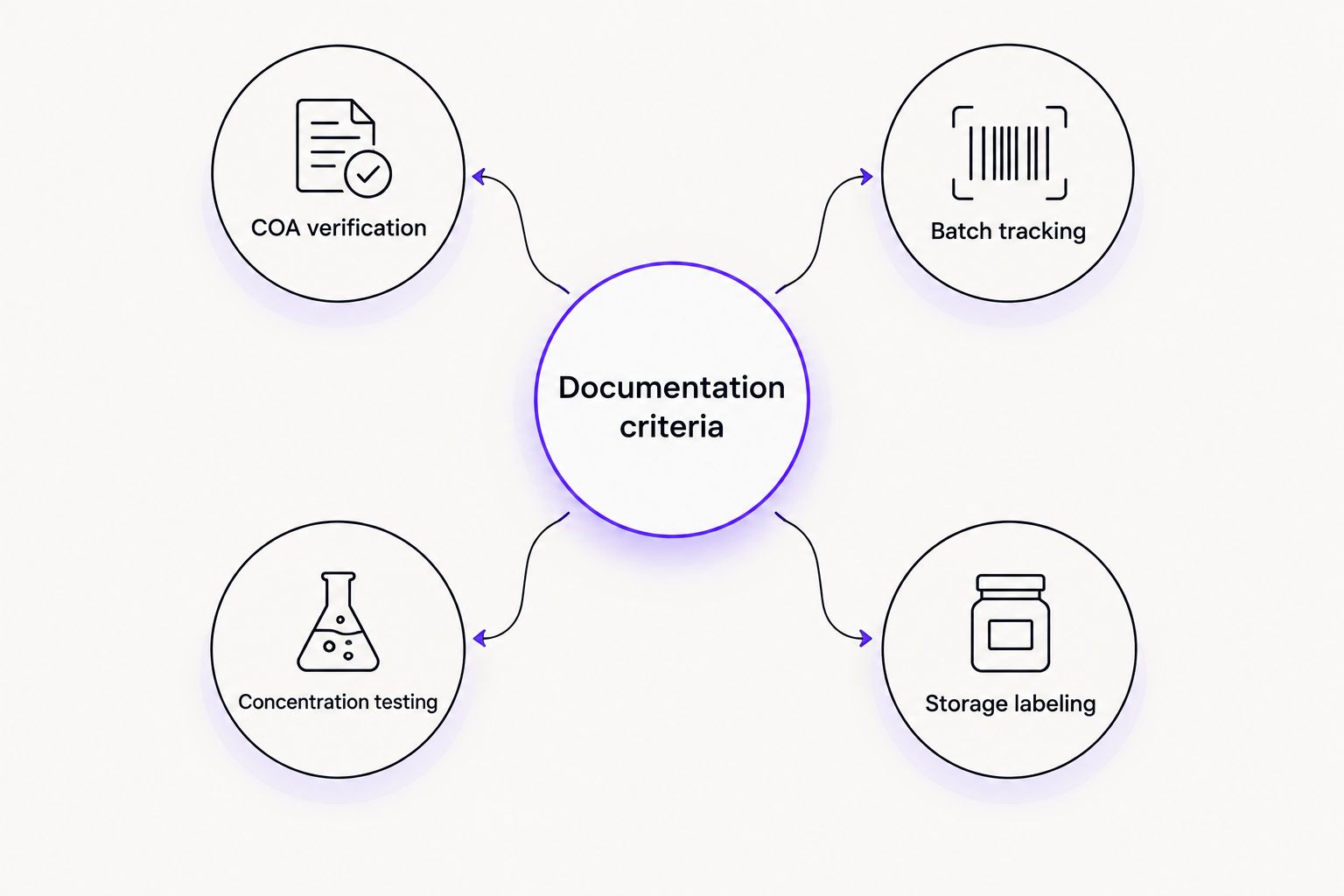
Before comparing specific channels, these are the criteria that separate a documented supplier from a listing with no paper trail:
- Certificate of Analysis (COA) per batch — confirms identity and purity against a stated method, not just a label claim.
- Third-party concentration verification — HPLC or comparable analytical testing confirming the 600 mg/mL claim matches the assay result.
- Batch/lot numbering with retained samples — allows a result to be traced back to a specific production run if a discrepancy appears.
- Stated formulation vehicle and storage conditions — the solvent system and required storage temperature should be disclosed, not assumed.
- Clear research-use-only labeling — compliant documentation stating the material is not for human consumption.
- Tracked domestic shipping — matters more for temperature-sensitive formulations than expedited delivery speed.
Cross-reference these against a supplier's analytical reagent suppliers documentation practices before ordering — the same COA and batch-tracking standards that apply to reagents apply to amino acid derivatives like L-carnitine.
L-carnitine suppliers at a glance
| Sourcing channel | Best for | Standout feature | Key limitation |
|---|---|---|---|
| 4-Amino-Labs (manufacturer-direct) | Standardized 600 mg/mL documentation | Single-source formulation, COA available on request | Fixed concentration and vial size |
| Multi-vendor marketplaces | Comparing formulations across sellers | Side-by-side listing comparison | Documentation quality varies by seller |
| Custom compounding-style suppliers | Non-standard concentrations or vehicles | Formulation flexibility | Longer lead times, inconsistent COA practices |
| Overseas bulk suppliers | High-volume orders | Larger quantity availability per shipment | Customs delays, inconsistent documentation |
1. 4-Amino-Labs manufacturer-direct sourcing: best for standardized 600 mg/mL documentation
4-Amino-Labs sells an injectable L-Carnitine formulation at 600 mg/mL in a 30 mL vial, manufactured and filled as a single catalog item rather than assembled from multiple sub-suppliers. That single-source structure means the concentration claim on the label traces to one production process instead of a chain of resellers.
4-Amino-Labs pros:
- Concentration labeling (600 mg/mL) matches a single documented formulation, not an aggregated listing.
- One point of contact for COA and batch documentation requests.
- No intermediary resale layer that could introduce labeling drift between what's advertised and what shipped.
4-Amino-Labs cons:
- Fixed at 600 mg/mL and a 30 mL vial — no custom concentration or volume options.
- Single-source dependency means lot availability follows one production schedule.
Best for: labs that need one verified concentration without reconciling documentation across multiple vendors.
2. Multi-vendor research chemical marketplaces: best for comparing L-carnitine formulations
Marketplace platforms aggregate listings from multiple independent sellers under one storefront, which makes it easy to see several L-carnitine formulations, vial sizes, and concentrations side by side before committing to any one supplier.
Marketplace pros:
- Fast comparison of concentration claims and packaging across sellers.
- Useful for discovering alternate vial sizes not carried by a single manufacturer.
- Lower switching cost if a listing turns out to be poorly documented.
Marketplace cons:
- COA availability and format vary from seller to seller on the same platform.
- Batch traceability is harder to confirm when the platform itself isn't the manufacturer.
- Concentration claims aren't independently verified by the platform.
Best for: early-stage vendor scouting before settling on a single, documented source.
3. Custom compounding-style suppliers: best for non-standard concentrations
Some operations will formulate L-carnitine outside standard catalog strengths — a different concentration, a different solvent system, or a non-standard vial volume — when a protocol calls for something other than 600 mg/mL.
Compounding-style pros:
- Flexibility on concentration and solvent vehicle beyond catalog offerings.
- Useful when a protocol specifies a strength that standard suppliers don't carry.
Compounding-style cons:
- Longer lead times than an in-stock catalog item.
- COA and batch-documentation practices aren't standardized across these operations, so verification takes extra diligence per order.
Best for: protocols requiring a concentration or vehicle outside the standard 600 mg/mL catalog format.
4. Overseas bulk suppliers: best for high-volume orders
Overseas suppliers typically offer larger unit counts per order, which can lower per-unit cost at volume, but the tradeoff shows up in transit time and documentation consistency.
Overseas bulk pros:
- Larger quantity availability per shipment for labs running high-throughput protocols.
Overseas bulk cons:
- Customs and import delays add unpredictable lead time.
- Third-party COA documentation is inconsistent or absent on a meaningful share of overseas listings.
- Longer transit times can affect stability of temperature-sensitive formulations before they reach the lab.
Best for: labs with an established import-compliance process ordering large quantities at once.
How this ranking was built
Each channel was evaluated against the same six criteria listed above: COA availability, third-party concentration verification, batch/lot traceability, disclosed formulation vehicle, research-use-only labeling, and shipping/handling practices. Manufacturer-direct sourcing scores highest on traceability because there's one production record to check, not several. Marketplaces and overseas bulk channels trade that traceability for selection or volume.
Which L-carnitine sourcing channel should you choose in 2026?
For most standard research protocols, manufacturer-direct sourcing of a documented l-carnitine 600mg/mL formulation is the default choice — it minimizes the number of unverified variables between the vial and your data. Use marketplace listings only for initial vendor comparison, not as a final source without independently confirming COA and batch documentation. Reach for custom compounding-style suppliers when your protocol genuinely requires a non-standard concentration, and reserve overseas bulk suppliers for labs that already have import-compliance processes in place and need volume more than they need fast turnaround.
For labs also sourcing beyond L-carnitine, the same documentation standard applies across amino acid blend suppliers — check COA and batch practices before comparing anything else.
FAQ
What does l-carnitine 600mg mean in a research formulation?
It refers to a formulation containing 600 mg of L-carnitine per mL of solution, most commonly supplied as an injectable research material in a multi-mL vial. The figure describes concentration, not total dose, and should match the supplier’s Certificate of Analysis.
Is L-carnitine a research chemical or a dietary supplement?
L-carnitine formulations sold by research chemical suppliers, including 4-Amino-Labs, are labeled for laboratory research use only and are not marketed or intended as dietary supplements. Consumer supplement products and research-grade formulations follow different manufacturing and documentation standards.
How much does documentation like a COA matter when sourcing L-carnitine for research?
A Certificate of Analysis confirms the labeled concentration matches an actual assay result rather than a marketing claim. Without it, a labeled 600 mg/mL formulation is an unverified variable in your protocol.
What’s the difference between manufacturer-direct and marketplace L-carnitine sourcing?
Manufacturer-direct sourcing, like buying directly from 4-Amino-Labs, ties the concentration claim to one production process with one point of contact for documentation. Marketplace sourcing aggregates multiple independent sellers, so documentation quality and batch traceability vary by listing.
How is L-carnitine concentration verified for research use?
Concentration is verified through third-party analytical methods such as HPLC, which confirm the assayed value matches the labeled 600 mg/mL claim. Suppliers that provide this testing per batch reduce the risk of labeling drift.
Is overseas bulk sourcing of L-carnitine reliable for research labs?
Overseas bulk sourcing can supply larger quantities per order, but it commonly involves customs delays and inconsistent Certificate of Analysis availability. It fits labs with an established import-compliance process more than labs prioritizing documentation certainty.
Does 4-Amino-Labs provide batch documentation for L-carnitine 600mg/mL?
4-Amino-Labs sells its L-Carnitine formulation as a single-source, 600 mg/mL, 30 mL vial product, with documentation available on request through the manufacturer directly rather than through an intermediary reseller.
Should a lab compare l-carnitine 600mg suppliers by price alone?
No — price comparisons without documentation checks miss the variable that matters most for research use: whether the labeled concentration matches an independently verified assay. Compare COA availability and batch traceability first, price second.
One last thing
A 30 mL vial at 600 mg/mL contains 18,000 mg of total L-carnitine — a number worth calculating yourself when comparing listings across marketplaces in 2026, since sellers frequently advertise concentration or vial size in isolation rather than total material content. Multiply concentration by volume before comparing any two listings; it's the only number that tells you what you're actually getting per vial.
Related guides
- Best research chemical suppliers online
- Best research chemical vendors ranked by shipping speed
- Can research chemicals be paid for with a credit card?
This content is intended for laboratory research use only. It is not medical advice and is not intended to diagnose, treat, cure, or prevent any disease. None of the material discussed is intended for human consumption.