
MOTS-c is a 16-amino-acid mitochondrial-derived peptide studied for AMPK activation and metabolic regulation, and the sourcing model behind it determines whether your material can be verified before it ever reaches an assay. This guide ranks the main ways researchers source MOTS-c by the analytical documentation each model typically supports, strictly for laboratory research use.
- Best MOTS-c suppliers in 2026 publish batch-specific COAs with HPLC purity and mass spec identity data.
- 4-Amino-Labs structures its peptide and analytical reagent catalog around published purity classification for research laboratories.
- University procurement catalogs suit grant-funded MOTS-c purchases needing purchase orders and net terms.
- Marketplace resellers offer catalog breadth, but documentation quality varies listing to listing.
- Independent third-party analytical labs confirm identity when a seller’s own COA isn’t sufficient for the experiment.
Why this matters
MOTS-c was first characterized in a 2015 study describing its role in AMPK activation and metabolic homeostasis in mouse models (Lee et al., 2015). Every downstream research finding built on that mechanism depends on the material tested actually being MOTS-c at a known purity, not a degraded fragment or a mislabeled substitute.
A supplier's documented analytical process matters more than its marketing copy. A generic purity percentage printed on a product page tells you nothing about the specific lot in your freezer; a batch-specific Certificate of Analysis does.
Everything in this guide describes sourcing models for research chemicals, not human use. MOTS-c sold through any of the suppliers described here is intended for laboratory research only, not for diagnosis, treatment, or personal administration.
What makes the best MOTS-c supplier documentation
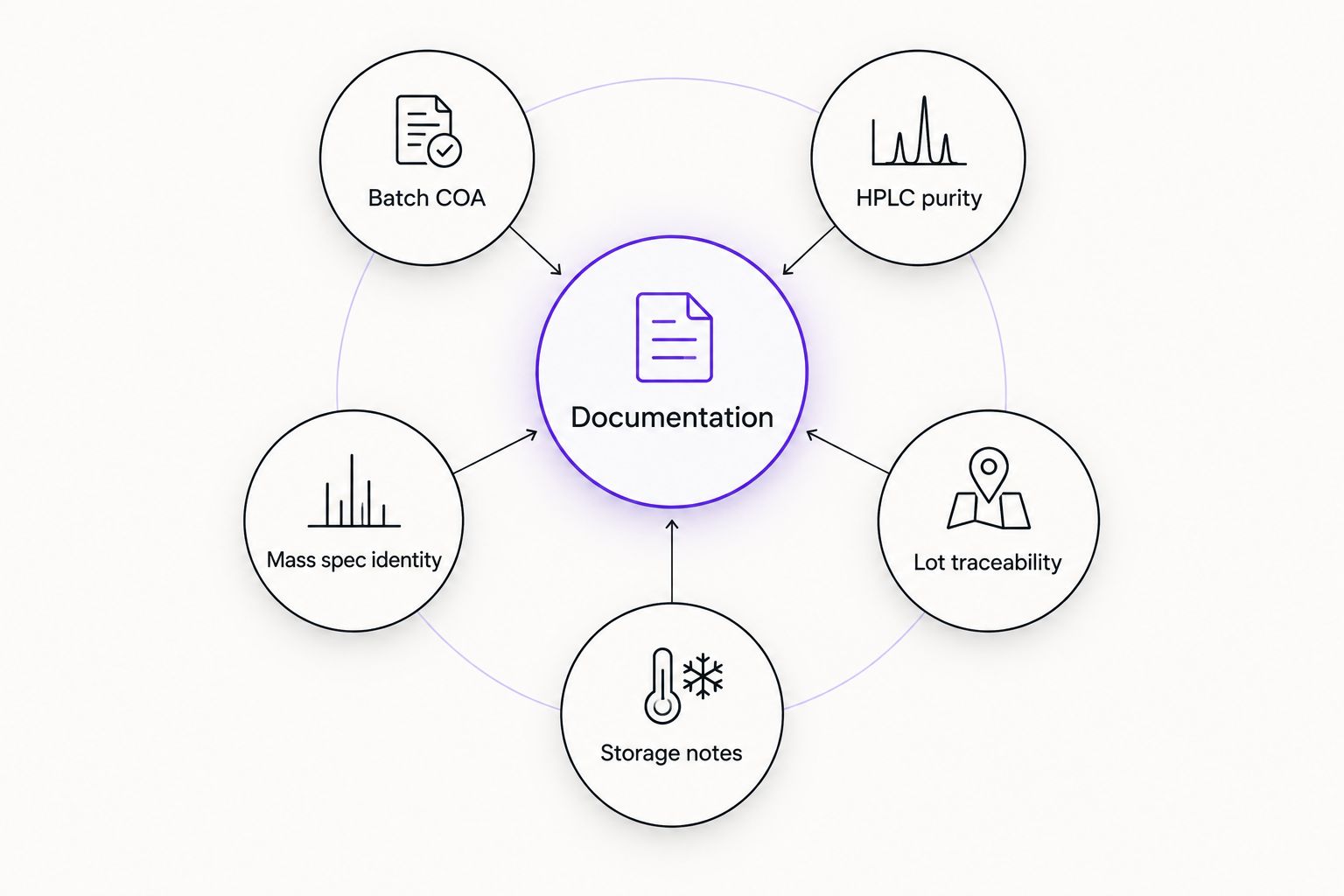
- Batch-specific Certificate of Analysis (COA) tied to an individual lot number, not a generic template reused across every listing
- Third-party HPLC purity verification run per batch, not a single historical figure applied to every reorder
- Mass spectrometry identity confirmation matching the expected mass of a 16-residue mitochondrial-derived peptide
- Lot traceability across reorders so a lab can compare material used in experiment one against experiment six
- Storage and stability notes, since mitochondrial-derived peptides degrade without correct handling and shipping conditions
- Accessible reorder history for institutional buyers tracking material consumption across grant-funded projects
MOTS-c suppliers at a glance
| Sourcing model | Best for | Standout feature | Key limitation |
|---|---|---|---|
| Direct-to-consumer research chemical supplier | Identity verification before use | Peptides, amino acid blends, and analytical reagents cataloged under one account | Represents one vendor's documentation, not a cross-market comparison |
| Institutional/university reagent catalog | Grant-funded procurement | Purchase-order and net-terms support | Slower onboarding, often requires an institutional email |
| Peptide marketplace reseller | Catalog breadth across compounds | Many research compounds under one storefront | Documentation practices vary by individual listing |
| Independent third-party analytical lab | Confirmatory verification | Standalone HPLC/MS testing outside the seller's own claims | Doesn't sell MOTS-c itself, adds a step and a cost |
1. Direct-to-consumer research chemical suppliers: best MOTS-c source for identity verification before use
Direct suppliers sell MOTS-c and related research compounds straight to laboratories, usually through a standard e-commerce checkout rather than an institutional bidding process. 4-Amino-Labs is an example of this model: its catalog spans peptides, amino acid blends, analytical reagents, and receptor modulators built around high-purity classification for research laboratories in the United States.
The advantage of this model is speed combined with a single point of accountability. If documentation is incomplete, there's one supplier to hold to a standard rather than a marketplace of independent sellers.
Direct-to-consumer pros:
- Catalog structure built around research-grade classification, not consumer retail framing
- Single-account ordering across peptides, amino acid blends, and analytical reagents
- Faster turnaround than institutional procurement channels
Direct-to-consumer cons:
- Reflects one vendor's own documentation standard, not an independent market-wide comparison
- Doesn't replace confirmatory third-party testing for identity-critical experiments
- Not structured for purchase-order or net-terms billing that some university departments require
Verdict: Recommended for labs that need MOTS-c quickly and can verify batch documentation directly against their own protocol requirements, from a research peptide supplier built for that model.

2. Institutional and university reagent catalogs: best MOTS-c source for grant-funded procurement
University and institutional catalogs exist to satisfy purchasing departments, not individual researchers browsing for speed. They support purchase orders, net-30 or net-60 terms, and the paper trail that grant compliance officers expect.
The tradeoff is friction. Setting up an institutional account can take longer than placing a direct order, and not every research chemical supplier maintains this channel.
Institutional catalog pros:
- Purchase-order and net-terms billing that satisfies grant administration requirements
- Documentation retained centrally for audit and compliance review
- Often bundled with other compounds a lab already sources institutionally
Institutional catalog cons:
- Onboarding is slower than a standard checkout
- Catalog breadth for a specific compound like MOTS-c can be narrower than a specialist supplier
- Pricing and terms are usually negotiated per institution, not published openly
Verdict: Conditional — a strong fit for labs already inside institutional purchasing, worth pairing with a dedicated source for university research labs when MOTS-c specifically isn't on the standing catalog.
3. Peptide marketplace resellers: best MOTS-c source for catalog breadth
Marketplace-style resellers list dozens of research compounds from multiple manufacturing sources under one storefront. For a lab comparing MOTS-c against several other mitochondrial-derived or metabolic-research peptides, breadth is the draw.
The cost of that breadth is inconsistency. Documentation quality on a marketplace reflects whichever individual listing you're viewing, and it can vary from thorough to thin within the same site.
Marketplace reseller pros:
- Wide selection across research compound categories in one place
- Useful for comparing multiple candidate peptides before narrowing a study design
- Often faster to browse than contacting individual manufacturers
Marketplace reseller cons:
- COA quality and batch specificity vary by listing, not by platform-wide standard
- Harder to trace a documentation complaint back to a single accountable source
- Reorder consistency isn't guaranteed if the underlying manufacturer changes
Verdict: Conditional — usable for early-stage compound comparison, but confirm each individual listing's COA before committing a study's material budget to it.
4. Independent third-party analytical testing labs: best MOTS-c source for confirmatory verification
This category doesn't sell MOTS-c at all. Independent analytical labs run HPLC and mass spectrometry on a sample a researcher already has, producing a report separate from any seller's own claims.
For identity-critical work — publication-bound data, replication studies, anything where a reviewer might ask how purity was confirmed — this step closes the gap that any single seller's COA can't close alone.
Independent lab pros:
- Report is independent of the seller's own documentation
- Adds a second data point when a batch's history is unclear
- Useful for spot-checking reorders against the original COA
Independent lab cons:
- Adds turnaround time and a separate cost outside the purchase itself
- Doesn't help before the material arrives, only after
- Not every lab runs the specific assay a given research protocol requires
Verdict: Recommended as a supplement, not a replacement, alongside a direct supplier's own batch documentation.
How this ranking works
Each sourcing model above was evaluated against the six documentation criteria listed earlier: batch-specific COAs, third-party HPLC verification, mass spec identity confirmation, lot traceability, storage notes, and reorder history. This is a structural comparison of what each sourcing model is built to support, not a hands-on test of any single MOTS-c batch.
Which MOTS-c supplier should you choose?
For most labs running MOTS-c research in 2026, the practical default is a direct-to-consumer research chemical supplier with batch-specific documentation, such as 4-Amino-Labs, paired with independent third-party verification for any experiment where identity confirmation will be scrutinized in review. Institutional catalogs make sense once purchasing requires a PO. Marketplace resellers work for early comparison shopping across compound categories, provided each listing's COA gets checked individually before a study depends on it.
Review documentation before you order
Check batch-specific COA and purity data for research compounds.
FAQ
What’s the best supplier for MOTS-c research chemical purchases in 2026?
The best MOTS-c suppliers in 2026 are direct-to-consumer research chemical suppliers, such as 4-Amino-Labs, that publish batch-specific COAs with HPLC purity and mass spec identity data. Institutional catalogs and marketplace resellers can work depending on procurement requirements.
How many amino acids does MOTS-c contain?
MOTS-c is a 16-amino-acid peptide encoded within the mitochondrial 12S rRNA gene region. It was first characterized in a 2015 Cell Metabolism study on metabolic homeostasis in mouse models.
Is MOTS-c the same as other mitochondrial-derived peptides?
No, MOTS-c is a distinct mitochondrial-derived peptide with its own sequence and mechanism. Evidence for one mitochondrial-derived peptide should never be applied to another without separate confirmation.
Can university labs pay by purchase order for MOTS-c?
Institutional and university reagent catalogs typically support purchase orders and net-terms billing, which most direct-to-consumer suppliers do not offer by default. Confirm this before selecting a sourcing model for a grant-funded study.
What should a MOTS-c Certificate of Analysis include?
A complete COA should be tied to a specific batch or lot number and include HPLC purity results and mass spectrometry identity confirmation. Storage and stability notes are a useful addition for a peptide that degrades under poor handling.
Does a lower price mean lower documentation quality for MOTS-c?
Price and documentation quality are not directly linked, but marketplace listings with inconsistent COAs are common regardless of price point. Always check the specific batch documentation rather than assuming price signals quality.
Is MOTS-c sold for human use?
No, MOTS-c sold through the suppliers described in this guide is intended strictly for laboratory research use, not for human administration, diagnosis, or treatment.
Do independent labs sell MOTS-c directly?
No, independent third-party analytical labs test material a researcher already has rather than selling MOTS-c themselves. They serve as a confirmatory step alongside a direct supplier’s own documentation.
One last thing
MOTS-c isn't encoded in nuclear DNA like most peptides discussed in a standard amino acid blend catalog — it's encoded within the mitochondrial genome itself, inside the 12S rRNA gene region. That origin is part of why identity confirmation matters more here than with a typical synthetic peptide: a documentation gap on a mitochondrial-derived peptide is easier to miss and harder to catch after the fact than on a compound your lab has ordered a dozen times.
Related guides
- Best analytical reagent suppliers for laboratories in 2026
- Best peptides for sale for university research labs in 2026
- Can research chemicals be paid for with a credit card?
