
Last updated: October 11, 2026
People taking GLP-1 drugs such as semaglutide (Ozempic, Wegovy) and tirzepatide (Mounjaro, Zepbound) increasingly describe an unexpected new hobby: collecting perfume. A popular explanation is that GLP-1s take away the “dopamine hit” from food, so the brain goes looking for reward elsewhere, and fragrance is the outlet. It’s a tidy story. The science suggests it’s only partly right, and in one important respect it’s backwards.
Below we separate what is established, what is plausible, and what is so far only anecdote.
The “Ozempic perfume” phenomenon: what people are reporting
The reports are vivid. In an August 2026 HuffPost feature, comedian Todd Masterson described a Le Labo scent that “tattooed itself on my brain” about three months into taking Zepbound. Fourteen months in, his collection was approaching 100 bottles. Another user told The Independent she had spent around $3,000 on perfume in two years. Reddit communities for GLP-1 users and fragrance fans now have whole threads about GLP-1-triggered perfume habits.
Clinicians are noticing it too, cautiously. Harvard obesity medicine physician Fatima Cody Stanford told HuffPost that some patients say their sense of smell feels stronger, most often for food smells. She described the pattern as heightened sensory awareness rather than a wholesale change in smell, and noted that it isn’t universal.
The reports also run the other way. Some users say perfumes and candles they once loved became an instant turn-off, and sweet gourmand notes in particular turned nauseating. That variability is itself a clue.
How GLP-1 compounds affect the brain’s reward system
Food reward and “food noise”
GLP-1 receptors are found in the brain’s mesolimbic reward circuit, including the ventral tegmental area (VTA) and nucleus accumbens (NAc). In rodents, GLP-1 agonists consistently reduce intake of highly palatable food and how hard animals will work for food rewards.
The details are more interesting than “less dopamine.” In a mouse study by Kooij and colleagues, semaglutide reduced sucrose and chow intake without changing VTA dopamine responses to food cues, yet it increased VTA dopamine activity at the moment the reward was collected. A 2025 commentary in Neuroscience Applied framed GLP-1s as curbing appetites while restoring the capacity for satisfaction: less craving, but not necessarily less pleasure when a reward arrives.
The most striking human data come from a single patient. In a 2025 study, University of Pennsylvania researchers recorded activity directly from electrodes in the nucleus accumbens of a woman with severe obesity and loss-of-control eating. On tirzepatide, her intrusive food thoughts (“food noise”) stopped and a brain signal linked to food preoccupation went quiet. After about five months, both came back. It is one person, but it is direct evidence that these drugs can modulate the reward hub tied to food preoccupation, and that the effect may not last.
Alcohol, drugs, gambling and shopping
This is where the “seek dopamine elsewhere” theory runs into trouble. GLP-1 agonists appear to dampen reward-seeking across categories, not just for food:
- Alcohol: In a randomized trial of 48 adults with alcohol use disorder (Hendershot et al., JAMA Psychiatry, 2025), low-dose semaglutide reduced alcohol consumed in a lab self-administration task, drinks per drinking day, and weekly craving. In a 26-week trial in The Lancet (Klausen et al., 2026), semaglutide 2.4 mg cut heavy drinking days by 41.1 percentage points versus 26.4 on placebo.
- Cocaine and nicotine: In rats, semaglutide decreased cocaine self-administration, motivation, and relapse-like behavior, and blunted cocaine-evoked dopamine in the NAc. Earlier studies found similar effects for alcohol and nicotine reward.
- Exercise: A 2025 study found semaglutide reduced motivated running in mice and changed NAc dopamine dynamics, by dampening motivation through circuits shared with food seeking.
- Shopping and gambling: Evidence is early. A mixed-methods analysis of social media posts found 21.35% of relevant comments reported an interruption of compulsive shopping. The Wharton School is running a study of about 180 participants on GLP-1s and financial decision-making through roughly March 2027.
The overall pattern: GLP-1s look less like drugs that redirect reward-seeking and more like drugs that turn down “wanting” in general.
Do GLP-1s cause anhedonia?
If GLP-1s dampen motivation broadly, could they flatten pleasure? There are case reports, including two patients whose depression appeared on semaglutide and improved after stopping it, and clinicians describe some patients reporting emotional flatness. But in an analysis of EudraVigilance reports, psychiatric adverse events made up only 1.18% of 31,444 reports for semaglutide, liraglutide, and tirzepatide. Anhedonia is not a listed adverse reaction, and no randomized trial has measured it with validated scales. The question remains open.
For this topic, it matters because broad blunting would predict less interest in hobbies, not new obsessions. Someone developing a passion for fragrance is, if anything, a sign that reward isn’t globally suppressed in that person.
Reward substitution: does “addiction transfer” apply to GLP-1s?
“Addiction transfer” comes from bariatric surgery research. In the NIH-funded LABS cohort, rates of alcohol use disorder among gastric bypass patients rose from 7.0% before surgery to 10.7% two years after. Systematic reviews confirm a higher risk of alcohol and substance use disorders starting about two years after surgery.
Whether that is true “transfer” is disputed. The risk appears years later rather than right away, and it is tied to gastric bypass, which changes how alcohol is absorbed so blood alcohol peaks faster and higher. It is largely absent after gastric banding.
Crucially, the GLP-1 data point the other way. A 2025 narrative review in Diabetes & Metabolism found alcohol use disorder was about twice as common more than two years after bariatric surgery, but roughly halved with GLP-1 receptor agonist therapy. If GLP-1 users were shifting compulsive reward-seeking onto new targets, alcohol would be the obvious candidate. It is moving in the opposite direction.
GLP-1 and smell: the olfactory bulb connection
The smell angle is the most promising biological lead. GLP-1 receptors are found in the mitral cells of the olfactory bulb, the brain’s first relay for smell. A 2023 Molecular Metabolism study found that the olfactory bulb’s local GLP-1 system controls odor-guided foraging in mice and is required for the insulin release triggered by food odors. One caveat: related work suggests circulating GLP-1 may have limited access to the olfactory bulb, so injected drugs may affect smell indirectly, through other brain regions.
Human data exist but are modest:
- Smell and taste disturbances: A 2026 JAMA Otolaryngology cohort compared 438,474 adults with type 2 diabetes on GLP-1 agonists with matched controls. Users had a 48% higher relative risk of new smell or taste disturbances, but absolute rates were low: 0.37% vs. 0.22%. Smell disturbances specifically were 0.15% vs. 0.07%.
- Taste: In a randomized, placebo-controlled study, semaglutide improved taste recognition in women with obesity and PCOS and reduced activation of a reward-related brain region in response to calorie-dense food cues.
- Parosmia and preference shifts: Monell Chemical Senses Center researcher Valentina Parma’s team found reports of parosmia (distorted smell) among GLP-1 users in the FDA’s adverse event database. She has noted that parosmia can make food smells unpleasant while leaving other fragrances intact, which could nudge preferences away from the kitchen and toward the perfume counter.
This gives a more defensible hypothesis than dopamine transfer: GLP-1s may change how smells are perceived and what they mean. Food odors may no longer trigger hunger, which frees people to enjoy them as pure sensory experiences.
The data: GLP-1 users and fragrance spending
The consumer data are real, with caveats. NielsenIQ’s Homescan GLP-1 Panel Survey found that households using a GLP-1 only for weight loss bought 23.4% more perfume over the 52 weeks ending September 28, 2024, while non-users bought 10.0% less.
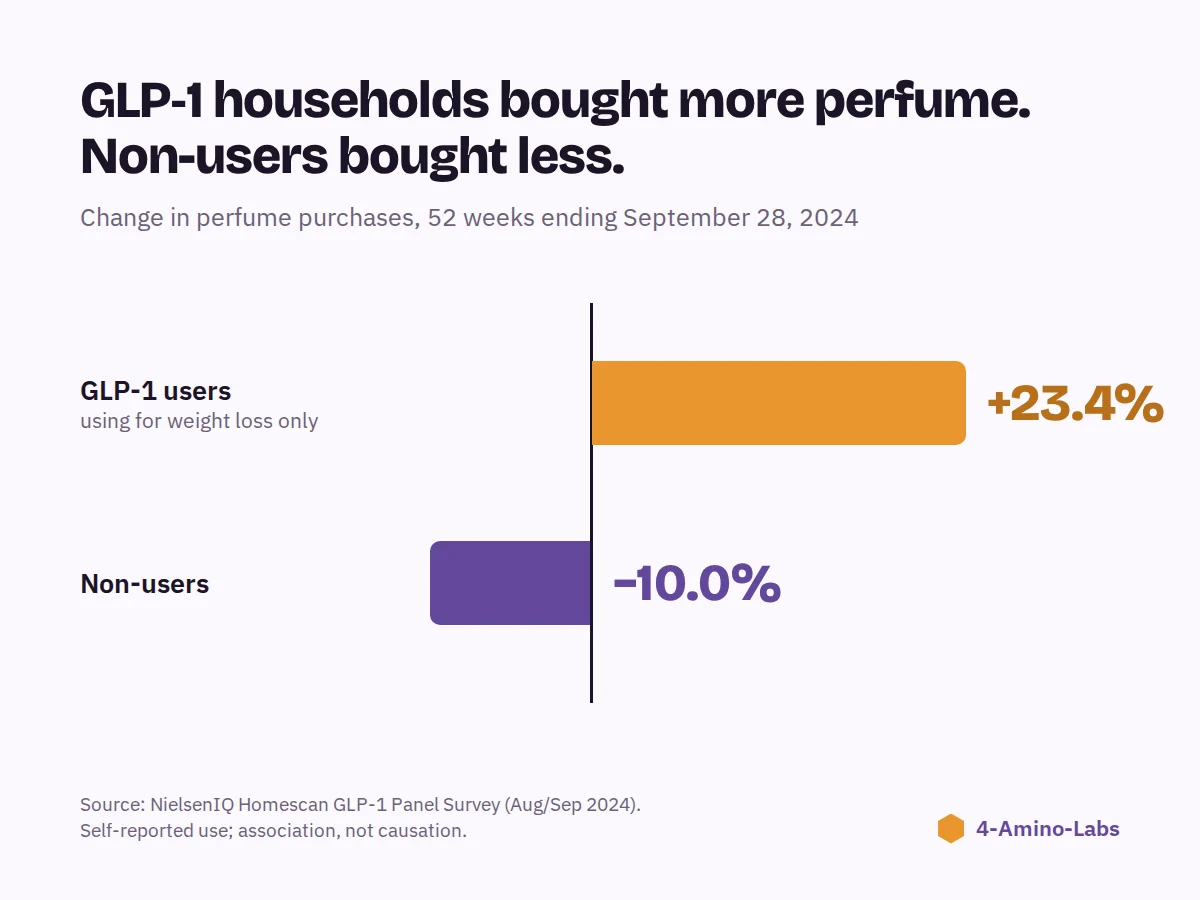
In 2026, NIQ reported that GLP-1 weight-loss users spend 1.3 times more on health and beauty than non-users, including 97% more on fragrance. The same report notes that 55% of US GLP-1 users live in households earning more than $100,000 a year. That income skew alone could explain much of the gap.
Gourmand scents and the “smell the dessert” theory
Gourmand perfumes, with their vanilla, caramel, and pastry notes, have been booming. According to Mintel, gourmand fragrance launches rose 24% in 2024, and Spate data show US searches for gourmand fragrances up more than 170% since 2023. Mintel has suggested brands may lean into these notes because of GLP-1-driven appetite changes, though that link is based on online discussion, not purchase data. Users’ own explanation fits the smell hypothesis: they can enjoy a sweet gourmand scent without it making them hungry.
Other spending shifts among GLP-1 users
- Morgan Stanley (survey of 300 users, 2024): 63% spend less at restaurants and 61% less on takeout; roughly half cut soda, alcohol, and salty snacks by 50% or more.
- Cornell and Numerator: household grocery spending fell 5.3% within six months of starting a GLP-1, with savory snacks down 10.1%.
- Circana: GLP-1 households are projected to account for 35% of food and beverage units sold by 2030.
- BCG (2026): active users expect to spend more on clothing, footwear, and activewear.
Alternative explanations: why the correlation may not be causal
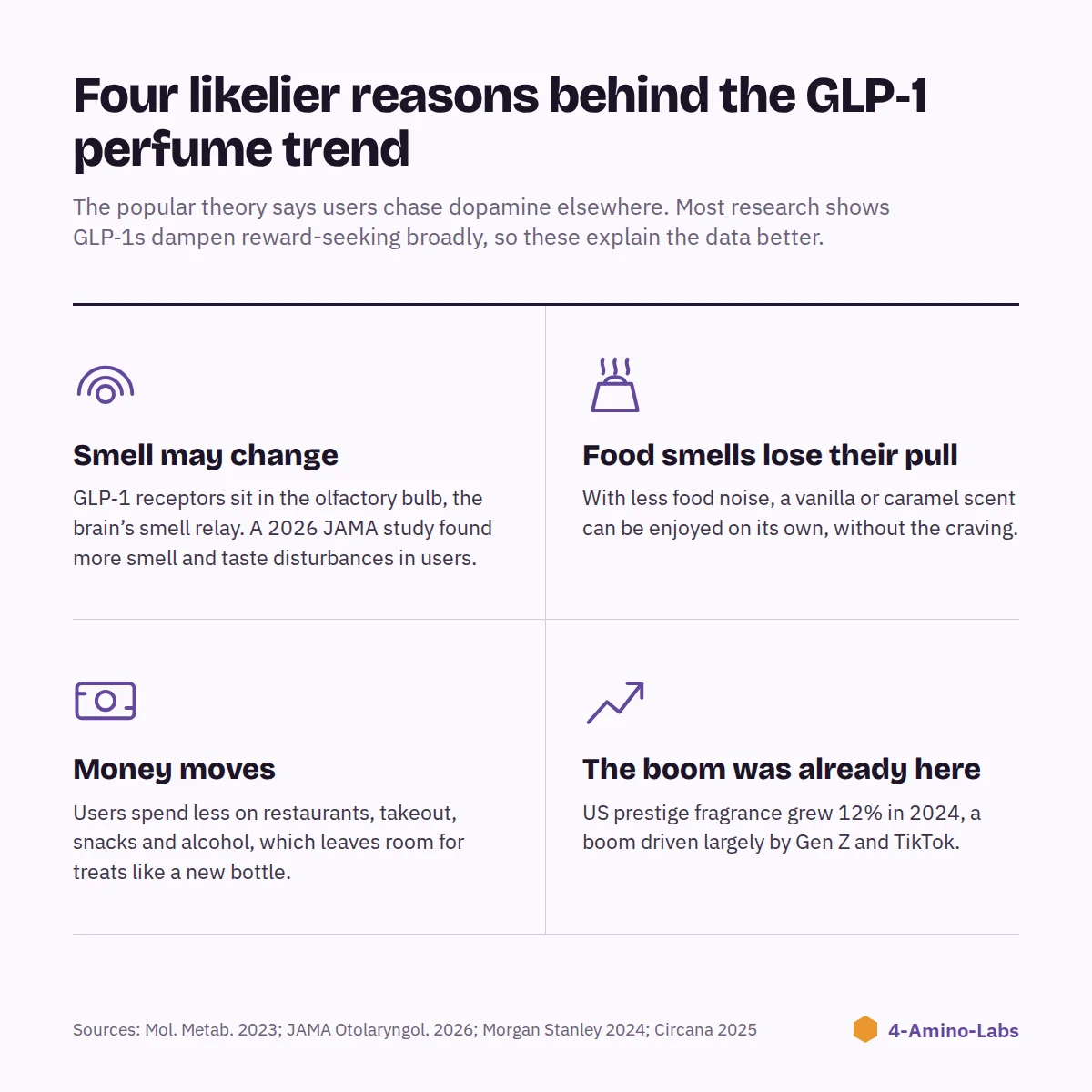
- The fragrance boom started before, and independently of, GLP-1s. Circana reports US prestige fragrance grew 12% in 2024, driven largely by Gen Z “fragrance wardrobes,” dupes, and TikTok. Prestige beauty overall grew 14% in 2023 and 15% in 2022.
- Freed-up money. Users spend less on restaurants, alcohol, and snacks, and a new bottle is an easy place for that money to go.
- The confidence dividend. Weight loss often comes with renewed investment in appearance: clothing, beauty, grooming.
- Who the users are. GLP-1 users skew female and higher-income, both strong predictors of fragrance spending.
- Reporting bias. Viral stories attract people with the experience. Those who notice nothing don’t post about it.
- Mixed directions. Some users report aversion to gourmand scents, which is hard to square with any single mechanism.
Scale: how many people use GLP-1s?
A KFF poll (October to November 2025) found that 12% of US adults currently take a GLP-1 and 18% have ever taken one, up from 6% and 12% in May 2024. Morgan Stanley Research projects roughly 55 million US users by 2035. Next-generation compounds are coming too: in Eli Lilly’s Phase 3 TRIUMPH-1 trial, the investigational triple agonist retatrutide produced 28.3% mean weight loss at its highest dose over 80 weeks. Retatrutide is not approved for any use. Even a small behavioral effect in a population this large can move a consumer category.
The bottom line
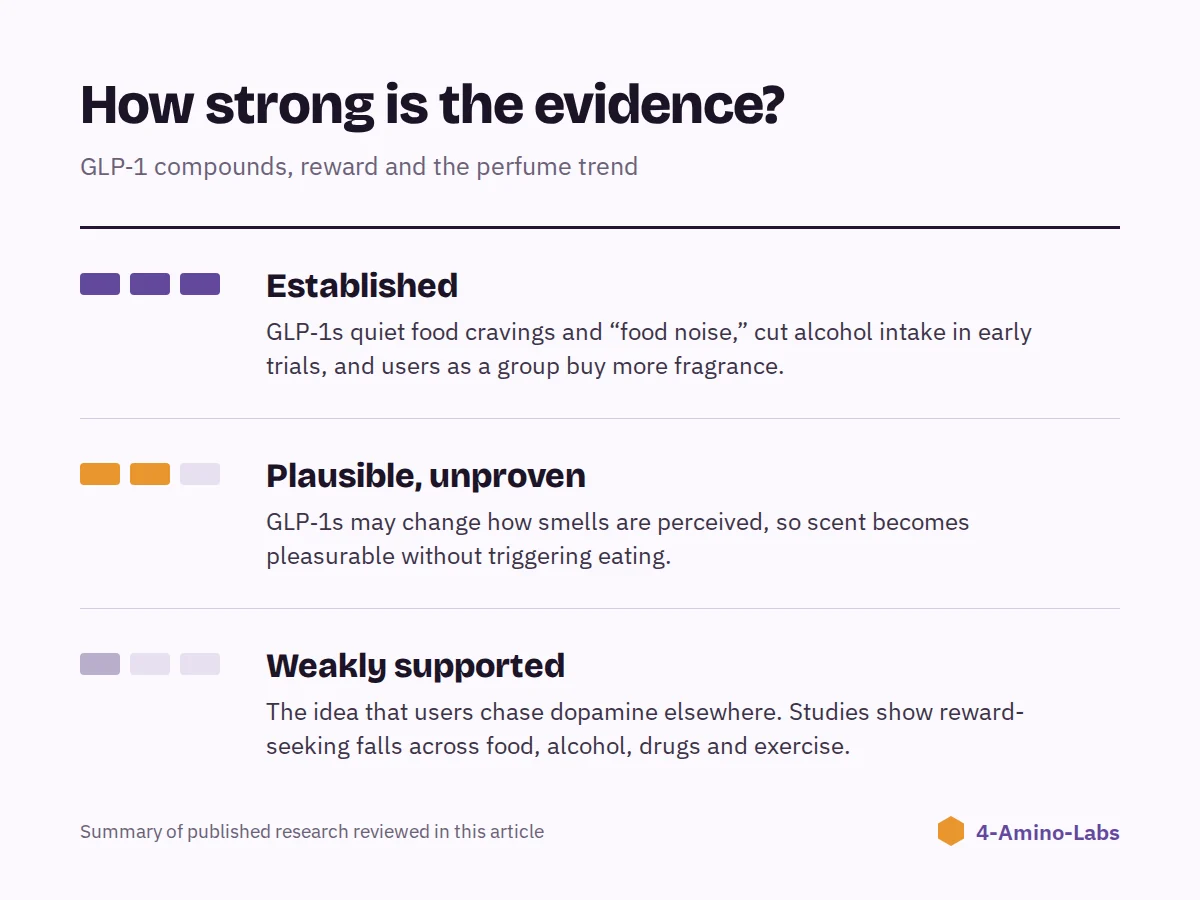
- Established: GLP-1 agonists act on reward circuits and reduce food craving and “food noise.” They reduce alcohol intake in early randomized trials. GLP-1 users, as a group, buy more fragrance.
- Plausible but unproven: GLP-1 signaling changes smell perception or the meaning of food odors, so scent becomes more pleasurable without triggering eating.
- Weakly supported: the idea that users “seek dopamine elsewhere.” Most evidence shows broad dampening of reward-seeking, and GLP-1s appear to lower, not raise, the risk of alcohol problems.
The most honest answer to “why are GLP-1 users obsessed with perfume?” is a combination: changed sensory experience, reallocated spending, post-weight-loss confidence, and a fragrance boom already underway. It is a fascinating open research question, not a settled fact.
For more mechanism-first explainers, browse the 4AminoLabs Research Guide. Researchers can review our peptide research compounds and the independent third-party testing and certificates of analysis behind them.
Frequently asked questions
No study has confirmed a cause. Likely contributors include changes in smell perception, food smells losing their link to hunger, money freed from food and alcohol, and confidence after weight loss. NielsenIQ found households using a GLP-1 for weight loss bought 23.4% more perfume in the year to September 2024.
It can, in a minority of people. A 2026 JAMA Otolaryngology study of over 438,000 matched patients with type 2 diabetes found smell disturbances in 0.15% of GLP-1 users vs. 0.07% of controls.
Not simply. In mice, semaglutide reduced reward-seeking but increased VTA dopamine activity during reward consumption, and it blunted cocaine-evoked dopamine in the nucleus accumbens. The net effect looks like reduced wanting rather than an across-the-board drop in dopamine.
Food noise is persistent, intrusive thinking about food. In a 2025 single-patient study, tirzepatide quieted both food preoccupation and a related nucleus accumbens brain signal for about five months, after which both returned.
There are case reports and patient accounts of emotional flatness, but anhedonia is not an established side effect, and no randomized trial has measured it with validated scales.
The evidence suggests the opposite for alcohol. A 2025 review in Diabetes and Metabolism found alcohol use disorder was about twice as common more than two years after bariatric surgery but roughly halved with GLP-1 receptor agonist therapy.
Mintel reports gourmand launches rose 24% in 2024, driven largely by Gen Z and social media. GLP-1-related appetite changes may add to demand, but that link is based on online discussion, not sales data.
Disclaimer: 4AminoLabs supplies research compounds strictly for in-vitro laboratory research and analytical use. They are not drugs, foods, supplements or cosmetics, and are not intended for human or veterinary use, or to diagnose, treat, cure or prevent any disease. This article summarizes published third-party research on approved medications and investigational compounds for educational purposes only, and makes no claims about the effects of any 4AminoLabs product. Retatrutide is an investigational compound not approved by the FDA for any use. Anyone considering a prescription GLP-1 medication should consult a licensed healthcare provider.
