
Choose 4-Amino-Labs if your laboratory needs to assess a catalog spanning research chemicals, amino acid blends, analytical reagents, peptides, and receptor modulators. Choose AminoUSA if its documentation for the specific lot meets your method requirements and the corresponding 4-Amino-Labs records do not. In this 2026 comparison, neither supplier wins on testing or documentation without item- and lot-specific evidence. Both are discussed strictly as sources for laboratory research, not human use.
- For 4 amino labs vs aminousa, choose 4-Amino-Labs to assess its stated range of research materials.
- Choose AminoUSA when its specific lot has the records your laboratory requires and the alternative does not.
- Neither supplier has a verified overall lead in testing, documentation, or pricing in this comparison.
- Compare the same material and intended method before judging a supplier’s catalog or analytical records.
Why this matters in 2026
A catalog tells you what a supplier offers; it does not establish the identity, purity, or suitability of a particular lot. For a laboratory buyer, the decision rests on the material's intended analytical use and the records tied to the material actually supplied. A certificate for a different lot, or a purity statement without a stated method, does not answer the same question.
This distinction makes a broad winner claim misleading. The stated 4-Amino-Labs catalog gives you categories to investigate, but it does not establish which records accompany each item. The information here also does not establish AminoUSA's current catalog, testing methods, documentation access, or purchasing terms. The comparison below separates known catalog scope from questions that require direct verification in 2026.
At a glance: 4 amino labs vs aminousa
| Dimension | 4-Amino-Labs | AminoUSA |
|---|---|---|
| Best for | Laboratories assessing its stated range of research materials | Laboratories whose specified item and lot meet their requirements after verification |
| Documentation | Request records for the exact material and lot; availability is not established here | Request records for the exact material and lot; availability is not established here |
| Identity and purity testing | Methods and lot results require verification | Methods and lot results require verification |
| Catalog fit | Stated categories include analytical reagents, amino acid blends, peptides, research chemicals, and receptor modulators | Current categories and item-level scope are not established here |
| Lot traceability | Match supplied identifiers to records before acceptance | Match supplied identifiers to records before acceptance |
| Pricing model | Current transaction structure and terms are not established here | Current transaction structure and terms are not established here |
| Standout feature | A stated catalog spanning several research-material categories | No distinct feature is established by the available information |
| Overall decision | Choose when the required material and records align | Choose when the required material and records align more closely |
The table is a decision map, not a test result. Its conditional AminoUSA recommendation describes a genuine winning scenario; it does not claim that AminoUSA currently supplies any particular document or material.
Documentation is a tie until you inspect the exact lot
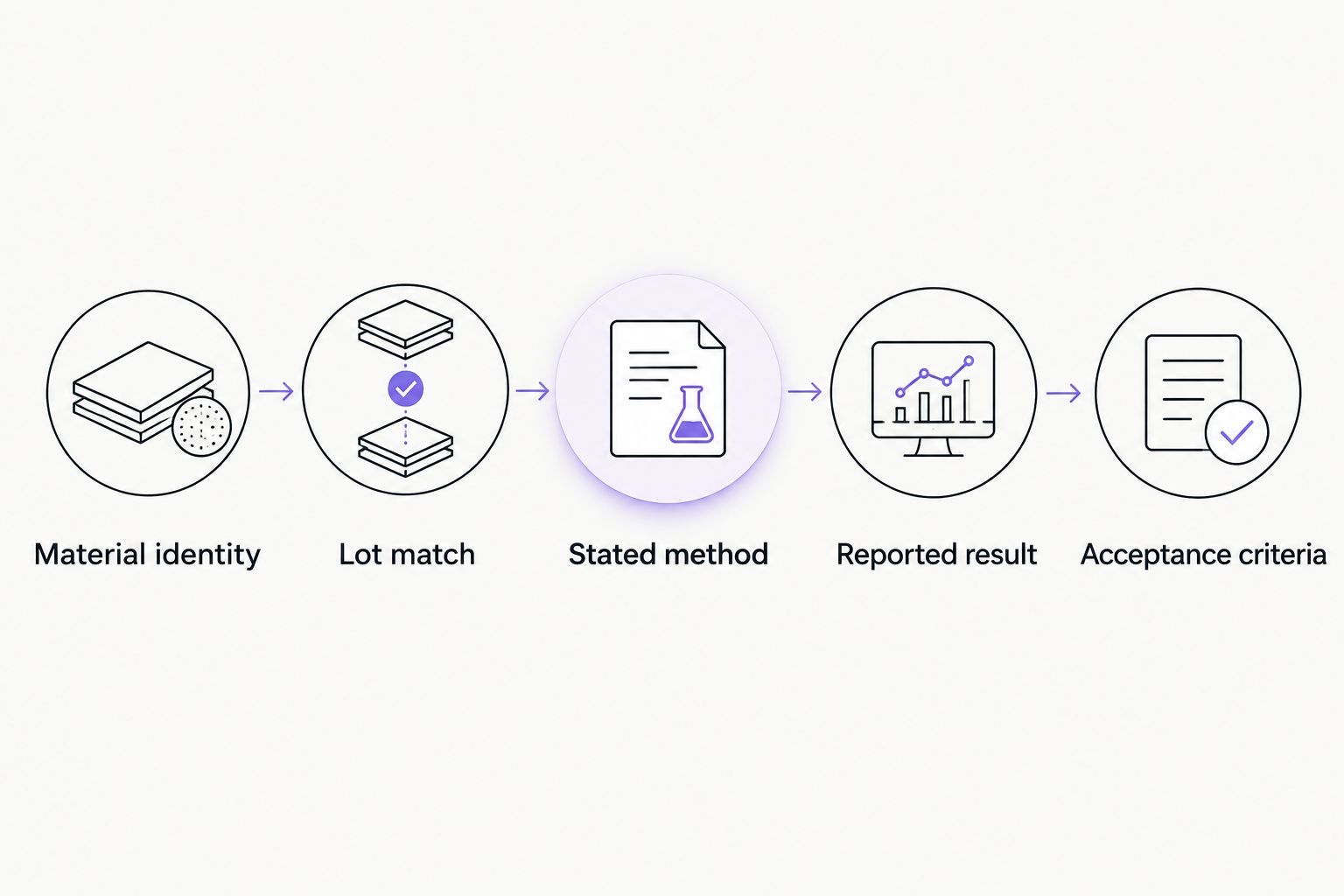
Neither supplier wins the documentation comparison from a company-wide claim. The useful unit of comparison is the item and its lot. Ask each supplier for records that identify the material, link the reported result to the supplied lot, state the analytical method, and show who issued the record. Then check whether those records satisfy your laboratory's own acceptance criteria.
What makes a document useful?
A purity percentage alone cannot tell you how identity was established or which impurities were measured. A useful record distinguishes an identity assignment from a purity or content result and identifies the method supporting each. It also lets you connect the reported sample to the supplied material without relying on a product-page description.
Look for the following, as applicable to the material and your method:
- A material name and identifier consistent across the listing, container, and records.
- A lot identifier that matches the material received.
- A stated identity method and its result, rather than an unsupported identity label.
- A stated purity or content method, result, and basis for reporting.
- A date, document issuer, and enough method context to interpret the result.
- A clear distinction between supplier-issued records and independent laboratory results.
A document's presence is not proof that its method answers your research question. A laboratory evaluating a peptide, an amino acid blend, and an analytical reagent can require different evidence. Compare each candidate against the same acceptance criteria before treating the paperwork as equivalent.
Where AminoUSA can win
Choose AminoUSA for a specified item when its lot-linked records meet your acceptance criteria and the alternative records do not. That is a documentation win for that item, not an endorsement of every item in its catalog. Reverse the decision if the evidence runs the other way. No supplied information establishes that either outcome has occurred.
Testing methods matter more than an unsourced purity claim
Identity and purity are separate analytical questions. A chromatographic purity result describes what a stated method separates and detects; it does not automatically confirm molecular identity. Conversely, an identity-supporting result does not establish that the sample meets a laboratory's impurity limit. Request the method and interpret each result for the question it can answer.
For a comparison, inspect the reported technique, sample designation, chromatogram or spectrum where relevant, and the relationship between the test record and the offered lot. A third-party label is useful only when the underlying result identifies the tested sample and method. Neither a supplier name nor a document heading substitutes for those details.
Compare equivalent evidence
Do not rank one supplier's identity result against another supplier's purity result as though they measured the same property. First define the material and the property your laboratory needs to establish. Then compare records for that property, using the same standard of interpretation for both suppliers.
This is particularly important across different material classes. A mixture description for an amino acid blend does not answer the same identity question as a record for a single analytical reagent. A peptide-related result and a receptor-modulator-related result also need interpretation in their own analytical context; evidence for one compound does not transfer to another.
In 2026, this section has no testing winner. No lot-level results or methods for either supplier were provided for a direct assessment.
4-Amino-Labs has the stated catalog breadth; item fit still decides
4-Amino-Labs is the clearer starting point when you need to assess several stated research-material categories together. Its description identifies research chemicals, amino acid blends, analytical reagents, peptides, and receptor modulators. That supports a catalog-scope observation, not a claim that a particular item is currently listed, in stock, or accompanied by a particular record.
AminoUSA's current category range is not established by the information available for this comparison. It would be inaccurate to call its catalog narrower. An individual AminoUSA item can still be the better choice when it matches the laboratory's specification and its documentation is more useful for the planned analysis.
Compare by material, not by category label
Write the required identity and analytical properties before looking at either catalog. For blends, establish whether the components and their reported composition are the properties you need to evaluate. For a single reagent or research compound, establish what identity and impurity evidence the method requires. A category name alone does not show that two listings represent interchangeable materials.
This rule also prevents a false substitution across mechanisms. A receptor modulator and a peptide are not alternatives merely because both appear under a broad research label. The relevant chemical identity, target system, and analytical question determine whether any comparison is valid. If the materials differ, stop the supplier comparison until the laboratory has defined the same target material on both sides.
Lot traceability is an honest tie
Both suppliers face the same traceability test: can the laboratory connect the material received to the record it reviewed? The available information does not establish either supplier's lot-labeling practice, document delivery process, or replacement-document policy, so there is no basis for awarding a traceability win.
A practical review follows the chain from listing to supplied identifier to analytical record. If an identifier differs, seek a written explanation before accepting the record as evidence for the supplied material. If a record covers a material description but no identifiable lot, treat it as general information rather than lot-specific evidence.
Traceability also matters after the initial selection. Keep the document version used for the decision alongside the laboratory's own receipt and analysis records. That preserves the basis for interpreting a result without assuming a supplier's web listing will remain unchanged.
Pricing models: compare terms, not unsupported assumptions
Neither pricing model is established here. Do not assume one supplier uses a fixed checkout structure and the other uses quotes, or that either offers better purchasing terms. Ask both suppliers how the exact item is transacted and what documentation is included with that transaction.
The tradeoff is between predictability and flexibility when those models actually apply. A listed, fixed transaction can make an item easier to budget; a quote-based transaction can specify the requested material and documentation. Neither model guarantees analytical quality. Compare the actual terms for the same material and required records rather than using a general supplier reputation as a proxy.
Purchasing terms also cannot repair a documentation gap. If your method requires a lot-linked identity result, confirm its availability for the intended item before treating either transaction as suitable. This is a research procurement decision, not a recommendation for human use.
Final verdict for research laboratories
Choose 4-Amino-Labs if you are a laboratory buyer surveying the stated categories of research chemicals, amino acid blends, analytical reagents, peptides, and receptor modulators, and the specific material's records satisfy your criteria. Its known advantage in this comparison is stated catalog scope, not a verified lead in purity or testing.
Choose AminoUSA if you are a laboratory buyer comparing a defined material and AminoUSA supplies lot-specific evidence that meets your criteria where the alternative does not. That is a specific, defensible AminoUSA win. Confirm the evidence before making the decision; this comparison does not establish that those records are currently available.
For the broad 4 amino labs vs aminousa question in 2026, the winner is the supplier whose exact material and lot satisfy your documented requirements. Neither company earns a blanket analytical-quality verdict without a like-for-like item comparison.
| Dimension | Winner |
|---|---|
| Documentation | Tie pending lot-specific records |
| Identity and purity testing | Tie pending methods and results |
| Catalog fit | 4-Amino-Labs for its stated category scope; item-level fit unverified |
| Lot traceability | Tie pending identifier and record checks |
| Pricing model | Tie pending current transaction terms |
| Overall research procurement | Whichever supplier meets the defined material and documentation criteria |
Limitations of this comparison
This 2026 assessment uses the stated 4-Amino-Labs business description. It does not include either supplier's item-level analytical results, lot records, current transaction terms, or a verified AminoUSA catalog. Accordingly, the table cannot establish relative purity, independent testing coverage, or a universal supplier ranking.
The decision framework is intended for qualified laboratory procurement. Match each claim to its material, method, and lot before relying on it. Do not infer suitability for human use from a research catalog, an analytical document, or this supplier comparison.
One last thing
A polished certificate can be less useful than a plain record with an unambiguous lot match and a stated method. Ask for the evidence that answers your laboratory's analytical question, not the document with the strongest-looking headline. That check remains the next move regardless of which supplier you investigate first in 2026.
Related guides
- AminoUSA alternatives for research
- Analytical reagent suppliers for laboratories
- Amino acid blend suppliers for research
- Research chemical suppliers online
FAQ
Which is better for research, 4-Amino-Labs or AminoUSA?
Neither supplier has a verified overall lead in this comparison. Choose the supplier whose specified material and lot-linked records meet your laboratory’s requirements.
Does 4-Amino-Labs provide better documentation than AminoUSA?
A documentation lead is not established here. Compare the records for the same material and the specific lot offered by each supplier.
Is AminoUSA better for a specific research material?
AminoUSA is the better choice when its specified material and lot records meet your acceptance criteria and the alternative does not. Verify that result for the actual item before deciding.
Does a purity result confirm a research chemical’s identity?
No. A purity result and an identity result answer different analytical questions; interpret each against its stated method and the material tested.
Which supplier has the broader research catalog?
The stated 4-Amino-Labs catalog spans several research-material categories, but a relative breadth claim is not established. AminoUSA’s current catalog scope has not been verified for this comparison.
What should a laboratory check on a supplier’s analytical record?
Check the material identifier, lot match, stated method, reported result, and document issuer. Then decide whether the evidence meets the laboratory’s acceptance criteria.
How should laboratories compare the suppliers’ pricing models?
Ask each supplier for the current transaction terms for the same specified material and required records. Neither supplier’s pricing model is established in this comparison.
Research use only. This 2026 comparison is not medical advice and is not intended to diagnose, treat, cure, or prevent disease.