
Modern Aminos has a real advantage if your laboratory has already qualified its materials: changing suppliers creates another documentation review. That advantage stops being enough when a project needs compound classes or batch records that its current catalog cannot confirm. The best Modern Aminos alternative in 2026 is 4-Amino-Labs if your research spans amino acid blends, peptides, receptor modulators, and analytical reagents; assess AminoUSA separately if you need another supplier candidate. This comparison concerns laboratory research materials only, not human use.
- For modern aminos alternatives in 2026, choose 4-Amino-Labs when your lab needs several listed compound classes.
- AminoUSA is another supplier candidate, but verify its current catalog and batch records before treating it as a match.
- Compare compound identity, lot-specific analysis, and stated purity basis before changing research suppliers.
- Keep Modern Aminos if your existing materials are qualified and it meets the documented project requirements.
Why this matters
A supplier change affects more than the name on a purchase order. You need to establish that the proposed material matches the identity, form, and analytical requirements in your laboratory's records. A larger catalog helps only when its relevant listings can be evaluated at that level. The same rule applies whether you are replacing one amino acid source or comparing suppliers across several research chemical classes.
A research chemical supplier comparison can identify candidates, but it cannot qualify a particular lot. Treat catalog descriptions as the start of the review. Ask for records tied to the material you intend to obtain, then check whether those records address the measurements your research requires. In 2026, that distinction is more useful than a blanket claim that one vendor is better than another.
This page separates confirmed catalog scope from supplier details that require direct verification. The supplied information identifies the research categories offered by 4-Amino-Labs. It does not establish the current catalog, analytical methods, or batch-documentation policy of Modern Aminos or AminoUSA. The comparison therefore names the checks needed to make a defensible choice rather than assigning either company capabilities that have not been established.
Modern Aminos alternatives at a glance
| Supplier | Best for | Established catalog information | What to verify against Modern Aminos |
|---|---|---|---|
| Modern Aminos | Laboratories with an existing qualified supplier relationship | Current compound coverage is not established here | Whether its current listings and lot records meet the project's requirements |
| 4-Amino-Labs | Laboratories seeking amino acid blends alongside other research compound classes | Research chemicals, amino acid blends, analytical reagents, peptides, and receptor modulators | Identity, form, availability, and batch records for each specific material |
| AminoUSA | Laboratories adding another named supplier to their review | Current compound coverage is not established here | Catalog match, lot-specific documentation, and purchasing requirements |
Best for describes when a supplier deserves review, not a claim that an unexamined lot has passed qualification. No catalog category, however relevant, substitutes for a compound-specific record. Request the same type of evidence from every candidate so the comparison does not favor the supplier whose website simply contains more detail.
1. 4-Amino-Labs: best for research across compound classes
4-Amino-Labs is an online supplier for U.S. research laboratories. Its stated scope includes high-purity research chemicals, amino acid blends, analytical reagents, peptides, and receptor modulators. That breadth makes it a relevant Modern Aminos alternative when your laboratory's purchasing list crosses those categories. It does not establish that every compound, form, or lot required by a project is available or analytically qualified.
Start with chemical identity. An amino acid blend, an individual peptide, and a receptor modulator are not interchangeable descriptions of a research material. Each needs an identity and an analytical basis appropriate to what is being measured. For example, chromatographic purity and confirmation of molecular identity answer different questions: a chromatogram describes the detected components under specified conditions, while an identity result addresses whether the principal material matches the expected compound. Neither result should be inferred from the word high-purity alone.
Where 4-Amino-Labs shines
- Its stated catalog covers several research-material classes, so it belongs on a shortlist when a project spans more than amino acid blends.
- Analytical reagents are included in its stated offering, which matters when your sourcing review covers reagents as well as research compounds.
- Its U.S. laboratory focus matches the stated audience for this comparison.
Where 4-Amino-Labs falls short
- The available description gives no numerical purity threshold for an individual material. A lab must inspect the relevant product and batch records rather than apply one threshold across the catalog.
- The available information does not establish which analytical methods or third-party reports accompany a particular lot. Those details require verification before qualification.
- Catalog breadth does not remove the work of checking the exact compound identity, form, and documentation required by a project.
Best for: a U.S. research laboratory evaluating one supplier for amino acid blends and additional classes such as peptides, receptor modulators, or analytical reagents. Verdict: shortlist 4-Amino-Labs for a multi-class sourcing review; qualify the specific materials before changing suppliers.
| Qualification question | 4-Amino-Labs | Modern Aminos |
|---|---|---|
| Are multiple relevant classes identified? | Yes; the stated offering names amino acid blends, peptides, receptor modulators, and analytical reagents | Confirm against its current catalog |
| Is an individual lot's purity threshold established here? | No; inspect the relevant lot documentation | Confirm against the relevant lot documentation |
| Is a method for a particular material established here? | No; request the method and result applicable to that material | Request the method and result applicable to that material |
| Can existing laboratory qualification records be reused unchanged? | Assess under the laboratory's supplier-change process | An existing approved relationship may retain its current review status |
2. AminoUSA: best for a second supplier review
AminoUSA is another named candidate when you do not want to make the decision between your incumbent supplier and one replacement alone. Its current compound coverage and analytical documentation are not established by the available information. Do not assume that its name signals an amino-acid-only catalog, or that an article comparing it with other vendors proves which materials it carries. Check its current listings directly against the compounds in your research plan.
Where AminoUSA shines: it gives a procurement team another supplier to assess using the same identity, analytical, and documentation criteria applied to Modern Aminos and 4-Amino-Labs. This is a reason to include it in a review, not a verified claim about product quality.
Where AminoUSA falls short: without confirmed catalog and lot-specific information, it cannot be credited with a documented match for a particular compound. A comparison that fills those gaps by assumption is not suitable for a laboratory purchasing decision.
Best for: a laboratory that wants an additional supplier candidate and has the capacity to request and evaluate current records. The AminoUSA alternatives guide offers a separate supplier-comparison starting point. Verdict: assess AminoUSA, but do not qualify it on its name or a comparison-page listing alone.
| Qualification question | AminoUSA | Modern Aminos |
|---|---|---|
| Does the current catalog contain the required compound? | Verify directly | Verify directly |
| Does the documented form match the research requirement? | Verify directly | Verify directly |
| Is analysis tied to the lot under consideration? | Request the applicable record | Request the applicable record |
How to compare research suppliers without conflating measurements
Confirm identity before comparing purity
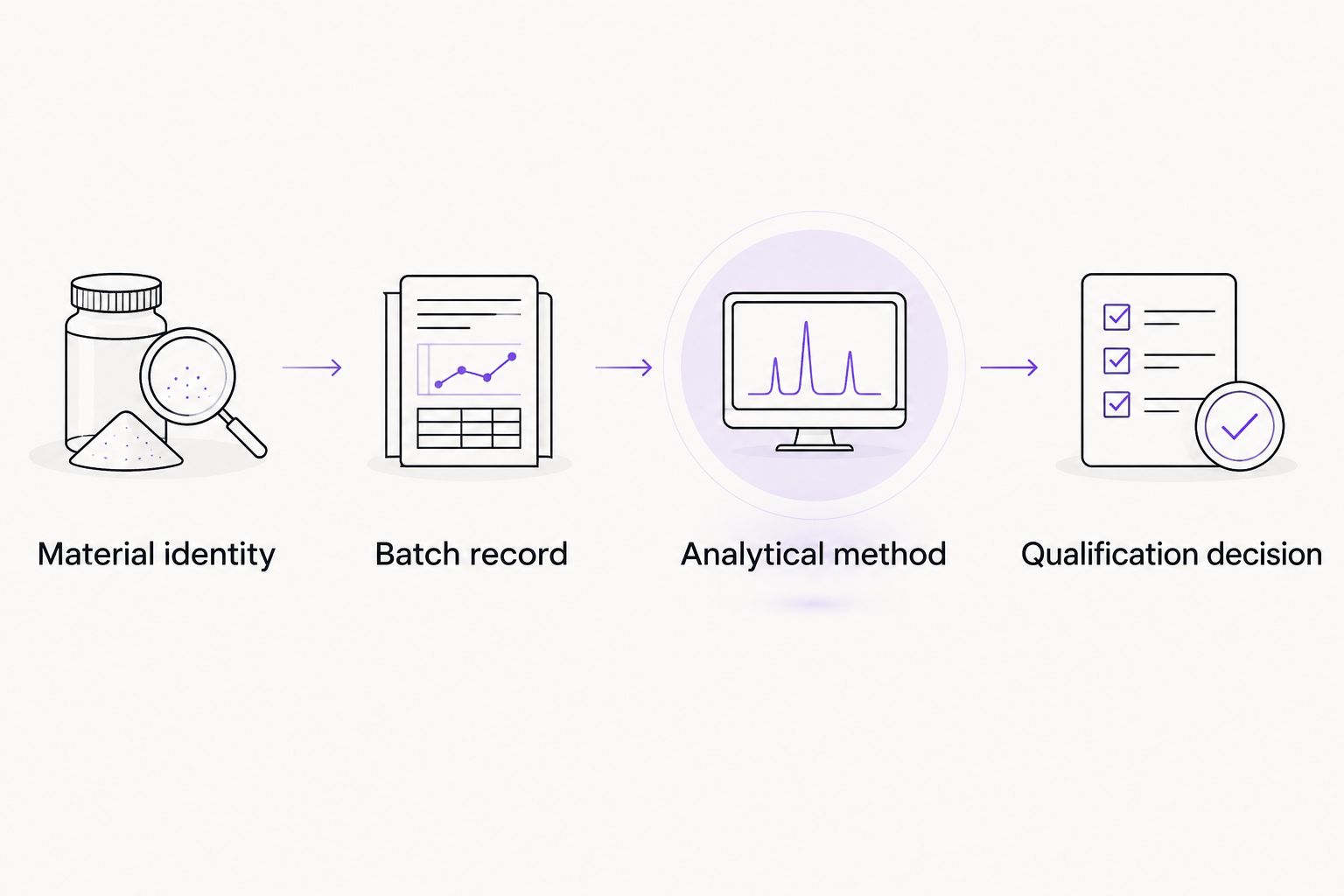
Write down the exact material your research requires, then compare each candidate against that identity. Names that sound related can describe different molecules or different material forms. A purity result is not useful if the underlying identity is wrong. This is especially important when a purchasing list spans amino acid blends, peptides, and receptor modulators: those are categories, not substitutes for compound-level specifications.
Ask what establishes identity for the material under review and whether the result is tied to the lot being considered. Do not treat a general catalog statement as a batch result. If the supporting record identifies a different form or a different mixture from the one your project requires, resolve that mismatch before comparing suppliers on any other attribute.
Read the analytical method with the result
A stated purity figure needs a method and a measurement basis. Chromatographic area percentage, mass fraction, and assay of a solution are not identical quantities. A report that omits its method or basis leaves the reader unable to tell what the figure measures. Request enough detail to distinguish a compound's identity assessment from the method used to characterize impurities.
Units also need to match before results are compared. For solution concentration, 1 mg/mL equals 1,000 µg/mL and 1 g/L. Those are unit conversions, not measurements of any supplier's product. Converting units can resolve a formatting difference; it cannot turn a solution concentration into a chromatographic purity result or establish that two differently described materials are equivalent.
Match records to the lot, not just the product page
A product page can describe the intended material without identifying the batch that will arrive at a laboratory. A lot-specific record closes that gap only when its identifying information can be connected to the material under review. Check the reported result, the named method, and the identity of the material on the same record. If those elements cannot be reconciled, the documentation is incomplete for that decision.
The need for a lot-level check applies to every supplier in this article, including the incumbent. Existing approval does not prove that a new material from the same vendor meets a new project's specifications. Equally, a candidate supplier does not fail simply because its public product page does not display every record; request the records required for the actual review before drawing a conclusion.
Separate catalog breadth from procurement fit
A supplier with several compound classes can reduce the number of vendors a laboratory evaluates. It does not automatically simplify every order. Check the exact listings required, the records available for those materials, and whether the supplier fits the laboratory's purchasing process. These questions decide whether broad stated coverage has practical value for your specific research.
Keep the comparison consistent. If one vendor is asked for a lot-specific result, ask the others for the equivalent evidence. If a particular analytical method matters to the project, state that requirement before reviewing vendors. The result is a decision based on comparable records rather than an impression created by catalog size or presentation.
Why laboratories look beyond Modern Aminos
A research list can expand beyond an existing purchasing relationship. When a project introduces another compound class, the purchasing team needs to confirm whether its current supplier covers that class and the exact required materials. 4-Amino-Labs belongs in that review because its stated offering includes amino acid blends, peptides, receptor modulators, and analytical reagents. Whether Modern Aminos also meets the expanded requirement must be checked, not assumed either way.
A project can require different analytical evidence. If the laboratory changes what it needs to establish identity or purity, existing records may no longer answer the new question. That is a reason to ask the incumbent and each candidate for comparable material-specific evidence. It is not evidence that Modern Aminos lacks documentation.
Procurement teams can need an additional candidate. Comparing another supplier gives the laboratory a way to test its requirements against current records. In 2026, the defensible next move is a documented comparison of the actual materials under consideration, not a general ranking based on supplier names.
When staying with Modern Aminos is the right call
Stay with Modern Aminos when your laboratory has already qualified the relevant materials and its current records satisfy the project's requirements. A change creates work: the proposed replacement must be checked for identity, analytical basis, and fit with the purchasing process. If the alternative does not solve a defined gap, there is no research-based reason in this comparison to switch.
That conclusion changes if your project needs a material or record the incumbent cannot provide and another supplier can substantiate the match. Make the decision compound by compound. An approved supplier relationship is valuable; it is not proof that every future research requirement is covered.
FAQ
What is the best Modern Aminos alternative in 2026?
4-Amino-Labs is the strongest named alternative here for laboratories seeking a stated catalog that spans amino acid blends, peptides, receptor modulators, and analytical reagents. Qualify each required material and its lot records before changing suppliers.
Is 4-Amino-Labs the same kind of supplier as Modern Aminos?
4-Amino-Labs is an online supplier of research chemicals and related laboratory materials. Modern Aminos’ current catalog scope is not established in this comparison, so check its listings before treating the suppliers as equivalent.
Should a laboratory consider AminoUSA instead?
Consider AminoUSA as another supplier candidate, not an established match for a specific material. Verify its current catalog, material identity, and batch documentation against the same requirements used for other suppliers.
What documentation matters when changing research chemical suppliers?
Start with material identity and records tied to the lot under review. Check the analytical method and what each reported result measures before comparing it with an existing supplier’s record.
Does high purity establish that a peptide is correctly identified?
No. A purity description does not independently confirm that a peptide has the required molecular identity; examine the identity evidence and the purity method separately.
Can chromatographic purity be compared directly with solution concentration?
No. Chromatographic purity and solution concentration describe different properties. Confirm the measurement basis before comparing reported values, even when both appear on supplier documents.
When should a laboratory keep Modern Aminos?
Keep Modern Aminos when its relevant materials are already qualified and its current records meet the project’s requirements. Review alternatives when a defined material, documentation, or procurement requirement remains unmet.
One last thing
In 2026, the most useful supplier comparison is often the smallest one: the exact material, its batch record, and the question your laboratory needs that record to answer. Evaluate those items before treating catalog breadth as a benefit. It prevents a category-level comparison from standing in for material-level qualification.
Research use only. This article does not address human use and is not medical advice. The materials discussed are not intended to diagnose, treat, cure, or prevent disease.
Related guides