
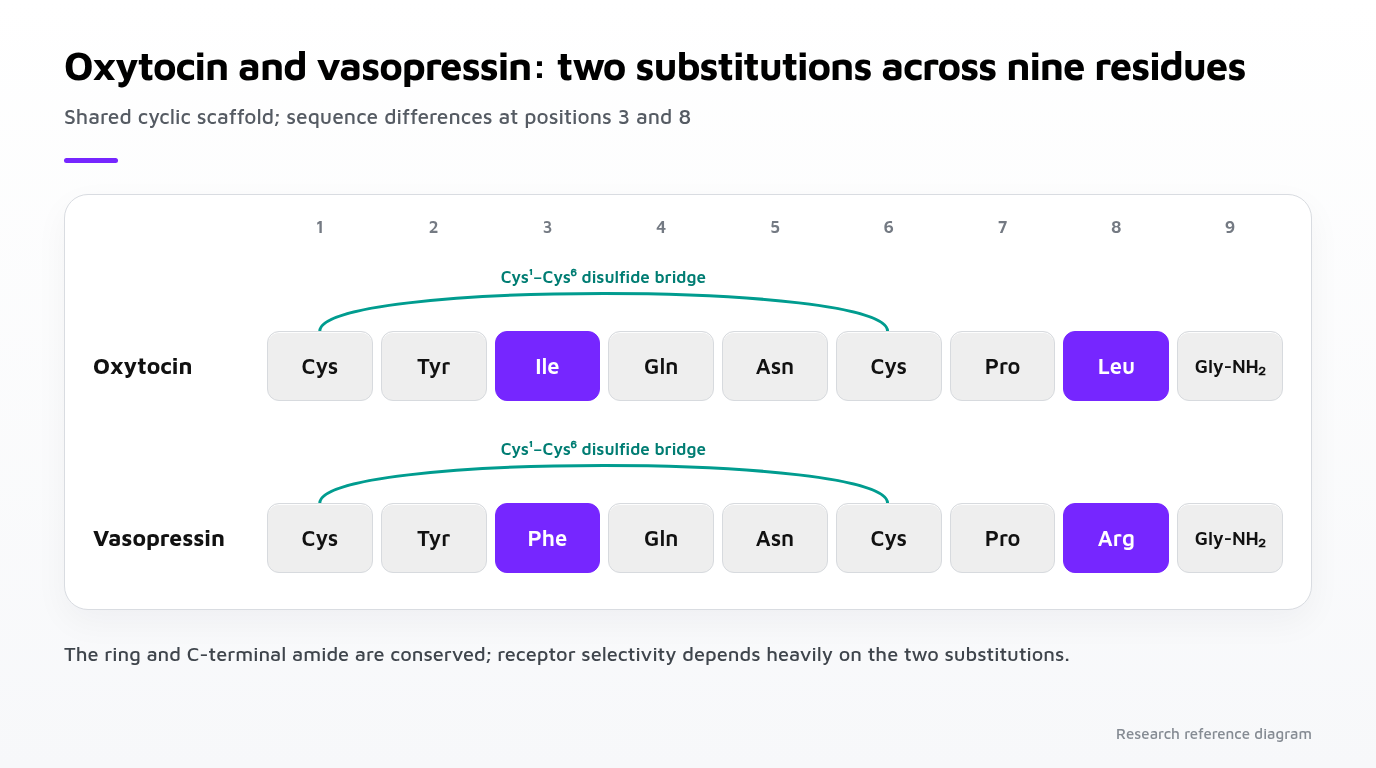
Oxytocin and vasopressin differ at only two of nine positions. Position three carries isoleucine instead of phenylalanine, and position eight carries leucine instead of arginine. The disulfide ring and the C-terminal amide are shared.
Because the two peptides are so similar, selectivity is the central problem in oxytocin work. Potency is rarely the issue.
Oxytocin also engages Gq and the Gi/o family at its receptor, OXTR. That breadth is why it serves as the unbiased reference against which biased ligands are measured. 4AminoLabs supplies oxytocin as a lyophilized peptide for receptor pharmacology and related in vitro work.
Oxytocin is an approved medicine in many countries for obstetric use. This material is not supplied for that or any other clinical purpose. Everything below summarizes published laboratory findings and scientific debate. Research use only. Not for human or veterinary use.
- Oxytocin is a nine-residue cyclic peptide closed by a Cys1-Cys6 disulfide bond.
- Its close similarity to vasopressin makes receptor selectivity the central experimental control.
- The native peptide activates both Gq and Gi/o signaling and serves as the reference for biased-ligand studies.
- Adsorption, disulfide reduction, and assay choice can materially alter an experiment.
What oxytocin is
Oxytocin is a cyclic nonapeptide. A disulfide bond between Cys1 and Cys6 closes a six-residue ring, and a three-residue tail ending in an amide extends from it.
Identity and physical data
| Property | Value |
|---|---|
| Compound | Oxytocin |
| Sequence | Cys-Tyr-Ile-Gln-Asn-Cys-Pro-Leu-Gly-NH2 |
| Ring | Disulfide between Cys1 and Cys6 |
| PubChem CID | 439302 |
| CAS number | 50-56-6 |
| Molecular formula | C43H66N12O12S2 |
| Molecular weight | 1007.2 g/mol |
The disulfide defines the molecule
Reducing the disulfide opens the ring and produces a different molecule with different receptor behavior. The linear form is about two mass units heavier than the cyclic parent. Keep DTT, beta-mercaptoethanol, and TCEP away from working solutions unless opening the ring is the goal.
The C-terminal amide
Position nine is glycinamide, not free glycine, and losing the amide reduces receptor affinity. A batch that has partly hydrolyzed to the free acid carries an impurity about one mass unit heavier, which a low-resolution instrument can miss.
A landmark in peptide chemistry
Oxytocin was the first polypeptide hormone to be chemically synthesized, work recognized with the 1955 Nobel Prize in Chemistry. Synthetic access has been settled for decades, so today’s disputes concern biology, delivery, and measurement rather than whether the molecule can be made.
The vasopressin problem
Two residues, four receptors
Oxytocin acts at OXTR. Vasopressin acts at V1a, V1b, and V2. Two residues of difference do not produce clean separation across four receptors, so cross-reactivity within this family is the field’s main confound.
What that means at the bench
Attributing an effect to OXTR requires evidence that vasopressin receptors did not carry it. Selective antagonists supply that evidence. Selectivity also varies by species, so ligand behavior established at human receptors cannot be assumed to hold at mouse or rat receptors.
The receptor and its signaling
Cloning came in 1992
The human oxytocin receptor was cloned and reported in Nature in 1992 (Kimura et al.). Expression mapping and structural work all trace back to that sequence. [1]
Two pathways, not one
OXTR couples to Gq and to Gi/o. Studies with functionally selective oxytocin ligands have been used to separate the contributions of individual Gαi/o isoforms. The native peptide engages this full set of pathways, which makes it a reference point and not a tool for isolating a single route.
Where the receptor sits
OXTR is found in uterine and mammary tissue, in several brain regions, and in cardiovascular and gastrointestinal tissue. In vitro, this breadth is manageable because you choose the cell line or tissue. In vivo, a systemic exposure reaches many targets at once and answers a blurrier question than a targeted one.
Biased agonism and why an unbiased reference matters
Carbetocin as the contrast case
Carbetocin, an oxytocin analogue, has been characterized as a functionally selective Gq agonist. It induces beta-arrestin-independent internalization and does not promote receptor recycling afterward (Passoni et al., 2016). [6] One analogue, one pathway, a different cellular outcome.
Bivalent ligands go further
Bivalent ligands designed to span OXTR dimers have been reported, treating receptor dimers as real pharmacological entities (Busnelli et al., 2016). [4] This work changes how a concentration-response curve should be read.
The experimental logic
Each biased-ligand result is a comparison against the unbiased parent. Without oxytocin in the design, biased agonism has no baseline. A laboratory studying analogues still keeps the native peptide on the shelf for this reason.
Structural biology
From sequence to structure
The receptor sequence arrived in 1992, and the crystal structure of the human oxytocin receptor followed in 2020 (Waltenspühl et al., Science Advances). [2] Work in the intervening years inferred geometry from mutagenesis and modeling. The structure lets researchers check which of those inferences held up.
A disease-linked variant
Studies of the A218T receptor variant connect receptor structure to population genetics (Meyer et al., 2022). [3] Interpreting variant work requires the wild-type reference agonist.
Findings in animal models
Receptor gene dosage
Mice heterozygous for the oxytocin receptor gene showed impaired social behavior without increased aggression or cognitive inflexibility, described as a selective haploinsufficiency effect (Sala et al., 2013). [7] Halving the receptor complement changed one behavioral domain and left others intact.
Why animal work carries more weight here
Animal designs can delete the receptor, restrict a manipulation to one nucleus, and confirm ligand distribution afterward. These capabilities directly address the weaknesses critics identify in human work: uncertain delivery, uncertain site of action, and uncertain measurement.
The “social peptide” claim and its critics
The claim
A large literature describes oxytocin as a social neuropeptide. The idea began with maternal behavior, where the peptide’s role is best supported, and then broadened to social behavior generally. That broadening is the disputed step, because maternal physiology and social cognition are different problems.
The deconstruction
A 2022 analysis in Philosophical Transactions of the Royal Society B (Leng, Leng & Ludwig) mapped the field’s citation structure, identified interconnected clusters of papers, and assessed distinct types of evidence separately. [9] Its broader lesson is that a field can look large and consistent while resting on a small number of linked clusters.
Delivery and measurement: the two methodological cruxes
Delivery
A 2016 critique in Biological Psychiatry (Leng & Ludwig) examined intranasal delivery. It argued that very little of the peptide applied intranasally appears to reach cerebrospinal fluid, while peripheral concentrations rise to supraphysiologic levels. The authors called for preregistration, declared primary and secondary outcomes, and prespecified statistics. [8] Replies and counter-replies followed in the same journal.
A related result points the same way from the opposite direction. A peptide oxytocin antagonist given systemically to lactating rats showed no central action (Sabatier & Leng, 2016). [5] Peripheral peptide struggles to cross into the brain, and route determines which compartment an experiment actually tested.
Measurement
A 2016 review compared bioassays and immunoassays for oxytocin and vasopressin (Leng & Sabatier). Unextracted plasma immunoassays can report values orders of magnitude above extracted ones for the same samples. [10] A published concentration means little unless the assay and extraction step are named beside it.
Why the two cruxes compound
Delivery decides what reached the target, and measurement decides whether anyone can tell. An uncertain route combined with an unvalidated assay gives two unknowns that no statistical treatment can separate afterward. That combination explains much of the disagreement in this field better than any single flawed study does.
Designing an experiment with oxytocin
Include a vasopressin receptor control. A V1a antagonist arm, or a comparison against vasopressin at matched concentrations, separates the two families. Without one, an OXTR attribution rests on assumption.
State the species of every receptor. Human, mouse, and rat receptors differ in ligand selectivity. A number from a human assay should not set the concentration for a mouse experiment.
Choose the compartment deliberately. Say whether the design addresses central or peripheral exposure, and avoid describing a systemic result in language that implies a central mechanism.
Prepare fresh and verify. Adsorption and disulfide chemistry both act on the timescale of an experiment. Prepare dilutions immediately before use, and run an aliquot of the working solution at the end of a long experiment to confirm the peptide survived.
Physicochemical properties and handling
| Property | Detail |
|---|---|
| Appearance | White lyophilized powder |
| Solubility | Water soluble; acetate buffer commonly used for stocks |
| Reconstitution | Add diluent down the vial wall, swirl gently, do not shake |
| Storage, lyophilized | -20 °C, desiccated |
| Storage, reconstituted | 2 to 8 °C, short term only |
| Stability concerns | Disulfide exchange, deamidation, surface adsorption |
| Handling | Standard laboratory controls for a lyophilized peptide |
Adsorption is the underrated loss
Peptides of this size stick to glass and plastic, and a dilute solution in an untreated tube can lose a meaningful share of its content to the walls. Low-binding tubes, a carrier protein, or a low concentration of nonionic surfactant all help. Prepare dilute working solutions immediately before use.
Freeze-thaw and headspace
Each freeze-thaw cycle costs peptide, and a repeatedly opened vial absorbs moisture. Aliquot on the day of reconstitution into volumes sized for a single experiment. Smaller aliquots in fuller tubes also reduce headspace oxygen, which speeds disulfide chemistry.
Aqueous stability
Aqueous stability is limited, which is why formulation research on this peptide is active. Studies have examined excipients such as glucosamine derivatives and tetraethylene glycol, and preclinical work has explored heat-stable formulations. At the bench, two degradation routes matter: disulfide exchange, which scrambles or opens the ring, and deamidation at Asn and Gln, which shifts mass by one unit per event.
Analytical characterization
Mass detection
Electrospray gives a protonated ion near m/z 1007.4 and a doubly charged ion near 504.2. The doubly charged species usually dominates, so expect it.
Confirming the ring
Run the sample before and after reduction. The cyclic peptide gains two mass units on reduction, which is direct evidence the disulfide was intact. An already-reduced sample shows no such shift.
Watching for the linear form
The reduced linear peptide is the impurity most worth tracking. It forms under mild reducing conditions and can look like the parent on a fast method. High-resolution instruments resolve the two-unit difference, and a reduction comparison covers lower-resolution setups.
UV and chromatography
A single tyrosine gives absorbance near 275 nm, adequate for concentration checks on concentrated stocks. Reversed-phase HPLC can separate the parent from the linear reduced form and from deamidated species, but all three elute close together, so use a shallow gradient. Batch documentation for 4AminoLabs material is available in our certificate of analysis library.
Review analytical documentation
Check batch-specific certificates and third-party testing standards before selecting research material.
Where oxytocin sits among research peptides
| Compound | Studied theme | Length |
|---|---|---|
| Oxytocin | OXTR agonism, Gq and Gi/o signaling | 9 residues, cyclic |
| Kisspeptin-10 | KISS1R signaling, reproductive axis | 10 residues |
| DSIP | EEG and stress-model research | 9 residues |
| Epithalon | Telomerase, pineal signaling | 4 residues |
Few research peptides have a cloned receptor, a solved receptor structure, selective antagonist tools, and a large critical literature behind them. Oxytocin has all four.
For more background, see our overview of what research peptides are, our comparison of CJC-1295 and Sermorelin, or browse all peptide research articles.
What this literature does not establish
- That intranasal administration reliably delivers to the brain. The critique above remains unresolved and must be addressed by anyone citing intranasal behavioral results.
- That the social peptide framing is settled. Citation analysis suggests the claim rests on interconnected clusters, not independent convergent evidence.
- That published concentrations are comparable. Assay method and extraction determine the number, and older unextracted values are the least usable.
- That in vivo results identify a site of action. Systemic delivery reaches uterine, mammary, cardiac, gastrointestinal, and brain receptors alike.
- That receptor selectivity comes for free. Two residues separate oxytocin from vasopressin, and an experiment without a selectivity control has not isolated OXTR.
Frequently asked questions
What is the sequence of oxytocin?
Cys-Tyr-Ile-Gln-Asn-Cys-Pro-Leu-Gly-NH2, cyclized by a disulfide bond between Cys1 and Cys6, with a molecular weight of 1007.2 g/mol.
How does oxytocin differ from vasopressin?
They differ at two positions: isoleucine instead of phenylalanine at position three, and leucine instead of arginine at position eight.
Why is oxytocin called an unbiased reference agonist?
Oxytocin activates Gq and Gi/o pathways at the oxytocin receptor, whereas analogues such as carbetocin activate a subset. Biased ligands are defined by comparison against the native peptide.
How do I confirm the oxytocin disulfide bond is intact?
Compare mass before and after reduction. An intact ring gains about two mass units on reduction, while an already-reduced peptide shows no shift.
Why does my dilute oxytocin solution lose potency?
Adsorption to tube walls is the most likely cause. Use low-binding tubes with a carrier protein or a nonionic surfactant, and prepare dilutions immediately before use.
Is the intranasal oxytocin literature usable?
It should be read alongside the 2016 critique of intranasal delivery and the replies that followed, since the delivery question sits upstream of any behavioral interpretation.
References
- Kimura T, et al. Structure and expression of a human oxytocin receptor. Nature. 1992;356(6369):526-9.
- Waltenspühl Y, et al. Crystal structure of the human oxytocin receptor. Sci Adv. 2020;6(29):eabb5419.
- Meyer M, et al. Structure-function relationships of the disease-linked A218T oxytocin receptor variant. Mol Psychiatry. 2022;27(2):907-917.
- Busnelli M, et al. Design and characterization of superpotent bivalent ligands targeting oxytocin receptor dimers via a channel-like structure. J Med Chem. 2016;59(15):7152-66.
- Sabatier N, Leng G. The peptide oxytocin antagonist F-792, when given systemically, does not act centrally in lactating rats. J Neuroendocrinol. 2016;28(4).
- Passoni I, et al. Carbetocin is a functional selective Gq agonist that does not promote oxytocin receptor recycling after inducing beta-arrestin-independent internalisation. J Neuroendocrinol. 2016;28(4).
- Sala M, et al. Mice heterozygous for the oxytocin receptor gene show impaired social behaviour but not increased aggression or cognitive inflexibility. J Neuroendocrinol. 2013;25(2):107-18.
- Leng G, Ludwig M. Intranasal oxytocin: myths and delusions. Biol Psychiatry. 2016;79(3):243-50.
- Leng G, Leng RI, Ludwig M. Oxytocin, a social peptide? Deconstructing the evidence. Philos Trans R Soc Lond B Biol Sci. 2022;377(1858):20210055.
- Leng G, Sabatier N. Measuring oxytocin and vasopressin: bioassays, immunoassays and random numbers. J Neuroendocrinol. 2016;28(10).
Research use only. All products supplied by 4AminoLabs are intended strictly for laboratory research. They are not drugs, dietary supplements, food, cosmetics, or veterinary products, and are not for human or animal consumption.