
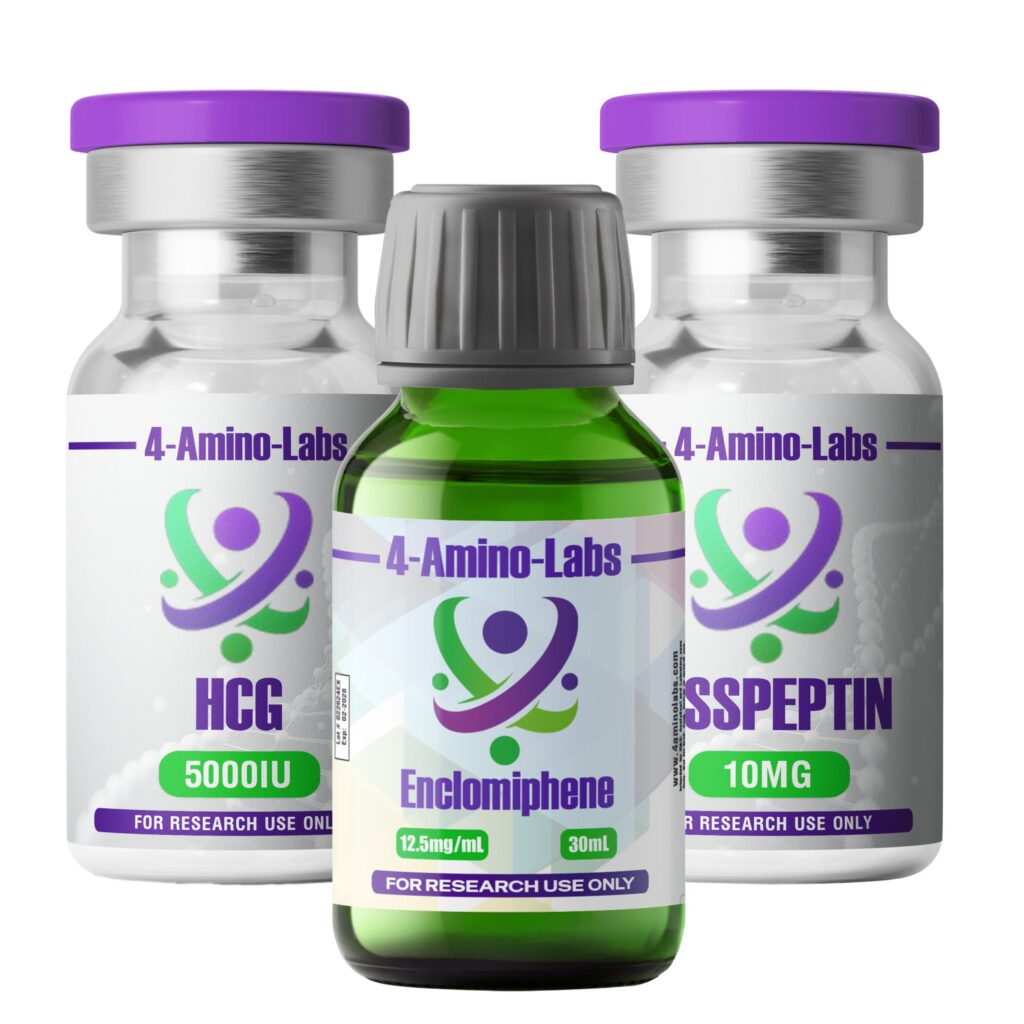
HCG and enclomiphene both end up raising endogenous testosterone in research models of the hypothalamic-pituitary-gonadal (HPG) axis — but they don’t touch the same receptor, and they don’t act at the same level of the axis. One is a direct gonadal agonist. The other works upstream, at the brain, by removing a brake.
Two different mechanisms, one axis
The HPG axis runs: hypothalamus (GnRH) → pituitary (LH, FSH) → testis (testosterone, plus estradiol via aromatization) → negative feedback on the hypothalamus and pituitary. HCG and enclomiphene intervene at opposite ends of that loop.
HCG: direct LH receptor agonist
Human chorionic gonadotropin is a glycoprotein hormone that binds the LH/hCG receptor on Leydig cells in the testis — the same receptor luteinizing hormone activates. Because HCG binds this receptor directly, it stimulates testosterone production regardless of what the pituitary is doing upstream. This is why HCG remains active even when endogenous LH secretion is suppressed: it doesn’t require an intact hypothalamic-pituitary signal, only functional Leydig cells downstream. Its structure — a heterodimeric glycoprotein with alpha and beta subunits, the beta subunit conferring receptor specificity — also gives it a considerably longer circulating half-life than LH itself, due to extensive glycosylation that slows renal clearance.
Enclomiphene: a selective estrogen receptor modulator, acting centrally
Enclomiphene is the trans-isomer of clomiphene citrate, a triphenylethylene selective estrogen receptor modulator (SERM). It doesn’t touch the LH receptor or the testis directly. Instead, it acts as an estrogen receptor antagonist at the hypothalamus and pituitary, blocking estradiol’s negative feedback signal. With that feedback blunted, the hypothalamus increases GnRH pulsatility, which in turn raises pituitary LH and FSH output. The testosterone increase seen with enclomiphene is therefore downstream and indirect — it depends entirely on an intact, responsive HPG axis at every level between the brain and the testis.
What’s actually different — and what isn’t
- Receptor target: HCG acts on the LH/hCG receptor at the testis; enclomiphene acts on estrogen receptors at the hypothalamus/pituitary. These are not the same receptor family.
- Dependence on axis integrity: HCG bypasses the pituitary and works even if upstream LH signaling is suppressed. Enclomiphene requires a functioning hypothalamus and pituitary to produce any effect — it does nothing at the level of the testis itself.
- Effect on LH/FSH: HCG mimics LH action but doesn’t raise endogenous LH/FSH secretion. Enclomiphene raises endogenous LH and FSH by disinhibiting GnRH pulsatility.
- Estrogenic activity: HCG’s stimulation of Leydig cells also increases aromatization to estradiol as a downstream consequence. Enclomiphene works by blocking estrogen receptor signaling, producing the opposite directional pressure on the estrogen side of the feedback loop.
- Not implied by either: neither compound is interchangeable with the other as a research tool for “raising testosterone” — the point in the axis being manipulated, and what that implies for FSH, LH, and axis-integrity assumptions, is different.
Evidence, scoped honestly
HCG’s research and clinical literature centers on conditions where direct testicular stimulation is the goal independent of pituitary function — for example, maintaining testicular function during suppression of endogenous gonadotropins. Enclomiphene’s literature centers on raising endogenous LH/FSH and testosterone in men with an intact but under-signaled axis, typically framed around secondary hypogonadism where the testis itself retains responsiveness. A research design built around HCG’s testis-direct mechanism does not transfer to enclomiphene’s pituitary-dependent mechanism, and vice versa — the assumptions about what’s intact and what’s being manipulated are different in each case.
Not interchangeable
“Raises testosterone” is not a single mechanism, and treating HCG and enclomiphene as substitutable research tools ignores where each one intervenes. HCG’s effect persists even with a non-functional hypothalamus or pituitary. Enclomiphene’s effect disappears entirely without one. Any protocol assumption about axis integrity, LH/FSH response, or downstream estrogen levels needs to track which compound — and which point in the axis — is actually being studied.
FAQ
Do HCG and enclomiphene act on the same receptor?
No. HCG binds the LH/hCG receptor directly on testicular Leydig cells. Enclomiphene binds estrogen receptors in the hypothalamus and pituitary.
Does enclomiphene work if the pituitary isn’t responding?
No. Enclomiphene’s entire mechanism depends on an intact hypothalamic-pituitary response to reduced estrogen feedback. If that signaling is impaired, enclomiphene has nothing to act on.
Does HCG raise LH or FSH?
No. HCG mimics LH’s action at the receptor level but does not increase the body’s own secretion of LH or FSH — it substitutes for LH signaling rather than amplifying it.
Can HCG and enclomiphene data be used interchangeably in axis research?
No. They intervene at different points in the HPG axis with different dependencies on upstream signaling, so the study designs, sampling assumptions, and expected feedback responses differ between them.
For research and laboratory use only where sold as such. Not for human consumption when labeled RUO. Not intended to diagnose, treat, cure, or prevent any disease. This content is for educational and informational purposes only and is not medical advice.