
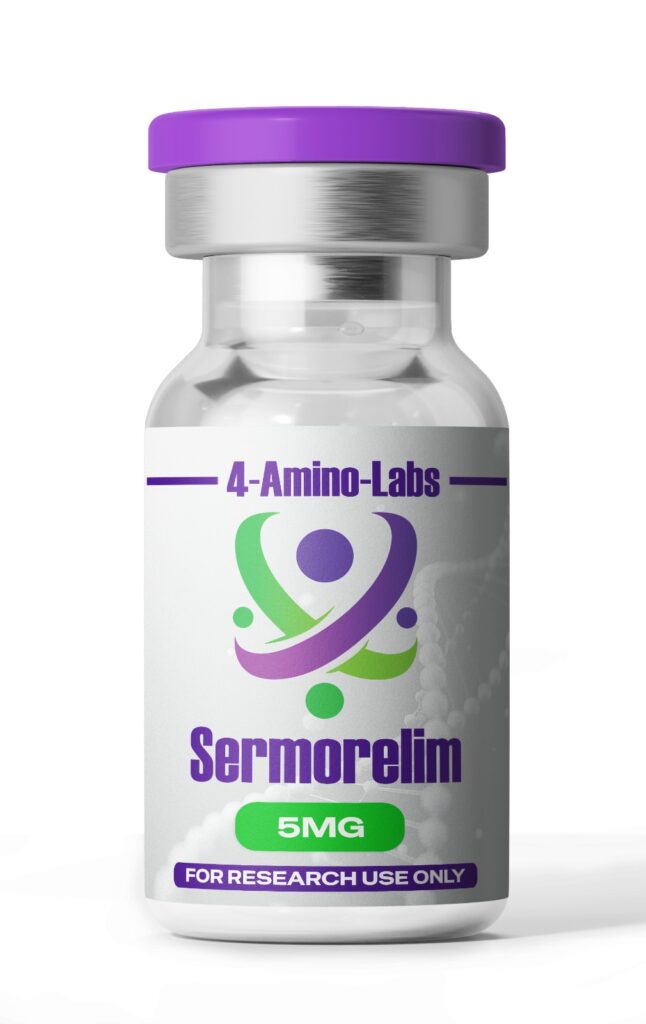
CJC-1295 and sermorelin are both GHRH receptor agonists, and that shared target is exactly where the similarity ends. Length, chemical modification, and receptor occupancy time differ enough between them that data generated with one shouldn’t be read onto the other.
The shared mechanism
Both compounds activate GHRH-R, the growth hormone-releasing hormone receptor expressed on pituitary somatotrophs. Receptor activation triggers a Gs-coupled cascade that raises intracellular cAMP, driving pulsatile release of growth hormone from the anterior pituitary. Downstream, GH stimulates hepatic and local IGF-1 production. This pathway — GHRH-R activation → cAMP signaling → pulsatile GH release → IGF-1 production — is identical for both compounds. What differs is how long each one occupies the receptor and what happens to it before it gets the chance to.
Sermorelin: GHRH(1-29)
Sermorelin is the first 29 amino acids of native human GHRH, typically supplied as the acetate salt. It retains full agonist activity at GHRH-R because the receptor-binding domain sits within this N-terminal fragment. The tradeoff is stability: like native GHRH, the sequence is a substrate for dipeptidyl peptidase-4 (DPP-4), which cleaves the peptide from its N-terminus within minutes of exposure to plasma. Short occupancy time and rapid enzymatic clearance mean sermorelin functions more as a pulse/diagnostic tool — useful for assessing whether the pituitary can still respond to GHRH stimulation at all — than as a sustained-release secretagogue.
CJC-1295: a modified, longer-acting analog
CJC-1295 is a GHRH(1-29) analog carrying amino acid substitutions at the DPP-4 cleavage site plus, in its most common research form, a Lys-conjugated maleimidopropionic acid (MPA) linker — a Drug Affinity Complex (DAC) — that allows covalent binding to circulating albumin. Albumin binding does two things: it resists DPP-4 cleavage (the modified N-terminus alone already reduces this), and it dramatically extends systemic half-life by piggybacking on albumin’s own slow clearance. The practical result is a GHRH-R agonist that occupies and re-engages the receptor over a much longer window than unmodified GHRH fragments, supporting sustained rather than single-pulse GH release patterns in research models.
What’s actually different — and what isn’t
- Receptor target: identical — both are GHRH-R agonists.
- Sequence stability: sermorelin is DPP-4 labile; CJC-1295’s modified N-terminus and (in the DAC form) albumin binding resist this.
- Occupancy/half-life: sermorelin’s action window is short (minutes); CJC-1295 with DAC extends plasma half-life to days in reported research use.
- Research application implied by the data: sermorelin’s file supports acute pituitary-reserve testing; CJC-1295’s file supports sustained GH-axis stimulation protocols.
- Not implied by either: neither compound is a GLP-1 receptor agonist, and neither bypasses the requirement for a functioning pituitary — both are GH-axis dependent, not GH replacements.
Evidence, scoped honestly
Sermorelin’s research history is built around its use as a GHRH-reserve diagnostic — assessing whether a blunted or absent GH response indicates a pituitary or hypothalamic problem. That’s a narrow, specific data set: a transient GH pulse in response to a fragment with a short window, not a body-composition or long-term axis-stimulation outcome. CJC-1295’s data, by contrast, centers on sustained IGF-1 elevation over multi-week research protocols, a direct function of its extended occupancy. Applying CJC-1295’s sustained-elevation findings to sermorelin, or sermorelin’s diagnostic-pulse findings to CJC-1295, conflates two different pharmacokinetic profiles under one receptor name.
Not interchangeable
“GHRH analog” is not a single research file. A 29-residue fragment with a several-minute half-life and a modified, albumin-bound analog with a multi-day half-life will produce different exposure curves even at matched doses. Study design, sampling intervals, and expected GH pulse patterns that make sense for one will not transfer cleanly to the other.
FAQ
Do sermorelin and CJC-1295 bind the same receptor?
Yes. Both are GHRH-R agonists acting through the same Gs/cAMP signaling pathway on pituitary somatotrophs.
Why does CJC-1295 last longer than sermorelin?
CJC-1295’s N-terminal modifications reduce DPP-4 cleavage, and its DAC form covalently binds circulating albumin, extending plasma half-life well beyond an unmodified GHRH fragment.
Can sermorelin data be used to predict CJC-1295 outcomes?
No. The two compounds have different occupancy times and exposure profiles at the same receptor, and the existing data sets reflect different study designs (acute pulse testing vs. sustained elevation).
Is either compound a GLP-1 receptor agonist?
No. Both act exclusively on GHRH-R and the GH axis; neither engages GLP-1 receptor pathways.
For research and laboratory use only where sold as such. Not for human consumption when labeled RUO. Not intended to diagnose, treat, cure, or prevent any disease. This content is for educational and informational purposes only and is not medical advice.